Six surnames, four letters
Here is the difficulty with this name, stated plainly at the top, because it is what most people arrive wanting.
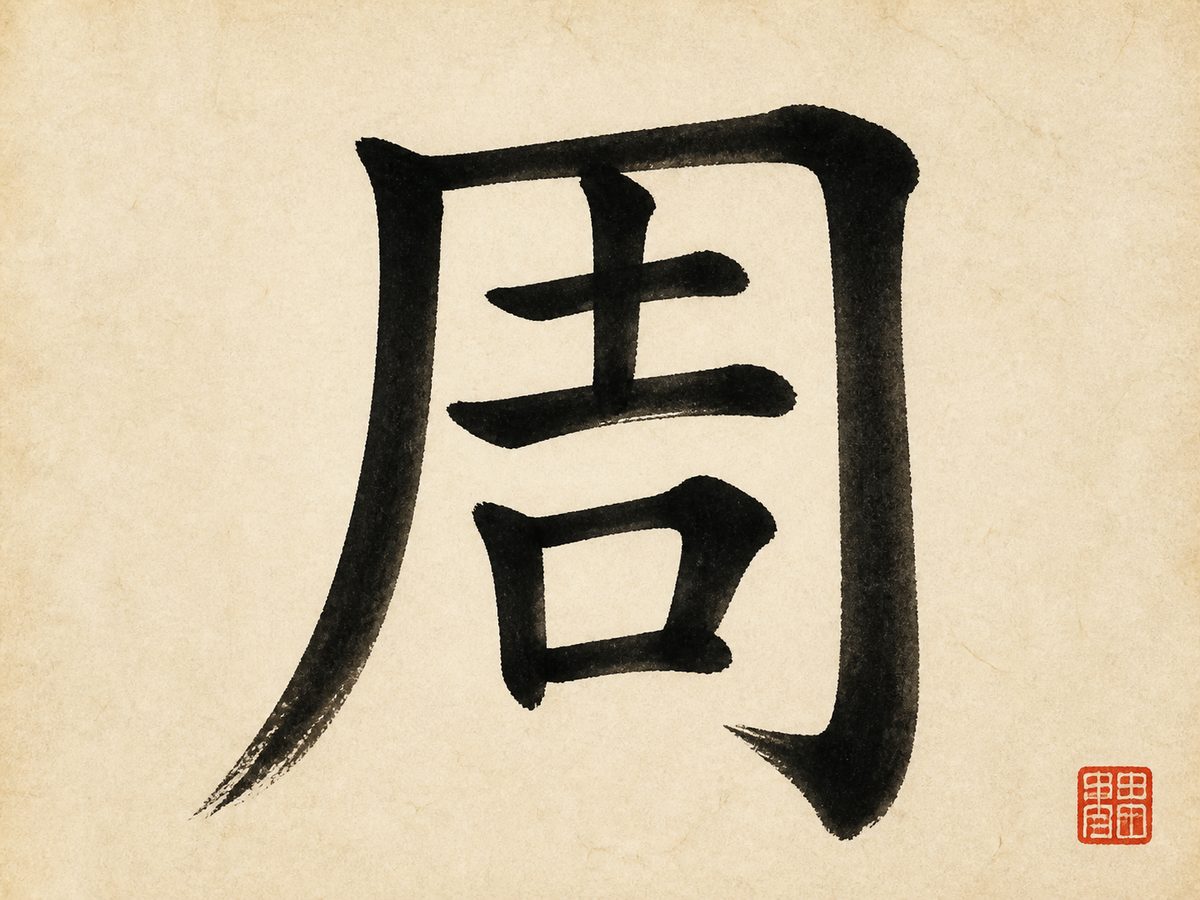
Six separate and unrelated Chinese surnames have all ended up spelled Chow in English. This one, 周. Then 鄒, which Mandarin calls Zou. Then 趙, 曹, 秋 and 仇, which Mandarin calls Zhao, Cao, Qiu and Qiu. Different families, different characters, different histories, one English spelling, arrived at by different dialects and different immigration clerks over about a hundred and fifty years.
Five of those you can at least separate by asking a Mandarin speaker. The sixth you cannot. In Cantonese, 鄒 and 周 are homophones. Not similar: identical. Two Cantonese families named Chow can be entirely unrelated and nothing in the sound of the name will ever tell them apart.
This one, though, is the big one. Around twenty-five million people in China carry 周, which puts it tenth on the national list, and it is heavily concentrated in Hunan. If you are looking for a Chow and have nothing else to go on, this is where to start.
How to say it, and why Chow is the good spelling
Unusually, the anglicized spelling is the accurate one and the official one is the trap.
Chow rhymes with now. That is it. English speakers get it right by instinct, which almost never happens with Chinese names.
Zhou is the problem. The zh is not a z. It is the j of "joke", made a little further back in the mouth with the tongue curled. And the ou is not "oo" and not "ow"; it is the o of "go". So Zhou is, near enough, "joe". A great many English speakers have spent years reading about a Chinese premier called Zoo Enlai, or possibly Zow, and the man's family in Taiwan would have spelled him Chou, which would have got them closer.
Chou, the Wade-Giles form, is the middle case. It is fine if you know that ou is "oh", and misleading if you do not, which is why Jay Chou is routinely called Jay Chow by people who have only ever seen his name written down. They are, as it happens, saying it correctly.
The surname that is also lunch
For an English-speaking reader this name has one problem no other Chinese surname has, which is that it is already a word.
Chow, meaning food, entered American English in California in 1856, out of the Chinese pidgin English chow-chow, recorded from 1795, which meant food, or a mixed pickle, or a medley of things. It comes from Chinese words for mixing or frying. Chow mein is the same first syllable and is simply fried noodles. And the Chow Chow, that magnificently disgruntled dog with the blue-black tongue, turns up under that name around 1886 for reasons nobody has ever satisfactorily established, though the theories are unkind.
None of which has anything whatever to do with the surname. It is a pure collision. Twenty-five million people share a family name with an English slang word for dinner and a bad-tempered dog, and no linguistic connection exists between them at all.
What the family does have is an extraordinary run of famous faces, out of all proportion to a single surname. Chow Yun-fat, who is most of Hong Kong cinema's international reputation on his own. Stephen Chow, who made Shaolin Soccer and Kung Fu Hustle and whose particular brand of comedy has its own name in Chinese. Jay Chou, who has been the biggest pop star in the Chinese-speaking world for about two decades. Chou Tzuyu, of the Korean group Twice. Zhou Guanyu, the first Chinese driver to race a full Formula One season. And Zhou Enlai, who ran the Chinese government for twenty-seven years.
Six spellings would have caught all of them. English uses four.
Gone to see the Duke of Zhou
Now the best thing about this surname, which is that its most famous holder is a euphemism for going to bed.
The Duke of Zhou was the younger brother of the man who overthrew the Shang, and when that brother died leaving a child on the throne, the Duke governed as regent and then, remarkably for the period, handed the throne back when the boy came of age. Tradition credits him with the ritual and political order of the Western Zhou, which is roughly like being credited with the constitution. Confucius, five centuries later, thought he was the finest man who had ever lived and modeled his entire political program on him.
Which brings us to a single line in the Analects, in the chapter called Shu Er, and it is one of the saddest things in the book. The Master said: how far I have declined. It has been a long time since I last dreamed of the Duke of Zhou.
He means that he used to dream about him, and now the dreams have stopped, and he takes it as evidence that his powers and his hopes are going together. James Legge's Victorian rendering, still the one most quoted in English, has it as "Extreme is my decay. For a long time, I have not dreamed, as I was wont to do, that I saw the duke of Chow."
And then something wonderful happened to that line over two and a half thousand years. Because Confucius met the Duke in dreams, dreaming came to be associated with the Duke, and the association ran away entirely. To this day, a Chinese speaker who is off to bed will say they are going to see the Duke of Zhou. A student who falls asleep in a lecture has gone to see the Duke of Zhou. It is exactly as ordinary as the English "off to see the sandman", and it comes out of a philosopher's private grief about getting old.
The Duke also has a dream dictionary named after him. The Duke of Zhou Interprets Dreams is still sold in Chinese bookshops and still consulted in app form when somebody wakes up having dreamed about losing a tooth. He did not write it. The attribution is traditional and much later, and it attached itself to him for the same reason the napping idiom did: he is the man you meet when you are asleep.
A field with the crops planted close
The character itself is a good deal older than the dynasty, and its picture is agricultural.
The oracle-bone form is a plot of land divided into sections with dots scattered through it: a field with the crops planted tight. Later bronze inscriptions added an enclosing element underneath, emphasizing the boundary around the planting. By the time Xu Shen came to compile the Shuowen Jiezi around 100 CE, the original picture had faded and he glossed the character with a single word: dense.
That sense never went anywhere. Modern Chinese is full of it. Something thorough and attentive is zhōu dào, dense-arriving, and it is one of the highest compliments you can pay a host. Everything around you is zhōu wéi, the dense surround. A full turn of the calendar is zhōu nián, an anniversary. And a week is yī zhōu, one circuit.
So the surname means, at root, closely planted, and by extension thorough, and by extension all the way round. As surnames go it is a good one to be landed with, though as usual the meaning had nothing to do with why anyone got it.
The dynasty that handed out its own name
The reason twenty-five million people carry this name is that a state was named after a field.
The Zhou people farmed a plain in the shadow of Mount Qi, in what is now Shaanxi, and the plain was called Zhouyuan, which means, more or less, the well-planted land. They took the place as the name of their people. Their ruling family's ancestral clan name was actually Ji. When they overthrew the Shang around the eleventh century BCE, the state they founded took the name of that plain with it, and it lasted, in one form or another, some eight hundred years, longer than any other dynasty in Chinese history.
When it finally ended, around 256 BCE, its descendants did the thing that Chinese families reliably did when a state collapsed: they took the fallen state's name as a surname and carried it forward. That is why the tenth most common surname in China is the name of a dynasty, and why it is also, several layers down, the name of a field.
The book with this surname in its title
One last thing that most pages on this name miss entirely.
The I Ching, the oldest book in the Chinese canon and the ancestor of almost everything on this site, is properly called the Zhouyi, the Zhou Changes. That first character is this surname. The core text dates from the Western Zhou, and tradition assigns the hexagram statements to King Wen and the line statements to, of all people, the Duke of Zhou, in prison and out of it respectively.
Whether either of them wrote a word of it is very doubtful and the scholarship has been arguing about it for a century. But the name stuck, and the whole apparatus of trigrams, hexagrams and directions that Chinese divination and feng shui still run on carries a dynasty's name at the top of it. If you want to see the descendant of that system doing something practical, our kua number calculator works out the four directions that suit you and the four that do not, off the same eight trigrams the Zhou were arranging three thousand years ago.
A field, a dynasty, a book, a nap, and twenty-five million people. Not a bad run for eight strokes.