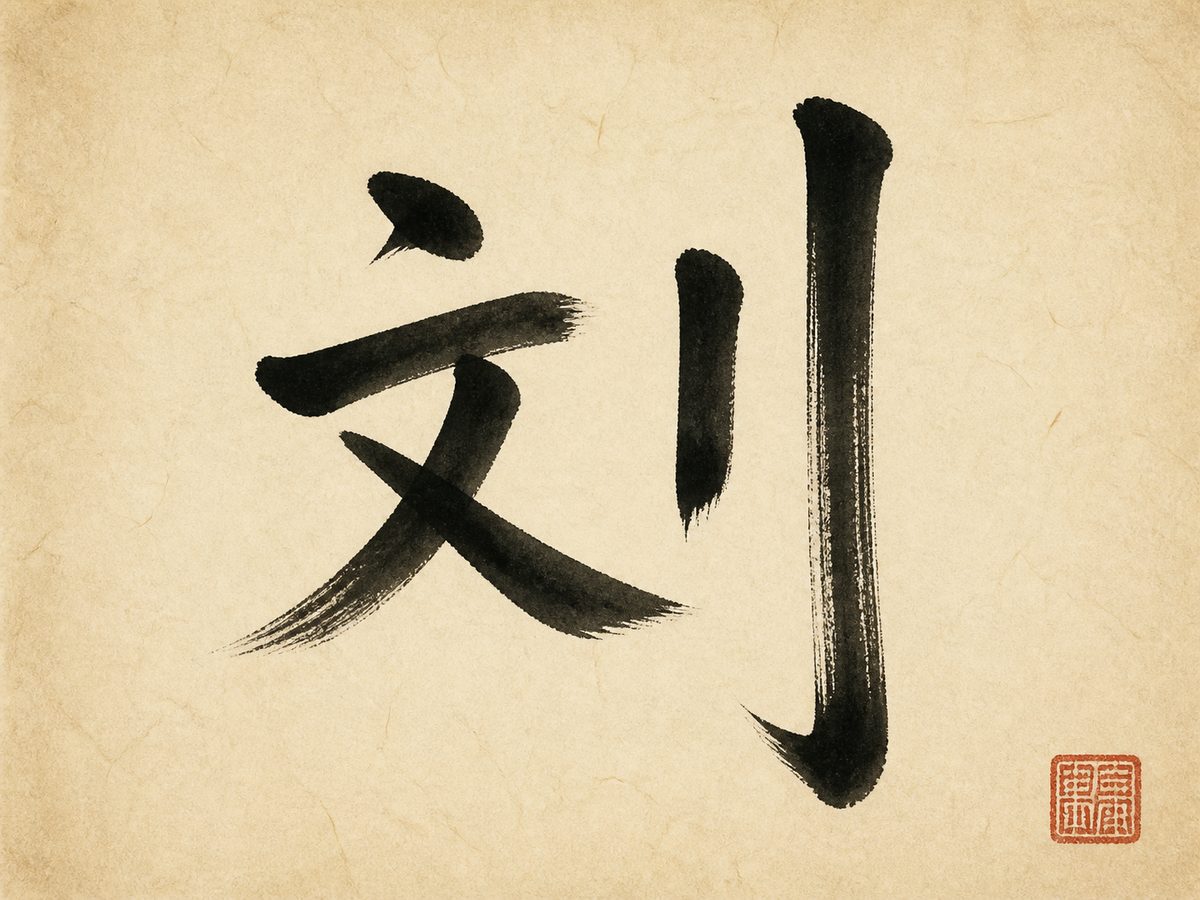
The dictionary says it means to kill
Most big Chinese surnames turn out not to mean the thing they look like. Chen is a fallen kingdom rather than a word, Wang is a king who had stopped being one, Li borrowed a plum tree from a job title. Liu is the exception, and it is not the exception anyone hopes for.
Open the Shuowen Jiezi, the dictionary Xu Shen finished around 100 CE, and the entry for this character is one word long. To kill. The Kangxi Dictionary, compiled sixteen hundred years later, quotes the gloss and moves on, as though nobody along the way had found it remarkable. The Erya, the oldest Chinese thesaurus, files two further senses that are almost stranger: to spread out, and to thin.
The reason is that the character was a weapon before it was a word. It named a type of battle-axe, and the verb came from what you did with one. And then, at some point in the long slide of Chinese vocabulary, the axe and the verb both fell out of use and left the character with exactly one job. Today it is essentially not a word at all. It is a surname, carried by around sixty-eight million people, and nothing else.
The knife stayed, the metal left
The traditional form makes the weapon obvious. 劉 is a phono-semantic compound: one component supplies the sound and the other two supply the sense, and the two doing the sense work are metal and a knife. A metal blade. The character is a labeled picture of the object it named.
Simplification took the metal out. What remains is 刘, six strokes, with the standing-knife radical still falling down the right side and something on the left that looks exactly like the character for writing.
It is a wonderful accident and it is worth resisting. Read 刘 as "the pen and the sword" and you have a slogan good enough to put on a family crest, but the traditional form has no such element anywhere in it. The shape on the left is what the left side collapsed into once the metal came out; it is not the word for culture keeping the blade company. The Lius have a better story than that one, and it is true.
If you want to see the dense old form and the lean new one side by side, along with four classical scripts, our calligraphy tool draws 刘 live, free.
How a family name became an ethnicity
Where the name came from before all that is, as usual, two answers rather than one. The genealogies give the Lius two founding lines: descendants of the Qi clan of the sage-king Yao, and the Ji clan of King Qing of Zhou, whose branch held a small territory called the State of Liu. Neither is the kind of claim a historian will stand behind, and both are the standard shape of a Chinese surname origin, which is a place or an office rather than a word. The character was already lying around as a name for an axe; a family took it because of where they lived, not because of what it meant.
In the last decade of the third century BC, the man who would take this surname to the top of Chinese history was working as the sheriff of a village post station called Sishui Booth, in Pei County. Liu Bang was born a peasant, which puts him in a category of roughly two among all the founders of Chinese dynasties. He was not a general, an aristocrat, or a king's cousin. He supervised a stretch of road.
The Qin collapsed, the empire came apart, and Liu Bang and the aristocratic warlord Xiang Yu spent four years deciding who got it. When it was over, Xiang Yu had handed his rival a provincial fief called Hanzhong, on the Han River in what is now Shaanxi, intending it as a demotion to the back of beyond. In 202 BC, after winning the final battle at Gaixia, Liu Bang took that consolation prize's name for his dynasty.
What happened next is the part worth sitting with. The Han lasted about four hundred years, with thirty emperors, every one of them a Liu. It ran so long, and mattered so much, that the name of the dynasty stopped being the name of a dynasty. The majority ethnic group of China calls itself the Han people. Chinese speech is the Han language. The characters this page keeps showing you are Han characters. The overwhelming majority of the people of China identify by an ethnonym that began as the name of a river valley a rival sent Liu Bang to as a punishment.
The four centuries break exactly once. From 9 to 23 AD the throne belonged to Wang Mang, who took it, renamed the dynasty Xin, and lost it, after which the Lius came back for another two hundred years. That is the single gap in the record, and it is told properly on the page for his surname.
Four lives of the name
Not five. The emperors already had their section.
The mat weaver who founded a kingdom on his own surname
Liu Bei, who lived from 161 to 223, grew up poor enough that he and his mother sold shoes and woven straw mats to eat. He also claimed descent from Liu Sheng, ninth son of Emperor Jing of Han and first King of Zhongshan, which made him, in principle, a distant relative of the reigning house. When the Han finally came apart at the end of the second century, that claim was the thing he had. It was enough. Men joined him for it, he built an army around it, and in 221 he founded the kingdom of Shu Han and took the throne of it, dying two years later.
Read that again as a fact about a surname. A man with no land, no title, and a stall selling sandals converted a genealogical assertion into a state. The novel that made him world famous, Romance of the Three Kingdoms, came a thousand years afterward and turned him into the ideal benevolent ruler; historians looking at the actual administration find something rather more Legalist under the Confucian paint. Both versions rest on the same starting capital, which was a family name.
The Lau everybody has seen
Andy Lau, born in 1961, spells the surname the Cantonese way and is probably the reason most non-Chinese readers have seen the letters L-A-U at all. He was one of Cantopop's Four Heavenly Kings alongside Jacky Cheung, Aaron Kwok, and Leon Lai, and he has been famous without interruption for four decades, which in that industry is close to geological. By 2005 he had appeared in 108 films. In 2000 he went into the Guinness World Records for the most awards won by a Cantopop male artist, and by 2006 the count was 444 music awards, a number that says as much about the Hong Kong awards industry as about him.
Twelve point nine one
At the Athens Olympics in 2004, Liu Xiang ran the 110-meter hurdles in 12.91 seconds, tying a world record that had stood for eleven years and taking China's first Olympic gold medal in a men's athletics event. Nothing in Chinese sport had prepared anyone for it. Two years later in Lausanne he took the world record outright at 12.88.
Then the Achilles tendon that had been troubling him for years chose the worst possible moments. At Beijing in 2008, in front of a home stadium built partly on the expectation of watching him win, he pulled up and withdrew. At London in 2012 he tore the tendon on the first hurdle, and rather than leave the track he hopped the length of the straight on one leg to finish the distance, stopped at the final hurdle, and kissed it. It is the most watched moment of his career, and he lost.
The power-plant engineer who won the Hugo
Liu Cixin was working as a computer engineer at a power station in Shanxi, writing science fiction in his own time, when he published The Three-Body Problem in 2006. The English translation appeared in 2014 and took the Hugo Award for Best Novel in 2015, making him the first author from Asia ever to win it. Netflix ordered a series in 2020 and released it in 2024. A novel about a doomed civilization signaling across four light years, written in the gaps of an engineer's shift schedule, is now the most widely read Chinese novel of the century in English, which is a sentence nobody could have written in 2005.
If you carry the name
The surname is the half of a Chinese name you are handed; the given name is the half someone chose for you. If you are a Liu, a Lau, a Liew, or a Lưu looking for a Chinese given name to stand beside the old axe, our name generator builds real ones the way Chinese parents do, from meaning and sound rather than off a list. And if you want to see what the character looked like before the metal came out of it, the calligraphy tool renders 刘 live, free. If the spread of spellings in the table above is the part that interested you, the surname that scatters even further is Lin, Lam, and Lim.