Not the yang you are thinking of
Let us get the big one out of the way, because roughly everybody arrives with it.
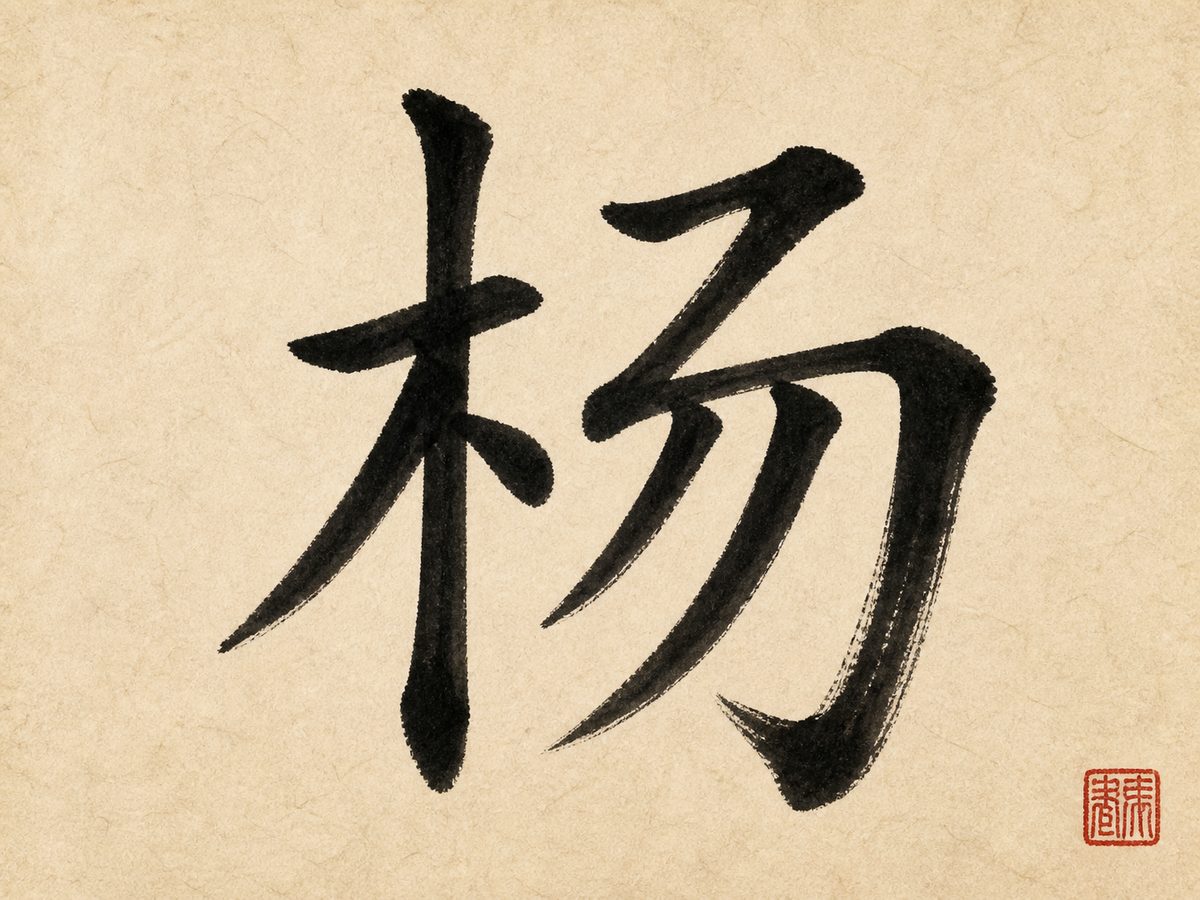
The surname Yang has nothing to do with yin and yang. Different word, different character, different family. The yang of yin and yang is 阳, which originally meant the sunlit south face of a hill, and it is also a Chinese surname, but a small and uncommon one. The surname carried by ninety-odd million people is 杨, and it is a tree.
This is not a trivial mix-up. It is probably the single most common misunderstanding of any Chinese surname in English, because the other word is one of the few Chinese terms that made it into English dictionaries, so the reader has a hook to hang the name on and hangs it on the wrong one. Anyone named Yang has spent a lifetime being told their name means balance and harmony and the interplay of opposites. It means poplar.
And even that is not the end of it, because a third Chinese surname, 羊, meaning sheep, is also spelled Yang. Three unrelated Chinese families, one set of letters, and the alphabet cannot tell them apart.
A poplar, not a willow
Open the Shuowen Jiezi, the dictionary Xu Shen finished around 100 CE, and the entry for 楊 is short. It is a tree.
Which is where things get interesting, because Duan Yucai, annotating that dictionary in the early nineteenth century, did not believe the text in front of him. The received editions read "a tree," two characters, and Duan restored it to something more specific on the authority of four earlier works, two Tang encyclopedias and two Song ones, all of which quote the Shuowen saying the pu-willow. The Erya, the oldest Chinese dictionary of all, says the same. So what you are looking at, when you read a modern Shuowen entry for this character, is a sentence that was quietly worn down over a thousand years of copying and then repaired by a scholar comparing quotations.
Now the tree itself, where English has been careless for a long time. The Qing philologist Zhu Junsheng set the two species side by side and stated the difference flatly: the poplar's branches are stiff, brittle and short, and its leaves round, broad and pointed; the willow's leaves are long and narrow, and its branches soft and tough. That is a clean botanical distinction, made in Chinese, in the nineteenth century, and English translations of Chinese poetry have been ignoring it ever since. The compound that names both trees together is routinely rendered as "willow," and a great many Yangs have been told their name is the weeping tree by a riverbank. It is the other one: upright, brittle, fast-growing, the tree that lines every road in northern China because it will grow anywhere and grow quickly.
If you want to see the tree in the character, our calligraphy tool draws 杨 in six classical scripts for free.
The tree everybody in China had to write about at school
The poplar is not a glamorous tree and that is exactly what made it useful.
In 1941, at the worst stretch of the war against Japan, the novelist Mao Dun published a short essay called In Praise of the White Poplar. He had been traveling the road from Lanzhou to Xi'an, over the Liupan mountains and down into the loess plateau, and what he wrote about was a tree so ordinary that nobody looks at it: dead straight, no spreading crown, branches gripped tight to the trunk, standing up into the wind and refusing to bend. Then he says what he actually means. The scholar Li Yongdong, tracing how Mao Dun built a wartime picture of China out of landscapes, points at the sentence where the essay drops the disguise and names what the tree stands for: the plain, steadfast, striving spirit his people could not do without in the fight for national liberation. He means the farmers of the north, and the soldiers behind the lines on the North China plain.
The essay went into the middle-school textbooks and has stayed there through edition after edition, which means that for the better part of eighty years essentially every literate person in China has had to sit an exam question on the symbolism of this tree. It is the standard worked example of the technique of saying one thing to mean another.
So the surname carries a small bonus that most Chinese surnames do not. Li is a plum tree and nobody thinks about plums. But if your name is Yang, the tree in it has a settled public meaning, taught to the entire country, and the meaning is: unglamorous, upright, and extremely difficult to knock over.
The name came from a small state that lost
The surname begins, as a startling number of Chinese surnames do, with a place that stopped existing.
There was a state called Yang, and the family that held it belonged to the Ji clan, the royal house of the Zhou. The line is traced to Boqiao, a son of Duke Wu of Jin, who was enfeoffed there. In the ordinary course of Spring and Autumn politics the state was eventually absorbed by its larger neighbor, and the people who had been its lords did the thing displaced Chinese aristocrats did: they took the name of the place they had lost and wore it as a family name.
The Kangxi Dictionary, compiled in the eighteenth century, still records where the surname is supposed to come from, quoting an older register of names: two ancestral seats, Hongnong and Tianshui. Hongnong is the famous one. The Yang lineage of Hongnong became one of the great aristocratic houses of the Han and stayed powerful for centuries, which is a large part of why the surname is now the sixth most common in the country and sixteenth in the Hundred Family Surnames, the rhyming Song-dynasty list that most Chinese children still half-know by heart.
The Yangs who ran the country
In 581 a general named Yang Jian took the throne of a northern dynasty from his own grandson, and by 589 he had done something nobody had managed for two hundred and seventy years: put China back together.
He is known as Emperor Wen of Sui, he lived from 541 to 604, and the dynasty he founded is one of the shortest and most consequential in Chinese history. The Sui lasted a bare thirty-seven years and spent them building. It rebuilt the examination system, standardized coinage and weights, and began the Grand Canal. Then it collapsed under his son, and the Tang inherited a reunified empire with the infrastructure already laid, which is roughly the historical equivalent of someone else finishing your homework and getting the grade.
A century and a half later the most famous Yang of all was not a general but a consort. Yang Guifei was the beloved of Emperor Xuanzong, counted ever after among the Four Beauties, and when the An Lushan rebellion broke the Tang open in 755 the fleeing court blamed her family for it. At a post station called Mawei the emperor's own guards refused to march until she was dead. She is the reason a good deal of Chinese poetry about love is also about politics.
The women generals
Then there is the tradition that most Chinese people actually think of first, which is opera.
The Yang Family Generals are a cycle of stories about a northern military house defending the Song against the Liao, and they are enormous: novels, dozens of operas, films, television series, comics. The historical kernel is real. There was a general named Yang Ye who served the Song, was cut off in battle, and died. Everything piled on top of him over the following six centuries is fiction, and the fiction is where the good part is.
Because as the male Yangs die off one by one, the stories do something that popular Chinese storytelling almost never does: they hand the army to the women. The widows and the matriarch take the field. Mu Guiying, the most famous of them, is a general and a commander and appears in no historical record whatsoever; she is a character. The Women Generals of the Yang Family is one of the most performed titles in Chinese opera.
It is worth being straight about the seam here. Yang Ye is history. The women generals are literature, several hundred years of it, and they are not less interesting for that. They are a culture arguing with itself, on stage, for six centuries, about who is allowed to command.
Yang in America is often not Chinese at all
Here is the part that a page written from Chinese sources alone would miss entirely, and it is the first thing people actually ask.
Yang is one of the major clan names of the Hmong, whose homeland is in the uplands of southern China, Laos, Vietnam and Thailand, and whose diaspora after the Vietnam War settled heavily in Minnesota, Wisconsin, California and France. In Hmong the name is Yaj. Hmong society is organized by clan in a way Han Chinese society has not been for a very long time: the clan is the unit that governs marriage, obligation and mutual aid, and there are around eighteen of them.
The relationship to the Chinese surname is genuinely tangled and worth stating carefully. The Chinese character 杨 is the one conventionally used to write the Hmong clan name, assigned under Chinese administration in a period when everybody living under it needed a Chinese-style surname on a register. That is documented. What that character does not establish is descent. A Hmong Yang and a Han Chinese Yang may share a written character, an administrative decision made for them, and nothing else.
The practical upshot for an English speaker is simple. In Saint Paul or Fresno, a Yang is statistically quite likely to be Hmong, and greeting them with a remark about the Chinese character is a small, well-meant misfire of exactly the kind this page exists to prevent.
Same character, spelling nobody would guess
Which brings us to the loveliest illustration of the whole problem.
In 2023 an actress from Ipoh in Malaysia won the Academy Award for Best Actress. Her surname is this one, 杨, and she spells it Yeoh because her family speaks Hokkien and Hokkien got to the alphabet first. Nothing in those four letters would tell you it is the same name as Yeung on a Hong Kong passport or Yang on a mainland one.
And in October 2025 the physicist Chen Ning Yang died in Beijing at a hundred and three, having been born in Hefei in 1922, won the Nobel Prize in 1957 with Tsung-Dao Lee for showing that a symmetry everyone had assumed was fundamental simply is not true, and lived long enough to see essentially the entire modern history of his country.
One tree, one lost state, one dynasty, an opera company's worth of imaginary women generals, a clan system in the hills, an Oscar and a Nobel. Not bad for a name that does not mean what everyone thinks it means.