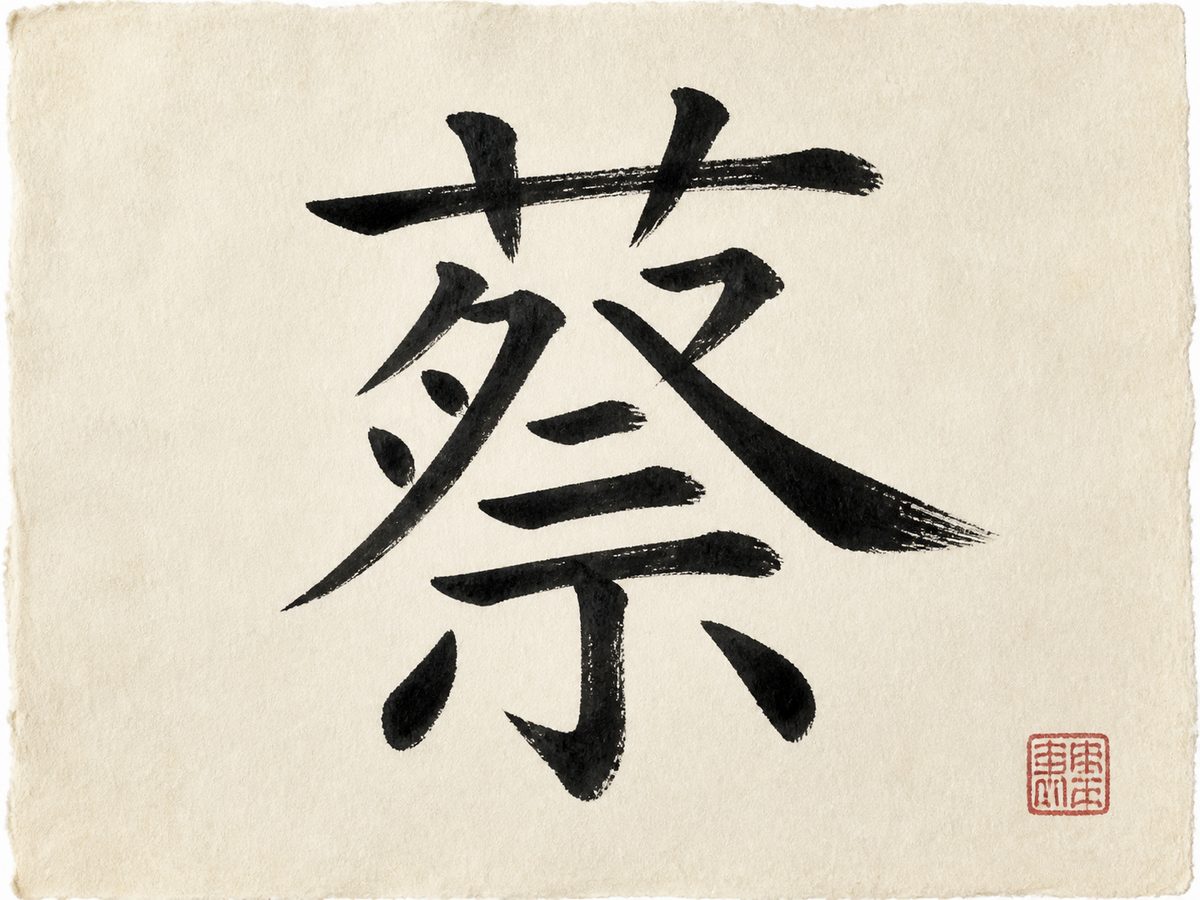
How to say it
Start here, because this is the name people look up in order to say out loud without embarrassing themselves, and both of its main spellings mislead an English reader in a different direction.
Tsai is one syllable. The vowel is easy: it is the word eye. The consonant is the problem, and it is a real one rather than a matter of fussiness. That opening ts is the sound at the end of the English word cats, and English is perfectly comfortable with it there. What English never does is put that sound at the front of a word. Mandarin does it constantly.
The workaround that actually functions: say cats, hold on to the ts at the end, and then attach eye to it. Cats-eye, minus the ca. Do it a few times and it stops feeling impossible.
Not sigh. Not zai. Not chai, though that is the closest of the three near-misses.
Then there is the pitch. Mandarin gives it a sharp falling tone, dropping from high to low, the pitch of an English speaker saying "No." firmly. Nothing rises.
The pinyin spelling, Cai, is the same sound written by a different system, and it fools people even more thoroughly. In pinyin the letter c is always that ts. Always. It is never a k and never an s, so Cai is not kai and not say. This is one of pinyin's more brutal choices, made because the alphabet had run out of letters and c was free, and it has been ambushing English speakers ever since.
Cantonese takes an easier route. Choi and Choy rhyme with boy. Hokkien gives Chua, which is roughly chwa.
Taiwanese or Chinese
This gets asked constantly and the honest answer has two halves that pull in opposite directions.
The name is Chinese and very old, taken from a state that existed in what is now Henan three thousand years ago, which is about as far from Taiwan as Chinese history gets. On the mainland it is the thirty-eighth most common surname.
But in Taiwan it is ninth. And in Singapore it is eighth. That is a large gap, and it is not noise. This surname sits heavily along the southeastern coast, in Fujian above all, and Fujian is the province that faces Taiwan across a hundred miles of water and supplied most of its Han settlement. The same coastline supplied Singapore, Malaysia and the Philippines, which is why there are so many Chuas in Southeast Asia.
The spelling then adds a second, entirely separate signal. Taiwan never converted personal names to pinyin; the mainland did, in the 1950s. So Tsai with a T is, in practice, a Taiwan spelling, or the spelling of a family that left China before the change. Cai with a C usually means the mainland or a recent emigrant.
Put the two together and the popular intuition turns out to be right for two different reasons at once. A Tsai probably does have a Taiwanese connection. The family is Chinese and older than the question.
A plant, a turtle, and a verb for throwing someone out
Now the character, which has led an unusually varied life.
The Shuowen Jiezi, around 100 CE, is brisk about it: a plant. It files the character under the grass radical, notes that the element underneath is supplying the sound rather than the sense, and moves on. That is the origin, and it is a slightly deflating one for a name this distinguished.
The second life is stranger and much better. This character also named a large tortoise, specifically the kind whose shell was heated until it cracked so that the cracks could be read as an answer from the ancestors. Divination tortoises appear to have come from the state of Cai, and the state's name went onto the animal.
Which produces a small scene in the Analects. Confucius, in the chapter called Gong Ye Chang, is unimpressed by a statesman named Zang Wenzhong, who kept one of these tortoises in a shrine with hills carved on the pillar capitals and duckweed painted on the beams. In James Legge's translation: "Zang Wen kept a large tortoise in a house, on the capitals of the pillars of which he had hills made... Of what sort was his wisdom?" It is Confucius being sarcastic about somebody's interior decorating, and the tortoise in it is this surname.
The third life is the odd one. The same character works as a verb meaning to banish, to cast out. And this is where the surname's own history folds back on itself, which is the next section.
The fourth, for completeness, is the state, and the Kangxi Dictionary adds a fifth sense, a standard or a law. A plant, a turtle, a banishment, a country and a rule. Not many characters carry that spread.
Named for a man who was thrown out
The founding ancestor of this surname was a traitor. This is not the usual thing for a genealogy page to lead with, but it is what the record says and it is far more interesting than the alternative.
King Wen of Zhou had a large number of sons. The second became King Wu, who overthrew the Shang. The fifth, Ji Du, was given the fief of Cai around 1046 BCE, as one of a group of royal brothers posted to keep an eye on the defeated Shang remnant.
Then King Wu died, leaving a child heir, and their younger brother the Duke of Zhou took the regency. Several of the posted brothers did not accept this and revolted, with the Shang prince they had been sent to watch. The rising was put down. Guan Shu, the ringleader, was executed. Cai Shu was banished.
Which brings us back to the verb. The Zuo Zhuan, recording the episode centuries later, has a sentence in which this character appears twice in immediate succession: the first is the verb, to banish, and the second is the man's name. The Duke of Zhou killed Guan Shu and cai-ed Cai Shu. The founder's disgrace is written into the grammar of the sentence that records it, and to a classically educated Chinese reader the pun is unmissable.
The family recovered. Cai Shu's son conducted himself well enough that the fief was restored to him, and the state of Cai ran on for another six hundred years until the southern power of Chu finally finished it off in 447 BCE. Its people did what people always did when a state fell, and took its name as their own.
The paper of Lord Cai
And then, eight centuries after the state disappeared, this surname produced a man with a stronger claim to have changed the world than almost anyone else in Chinese history.
Cai Lun was a eunuch at the Eastern Han court, in charge of the palace workshops, which meant he ran the empire's research and development. In 105 CE he presented the throne with a process for making a cheap writing surface out of tree bark, hemp waste, old rags and fishing nets, boiled to pulp and dried in sheets. He did not invent paper outright; fragments predate him by two centuries. What he did was make it good enough and cheap enough to replace silk and bamboo strips, which is the part that matters. The Book of the Later Han records that it came into use everywhere and was universally called the paper of Lord Cai.
Michael Hart, ranking the hundred most influential people in history, put him seventh, ahead of Gutenberg and ahead of Einstein, on the reasonable grounds that Gutenberg needed something to print on.
His ending is one of the bleakest in the dynastic histories, and it has nothing to do with paper. Cai Lun had been involved, years earlier, in palace intrigue that led to the death of an imperial consort. He was protected while his patron the Empress Dowager lived. When she died in 121 CE, the emperor summoned him to answer for it. He went home, took a bath, put on his formal robes, and drank poison.
The surname has kept producing people. Cai Wenji, a poet of the same dynasty, was carried off by the Xiongnu and eventually ransomed home by Cao Cao, and the poems attributed to her about that journey are still read. Tsai Ing-wen became the first woman to serve as president of Taiwan. Jolin Tsai has spent two decades as one of the biggest pop stars in the Chinese-speaking world.
If you want to see how a Chinese name is put together, sound and meaning at the same time, our name builder will make one from yours.
A weed, a turtle, a banished prince, and the paper this is all printed on.