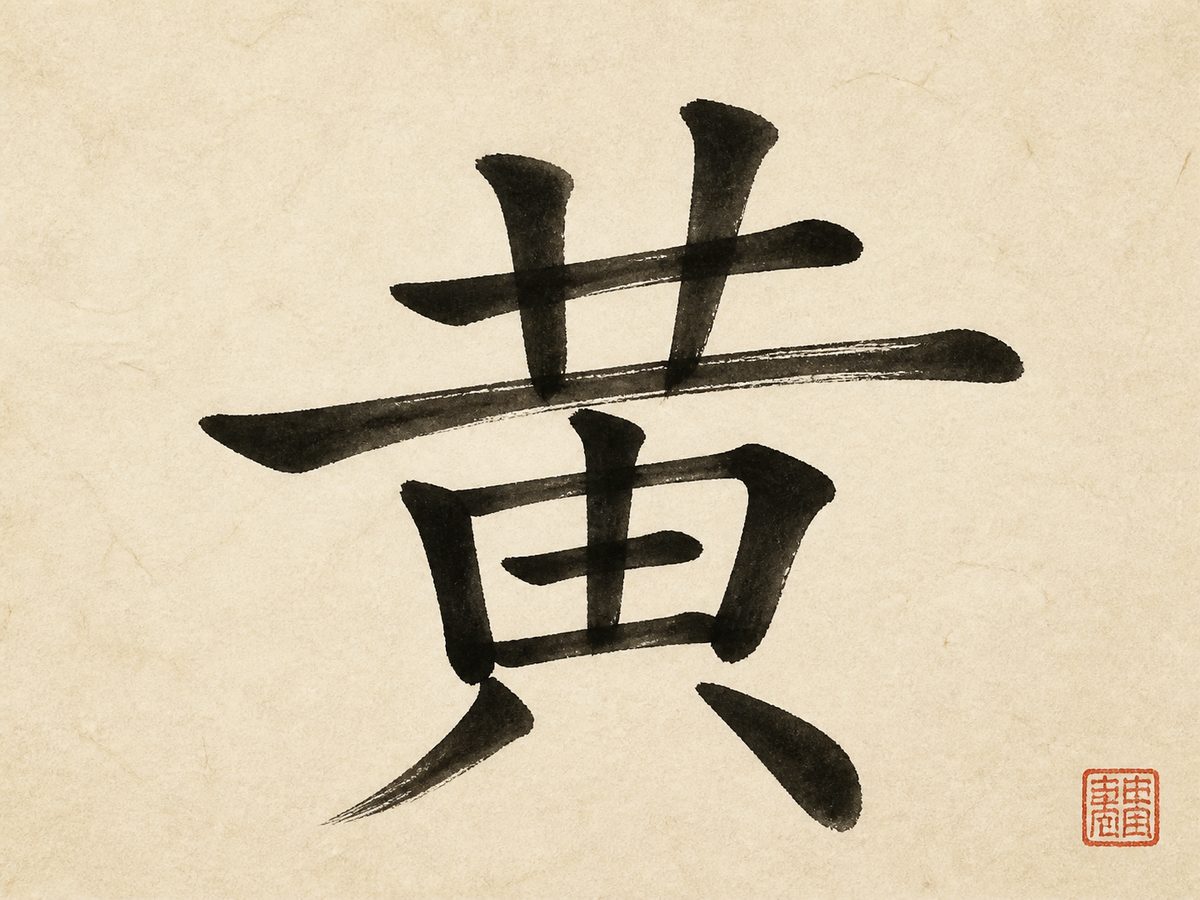
The yellow that was never yellow
Open the Shuowen Jiezi, the dictionary Xu Shen finished around 100 CE, and the entry for 黃 is confident and wrong. The color of earth, it says, composed of the field element with 炗, an old form of the word for light, supplying the sound.
You can see how he got there. In the small seal script Xu Shen was working from, there is something in the middle of the character that looks a great deal like the character for a field. Go back further, to the bronze inscriptions cast a thousand years before him, and the field turns out to be a rounded shape that later squared off and grew a lid. The thing in the middle was never a field. The character is not a landscape at all. It is a person, standing face on, with something at the chest.
What the something is remains an open argument, and the argument is more interesting than a settled answer would be. One reading, put forward by Li in 2012, has it as a semicircular jade pendant worn on the chest, the rounded element being the ring itself, which would make the name a picture of somebody wearing jade. Another, from Chi in 2010, reads the figure as a person with a protruding chest or abdomen, borrowed for the sound of the word "yellow" as early as the oracle bones. He, in 1998, connects that second reading to a rain ritual recorded in the Zuozhuan in which such a person was burned to bring the weather, and reads the rounded element as an upturned face. It is a bleak footnote and worth stating once, plainly, because the alternative is pretending the record is tidier than it is.
What everyone agrees on is the mechanism. Yellow is a rebus. The character was a picture of a person that happened to sound like the word for a color, got borrowed to write the color, and then never got it back. The most-used color word in imperial China is squatting in somebody else's house.
If you want to watch the three tiers stack up under a brush, our calligraphy tool draws 黄 in six classical scripts for free.
Not the Yellow Emperor's name
There is a tidy story that Chinese families with this surname are descended from the Yellow Emperor, and it is worth taking apart, because it is the first thing anybody guesses.
The Yellow Emperor's family name is given by Sima Qian as Gongsun. The Shuowen Jiezi has him taking the surname Ji from the river he lived beside. Xuanyuan, the name he is most often called, was a hill. As for the "Yellow," it is late: he was slotted into the Five Phases scheme during the Warring States period, where yellow is the color of the earth phase, and the character was in any case being used interchangeably with a different one meaning august or radiant. He is not a Huang. Nothing in the record connects him to this surname, and the several thousand years between them are not a rounding error.
The real origin is smaller and much better documented. There was a state called Huang on the Huai river, with its capital at what is now Huangchuan in Henan. In 648 BCE the state of Chu destroyed it after its ruler stopped paying tribute, which in the Spring and Autumn period was a reliable way to stop existing. Its people scattered and took the name of the country with them.
That is not folklore. Since 1975 the ground at Huangchuan has been giving up bronzes, among them a ritual cauldron naming a ruler of Huang called Meng. You can stand in a museum and read the name of the polity that this surname is the memory of. The genealogies that run further back, to Bo Yi of the Ying clan under Yu the Great, or to a Hui Lian appointed by Emperor Yao around 2220 BCE, are family tradition rather than record, and this page will not pretend otherwise.
The name behind two other names
Here is the practical problem with being a large southern surname.
The Cantonese pronunciations of 黄 and of 王 are close enough that both went into English as Wong. Those are the seventh and the first most common surnames in China. Two of the biggest families in the country walk around wearing the same four letters, and the letters give you no way to tell them apart. Our page for Wang says this from the other direction; this is what it looks like from here.
Ng is worse. In Hokkien, 黄 is read as a hummed consonant with no vowel in it, and that gets spelled Ng across Singapore, Malaysia, and Indonesia. But Cantonese also spells 吴 as Ng, and 伍 as Ng, and Hokkien uses it for 阮. Four unrelated surnames, two letters, no vowels. Wu, which owns the other big share of that spelling, covers the pronunciation side of it.
So this character sits underneath the two most overloaded spellings in Chinese naming, which no other surname manages. The lesson is not that romanization is messy in general. It is specifically that if you are a Wong or an Ng, the spelling is not your name; the character is, and it is the one piece of the information your family did not lose. If you would rather read spellings as a map of who sailed where, Lin has the clearest case of that.
How a taboo made a spelling
The strangest spelling in the table was not made by a dialect. It was made by manners.
In Vietnam the character is read hoàng, and Hoàng is the northern spelling. In the south it is Huỳnh, on identity cards and passports to this day, and the reason is a rule rather than a sound. Nguyễn Hoàng, who lived from 1525 to 1613 and governed Vietnam's southern provinces from 1558, had that syllable as his given name. Saying or writing a ruler's given name was forbidden, so in the territory he governed the surname was pronounced around, and the workaround outlived the man by four centuries. Chinese culture invented the naming taboo and exported it; this is one of the tidiest surviving fossils of it anywhere.
The rest of the distribution explains itself once you look south. Around 19 percent of China's Huangs live in Guangdong. In Taiwan the name is third. Those two facts are also the reason the spellings table is so long, because the south is the part of China that emigrated, and the south is the part with the dialects.
Four lives of the name
The man who wrote with a dry brush
Huang Tingjian, born in Jiangxi in 1045, is one of the Four Masters of Song calligraphy, and if you have ever admired a Chinese character where the ink breaks into streaks and lets the paper show through inside the stroke, you have admired his signature effect. The technique is called flying white, and his Biographies of Lian Po and Lin Xiangru is the standard place to see it done at full stretch.
He was also a serious poet, founder of the Jiangxi school, and a lifelong friend of Su Shi, whose praise in 1078 made his literary name. Both of them were exiled repeatedly as the court factions turned over, and Huang died in 1105 in Guangxi, about as far from the capital as the system could put a man. The calligraphy outlasted all of the politics involved, which happens more often than politicians expect.
The woman who came back with the machines
Huang Daopo left Songjiang, near what is now Shanghai, at about ten years old, on a ship to Yazhou on Hainan island, roughly as far south as China goes. She stayed for decades and learned spinning and weaving from the Li people there, who were doing it better than anyone on the mainland.
Around 1295 she came home, and she brought the technology with her. Improved gins, a redesigned spinning wheel worked by foot that could draw three yarns at once, better looms. Within a generation the Yangtze delta was a cotton economy, and it stayed one for six hundred years. The industrial history of the richest part of China turns on a woman who was sent away young, learned from an ethnic minority most Chinese records of the period ignored, and carried it back north in her head.
The doctor everyone thinks was only a fighter
Wong Fei-hung, born in 1847, has been played on screen by more actors than almost anyone in Chinese cinema. His film series holds the Guinness World Record for the longest-running film series and the most films in one series, with more than a hundred films and television shows since 1949, which means the character has been in continuous production for longer than most countries have had a film industry.
The man himself is not quite the man on screen. He was a master of Hung Ga, certainly. But his actual public standing in Canton came from medicine: he ran a clinic, taught acupuncture and bone-setting, and was known to his neighbors as a physician who could also fight rather than a fighter who dabbled. He died in 1925, poor, having watched his clinic burn in the fighting of his last years.
The man from the Denny's
Jensen Huang was born in Taipei in 1963 and sent to the United States at nine, in 1973, to live with an uncle near Tacoma, Washington. Twenty years later, in 1993, he sat down in a Denny's in East San Jose with Chris Malachowsky and Curtis Priem and worked out the business plan for a company to make graphics chips for computer games.
He has run Nvidia ever since, which is an unusually long tenure by any standard and an almost unheard-of one in that industry. Whether the chips he ended up making turned out to matter for reasons entirely unrelated to computer games is a question this page will leave to the business press, which has covered it thoroughly.
If you carry the name
The surname is the half of a Chinese name that arrives with you; the given name is the half somebody sat down and chose. If you are a Huang, a Wong, an Ng, an Ooi, or a Huỳnh looking for a Chinese given name to stand beside the character, our name generator builds real ones the way Chinese parents do, out of meaning and sound rather than off a list. And since one of the four people above was among the finest brush writers China produced, the calligraphy tool renders 黄 live, free, flying white included.