A surname that is a verb
Open the Shuowen Jiezi, the dictionary Xu Shen finished around 100 CE and still the first place to look for where a Chinese character came from, and the entry for 張 is four characters long. To fit the string to the bow. Composed of the bow radical, with 長 supplying the sound.
Read that again, because the grammar is the point. It does not say "a bow." It does not say "an archer." It says the act of stringing one, the moment of tension before anything is released. Chinese surnames are almost never like this. Wang is a king. Li is a plum tree. Chen is a place somebody came from. Liu began as a kind of axe. The third most common name in the country is not a noun at all; it is something you do with your hands.
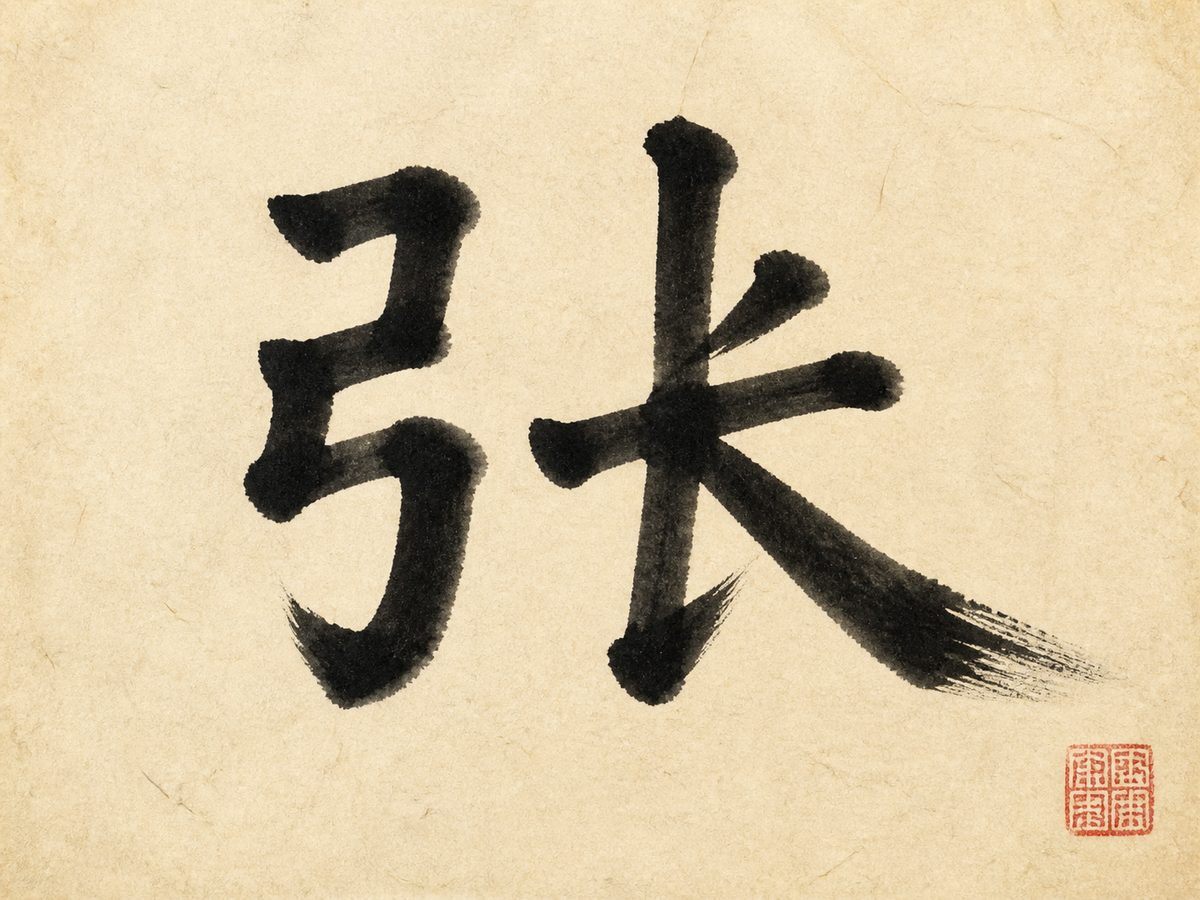
The character is seven strokes and it splits cleanly down the middle. On the left is 弓, a bow drawn as a bow, three strokes of a stave bent back on itself. On the right is 长, which is there for the sound rather than the meaning, and which happens to mean long, so the character looks like a long bow whether or not anyone planned it that way.
The verb never really left. Modern Mandarin still uses the same word for opening anything that spreads out, and it is the standard measure word for flat things, so a Chinese speaker counts one zhang of paper, one zhang of table, one zhang of face. The surname of eighty million people is also the word you use to order a sheet of A4.
If you want to watch a calligrapher hold the bow tight and then let the last stroke go, our calligraphy tool draws 张 in six classical scripts for free.
The man who was given a job and got a family
Every Zhang genealogy starts with an invention.
The story goes that Hui, a descendant of the Yellow Emperor through his fifth son, looked up at the constellation Chinese astronomy calls the Heavenly Bow, worked out how the thing might be built, and made the first bow and arrow. The court gave him the office of First Bow and then, in the neat way these stories have, gave him the job as a name. His descendants have been Zhangs ever since.
It is a very good story and it is genealogy rather than history. Nobody has a Shang or Zhou document naming Hui; what exists are family records compiled thousands of years after the fact by people who already carried the name and wanted to know where it came from. That is worth saying plainly rather than passing over, and it costs the story nothing. What the legend actually preserves is a real and old idea about how Chinese surnames worked, which is that a great many of them began as occupations handed down until the job disappeared and only the label was left. The Zhangs are the case where you can still read the job in the letters.
Chinese for "some guy"
Here is the strange thing about being enormous.
When Chinese needs a name for a person who is nobody in particular, the way English reaches for John Doe or Tom, Dick, and Harry, it reaches for this one. The idiom is Zhang Three and Li Four, and it means anybody at all, the man in the street, whoever. Li, the name in the second half of it, sits directly above Zhang in the rankings. Between them and Wang they account for something like a fifth of the country, so the language did the sensible thing and drafted the two of them as variables.
The numbers behind that are worth a second. A 2007 count put roughly 87.5 million Zhangs on the mainland, about 6.83 percent of the population. Zhang is third nationally and third in Taiwan, which is unusual in itself, since most Chinese surnames shift rank wildly the moment you cross a strait or a provincial border. This one does not really move. It is not a southern name or a northern name. It is simply everywhere, which is exactly why the idiom picked it.
The one Zhang family that is nobody's placeholder
And then, inside the most generic surname in China, the least generic family in Chinese religion.
In the year 142, on a mountain in Sichuan called Heming, a man named Zhang Daoling reported that Laozi, by then long dead and thoroughly deified, had appeared to him and handed over what he called the Doctrine of the Orthodox One. Zhang built a working theocracy out of it in the hills, divided into parishes, and outsiders nicknamed the movement the Way of Five Pecks of Rice after the grain tax he levied on members. This is roughly where organized Daoism, as opposed to Daoist philosophy, begins.
What happened next is the part almost nothing else in world religion can match. The office passed to Zhang Daoling's son, Zhang Heng, and then to his grandson Zhang Lu, and it kept going. The title of Celestial Master has descended through that bloodline for nineteen centuries. The sixty-third holder, Zhang Enpu, left the mainland for Taiwan in 1949 with the retreating Nationalist government and took the office with him; since he died the succession has been contested between branches in Taiwan and on the mainland, and this page is not going to pretend that argument is settled.
Two honest qualifications. The details of Zhang Daoling's own life come almost entirely from hagiography written well after he lived, so the founder is a firmer figure in religion than in the historical record. And a hereditary office is not a family business: Daoism is vastly larger than one lineage, and the Celestial Masters hold one seat inside it, not the building. Still, the arithmetic stands. One surname, one office, since the second century. The Jade Emperor who sits at the top of the celestial bureaucracy is presiding over a court that this tradition largely furnished.
One small trap while we are here: the Zhang Heng who inherited the Celestial Master title is not the Zhang Heng in the next section. The name is too common for that kind of luck.
Four lives of the name
The man who walked west
In 138 BCE the Han emperor sent a court attendant named Zhang Qian west with about a hundred men to find allies against the Xiongnu. The Xiongnu caught him almost immediately and kept him for thirteen years. He married, had a child, and did not give up the emperor's staff of office. Then he escaped, kept going west instead of turning around, and came back in 125 BCE with two survivors and the single most valuable report in Han history.
There were, he told the throne, large settled states out there, farming much the way China did: Ferghana, Bactria, Parthia, with cities and coined silver and horses that were said to sweat blood. Nobody at court had known. Within a few years the Han were sending embassies west by the dozen, and the roads those embassies wore down are the ones later centuries would call the Silk Road. It exists, in part, because one man was captured and refused to consider the trip canceled.
The man who felt an earthquake 400 miles away
Zhang Heng, who lived from 78 to 139 and did everything, built a machine in 132 that has been argued about ever since. It was a bronze vessel with eight dragons around the outside, each holding a ball above an open-mouthed bronze toad, and it was meant to drop one ball in the direction of a distant earthquake.
One day it dropped a ball toward the northwest and nobody in Luoyang had felt a thing. The court decided the instrument was junk. Several days later a messenger arrived from Gansu, 400 to 500 kilometers away, reporting an earthquake. That was in the second century, and it is still the earliest recorded instance of anyone detecting a quake they could not feel. Zhang also built a water-powered armillary sphere, cataloged some 2,500 stars, and wrote poetry good enough to be anthologized, which suggests he was insufferable at parties.
The writer who left
Eileen Chang was born Zhang Ailing in Shanghai in 1920, into the wreckage of a distinguished family, and she wrote the two novellas that made her reputation, Love in a Fallen City and The Golden Cangue, in 1943, while the city was under Japanese occupation. She was twenty-three. Nobody in modern Chinese literature writes cruelty inside a family better.
In 1952 she understood that there was no future for her writing on the mainland and left for Hong Kong, and later for the United States. She kept working for another four decades, and one of the last things she wrote, Lust, Caution, would be filmed long after her death. She was found in her apartment in Westwood, Los Angeles, in September 1995, having died of heart disease a few days earlier. Her instructions were carried out exactly: cremation, no service, ashes into the Pacific. She had spent her life declining to explain herself and did not stop at the end.
The farmhand who opened the Olympics
Zhang Yimou spent the Cultural Revolution doing farm labor and then working in a textile mill. When the universities reopened he talked his way into the Beijing Film Academy in 1978, part of a class that would remake Chinese cinema. Red Sorghum took the Golden Bear at Berlin in 1988, Raise the Red Lantern got him an international audience in 1991, and Hero in 2002 proved that a Chinese film could be a global blockbuster.
Then, in 2008, he directed the opening and closing ceremonies of the Beijing Olympics for an audience of something like a billion people, and in 2022 he did it again for the Winter Games, becoming the only person ever to stage both. A man who had been assigned to a mill because of his family background ended up designing how his country introduces itself to the world. The name that means to draw a bow has produced a lot of that particular arc.
If you carry the name
The surname is the half of a Chinese name that arrives with you; the given name is the half somebody sat down and chose. If you are a Zhang, a Chang, a Cheung, or a Teoh looking for a Chinese given name to stand beside the bow, our name generator builds real ones the way Chinese parents do, out of meaning and sound rather than off a list. And the character has been one of the most satisfying shapes in the language to write for three thousand years, because half of it is under tension and the other half is released: the calligraphy tool renders 张 live, free. If the spelling problem in the table above is the part that interested you, the name that has it worst is Ng.