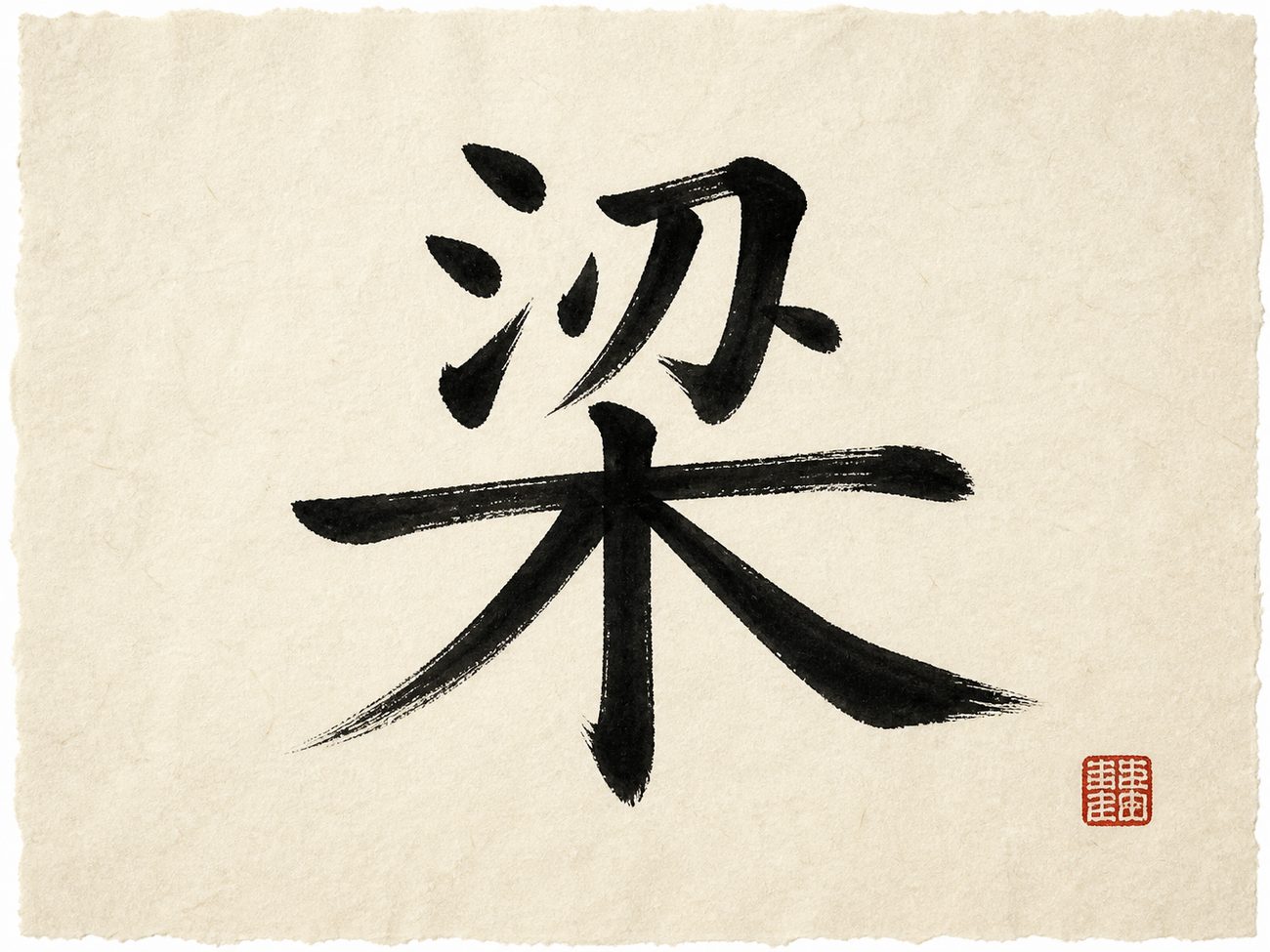
A bridge, not a beam
Look this name up in English and you will be told it means beam, as in the timber holding up a roof. That is not wrong, exactly, but it is the second meaning, and the first one is better.
The Shuowen Jiezi, the first systematic Chinese dictionary, compiled around 100 CE, defines the character in three characters of its own: a bridge over water. It then takes the graph apart into wood and water, with a third element supplying the sound, and notes an older variant form for good measure. Wood and water. That is a plank across a stream, which is the oldest bridge there is.
The roof beam came afterward, by an obvious extension: a beam and a footbridge are the same object, a length of timber spanning a gap, and the only difference is what is underneath. Chinese eventually felt the strain and minted a second character, 樑, with an extra piece of wood added to the left, to carry the beam sense on its own. That character shows up in a story further down this page, and when it does it is worth noticing.
How to say it: one syllable, not two. The vowel of see, cut short, sliding straight into the sound of long. Let your voice rise through the whole thing, the way it would if you were asking a one-word question. In Hong Kong the same character is Leung, which is closer to lyoong, and in Singapore it can turn up as Neo, which is the same name and looks like a different planet.
The state that was talked out of existence
The surname comes from a country that no longer exists, which is unremarkable. What is remarkable is how it stopped existing.
There was a small state called Liang on the Yellow River in what is now Shaanxi, its capital just south of the modern city of Hancheng. It was created around 768 BCE for a son of the ruler of Qin, which puts its ruling house in the Ying clan, the same clan that five centuries later produced the man who conquered everybody else and called himself the First Emperor. Liang was, in other words, a cadet branch of the family that would eventually eat it.
It lasted about 127 years. The Zuo Tradition, under the nineteenth year of Duke Xi, explains the end in about forty characters, and they are worth having in full:
The Lord of Liang was fond of earthworks. He walled towns repeatedly and then did not occupy them. The people were worn out and could not bear it, so he would say, "raiders are coming." Then he dug a moat around the ducal palace and said, "Qin is about to attack us." The people took fright and scattered, and Qin thereupon took Liang.
That is a ruler who could not stop building, who kept his exhausted population digging by inventing an enemy, and who was finally believed. The last thing he told them was true by accident. They ran, and there was no one on the walls when Qin arrived. It cost Qin, as far as the record shows, nothing at all.
The Spring and Autumn Annals record the event itself in two characters: Liang perished. No conqueror is named. The chronicle that logs every battle and every treaty declines to say that Qin took anything, and simply notes that the state ended. Whatever the annalist meant by it, the Zuo Tradition's account explains why it reads that way.
The survivors went east to the state of Jin, and took the name of the country they had lost as the name of their family. That is a common enough way for a Chinese surname to begin. It is less common for the founding story to be quite so specific about whose fault it was.
The translation above is ours. James Legge translated the Zuo Tradition into English in the nineteenth century, but we have not verified his wording for this particular passage, and we would rather render it plainly than put a name to a version we have not checked.
The gentleman on the beam
Here is the character in its second career, and the story behind it is one of the nicest things in the History of the Later Han.
Chen Shi was a local magistrate in the second century CE with an enormous reputation for decency. In a famine year, a thief got into his house at night and settled himself on the roof beam to wait. Chen Shi saw him. He did not shout.
Instead he got up, straightened his clothes, called in his children and grandchildren, and delivered a short lecture in the stern voice reserved for family instruction. A person must make an effort with himself, he told them. A bad man is not necessarily bad to begin with. Habit hardens into character, and that is how people end up here. And then, presumably without looking up: the gentleman on the beam there is an example of it.
The thief threw himself off the beam onto the floor and knocked his head on the ground in confession. Chen Shi looked him over and said he did not have the face of a bad man and had better take himself seriously in hand, and that this must be a matter of poverty. Then he gave him two rolls of silk. The History of the Later Han adds that there were no more thefts in the county after that, which may even be true.
The gentleman on the beam has meant a burglar ever since, and it remains the most gracious way in Chinese to call someone a thief. And the small point worth noticing: the transmitted text writes that beam with the extra piece of wood, 樑, the differentiated character invented for exactly this sense. The bridge and the beam had already gone their separate ways by the time a copyist reached this line.
Where you meet it
Qiaoliang, bridge-and-beam, is the ordinary modern word for a bridge, and the character has never let go of its first job.
Dongliang, ridgepole-and-beam, means a pillar of the state, the person an institution rests on. It is the compliment you pay someone at their retirement dinner, and it is pure architecture.
Tou liang huan zhu, steal the beams and swap the pillars, is one of the Thirty-Six Stratagems, usually rendered in English as replacing the beams with rotten timbers. It is the art of hollowing something out while leaving its outward shape intact, which is a very good description of both a con and a hostile takeover.
And then there is Liang Shanbo, who is the reason a great many people outside China have heard this surname without knowing it. He is the male half of the Butterfly Lovers, the story of a young woman who dresses as a man to go to school, spends three years as her classmate's inseparable friend, and is betrothed elsewhere before he works out what she is. He dies. On her wedding day the procession is stopped by a storm at his grave, she goes down into it, and the two of them come out as a pair of butterflies. It is set in the fourth century, traceable in writing to the late Tang, counted one of the Four Great Folktales, listed by UNESCO in 2006, and known to every Chinese household through the violin concerto written in 1958, which is the single most performed piece of Chinese orchestral music there is. English-language coverage tends to file it as the Chinese Romeo and Juliet, which is fair enough as far as it goes and misses that this one is about school.
Korea, and a hole in the ground on Jeju
The most-asked question about this name in English is whether it is Chinese or Korean, and the answer is that it is genuinely both, in a way worth being precise about.
In Korean the character is read Yang, written 양, and 389,152 South Koreans carry it. That makes it the most common of the several different characters that all come out as Yang in English, well ahead of the willow character at 93,416. North Korean romanization writes the same syllable Ryang.
The largest branch is the Jeju Yang, 133,355 people at the 2000 census, and their origin story is the best one on this page. At a spot in the middle of Jeju City there are three depressions in the ground, a site called Samseonghyeol, where three demigods are said to have come up out of the earth some four thousand years ago, found three princesses in a wooden box that had arrived by sea, married them, and founded the kingdom of Tamna. The three were named Go, Yang and Bu, and their descendants are the three founding clans of the island.
Two things about that. First, the Jeju Yang trace themselves to Yang Eul-na, and his name is recorded with a different character from this one; the clan came to write it as 梁 later. So a Korean Yang and a Chinese Liang share a graph, not a grandfather, and anyone telling you otherwise is selling a family tree.
Second, and this pleases us more than it should: the Gao surname page, published on this site yesterday, ends on the Jeju Ko clan. Go and Yang are two of the three. We are one hole in the ground short of the complete set.
The man named Beam who wrote the book on buildings
Liang Sicheng, 1901 to 1972, is the reason anybody can say anything precise about the history of Chinese architecture.
Before him, the subject barely existed as a field. Chinese buildings were timber-framed, timber burns, and the written record was full of descriptions of halls nobody could point to. Starting in 1932, Liang and his colleagues went out into the countryside on appalling roads to measure what was still standing, and they found the two oldest surviving timber structures in China, at Nanchan Temple and at Foguang Temple on Mount Wutai. The great hall at Foguang dates to 857 CE. It had been sitting there, in use, for eleven hundred years, and the discipline that could recognize what it was did not exist until he built it.
He wrote the first modern history of the subject and a structural analysis of Qing building regulations that is still handed to students. His father was Liang Qichao, the reformer who fled to Japan after the Hundred Days' Reform of 1898 and spent fourteen years there inventing, more or less single-handedly, the Chinese vocabulary for Western political ideas. His wife and co-worker was Lin Huiyin, who was out on those surveys with him, and who is one of the reasons the surname Lin is worth its own page.
A man called Beam, son of a man who built a language, married to a woman who climbed the roof trusses with him, spending his life proving that Chinese buildings had a history. Sometimes a name earns itself.
If you want to know what your own name would look like built the Chinese way, from sound and meaning at once, our name builder will put one together.
Eleven strokes, wood over water, and a state that fell down because its ruler would not stop building things.