A job title in a plum tree's clothing
The traditional account, preserved in the genealogies, runs like this. Under the legendary Xia dynasty, the upright judge Gao Yao held the office of Minister of Justice, and his descendants took the office's character, 理 (lǐ, "to order, to judge"), as their family name. Generations later the name shifted to a different character with exactly the same sound: 李, the plum. Same syllable, new tree. Take the Xia-era details as legend rather than court record, the way the genealogists themselves half did; the pattern is the believable part, because it is the standard pattern. Even the surname that looks most like a simple noun turns out to be an office wearing an orchard as a disguise.
The first bearer historians will actually stand behind is worth the wait: Li Er, better known as Laozi, "the Old Master," the philosopher credited with the Daodejing and the founding of Daoism. The Tang emperors, who shared the surname, took the connection seriously enough to claim him as an ancestor. Having the author of the most translated Chinese book in history as your name's first verified entry is the genealogical equivalent of opening a scrapbook to page one and finding a signed first edition.
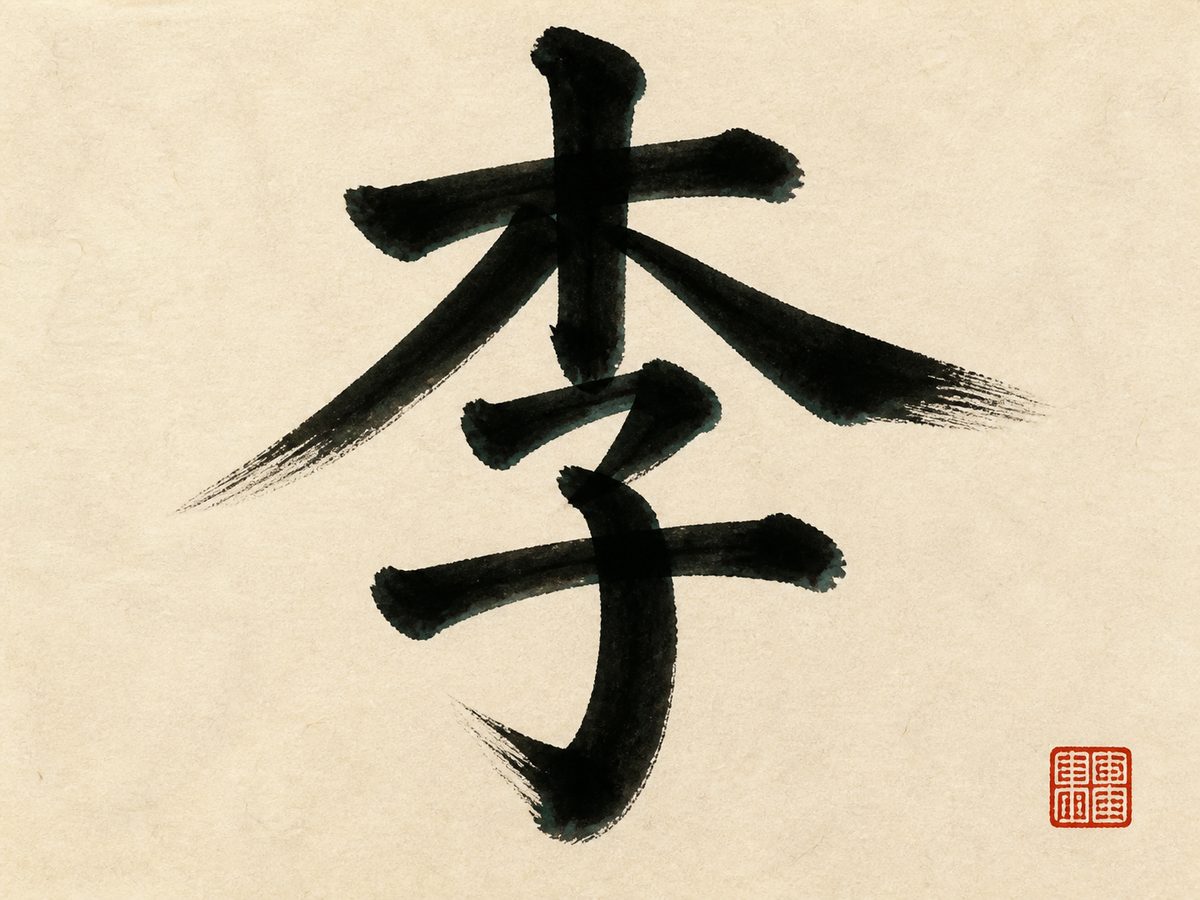
The plum does earn its keep in daily speech, twice over. First, in the way Lis introduce themselves: because so many surnames share a sound, Chinese has a spoken spelling code, and Li's is the most famous line of it. Say mù zǐ Lǐ, "wood-child Li," and you have named the character's two components and settled which Li you are; the formula opens the Surname Song, the rhyme in China's first-grade textbooks that teaches children to spell the great names by their parts. And second, in one of the language's warmest metaphors: a teacher's students are called táolǐ, "peaches and plums," things that take years of tending and then bear sweet fruit, so a life of teaching well is táolǐ mǎn tiānxià, "peaches and plums filling all under heaven." A hundred million Lis, and the word inside their name quietly stands for every student anyone ever taught.
Six lives of the name
One hundred million people generate a deep bench. Six bearers, from a golden age to a Hong Kong film set.
The dynasty that made it enormous
In 618, Li Yuan founded the Tang dynasty, and for nearly three centuries the surname sat on the throne of China's golden age. The Tang emperors treated the name as a decoration: they bestowed it on favored generals, allies, and chieftains the way later states pinned on medals, and every bestowal founded a new line of Lis. A dynasty that ruled that long, gave the name away that freely, and presided over that much prosperity is a large part of why the name now runs to nine figures. Chen grew by migration and Wang by converging refugees; Li grew by imperial generosity.
The poet who drank with the moon
The name's most luminous bearer is Li Bai (701-762), who stands beside Du Fu at the summit of Chinese poetry. About a thousand of his poems survive, a striking share of them about wine; as his Wikipedia article puts it, others may have drunk more, but no one has written more poems about it. His most famous piece pours a cup for the moon and his own shadow to make a drinking party of three. The legend of his death, told as legend even by its tellers: drunk in a boat, he leaned out to embrace the moon's reflection in the river and drowned. Historians prefer illness. The name keeps the better story on file.
The poet who lost everything except the poems
The finest woman writer in Chinese literary history was a Li: Li Qingzhao (1084-1155), master of the ci, the song-form lyric built for private feeling. Her life splits cleanly in half. In the first half she and her husband Zhao Mingcheng spent a happy scholarly marriage collecting books, bronzes, and rubbings, and her lyrics have the shine of someone writing from inside a charmed life. Then the Jin armies took the Northern Song capital in 1127; the couple fled south, the collection scattered, her husband died two years later, and she spent her remaining decades in Hangzhou writing some of the most piercing lines of loss in the language. About a hundred poems survive. It is China's canonical demonstration that a voice can outlast everything it loved.
The Lees who ruled Korea for five centuries
In 1392, the general Yi Seong-gye overthrew the Goryeo kingdom and founded the Joseon dynasty. His family name, Yi (이), is the Korean reading of 李, and his house ruled Korea for over five hundred years, one of the longest royal runs anywhere on record, ending only with Japan's annexation in 1910. There is a crossing of stories here: the dynasty the Yis overthrew was ruled by the Wangs, whose survivors, as told on our Wang page, hid from persecution inside other characters. One giant surname chased another off a throne. Even South Korea's first president, Syngman Rhee, was a descendant of the royal house: same character, older spelling.
The Lee who built a country
The diaspora's most consequential Lee governed from an island. Lee Kuan Yew (李光耀), a Hakka whose family line ran back to Dabu County in Guangdong, became Singapore's founding prime minister in 1959 and held the job until 1990, steering a resourceless port city into one of the wealthiest societies on earth. He is also a walking exhibit of this page's spelling map: a Chinese-descended Lee, English given name Harry, governing a majority-Chinese country where the same surname answers to Lee, Li, and Lý depending on which ancestor's boat you count. The name's talent for turning up wherever thrones, brushes, and borders are being redrawn apparently extends to founding modern states.
The Lee the whole world knows
Born in San Francisco in 1940 and raised in Hong Kong, Lee Jun-fan became the first global Chinese film star and, by wide agreement, the most influential martial artist cinema has produced. His screen name, Lee Siu-lung, means "Lee the Little Dragon," taken from the sign of the year he was born. Bruce Lee died at thirty-two having permanently changed what the West imagined a Chinese man could be, and he did it wearing the surname's most common overseas spelling. For millions of people, the first Li they ever heard of was a Lee.
If you carry the name
The surname is the inherited half of a Chinese name; the given name is the half somebody chooses. If you are a Li or a Lee picking a Chinese given name to sit beside the family character, our name generator builds real ones the way Chinese parents do. And the character, a tree over a child, has been beautiful in every script for three thousand years: the calligraphy tool renders 李 live, free.