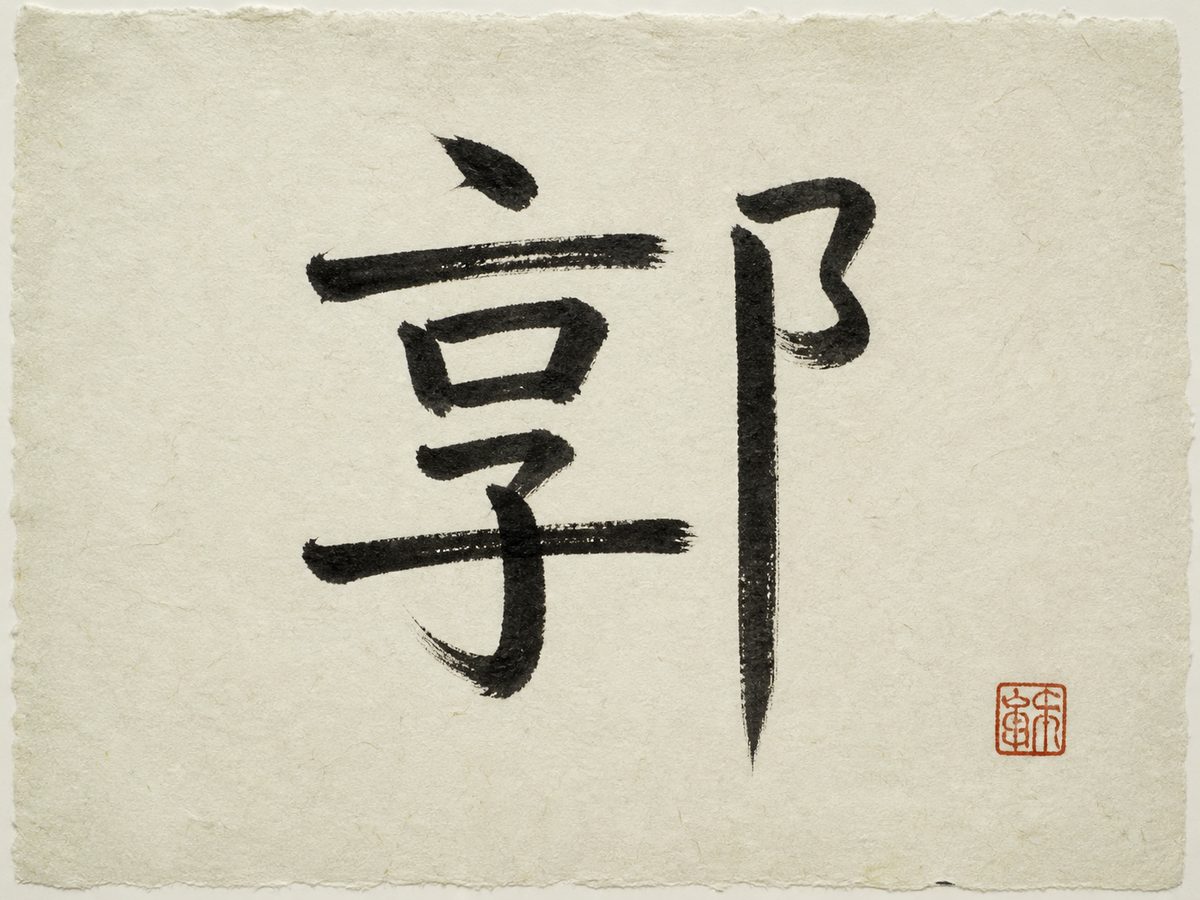
Which Guo, and why it is also Kwok
Start with the practical problem, because a reader who has arrived here from a form, a family tree or a colleague's email signature usually has one.
There are two Chinese surnames that reach English as Guo. The common one, the one this page is about, is 郭, and it is the sixteenth most common surname in mainland China. The other is 國, which means country, and it is rare enough that most Chinese people will never meet one. Google currently shows both on the same page of results, which is unhelpful of it, but the ratio in real life is not close. If you have met a Guo, you have almost certainly met this one.
Then there is Kwok, and Kwok is not a different name. It is this exact character, read aloud by a Cantonese speaker instead of a Mandarin one. Hong Kong, Macau, Guangdong and the older overseas communities spell it that way and always have. Aaron Kwok the singer and Guo Moruo the scholar were writing the same glyph.
Saying it: in Mandarin it is one syllable and English speakers reliably make it two. Begin with the gu of language, run straight into an aw, and keep the whole thing high and flat. Roughly gwaw, in one beat. In Cantonese it is gwok, and the k at the end is swallowed rather than released.
That k is worth a moment, because it is the single most interesting thing on the spelling table. It is not an eccentricity of Cantonese. It is a consonant this word genuinely used to end with, and Cantonese, Vietnamese and Korean all still have it while Mandarin does not. Mandarin lost every final p, t and k it once had, which is why no Mandarin word ends in any of them today. So Kwok is not a mangled Guo. It is closer to what the name sounded like a thousand years ago, and Guo is the version that has worn smooth.
The wall on the outside
The character means a city wall, and specifically the outer one.
This needs a word of explanation, because the English word "wall" collapses a distinction that Chinese kept. A serious old Chinese town had two rings. The inner ring enclosed the palace, the offices, the granaries, the people who mattered. The outer ring, further out and usually longer, enclosed everybody else: the markets, the workshops, the ordinary houses. The two had separate names, and this character is the outer one. The Kangxi Dictionary still preserves the pairing, glossing the word as the ring that lies out beyond the city proper.
Which gives one traditional explanation of the surname that is pleasingly unglamorous. Some families are named for a virtue, some for a fief, some for an ancestor's title. This one is named for a postcode. You lived outside the inner wall, so that is what people called you.
A dictionary entry that is an obituary
Here is the passage this page exists for.
The Shuowen Jiezi is the first systematic Chinese dictionary, compiled by Xu Shen around 100 CE, and it defines roughly nine thousand characters, mostly in the flat manner of a dictionary. Its entry for this character does not define it at all. What it says, in full, is that this is the ruined town of the Guo clan of Qi, that they praised the good but could not promote them and hated the bad but could not remove them, and that this is why the state was lost. Then it notes the phonetic component and moves on.
An obituary, in other words, filed under a surname, in a dictionary.
The story behind it survives, and it is better than the summary. It is preserved among the historical anecdotes collected by Liu Xiang, the Han imperial librarian who cataloged the palace library in the first century BCE. Duke Huan of Qi, out on the road, passes an abandoned town and asks whose it was. The Guo clan's, someone tells him. Why is it abandoned? Because they loved the good and hated the bad. The duke says, reasonably, that loving the good and hating the bad is how a state survives, not how it falls, so what happened? And the answer is the part worth carrying around: they loved the good but did not use them, and hated the bad but did not get rid of them. So the good men, knowing they were valued and not employed, grew resentful. The bad men, seeing they were disliked and not removed, grew hostile. And a state with the decent people resentful and the awful people hostile does not last.
That is a two-thousand-year-old note about the difference between having correct opinions and doing anything, and Xu Shen thought so much of it that he made it the definition of a word.
Lips gone, teeth cold
The surname's main line of descent runs back to a state, and the state is one that a great many people have heard of without ever knowing its name.
The traditional account is that the ancestral state was Guo, written with a different character, 虢, founded at the start of the Zhou dynasty and held by the brothers of King Wen. The two characters sounded close enough that the name settled into the simpler one, and the dictionaries record the link. As with all surname origins at this depth, this is what the tradition and the reference works say rather than something anyone can demonstrate.
What happened to that state, however, is recorded in detail, and it produced two of the most quoted phrases in the Chinese language.
In 655 BCE, Duke Xian of Jin wanted to destroy Guo, and to reach it his army had to pass through the small state of Yu. So he asked Yu for permission, with gifts. Yu had an adviser, Gong Zhiqi, who said no in the most memorable way anybody has ever said no. Guo, he told his ruler, is the outer screen of Yu. If Guo falls, Yu will follow. And then he quoted a proverb: the cheekbone and the jaw depend on each other, and when the lips are gone the teeth feel the cold.
The duke of Yu took the gifts and let the army through. Jin destroyed Guo, and on the way home destroyed Yu.
Both phrases survive. Chún wáng chǐ hán, lips gone, teeth cold, is ordinary modern Chinese for two parties whose fates are tied together, and it turns up in newspaper editorials about trade and alliances constantly. And "borrow a road to attack Guo" became one of the Thirty-Six Stratagems, the classical catalog of ruses, where it means to secure passage or access from a weaker party under a friendly pretext and then use it against them. Anyone who has read about Chinese strategy in English has met the stratagem. Almost nobody has been told that the Guo in it is the ancestor of a common surname.
The man who got the year right
Of all the people who have carried this name, the one worth putting in an almanac is Guo Shoujing.
He was an astronomer and hydraulic engineer under Kublai Khan, and in 1280 he completed a new calendar, the Season-Granting Calendar. To build it he rebuilt the instruments, and to check it he ran an observing campaign across the empire. The number he arrived at for the length of a year was 365.2425 days.
That value is worth sitting with for a second. It is about twenty-six seconds off the modern figure. It is also, to the last digit, the value the Gregorian calendar adopted when Europe reformed its own three centuries later, arrived at independently and considerably earlier. His calendar stayed in official use for 363 years, the longest run of any calendar in Chinese history.
He has an asteroid named after him, 2012 Guo Shou-Jing, and China's large survey telescope outside Beijing carries his name too. If you want to see the kind of arithmetic he was doing, our calendar converter runs on the same lunisolar system he was correcting.
The other Guos
Guo Ziyi is the one Chinese schoolchildren know. When the An Lushan rebellion nearly ended the Tang dynasty in the 750s, he was the general who took the capitals back, and he then spent decades being repeatedly dismissed by suspicious emperors and repeatedly recalled because there was nobody else. He died in his eighties, full of honors, which for a successful Chinese general is close to a miracle.
There is also a line of this surname that most accounts of it skip. In the fourteenth century a Persian Muslim merchant family settled at Quanzhou in Fujian, then one of the great ports of the world, and took Guo as their Chinese surname. Their descendants are still at Baiqi, still called Guo, and still Muslim. It is a reminder that a Chinese surname is a piece of paperwork as much as a bloodline, and that plenty of families acquired one by arriving.
And in Hong Kong the name is spelled Kwok and tends to mean either the Cantopop star or the property dynasty, the Kwok brothers of Sun Hung Kai, which is a fair summary of what Hong Kong has been for the last fifty years.
If you want to know what your own name would look like built the Chinese way, from sound and meaning at the same time, our name builder will put one together.
A wall on the wrong side of town, a ruined city with a moral attached, a proverb about teeth, and a man who got the year right in 1280. Ten strokes.