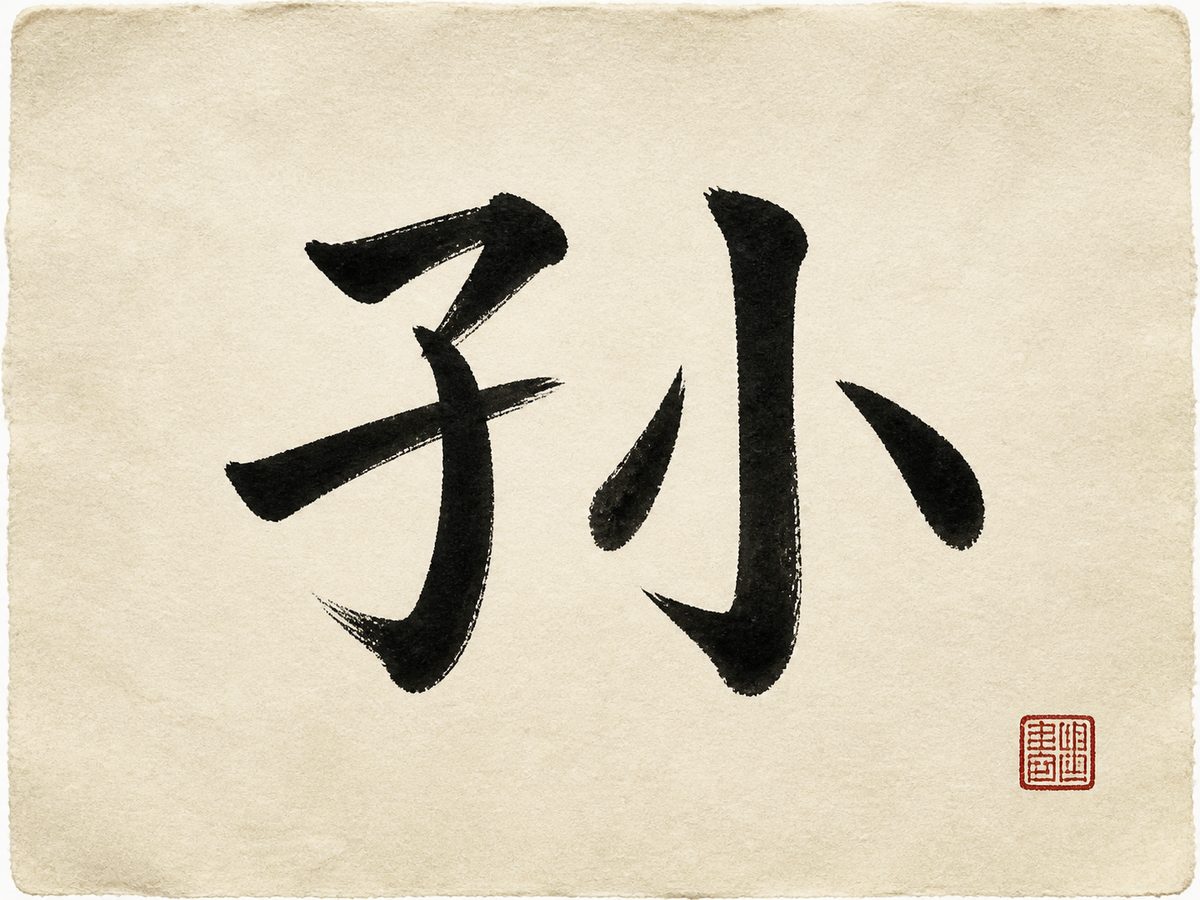
The surname that means grandson
Most Chinese surnames stopped meaning anything a very long time ago. They are places nobody can find, states that fell, offices nobody holds. Ask a Chinese speaker what their surname means and the usual honest answer is that it does not mean anything, it is just the name.
Sun is not like that. Sun means grandson. It means grandson in the dictionary, it means grandson in conversation, and it meant grandson when the first Chinese dictionary got to it around 100 CE. The Shuowen Jiezi disposes of the character in five words: the child of a child is called sun. Then it does something better, and takes the graph apart. On the left, 子, the character for child. On the right, in the older form of the name, 系, the character for a thread. And Xu Shen adds a three-word gloss on that second piece, in case you missed the point: thread means to continue.
So the character is a picture of a child with the line running on through them. Not a child, but a child considered as the next link. It is a startlingly abstract idea to find drawn in a graph that old, and it is sitting in the passport of eighteen million people.
You meet it constantly once you notice. The ordinary Chinese word for descendants is children-and-grandchildren. To call somebody your grandson in the wrong tone is a solid northern insult, and zhuāng sūnzi, to play the grandson, means to grovel, to make yourself small in front of someone with power over you. Nobody in China named Sun spends much time thinking about this, in the way that nobody named Baker thinks about bread. But it is right there.
Grandson's Art of War
Here is where it gets genuinely funny, and it is a thing English readers almost never get told.
Sun Tzu is not a name. Sunzi, to give it the modern spelling, is a title: Master Sun. Chinese does this to all its philosophers. Kongzi is Master Kong, which Latin turned into Confucius; Laozi is Old Master; Mengzi became Mencius. The man behind The Art of War is recorded as Sun Wu, courtesy name Changqing, from the state of Qi.
But the two characters that spell Master Sun are also the two characters that spell grandson. Identical, in that order. The only difference is a tone: the philosopher's title takes a full third tone on the second syllable, the kinship word lets it go slack and unstressed. In writing there is no difference at all. The most influential book on strategy ever composed is titled, on its cover, with a word that a Chinese six-year-old reads as grandson.
And the man may not have existed. This is not a modern Western doubt; the Chinese got there first, in the twelfth century, when the scholar Ye Shi pointed out that the Zuo Zhuan narrates the period in exhausting detail and has never heard of him. No surviving text mentions Sun Wu before Sima Qian's Records of the Grand Historian, three hundred years after he was supposed to have lived. The book contains equipment and tactics that look too late for his dates. The honest position is that somebody wrote a masterpiece and the tradition attached a name to it, and the name it chose was Master Grandson.
How the Monkey King got this name
The other famous bearer is not a person at all, and the way he was given the name is the best small joke in Chinese literature.
In the first chapter of Journey to the West, the stone monkey finally finds his teacher, the patriarch Subhuti, who has to give him a surname because he was born from a rock and has none. The patriarch looks him over and says, in the standard translation's sense, that although the body is unlovely it resembles a pine-nut-eating macaque, so the name may as well be taken off his own shape.
The word for macaque is written with two characters, and both of them carry the beast radical, the little marker Chinese puts on the left of an animal word. So Subhuti tries stripping the radical off, one character at a time, like a man checking two keys.
Take the beast radical off the first and what is left reads as old plus moon. Old is age, the patriarch says, and the moon is the female principle, and aged yin can neither bear nor nurture. Rejected. Then he tries the second character, 猻. Strip its beast radical and the remainder is 子 and 系, child and thread, the same two pieces the dictionary had found in the surname. Child means a boy, he says, and thread means the fine and infant thing, which fits exactly the doctrine of the infant. Accepted. The monkey is surnamed Sun.
It is a pun and a theological statement at once. The character the patriarch keeps is the one the Shuowen had already analyzed as child-plus-continuation, and he is choosing it for a creature with no parents and no descendants, on the grounds that the newborn state is the spiritually correct one. Then he adds the religious name Wukong, awakened to emptiness, and the most famous character in Chinese fiction is complete. If you want the rest of him, the Monkey King has his own page here, stone egg and all.
Third word in the book every Chinese child memorized
Chinese children have been learning their characters off the Hundred Family Surnames for about a thousand years, a Song-dynasty rhyming list with no meaning whatsoever, just names in fours. It opens: Zhao, Qian, Sun, Li. Sun is the third word in it.
Why those four has an answer, and it is wonderfully petty. The Song scholar Wang Mingqing worked it out in his notebook and it comes down to who was in the room. Zhao is the surname of the reigning Song emperors, so it goes first. Qian is the surname of the kings of Wuyue, the wealthy little coastal kingdom where the list was almost certainly written. Sun, third, is the surname of the principal consort of the Wuyue king Qian Chu. Li, fourth, belongs to the rival kings of Southern Tang next door.
Then the second line, Zhou, Wu, Zheng, Wang, and Wang Mingqing says flatly that these are the consorts of the Wuyue house from King Wusu onward. So the opening eight words of the book that taught China to read are a court seating plan: the emperor, the local king, his queen, the neighboring king, and then four more royal wives. Three of those queens have their own pages here, at Zhou, Wu and Wang.
Where the name actually comes from
The kinship meaning is not why anyone is called this. Surnames in China almost never come from what the character means, and Sun arrived by at least three separate routes that later pooled.
One branch descends from the ducal house of Wei. Duke Wu had a son whose style name was Hui Sun, and it was that son's grandson who took the second half of it as a family name, which is exactly how a great many Chinese surnames were made: you are called after something your grandfather was called. One comes out of the southern state of Chu, from the minister Sunshu Ao, whose descendants kept the first part of his style name in the same way. The third is the militarily interesting one. An officer of Qi named Sun Shu was granted the surname outright by Duke Jing of Qi for his part in a campaign against the small neighboring state of Ju, along with a fief at Le'an. Sun Wu, the man who may or may not have written The Art of War, is placed in that line.
There is a fourth story and it comes with a warning label. Han-dynasty texts sometimes call the philosopher Xunzi by the name Sun Qing instead, and the traditional explanation, credited to the Tang commentator Yan Shigu, is name taboo: the Han emperor Xuan was personally named Xun, and a subject could not write the emperor's name, so the philosopher's surname was quietly swapped for the homophone. Tidy, and repeated everywhere.
It has also been under attack since the seventeenth century. Gu Yanwu, who transmitted the taboo explanation in the first place, thought the two names were simply a sound shift and cited parallel pairs. Others have argued the two were interchangeable surnames from one ancestor, or that Sun was the original and Sima Qian wrote the other from a regional pronunciation. The current careful answer is narrower and rather good: the swap looks like the work of one editor, Liu Xiang, at the moment he prepared his edition of the Xunzi for imperial eyes, which is exactly when the taboo would bite hardest. Either way, no page in English about this surname tells you the story is contested. It is.
One man, four names
The most famous modern bearer is a small masterclass in why Chinese names confuse English speakers, and worth a minute because it explains a puzzle a lot of readers have quietly carried.
The founder of the Republic of China was registered in the family genealogy as Sun Deming. A schoolteacher gave him Sun Wen, which he used for most of his life and which is what a Chinese formal document will call him. His courtesy name was Zaizhi. At school in Hong Kong he took the art name Yixian, and because Hong Kong is Cantonese-speaking, an English clerk wrote that down the way it sounded there: Yat-sen. Later, hiding in Japan, a friend gave him a Japanese alias, Nakayama, which means central mountain. Chinese readers pronounced those characters their own way, Zhongshan, liked it, and it stuck.
Which is why the English-speaking world says Sun Yat-sen and the Chinese-speaking world says Sun Zhongshan and both are talking about a man whose name was Sun Wen. Cities, universities and a warship are named after the Japanese alias. Nobody planned any of it.
The other bearers are a decent haul: Sun Quan, who founded one of the Three Kingdoms and spends most of Romance of the Three Kingdoms being underestimated; Sun Yang, the swimmer; and Masayoshi Son of SoftBank, whose Korean family reads the same character their own way. If you want to see what a Chinese name is actually built from, sound and meaning at once, our name builder will put one together from yours.
A word for grandson, a queen's surname, a book that is not by anyone, and a monkey. Six strokes.