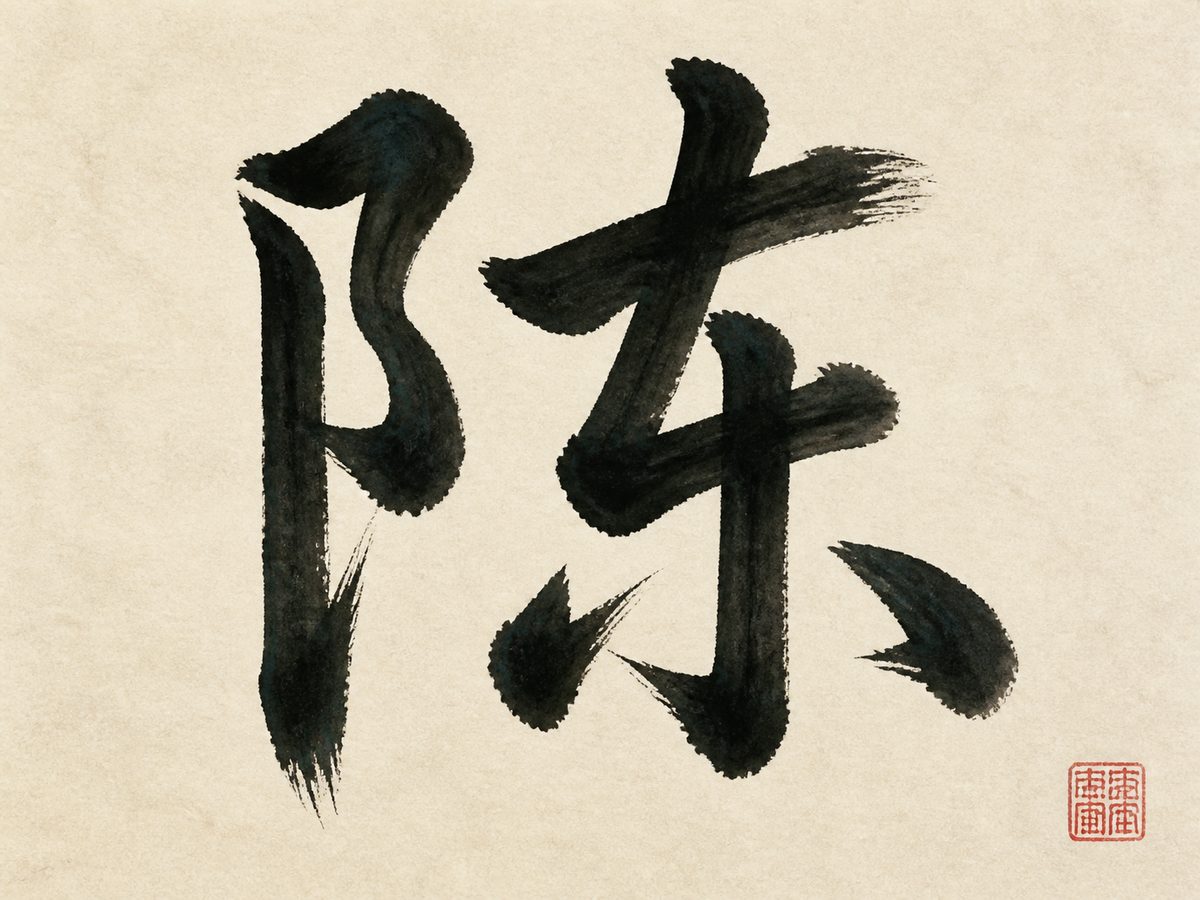
"Chen and Lin fill half the world"
Fujian has a proverb about itself: Chen Lin ban tianxia, "Chen and Lin fill half the world," sometimes extended with "and Huang and Zheng line every street." It is barely an exaggeration. Fujian Daily, the province's own paper, counts Chen, Lin, and Huang at 25.41 percent of Fujian's population: one resident in four carries one of three names. Lin, the other half of the proverb, spells itself Lam and Lim depending on which of those ports its families left from.
Cross the strait and the proverb crossed too. Taiwan counts roughly 2.5 million Chens, first place by a wide margin, because Taiwan's Han population overwhelmingly descends from Fujian migrants of the last four centuries. The surname table of Taiwan is, in effect, a passenger manifest of that migration. The same wave carried the name into Southeast Asia's ports as Tan, which is why the founder of Singapore's business establishment and of Xiamen University was a Jimei-born rubber magnate named Tan Kah Kee: at home, 陈嘉庚, a Chen of the Fujian coast.
The kingdom the name comes from
Sima Qian's Records of the Grand Historian, China's founding work of history, opens its chapter on the ruling house: "Hu Gong Man of Chen was a descendant of the sage-emperor Shun." When King Wu of Zhou overthrew the Shang around 1046 BC, the historian records, he sought out Shun's descendants, found a man named Gui Man, and enfeoffed him at Chen, in today's Huaiyang, Henan, so that the sacrifices to Shun would continue. A small state with a grand pedigree: its job, in effect, was to be a living memorial.
The state lasted five and a half centuries and fell to its huge southern neighbor Chu in 479 BC. Sima Qian marks the moment with a one-line aside that gives the date its weight: "That year, Confucius died." The kingdom and the sage went out together, and the people of Chen did what conquered peoples across Zhou China did: they kept their country as their name. Every Chen, Chan, Tan, and Trần is, on paper, a citizen of a state that has not existed since the fifth century BC.
The character itself is built from the "mound" radical (the narrow 阝 on the left, marking things to do with earthworks and high ground) plus the phonetic 东. As an ordinary word, chén means "to lay out, to display" (as in chénliè, a museum display), "to state" (chénshù, to give an account), and "old, aged" (chénnián, of wine and grievances). Pleasant meanings to have next door, but the surname does not descend from any of them. It is an address, not an adjective.
Because Chinese is crowded with surnames that sound alike, there is a standard way to say which chén you are, and it is built from those same components: a Chen introduces the name aloud as ěr dōng Chén, "ear-east Chen," naming the ear-shaped mound radical and the 东 beside it. The formula comes from the Surname Song (Xingshi Ge), a rhyme printed in China's first-grade textbooks that teaches children to spell the great surnames by their parts. Every Chen has recited it; most Chens have said "ear-east" a thousand times without once thinking about the Bronze Age earthworks the ear actually is.
Six lives of the name
A name carried by seventy million people accumulates history the way a harbor accumulates ships. Six episodes, each verified against the sources below, show its range.
The prince who became a Tian
In 672 BC, a succession bloodbath in Chen sent a prince named Chen Wan running. "Wan feared the trouble would reach him," Sima Qian writes, "and fled to Qi," the great state to the northeast, whose ruler Duke Huan gave him a post as master of works. His descendants quietly changed the family name to Tian, and the Tian family rose in Qi generation after generation until, centuries later, it supplied the state's ruling house. It is the surname world's version of a witness-protection success story, and it is why Chinese genealogists treat Chen and Tian as one family wearing two names. The story has a third act: when Qin swept the Tian kings away, their survivors renamed themselves once more, this time as Wang.
The laborer who questioned kings
In 209 BC, a farmhand-turned-conscript named Chen Sheng, marooned by floods on the way to a garrison posting where lateness meant death, decided he might as well die for something larger. His recorded words became one of the most dangerous sentences in Chinese: "Are kings and nobles born to their kind?" (wáng hóu jiàng xiàng nìng yǒu zhǒng hū). He had already supplied his own answer years earlier, laughing at a fellow field hand: "How could a sparrow understand the ambitions of a wild swan?" His uprising, the first commoner revolt in imperial history, cracked the Qin dynasty within months. A man named for a fallen kingdom taught China that dynasties, too, can fall.
The gentleman on the beam
The Chens' most storied branch is the clan of Yingchuan, in Henan, and its patriarch Chen Shi, a Han dynasty magistrate famous for judging people gently. The Book of the Later Han tells the story: in a famine year a burglar slipped into his house at night and hid on a roof beam. Chen Shi saw him, said nothing, called in his sons, and delivered a lecture: people are not born bad, he explained, they practice a habit until it hardens into nature, "like our gentleman up on the beam." The thief, says the text, was so shocked he threw himself to the floor and confessed. Two thousand years on, "gentleman on the beam" (liángshàng jūnzǐ) is still the standard literary Chinese for a burglar. Chen Shi got the rarest thing a moralist can get: a punchline that outlived the dynasty.
The village that taught the world to slow down
If you have ever watched people move through slow, circling forms in a park at dawn, you have watched the Chen family's export. Tai chi's oldest known style is Chen-style, born in Chen Village (Chenjiagou, "Chen Family Creek") in Wen County, Henan, where the clan settled in the thirteenth or fourteenth century and built a reputation for martial skill. Family tradition credits Chen Wangting, a ninth-generation village leader of the late 1500s, with codifying the practice into set routines, and for centuries afterward the art stayed deliberately in-house: it was not taught outside the Chen village world until 1928. The great exception proves the rule. One outsider, Yang Luchan, was accepted as a student, and his offshoot became Yang-style, the version most of the world now practices. Which means that nearly every tai chi lineage on earth, whatever its name, is downstream of one Henan village full of Chens.
The general who put the name on a dynasty
In 557 AD, a southern general named Chen Baxian seized a collapsing throne and did something with his surname that no Wang or Li ever managed: he made it the name of the state. The Chen dynasty ruled south China until 589, which means that for three decades "Chen" was simultaneously a family, an empire, and an address, the surname's old trick of being a place, performed in reverse. The dynasty lasted barely three decades, but the name joined the imperial list, and a surname can retire on that.
The family that took a throne abroad
Early in the twelfth century, a Chen named Trần Kinh emigrated from Fujian south to Đại Việt, Vietnam. His descendants prospered, married into the royal family, and in 1225 maneuvered a twelve-year-old of their own line onto the throne. The Trần dynasty ruled Vietnam for 175 years, and earned its keep: it repelled three Mongol invasions, in 1257, the 1280s, and finally at the Bạch Đằng River in 1288, one of the very few polities anywhere to stop the Mongols three times. A family from the Fujian coast, a century off the boat. Emigrant ambition has rarely compounded better.
If you carry the name
A surname is the half of a Chinese name you inherit; the given name is the half somebody chose, for its sound, its meaning, and how it sits beside the family character. If you are a Chen, Chan, or Tan reconnecting with the written form, or choosing a Chinese given name to go with it, our name generator builds real two- and three-character names the way Chinese parents do. And the character itself, in seal script or running hand, is a beautiful thing to see written: the calligraphy tool renders 陈 in six scripts, free.