Say it first
The most-read result for this name in English is currently a forum thread in which people ask each other how they feel about having it, which tells you that the genealogy databases are answering a question nobody is asking. The question people are actually asking is how to say it without embarrassment. So.
One syllable. Rhymes with cow. Not two syllables, not gay-oh, and not the first half of gaol. Say the g as in go, then run straight into the vowel of now, and hold the whole thing high and flat, the way you would hum a single note. That flatness is the first tone, and it is the part English speakers skip, because English uses pitch for emotion and Chinese uses it for meaning.
In Hong Kong the same character is spelled Ko and the vowel rounds off toward the o of more. In Taiwan it is spelled Kao and sounds exactly like Gao, because Wade-Giles simply used a k where pinyin uses a g. In Vietnam it is Cao. In Korea it is Ko, Koh or Go.
And one thing it is not: the Malian city of Gao, on the Niger, once the capital of the Songhai Empire, which shares three letters with this surname and absolutely nothing else. It is a persistent contaminant in search results and it has no business here.
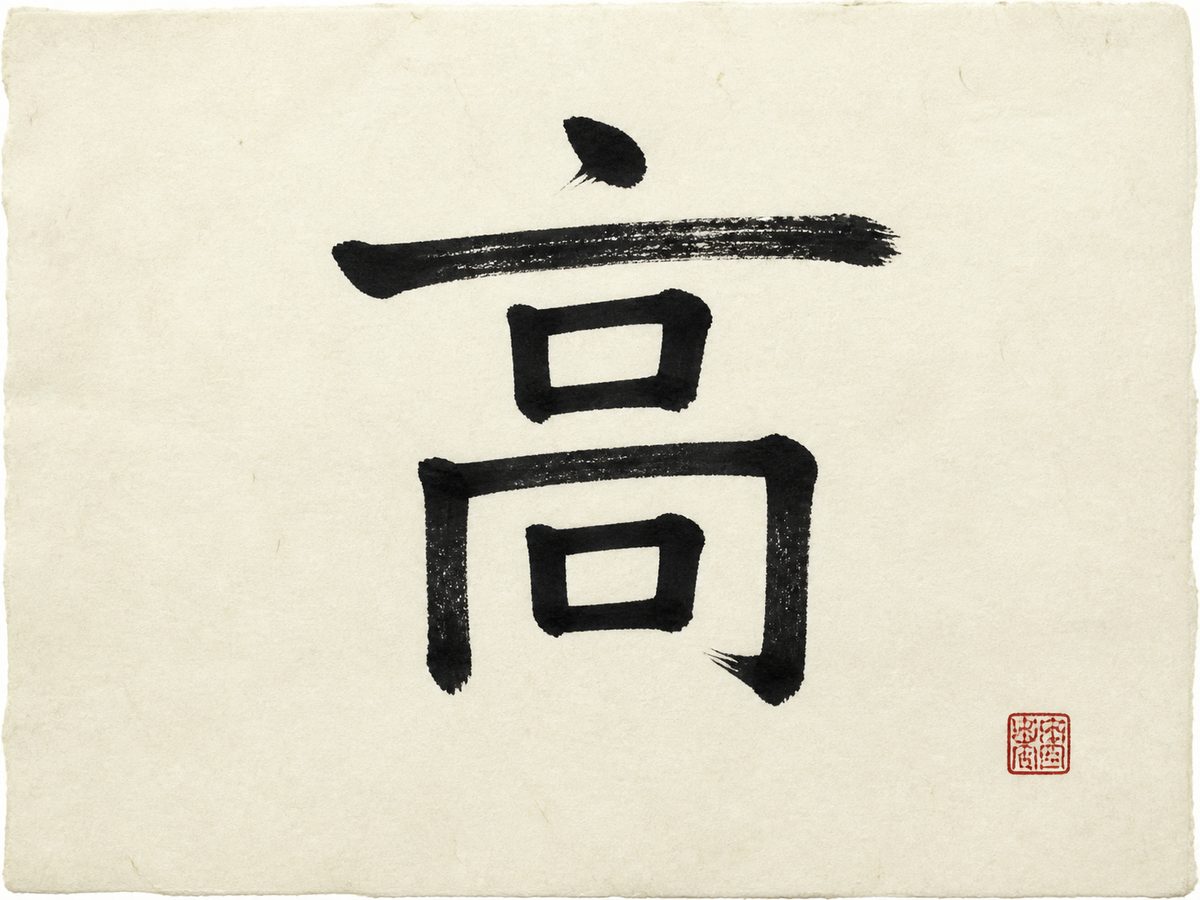
A character that is a building
Now the character itself, which is unusual.
Chinese surname characters are mostly plants, animals, places, or old titles. This one is architecture. The Shuowen Jiezi, the first systematic Chinese dictionary, compiled around 100 CE, glosses it as lofty and then says the shape depicts a tall terrace or tower. And then it does something quietly clever: it groups this character with the ones for granary and for lodging, on the grounds that all three are constructed on the same principle, as pictures of buildings seen from outside.
Look at the modern form and it still stands up. Four floors on one axis. A dot and a long horizontal across the top, which is the roof and its finial. A small closed box below, which is a window. A wide frame open along its bottom edge, which is the body of the structure. And inside that frame, another small box: a second window, lower down.
Two windows, stacked. That is what makes it tall. A single-story building does not need a window above a window.
It is the sort of thing you cannot unsee, and it is a useful mnemonic for anybody trying to write the name, though the mnemonic is mine and the dictionary's claim is the tower.
The man who made a hegemon
The main line of the surname begins in the state of Qi, on the Shandong peninsula, in the eighth century BCE, with a man whose name is recorded and whose dates are approximately known: Gao Xi, born around 728 BCE, died around 637.
His grandfather was Prince Gao, a son of Duke Wen of Qi, and under the naming conventions of the Zhou aristocracy a branch of the ruling house could establish itself as a separate lineage by taking the grandfather's name as its clan name. That is what happened. The surname is a grandson's decision, made about 2,700 years ago.
Gao Xi himself rose to be senior minister of Qi, and at the succession crisis he backed a prince called Xiaobai. Xiaobai won, took the throne, and is known to history as Duke Huan of Qi, the first of the great hegemons of the Spring and Autumn period, the man who assembled the other rulers under his leadership while the Zhou king looked on and did nothing. Gao Xi is counted the founding ancestor of the Bohai Gao, the branch that most Gao genealogies eventually run back to.
There is a small pleasure in this that is worth pointing out. Duke Huan of Qi shows up on this site twice in the same week. He is also the ruler who, riding past an abandoned town, asked whose it was and got the answer that ended up as a dictionary entry, which is the story on the Guo surname page. Two of the surnames published here on the same day meet at the same duke.
The tradition also names a much older figure, Gao Yuan, credited with building dwellings in high antiquity, as the earliest person to carry the name. That is legend rather than record, and it belongs in the same category as every other pre-dynastic origin story: repeated everywhere, verifiable nowhere.
How this character became the word Korea
Here is the claim on this page most worth carrying away.
The English word Korea is an exonym. It does not come from anything Koreans call their country today. It comes from Goryeo, the dynasty that ruled the peninsula from the tenth century to the fourteenth, whose name reached Europe through traders and travelers and came out, in Marco Polo's Italian, as Cauli. From there it drifted into Corea, then Korea.
And Goryeo was itself a shortened form of Goguryeo, the older northern kingdom, first abbreviated that way in the fifth century under King Jangsu. The first syllable of Goguryeo is this character.
Which means that a reader whose family name is Gao, or Kao, or Ko, is carrying around the first syllable of a country's name in a language neither of them speaks.
The Korean branch of the name is substantial in its own right. The largest clan is the Jeju Ko, which counted 325,950 members in 100,954 households at the 2000 census, and which claims descent from Go Eul-na, the first ruler of Tamna, the kingdom that governed Jeju Island until Joseon absorbed it. Other Ko clans point instead at the royal house of Goguryeo; the Hoengseong Ko genealogy names King Dongmyeong as a direct ancestor.
Now the honest part, which most pages skip. Whether the Korean Ko families and the Chinese Gao families are one lineage that separated, or two unrelated families that ended up writing themselves with the same character, is not settled. The English reference literature says the Korean origins remain debated among scholars, and that is the correct thing to report. Shared characters across East Asia sometimes mean shared descent and sometimes mean two peoples reaching for the same obvious word, and the honest answer here is that we do not know which this is.
Where you meet it every day
Unlike most surname characters, this one is in constant use as an ordinary word, and a reader who learns it gets four other words free.
Gāokǎo is the national university entrance examination, and it is not really translatable, because no English-speaking country has an exam that decides quite so much. Two days in June, one set of scores, and the shape of a life. Whole years of Chinese adolescence are organized around it.
Gāotiě is the high-speed rail, forty thousand kilometers of it, and the word is now shorthand for the way distances in China have quietly collapsed.
Gāoshǒu, high hand, is a master or an expert, and it carries a whiff of martial-arts novels even when someone is using it about a spreadsheet.
And gāoxìng, the ordinary everyday word for happy or pleased, is literally high spirits. The word an English speaker reaches for when a mood lifts is the same word a Chinese speaker reaches for, arrived at separately, which happens more often between languages than you would expect and is always slightly startling.
The people
Gao Shi was a Tang poet of the frontier school, a man who wrote about garrisons and cold and the specific boredom of soldiering, and who unusually for a Tang poet also had a successful official career.
Gao Lishi was the most powerful eunuch of Xuanzong's court, and features in one of the great anecdotes of Chinese literature, in which the poet Li Bai, having been summoned to write verses while extremely drunk, makes Gao Lishi pull his boots off. Whether it happened is anybody's guess. It has been repeated for twelve hundred years, which is its own kind of achievement.
Gao Xingjian won the Nobel Prize in Literature in 2000, for novels and plays written in Chinese, from exile in Paris.
And in Korea the name is Ko, and on Jeju Island it is one of the three founding clans of the place, which is a considerably better origin story than most families get.
If you want to know what your own name would look like built the Chinese way, from sound and meaning at the same time, our name builder will put one together.
Ten strokes, two windows, seventeen million people, and a country named after the first syllable.