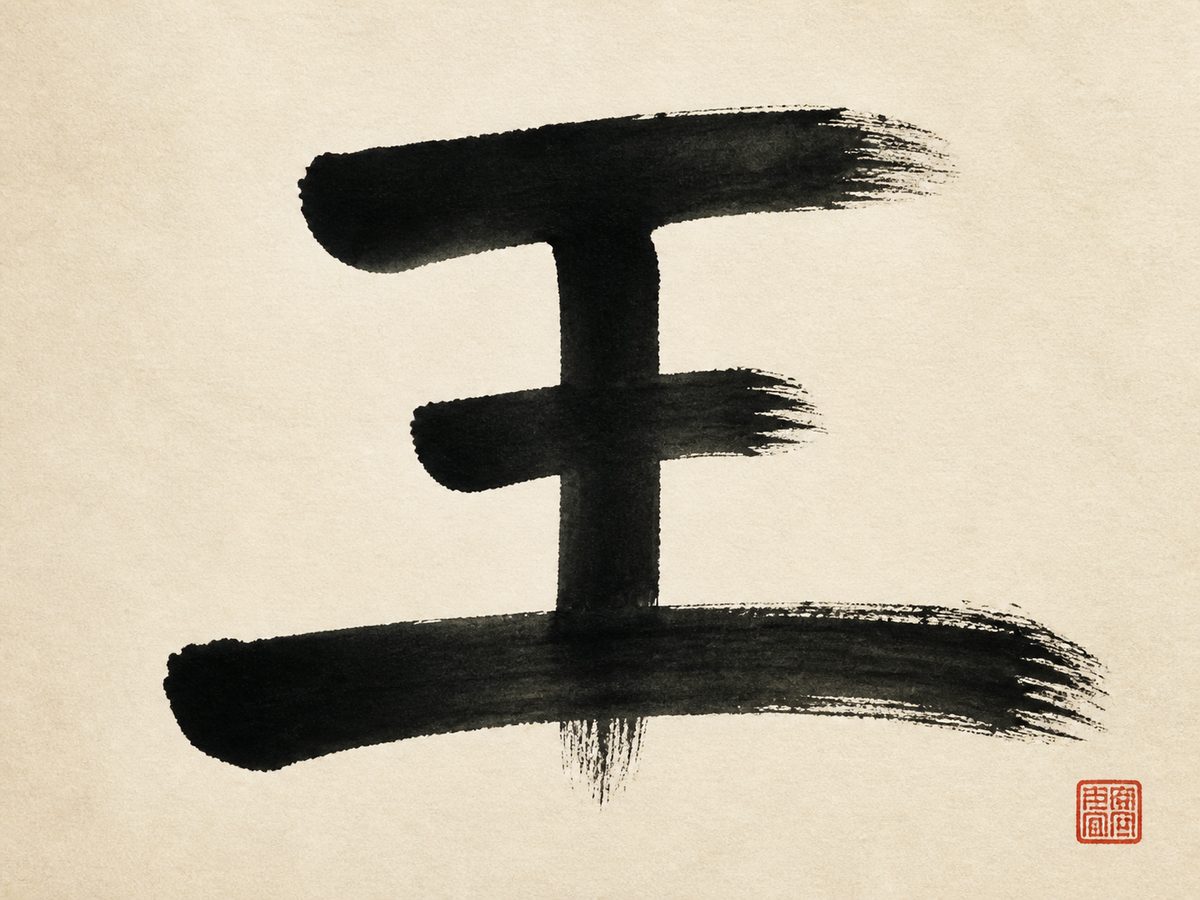
An axe, dressed up as a philosophy lesson
The classical reading of the character is lovely: three horizontal strokes for heaven, humanity, and earth, joined by the one vertical line, the king, who connects all three. Confucian scholars taught it that way for two thousand years, and it is the version you will still hear in classrooms.
The oracle bones tell a blunter story. The earliest forms of 王 depict a ceremonial axe head, likely of jade: the executioner's tool as the emblem of the man entitled to use it. Modern scholarship, as Wiktionary's etymology notes, treats the heaven-earth-man reading as folk etymology, beautiful and backdated. Kingship, in the original glyph, is not a cosmic connection. It is the axe.
Seven lives of the name
Ninety million people accumulate a lot of history. Seven episodes, each traceable in the sources below, show what the name has been through.
The kings who lost their thrones
Wang is not one family; it is a convergence of dethroned ones. One line descends from Bi Gan, the Shang royal uncle martyred for criticizing the last Shang king. Another from Prince Jin, a crown prince of Zhou who never reigned; his descendants wrote "royal" into their name instead. A third comes from the Tian family, who ruled the great state of Qi until Qin's unification swept them away, after which the survivors renamed themselves Wang: of-the-kings. If that family sounds familiar, it should. The Tians began as refugees from the state of Chen, as told on our Chen page, which means one bloodline has now worn three of China's biggest surnames: Chen, then Tian, then Wang. Each renaming marked a fall, and each fall multiplied the name.
The clan that split an empire with its emperor
The name's aristocratic peak has its own proverb. When the Jin court fled south in 317 and refounded itself at Jiankang, today's Nanjing, the man who organized the rescue was Wang Dao of the Langya Wang clan, and the clan's power beside the throne was summarized in six characters: the realm is jointly ruled by the Wang and the Sima, the Simas being the imperial family itself. A non-royal surname sharing top billing with the dynasty in a common saying is as high as a Chinese family name ever climbed. The Langya Wangs lived, along with their rival-and-partner clan the Xies, on Wuyi Lane, "Black Robe Lane," by Nanjing's Qinhuai River; four centuries later the Tang poet Liu Yuxi built one of the most famous quatrains in the language around the swallows that once nested in the halls of Wang and Xie and now flew into ordinary homes. Readers of our Vermilion Bird page have met that poem's neighborhood already; the Wang of its most quoted line is this clan. Aristocracy faded, the swallows moved, and the surname did what the poem says: it went to live with everyone.
The calligrapher no one could copy, including himself
The most revered hand in the history of Chinese writing belonged to a son of that same Langya clan: Wang Xizhi (303-361), nephew of Wang Dao and the "Sage of Calligraphy." On an April day in 353 he hosted a party at the Orchid Pavilion: cups of wine floated down a winding stream, and any guest a cup stopped beside had to produce a poem. Wang wrote the gathering's preface on the spot, slightly drunk, and the result, the Lantingji Xu, became the most celebrated piece of calligraphy of all time. The Tang emperor Taizong collected two thousand of his works and loved the Preface so much he had the original buried with him. Not one authentic Wang Xizhi survives today; every version on earth is a tracing of a tracing. The greatest work of Chinese calligraphy exists the way a legend does: entirely in copies.
The Wang who took the throne back
Only one man made the surname literal. Wang Mang (45 BC to AD 23), nephew of a Han empress, rose from regent to usurper and in AD 9 declared his own dynasty, the Xin. He then governed like a radical: abolishing slavery, redistributing land, issuing twenty-eight kinds of currency, an ancient reformer or an ancient tyrant depending on which historian you read. The experiment lasted fourteen years. Rebels stormed the capital in AD 23; his head was delivered to the restored Han court, and his dynasty became the hinge that splits the Western Han from the Eastern. The one Wang who reclaimed the throne is the reason Chinese historians treat the name's usual strategy, keeping "king" safely in the surname slot, as the wiser one.
The philosopher who fought his own battles
The name's greatest mind may be Wang Yangming (1472-1529), commonly ranked the most important Neo-Confucian thinker after Zhu Xi. His signature doctrine sounds simple and lands hard: knowledge and action are one thing, and a person who "knows" what is right but does not do it does not actually know it. Every person, he taught, is born already knowing good from evil; the work is acting on it. He then tested the theory on himself in the least academic way available: as a general, he put down a string of revolts, and in 1519 crushed the rebellion of the Prince of Ning, along the way leaving one of China's earliest battlefield accounts of an imported Portuguese cannon. His teaching went on to shape samurai ethics in Japan. Philosophy professors who also win wars are rare in any civilization; the Wangs can claim the canonical one.
The court lady who ended a war
The most consequential Wang may be a woman the emperor never looked at. In 33 BC the Xiongnu ruler Huhanye asked to seal peace with the Han by marriage, and a palace lady named Wang Zhaojun volunteered for the far-northern match no princess wanted. The legend attached to her, told as legend, blames a portrait: court painter Mao Yanshou, denied a bribe, painted her plain, so the emperor assigned her sight unseen and discovered at the farewell audience that he had given away the most beautiful woman in his palace. She rode north anyway, the peace held, and China counted her among its Four Beauties, the one whose pipa playing was said to make passing geese forget to flap and fall from the sky. Some 1,500 years of poets, about seven hundred poems by one count, have kept her on the road north ever since.
The royal Wangs who hid inside other names
In Korea the surname went the other direction: up onto a throne, then nearly out of existence. Wang Geon founded the Goryeo dynasty in 918, and for almost five centuries Wang (왕) was the royal surname of Korea, the dynasty that gave the country its English name. When Goryeo fell to the Joseon in 1392, bearing the royal name became dangerous; tradition holds that many Wangs escaped persecution by changing their surname, hiding inside characters like Jeon (田) and Ok (玉). Look closely at that last one: 玉, "jade," is 王 with a single dot added. A royal house survived by adding one brushstroke. Korea's 2000 census counted just 23,447 Wangs in the whole country, the small remainder of a name that once owned it. And the dynasty that drove them into hiding? It was surnamed Li.
If you carry the name
A surname is the inherited half of a Chinese name; the given name is the chosen half, picked for sound, meaning, and how it sits beside the family character. If you are a Wang, Wong, or Ong choosing a Chinese given name, our name generator builds real ones the way Chinese parents do. And four strokes have rarely looked better in a brush hand: the calligraphy tool renders 王 in six scripts, free.