Three different Luos, and only one of them is this one
Before anything else, some sorting, because this spelling is doing three jobs at once and Google cheerfully returns all of them together.
The East African Luo. About five million people in western Kenya and northern Tanzania, a Western Nilotic people who speak Dholuo, the fourth-largest ethnic group in Kenya at roughly a tenth of the population. Barack Obama's father was one. So is Lupita Nyong'o. They are not Chinese, the name is not a Chinese surname, and the identical spelling is pure coincidence between two languages that never met. If that is who you came looking for, you are on the wrong page and I would rather say so on the first line than bury it.
The other Chinese Luo. There is a second Chinese surname that pinyin also spells Luo. It is said on the falling fourth tone rather than the rising second, it is written 骆, and in archaic Chinese it meant a white horse with a black mane. It ranks 163rd, with something under a million bearers. Wikipedia gives it its own page and ranks that page in the results for this one, which should tell you how often the two get muddled.
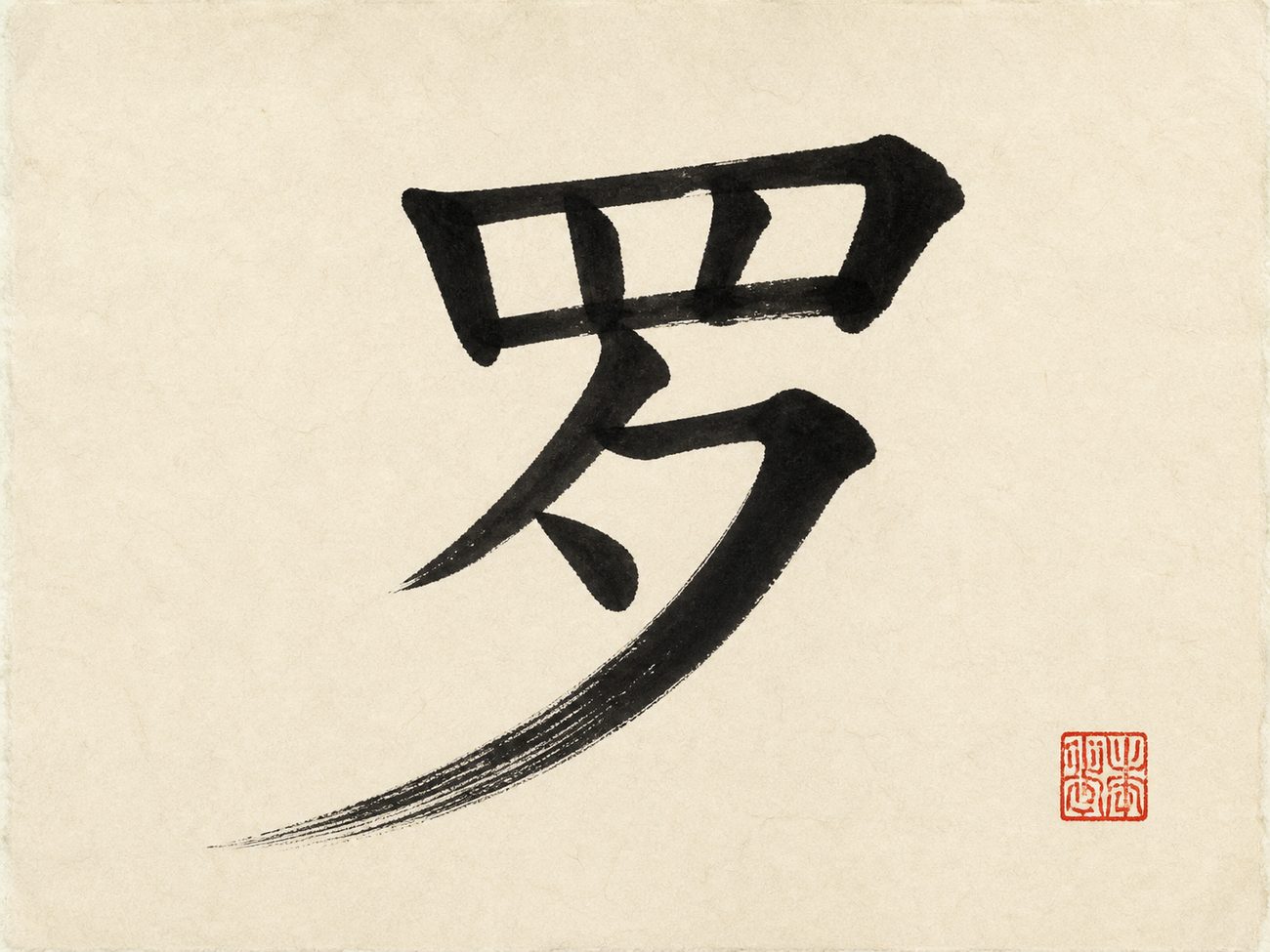
And this one. 罗, second tone, twentieth most common surname in mainland China as of 2019, around fourteen million people. Say it in one syllable, with the vowel of more and without the r, and let your voice rise through it like a short question. In Hong Kong it is spelled Law and sounds close to the English word, which is how that spelling was arrived at and why so many Laws get asked whether they went into the family business.
The character is a net for catching birds
Now the interesting part, which none of the genealogy databases bother with.
The Shuowen Jiezi, the first systematic Chinese dictionary, compiled around 100 CE, defines this character in six characters of its own: a silk net for birds. Not a net in general, not a fishing net. A net made of silk thread, for taking birds. It then analyzes the graph as being built from net plus silk cord, and finishes with a line that is very much in the Shuowen's manner, noting that in antiquity a man called Mang was the first to make one. Chinese dictionaries of that era liked to name an inventor, and were rarely troubled by whether he had existed.
The traditional form, 羅, is the picture intact. Along the top, the net. Underneath it, on the left, the silk-thread radical; on the right, the element for a short-tailed bird. Net, thread, bird. You could hardly ask a character to be more explicit about what it is for.
The simplified form kept the net and threw the rest away. Eight strokes now: the flat three-compartment frame along the top, and under it a three-stroke element with one dot in it and a long sweeping tail. The thread is gone and the bird is gone. What is left is the trap.
The emptiest doorway in Chinese literature
Here is where a dead etymology turns out not to be dead at all.
Around 91 BCE, Sima Qian finished the Records of the Grand Historian, and closed his chapter on two Han officials with a short bitter aside about how friendship behaves around power. He tells it through a man named Zhai Gong, of Xiagui, who had been Commandant of Justice, one of the nine great offices of state.
While Zhai Gong held the post, Sima Qian writes, the guests jammed his gate. When he was dismissed, outside his door you could have set a net for sparrows.
That is the surname's character, in its literal original sense, doing literal original work. The doorway was so untrafficked that you could have strung a fowling net across it and caught birds in the space where the visitors used to be. It is one of the most efficient images in Chinese prose, and it has never gone out of use: the phrase is still what a Chinese speaker reaches for to describe a restaurant on a bad night or a shop about to close.
The story has a second half that the idiom usually leaves behind. Zhai Gong got the job back. The guests began packing their bags to visit again. And he wrote on his gate:
One death and one life, and you know what friendship is. One poverty and one wealth, and you know how friendship behaves. One high station and one low, and friendship shows its face.
Sima Qian's own comment on all of it is two words long, and translates roughly as how sad. The English rendering above is ours; we have not verified a published translator's wording for this passage and would rather translate it plainly than attach somebody's name to it on a guess.
A state that lost, and moved, and lost again
The main origin story is a defeat.
There was a small state called Luo, in what is now Hubei. The traditional genealogies run its ruling line back to Zhurong, the fire deity of the old myth cycle, through the Mi clan, which makes it a distant cousin of the ruling house of the great southern power of Chu. Treat that the way you would treat any Bronze Age descent claim: it is what the tradition says, not what anyone can demonstrate.
What the record is clearer about is what happened next. In 690 BCE, Chu destroyed it. The survivors were moved once, to the Yangtze gorges, and then moved again, south into the valley of the Miluo River in Hunan. Somewhere in that displacement they stopped being subjects of a state called Luo and became a family called Luo, which is how a great many Chinese surnames were made: not by choosing a name, but by being the last people left holding one.
The geography of the surname today still remembers it. This is a southern and southwestern name. Something like 38 percent of Chinese Luos live in just three provinces, Sichuan, Guangdong and Hunan, with Sichuan alone accounting for about 16 percent. It is common among the Hakka, and common among the Zhuang, Miao and Yi, who are not Han at all. It sits 75th in the Hundred Family Surnames, the rhyming list of names that Chinese children have been memorizing since the tenth century.
Where you meet the net today
The character never retired. It picked up a second career out of the obvious metaphor: a net is a thing that spreads out and catches everything, so the character came to mean arraying, spreading, encompassing.
Wangluo, net-and-net, is the ordinary word for a network, and has been the word for the internet since the internet arrived in China. Every Chinese speaker types this character several times a week without thinking about birds.
Luolie is to set things out in rows. Xing luo qi bu, stars netted and chess pieces placed, describes anything scattered across a landscape in a pattern.
And a luopan is the feng shui compass. Up to forty concentric rings of formulas on a brass or wooden heaven dial, turning on a wooden earth plate, marked not in the four or eight directions of an ordinary compass but in twenty-four, at fifteen degrees each, with a red thread across it for the sightline. Its ancestors are the diviner's boards found in tombs dated between 278 and 209 BCE, and the magnetized needle in the middle was developed for exactly this job before anybody thought to steer a ship with one. If you have ever wondered what the practitioners in our feng shui section are actually holding, that is it, and the first character of its name is this surname.
Two words that are pure sound, borrowed for their pronunciation and meaning nothing: Luoma is Rome, and luohan is the Buddhist arhat, the enlightened disciple you meet in temple halls in sets of eighteen. Neither has anything to do with nets. Chinese has always raided its own characters for their noises when a foreign word turns up.
Two men named Luo
Luo Guanzhong is credited with the Romance of the Three Kingdoms, the historical novel that has done more than any history book to shape how a fifth of humanity pictures the third century. He is also credited with editing Water Margin into the hundred-chapter form we read. Almost everything else about him is contested. His dates are given as somewhere between about 1280 and 1400 depending on whom you ask, his birthplace is claimed by at least two provinces, and one recent argument holds that there were two men of the period with this name, a playwright and a novelist, who have been quietly merged. Moss Roberts translated the novel into English for the University of California Press in 1991, and it runs to four volumes, which gives you a sense of the thing.
Luo Zhenyu matters more to this website than he probably should.
In 1899 a Beijing official named Wang Yirong noticed that the "dragon bones" he had been sold as malaria medicine were covered in an unknown ancient script. He bought up the unground ones. What nobody could establish was where the apothecaries were getting them, and without a findspot the bones were curiosities rather than evidence.
Luo Zhenyu, born 1866, died 1940, is the man who found the field. In 1908 he traced the supply to a site outside the city of Anyang, went there, and turned up thousands more inscribed bones and shells. The place turned out to be the last capital of the Shang, the site the old histories call the Ruins of Yin. He published what he found, and he was among the first scholars to read the script at all; the study he wrote on those inscriptions is still cited.
Every page on this site that says "the oracle-bone form of this character shows..." is standing on that. When our symbol pages reach back past the Shuowen to what the Shang were actually scratching into bone in the second millennium BCE, they can do it because a man named Luo went looking for a hole in the ground in 1908 and found the right one.
If you want to know what your own name would look like built the Chinese way, from sound and meaning at once, our name builder will put one together.
Eight strokes, one net, fourteen million people, and a doorway in a two-thousand-year-old book where the birds came back.