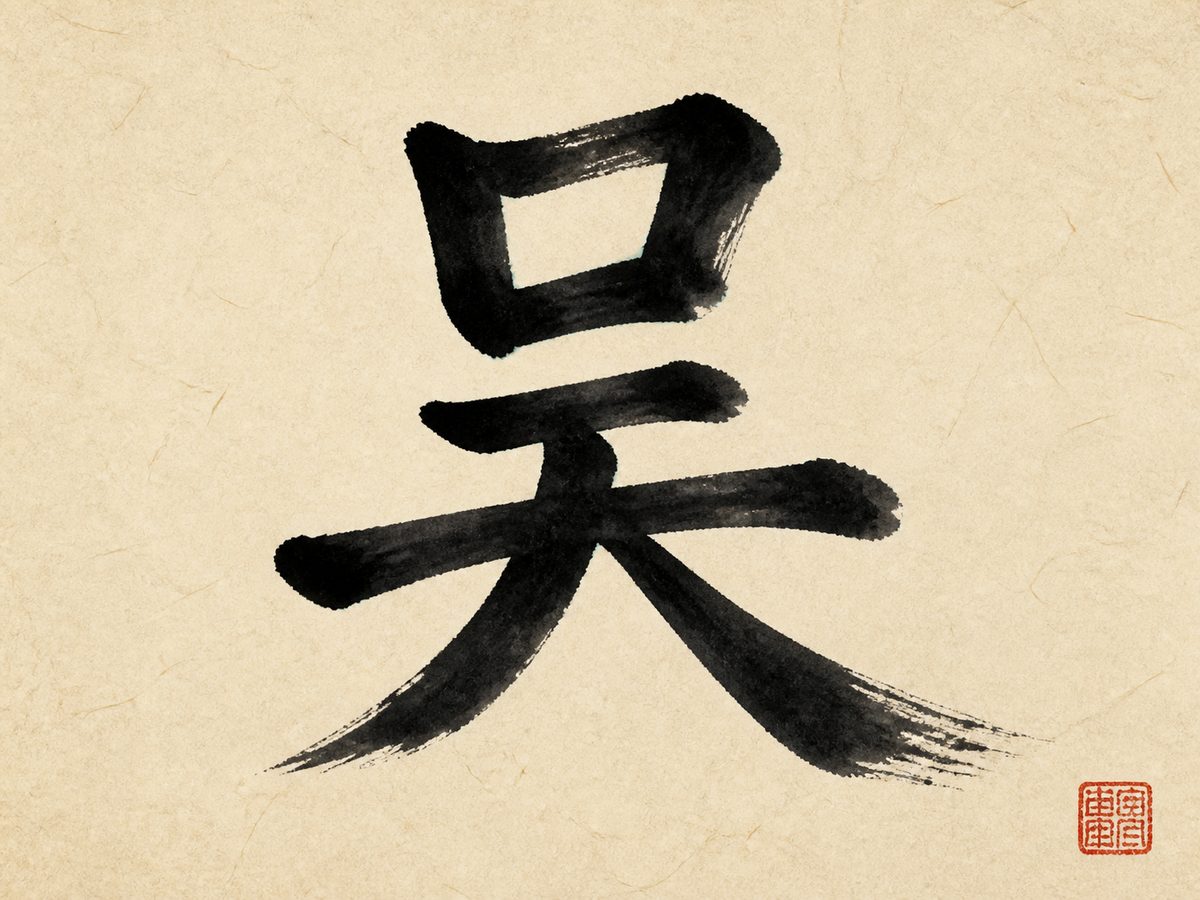
A name with no vowels in it
Ng is not a typo, an abbreviation, or a form somebody filled in wrong. It is a complete Chinese surname, spelled exactly as it sounds, and the reason it looks impossible in English is that English does not believe a consonant can be a syllable on its own. Cantonese does. The sound at the end of "sing" is, in Cantonese, a thing you can say by itself, hold, and give a tone to, and that hum is the whole name.
So the pronunciation is easier than the spelling suggests. Say "sing" and stop before you finish. Now say only the part you stopped on, and let the pitch rise a little, the way an English speaker's voice rises at the end of a question. Done. You have said a name that about two percent of China answers to.
English-speaking countries have spent two centuries failing to write this down. Ng gets pronounced "eng," "ing," or "uhng" by people doing their genuine best, and the surname has sprouted a family of surrender spellings to help them: Ang, Eng, Ing, and Ong in the United States, Ung in Australia. Each one is the same name with a vowel bolted on for the benefit of a clerk. The vowelless original survives anyway, mostly in Hong Kong, and it turns up regularly on lists of English words with no vowels, sandwiched between "hmm" and "tsktsk" as though it were a noise rather than several million people.
Which Ng are you?
Here is where the tidy story ends. Ng is the Cantonese spelling of 吴, and it is also the Cantonese spelling of 伍, an entirely separate surname. Cantonese keeps them apart by tone, the way English keeps "record" the noun apart from "record" the verb, but tone does not survive the trip into Latin letters. Both arrive as Ng.
Hokkien makes it worse, or better, depending on how you feel about your own name being a puzzle. In Hokkien communities across Malaysia and Singapore, Ng is the usual spelling of 黄 (Huang) and sometimes of 阮 (Ruan). Which means a Ng from Kowloon and a Ng from Penang can share a passport spelling, a checkout queue, and absolutely no character at all.
The oldest illustration of the problem is sitting inside this surname's own founding document. The Records of the Grand Historian, the first-century-BC history that gives Wu its earliest account, ends the kingdom of Wu with its last king falling on his sword and saying he regretted not taking Zixu's advice. Zixu is Wu Zixu, the adviser he had forced to kill himself a few years earlier. In English the two men look like relatives. In Chinese the king is a 吴 and the adviser is a 伍, and they were never the same name for a moment.
A third character muddies the English side without touching the Cantonese one: 武, the surname of the empress Wu Zetian, is also spelled Wu and has nothing to do with either. If you are tracing a family, the useful question is never "how do you spell it." It is "which character is it," and the answer is one of the few things every Chinese family reliably knows about itself.
The character is a shout
Open the Shuowen Jiezi, the dictionary Xu Shen finished around 100 CE and the baseline for any question about where a Chinese character came from, and the entry for 吴 does something unusual. It gives the surname first, the district second, and only then, as a third sense, the word's actual meaning: big speech. Duan Yucai, the Qing scholar whose commentary is still the standard companion to the dictionary, glosses that briskly. Big speech, he says, means a racket.
You can see it in the parts. The character is a mouth sitting on top of a figure with its head thrown back and to one side. Read the bronze-inscription form and the picture is a person shouting straight at someone loudly enough that the listener flinches and turns away. Not a word for a place, or a virtue, or a tree. A word for volume.
The modern simplified shape has quietly lost the joke. In 吴 the lower half now looks exactly like the character for sky, which invites the very reasonable and completely wrong reading of "a mouth under heaven." The bottom half is not sky. It is the tilted man, flattened by three thousand years of people writing quickly, and the seven strokes you write today are a picture of somebody yelling.
The prince who refused a kingdom
The kingdom came later, and it came from a refusal.
Sima Qian tells it at the top of chapter 31 of the Records of the Grand Historian, and where he tells it matters as much as what he says. Chapter 31 is the first of the hereditary houses, the section of the history reserved for the great families, and Sima Qian gave the opening slot not to the largest state or the richest but to this one.
The story: Taibo and his brother Zhongyong were the eldest sons of the Zhou king, and by every rule of succession the throne was Taibo's. Their youngest brother Jili had a son named Chang who was obviously, embarrassingly brilliant, and their father wanted the line to run through him. So the two elder brothers left. They went southeast into country the court considered wild, tattooed their bodies and cut their hair in the local style, and by doing so made themselves ritually ineligible to rule anything in the north. It was not a sulk. It was a legal maneuver conducted with a knife. Taibo took the name Gouwu, and Sima Qian records that more than a thousand families thought so well of it that they came over and made him their lord.
Chang grew up to become King Wen, whose son founded the Zhou dynasty. The greatest dynasty of the Chinese classical age exists because two men walked away.
Confucius, five centuries on, gave the verdict that fixed Taibo in the Chinese moral imagination. In the Analects, in the chapter that carries his name, the passage runs in James Legge's translation: "Tai Bo may be said to have reached the highest point of virtuous action. Thrice he declined the kingdom, and the people in ignorance of his motives could not express their approbation of his conduct." The sting is in the second half. He gave up everything and then arranged it so that nobody could even praise him for it.
His kingdom, in the delta around modern Suzhou, lasted until 473 BC, when Yue overran it and its last king killed himself. The name outlived the state by two and a half millennia and then some: 吴 still labels the whole language of the region, Wu Chinese, spoken by around eighty-three million people in Shanghai, Zhejiang, and southern Jiangsu. A prince gave up a throne, and the compensation was a language.
Five lives of the name
Twenty million bearers over three thousand years produce a strange guest list. Here are five, and two of them are opposites.
The painter who walked into the wall
Wu Daozi, who worked in the eighth century and is still called the Sage of Painting, was the most admired brush in the Tang dynasty. Not one of his paintings survives. Everything attributed to him is a later copy or a stone engraving made from his design, so his reputation rests entirely on what people who saw the originals said afterward, which is a peculiar kind of fame. The story they liked best has him finishing a landscape for Emperor Xuanzong, remarking that a spirit lived in the cave he had just painted, clapping his hands, walking into the cave, and vanishing along with the entire mural. It is told as a legend and should be read as one. It is also, as a way of describing what a painter can do to a wall, hard to improve on.
The man who probably wrote Monkey
Journey to the West, the sixteenth-century novel that gave the world the Monkey King, was published anonymously in 1592 and stayed that way for centuries. In the early twentieth century the scholar Hu Shih argued for Wu Cheng'en, a minor official from Huai'an in Jiangsu, on the strength of a 1625 local gazetteer crediting him with something called Journey to the West. Others have pushed back hard, pointing out that the gazetteer never says the something was a novel. Anthony C. Yu, who spent decades producing the standard English translation, put it as carefully as it can be put: Wu is the most likely author, and the authorship remains unclear. Which is worth saying plainly, because a great many pages will tell you flatly that he wrote it. What is not in doubt is the book, and Sun Wukong has outlived every argument about who is responsible for him.
The general who opened the gate
Then there is the mirror image of Taibo. On 22 May 1644, Wu Sangui commanded the Ming garrison at the Shanhai Pass, the fortress where the Great Wall meets the sea and the only convenient door into China from the northeast. Beijing had just fallen to the rebel Li Zicheng, who was holding Wu's family. Wu opened the gate and let the Manchu army through, and the Qing dynasty walked into China behind them. The Qing made him Prince Who Pacifies the West and gave him Yunnan and Guizhou to govern; he rebelled against them in 1673 anyway, declared himself emperor in 1678, and died a few months later with his rebellion collapsing around him. The surname begins with a man who gave away a kingdom to keep faith and includes a man who gave away a kingdom to break it.
The king who shut it again
In 938 a Vietnamese commander named Ngô Quyền, whose surname is this character read in Vietnamese, met a Southern Han invasion fleet at the mouth of the Bạch Đằng river. He had iron-tipped stakes driven into the riverbed at low tide, lured the fleet upstream on the high water, and waited. The falling tide impaled the ships, and hundreds of them burned. The victory ended roughly a thousand years of Chinese rule over Vietnam, begun under the Han in 111 BC, and Ngô Quyền founded a dynasty of his own. One 吴 opened a wall; another closed a river.
The Goh who ran a country
Goh Chok Tong spells the name the Hokkien way, as his parents' generation did in the Minnan region of Fujian before the family sailed south. He was prime minister of Singapore from November 1990 to August 2004, the man who followed Lee Kuan Yew, which is not the easiest fourteen years anyone has ever been handed, and stayed on as Senior Minister until 2011. The spelling is the point here as much as the man: a Goh, an Ng, and a Wu can be three cousins whose grandparents took three different boats.
If you carry the name
The surname is the half of a Chinese name you inherit; the given name is the half somebody chose. If you are an Ng, a Wu, a Goh, or an Ngô picking a Chinese given name to stand beside the family character, our name generator builds real ones the way Chinese parents do, from meaning and sound rather than from a list. And the character itself has been worth looking at since it was a shout scratched into bronze: the calligraphy tool renders 吴 live, free.