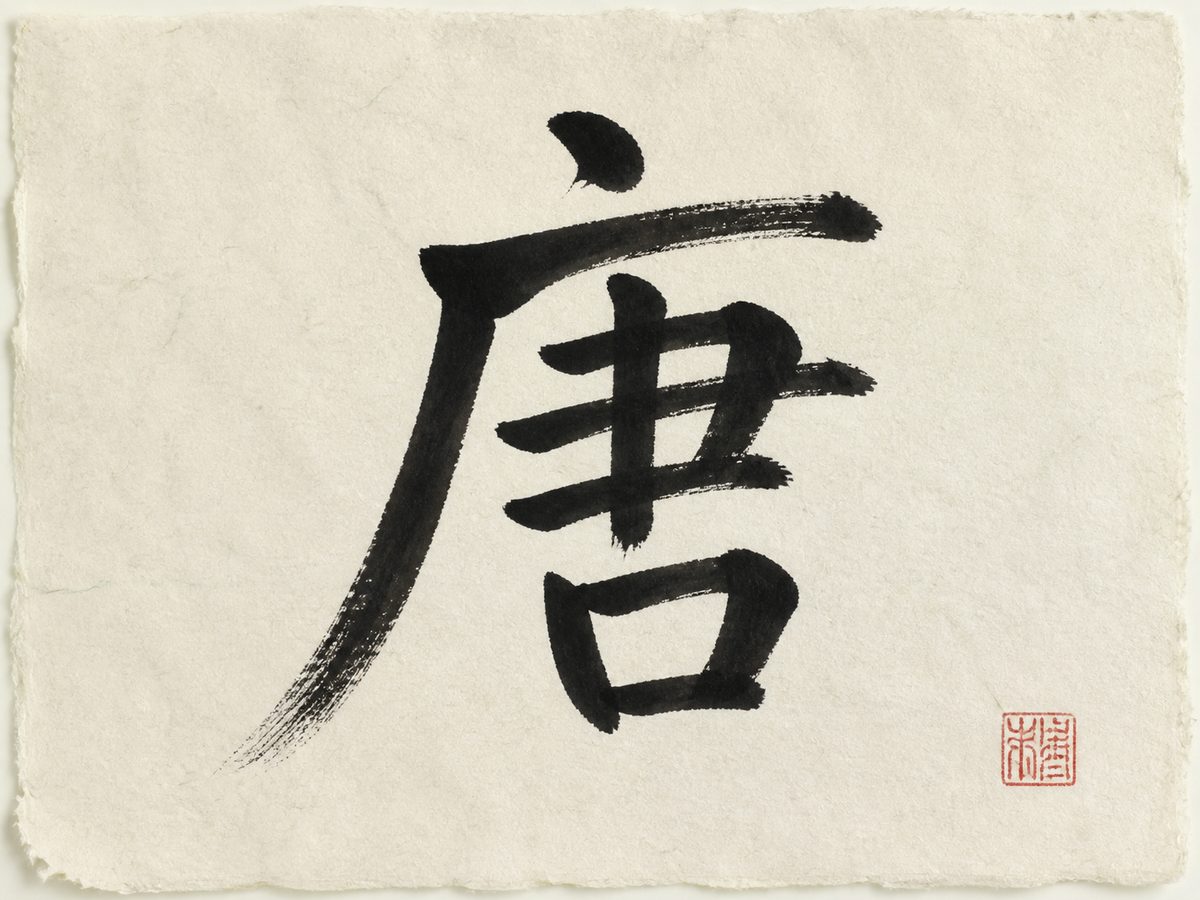
Three families, one spelling
Start with the thing that sends most people to a page like this, because the usual guides bury it.
Three unrelated Chinese surnames arrive in English as Tang. There is this one, 唐. There is 湯, which Mandarin says as Tāng and which means soup, or hot water, and which is a substantial old surname in its own right. And there is 鄧, which Mandarin calls Deng and which reaches English as Tang whenever a Cantonese speaker is doing the spelling.
Now the part that makes it genuinely confusing rather than merely annoying. Cantonese does not read this character as Tang. It reads it as Tong. So a Cantonese family that actually carries 唐 will generally have spelled it Tong for four generations, while the family down the road spelling it Tang is carrying a different character altogether.
Which gives a rule worth memorizing if you are working on a family tree:
In Cantonese romanization, Tang is usually 鄧 and Tong is usually 唐.
Hong Kong is the clearest case. When people there speak of the Tang family, they nearly always mean the Tang Clan of the New Territories, one of the Five Great Clans, who came down from the mainland in the eleventh century and whose walled villages at Kam Tin and Lung Yeuk Tau are still standing and still occupied. That family is 鄧. In Mandarin they are Dengs, which is to say they share a surname with Deng Xiaoping.
None of this can be settled by ear, by dialect, or by how long a family has been abroad. It is settled by one character. If there is a grave rubbing, a lineage book, a red packet with the name brushed on it, that single glyph is worth more than every spelling guide ever written, this one included.
The dynasty was not named after anyone called Tang
Here is the question this page exists to answer, and the answer is more interesting than either of the two versions people expect.
The Tang dynasty, three centuries of it, the poetry and the horses and the cosmopolitan capital that half of Asia copied, is written with the character on this page. So the reasonable guess is that a family called Tang founded it and gave the country their name, the way the Zhou did.
They did not. The Tang emperors were surnamed Li. Every one of them. If you want the family that actually ran the dynasty, that page is here.
What happened is duller and better. Li Yuan, who took the throne in 618, had inherited the title Duke of Tang, and the title referred to an ancient territory in central Shanxi that had been called Tang since long before anyone was writing dynastic histories. When he founded a state he named it after his title, which is what Chinese founders normally did. The dynasty was named for a place.
And the surname was named for the same place, by two much older routes, several centuries earlier. So the surname and the dynasty are not parent and child in either direction. They are two things that happened to the same patch of ground, roughly a thousand years apart, and never met.
A character that means talking too much
The character itself is a small joke at the expense of the most admired period in Chinese history.
The Shuowen Jiezi, compiled around 100 CE, gets it over with in three words: grandiose speech. Big talk. It then files the character under the mouth radical, with the element above it doing the sound rather than the sense, and moves on. The dictionary that defined the Chinese language for the next two millennia says that the character on the Tang dynasty's flag means boasting.
That sense never left. The everyday modern Chinese word for absurd, ridiculous, preposterous, the word you would use about a bad excuse or an outrageous price, is huāngtáng, and the second half of it is this character. Wasteland plus big talk.
And it has a wonderful pedigree. The phrase comes from the very end of the Zhuangzi, in the survey chapter where the book turns around and assesses its own author. Zhuang Zhou, it says, discoursed using far-fetched sayings, huangtang words, phrases with no boundaries. James Legge, whose Victorian translation is still the one most quoted in English, renders that middle term as "wild and extravagant words."
So the word that a modern Chinese speaker uses to dismiss something as ridiculous began life as a compliment a philosopher paid himself. The Kangxi Dictionary, incidentally, also records a straighter sense for the character, vast or spacious, and it is that meaning, not the boasting one, that got it attached to a territory and eventually to an empire.
The joke that made a state
The surname has two ancient origins and they both run back to the same ground in Shanxi.
The older one belongs to Yao, the sage-king at the very front of the Chinese historical tradition, whose clan is remembered as Taotang, pottery-and-Tang, the second half being the territory. Descendants took the place-name and dropped the pottery. That is the deep layer, and like everything at that depth it is tradition rather than record.
The second is a better story. King Cheng of Zhou was a child when he came to the throne, and one day he was playing with his younger brother Shuyu. He picked up a fallen paulownia leaf, cut it into the shape of a jade tablet of investiture, handed it over and said, more or less, here, I'm making you a marquis with this.
Children say things. What he had not accounted for was the court scribe, who wrote it down and then declined to let the matter drop, on the principle that a king's word is not a thing that can be unsaid. Shuyu was duly enfeoffed with the territory of Tang, and the episode entered the language as an object lesson in watching your mouth. His son later renamed the state Jin, and Jin went on to become one of the great powers of the Spring and Autumn period, which means an entire multi-century geopolitical career began with a boy handing his brother a leaf.
Those descendants who kept the older name took Tang as their surname. There is a third and much later stream too, southern non-Han populations who adopted the name from Han settlers, which is part of why the surname sits so heavily in the south today.
The character on the Chinatown gate
The last thing about this name is that a reader in San Francisco or London or Melbourne has almost certainly walked under it.
The Chinese name for Chinatown is tángrénjiē: Tang people's street. Not Chinese people's street. Overseas communities, Cantonese ones above all, have called themselves Tang people for centuries, in the same way northern Chinese have tended to call themselves Han people, and the usage stuck hard enough that it is now simply what the place is called in Chinese. That character on the arch over Grant Avenue is this surname.
The jacket does the same thing, and gets misunderstood the same way. A tangzhuang, the mandarin-collared silk jacket that turns up at weddings and, unfortunately, at costume parties, is named for the Tang people, not the Tang dynasty. Its actual design descends from Qing-dynasty dress, roughly twelve hundred years too late. Nobody in the Tang dynasty ever wore one.
As for the people: Tang Yin, the Ming painter of Suzhou, is the one every Chinese schoolchild knows, largely for a reputation as a romantic that his actual life does not much support. Tang Shaoyi was the first premier of the Republic of China. And Audrey Tang, Taiwan's first digital minister, is probably the most internationally recognized bearer alive, which is a pleasing outcome for a surname whose character means talking too much.
If you want to know what your own name would look like built the Chinese way, from sound and meaning together, our name builder will put one together.
A place, a leaf, a boast, and a gate in San Francisco. Ten strokes, and not one emperor.