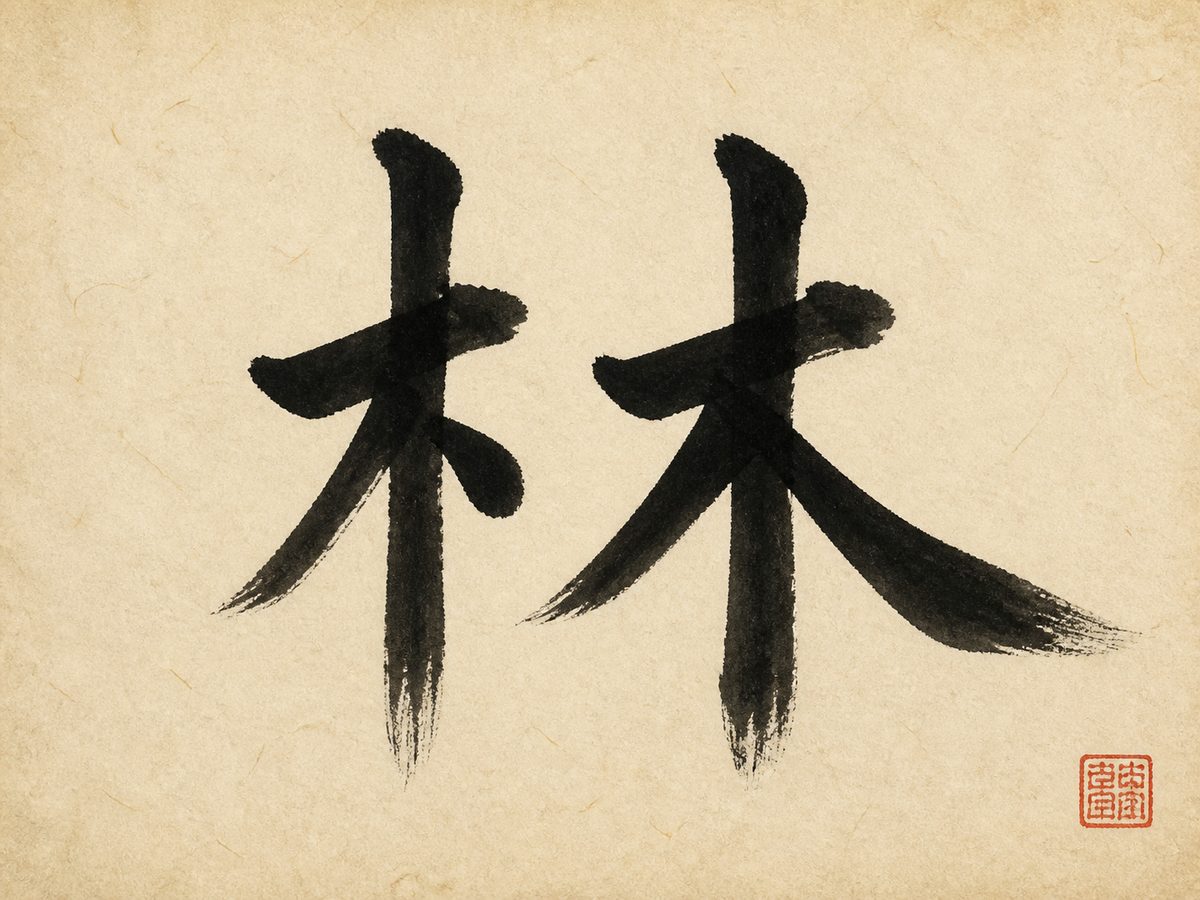
One character, three boats
Most Chinese surnames have a spelling problem. Lin has the textbook case of it, and once you see how it works here you can read the rest of the map.
Nothing about the name changes across the three spellings. The character is identical, the meaning is identical, the ancestor is identical. What changes is the language spoken in the room where the name was first written down in Latin letters, and that room was almost always a port office. A Mandarin speaker's name went down as Lin. A Cantonese speaker's went down as Lam, because in Cantonese the vowel opens all the way up. A Hokkien speaker's from the Fujian coast went down as Lim. Three clerks, three languages, three spellings that a stranger would never guess belonged together.
Because the Hokkien coast is where Chinese emigration to Southeast Asia mostly came from, Lim is the version the world got the most of. It is stacked through the phone books of Singapore, Malaysia, Indonesia, and the Philippines. Lam went out through Hong Kong and Guangdong. Lin, the pinyin spelling, is the newest of the three in the West, because it belongs to people who left after Mandarin romanization became standard. You can date a family's departure, roughly, from the letters alone.
Fujian has an old line about how few names it really uses, and since Lin is the second name in it, the story belongs to the page for the first one: Chen tells it.
Two trees on flat ground
Open the Shuowen Jiezi, the dictionary Xu Shen completed around 100 CE and still the first place to look for where a Chinese character came from, and the entry for 林 is shorter than this sentence and more exact than you would expect. Clustered trees on level ground, it says, are a lin. Composed of two tree elements.
Notice what got smuggled into that definition. Not "trees." Not "many trees." Trees on level ground, which means the word was doing survey work as well as botany, distinguishing a stand on the flat from whatever grows up the side of a hill. Two trees, drawn side by side, and the character is finished at eight strokes.
The rest of the family follows the arithmetic. Add a third tree and you get the character for deep forest. Put a fire over the trees instead and you get the character for burning, which is a fairly bleak thing for a language to have worked out early. Lin is the modest one in the set: not a wilderness, not a disaster, just a stand of trees somebody could walk into.
If you want to watch the two trees lean away from each other the way a calligrapher makes them, our calligraphy tool draws 林 in six classical scripts for free.
The minister with the seven-chambered heart
Every Lin genealogy in the world opens with the same man, and he is not a Lin.
Bigan was a minister of the late Shang court and an uncle of Di Xin, the last Shang king, whom Chinese tradition remembers as one of history's great monsters. Bigan kept telling him so. The story says he remonstrated for three days straight, and the king, who had heard that a sage's heart has seven openings in it, had him killed so he could check. Soldiers were sent after the rest of the household. Bigan's pregnant widow got out, hid in a stone chamber in a place called Long Forest, and gave birth there to a son who never met his father. When the Zhou overthrew the Shang, King Wu is said to have honored the boy by naming him for the forest he was born in. That boy is the ancestor every Lin claims.
It is a magnificent story and there is no evidence it happened. Bigan appears in no known Shang or Western Zhou oracle-bone inscription, which is where the period's actual paperwork survives, so a man whose death is the moral cornerstone of a twenty-million-person surname is missing from the record of his own century. What exists instead is the cult: a tomb and temple to him at Weihui in Henan, first built around 494 CE under Emperor Xiaowen of the Northern Wei, more than fifteen hundred years after the events it commemorates. The Lins did not inherit a document. They inherited a shrine, and a very good reason to be proud.
The rank that changes when you cross the strait
Nationally, Lin is unremarkable. Depending on which count you take it sits sixteenth or eighteenth on the mainland, with something like fifteen million bearers, and perhaps twenty million worldwide. Respectable, unspectacular, nowhere near the Wangs and Lis.
Now cross about a hundred miles of water. In Taiwan, on the Interior Ministry's 2023 figures, Lin is the second most common surname in the country, behind only Chen. It is also second among Fujian's Hokkien speakers.
That gap is not a statistical curiosity, it is a record of who got on the boats. Taiwan's Han population came overwhelmingly from the Fujian coast, and the coast's surname profile came with it, unchanged, the way a soil sample stays a soil sample after you move the jar. Nobody wrote this migration down as a list of names. The census did it for them, four centuries later, by accident.
Five lives of the name
A forest name, and its most famous bearer belongs entirely to the sea.
The silent girl who became a goddess
On Meizhou Island off Putian, in Fujian, a girl named Lin Moniang was born in 960 and died in 987, at twenty-seven. Her name means Silent Girl, said to have been given because she did not cry when she was born, or for a month afterward. That is the traditional account; no Song-dynasty source actually names her, and the oldest surviving record calls her only a woman of the Lin family who worked as a spirit medium. The full story is on her own page. The stories are about weather and drowning men.
After she died, sailors began praying to her, and they have not stopped. She is Mazu, the Queen of Heaven, the deity in the small shrine at the front of a Chinese fishing boat, and her worship went wherever the boats went. There are around fifteen hundred Mazu temples in twenty-six countries today, nearly a thousand of them on Taiwan alone, against 509 counted in 1980. The growth is not a historical footnote; it is happening now. A surname that means a stand of trees on flat ground produced the goddess of the open ocean, and the coast that sent the name overseas sent her with it.
The man who burned the opium
Lin Zexu had the worst job in the Qing empire. Sent to Canton as imperial commissioner at the end of 1838 to stop the opium trade, he confiscated the entire British stock and then had to get rid of it. Starting on 3 June 1839, five hundred workers spent twenty-three days destroying roughly 1.2 million kilograms of opium, mixing it with lime and salt and washing it into the sea at Humen.
He also wrote to Queen Victoria. The letter asked, politely and unanswerably, why a country that banned opium at home would insist on selling it abroad; it seems to have gone astray in transit and surfaced later in the London Times. Britain sent gunboats. Lin was made the scapegoat for losing the war he had been ordered to provoke and was exiled to Ili in remote Xinjiang in September 1840. He died a decade later on the road to another assignment. His statue stands in Chinatown in Manhattan, which is a long way from Humen and about right.
The architect Penn owed a degree for ninety-seven years
Lin Huiyin arrived at the University of Pennsylvania in 1924 wanting to study architecture and was not allowed to, because of her sex. She took a fine-arts degree instead, graduated in 1927, went home, and became the first female architect in modern China anyway. Between 1930 and 1945 she and her husband Liang Sicheng surveyed 2,738 old buildings across 190 counties, much of it during a war. In 1937 the two of them walked into the East Hall of Foguang Temple, in the Wutai mountains of Shanxi, and dated it to 857. That mattered more than it sounds. Japanese scholars had been saying for years that no Tang-dynasty timber building survived anywhere in China and that you had to come to Japan to see one; the hall they were standing in was the proof that they were wrong. Older ones have since been dated, including a hall of 782 at nearby Nanchan Temple, but Foguang was the one that broke the claim. After 1949 she worked on the design of the national emblem and the reliefs on the Monument to the People's Heroes. In 2024, ninety-seven years after it refused her, Penn awarded her the architecture degree. She had been dead since 1955.
The man who explained China in English
Lin Yutang, born in Fujian in 1895, did something nobody had managed before: he wrote about China for Western readers in English, in his own voice, and they read him in enormous numbers. My Country and My People came out in 1935 and The Importance of Living in 1937, and between them they shaped what a generation of Americans thought China was. He was nominated for the Nobel Prize in Literature six times between 1940 and 1973 and never won it. He also spent years designing the Ming Kwai typewriter, a machine for typing Chinese, patented in the United States in 1952 and never mass-produced, which is the sort of glorious near-miss that tends to run in this surname.
The point guard
For about a month in the winter of 2012, the most famous Lin alive played basketball. Jeremy Lin, born in Torrance, California, to parents who had come from Taiwan in the mid-1970s from a Hoklo family in Changhua, was an undrafted benchwarmer when the New York Knicks put him in the starting lineup in February. He averaged 22.5 points and 8.7 assists over his first twelve starts, the team won seven straight, and the resulting noise got its own word. Linsanity was the first time most American sports fans had watched an Asian American star in the NBA, because he was the first American of Chinese or Taiwanese descent to play in it at all. In 2019 he became the first Asian American to win a championship. The name had already crossed the ocean twice by then; this was just the part that made the news.
If you carry the name
The surname is the half of a Chinese name that arrives with you; the given name is the half somebody sat down and chose. If you are a Lin, a Lam, a Lim, or a Lâm looking for a Chinese given name to stand beside the two trees, our name generator builds real ones the way Chinese parents do, out of meaning and sound rather than off a list. And the character has been one of the most pleasing shapes in the language for three thousand years: the calligraphy tool renders 林 live, free. If the vowelless spelling problem in the table above interested you, the surname that has it worst is Ng.