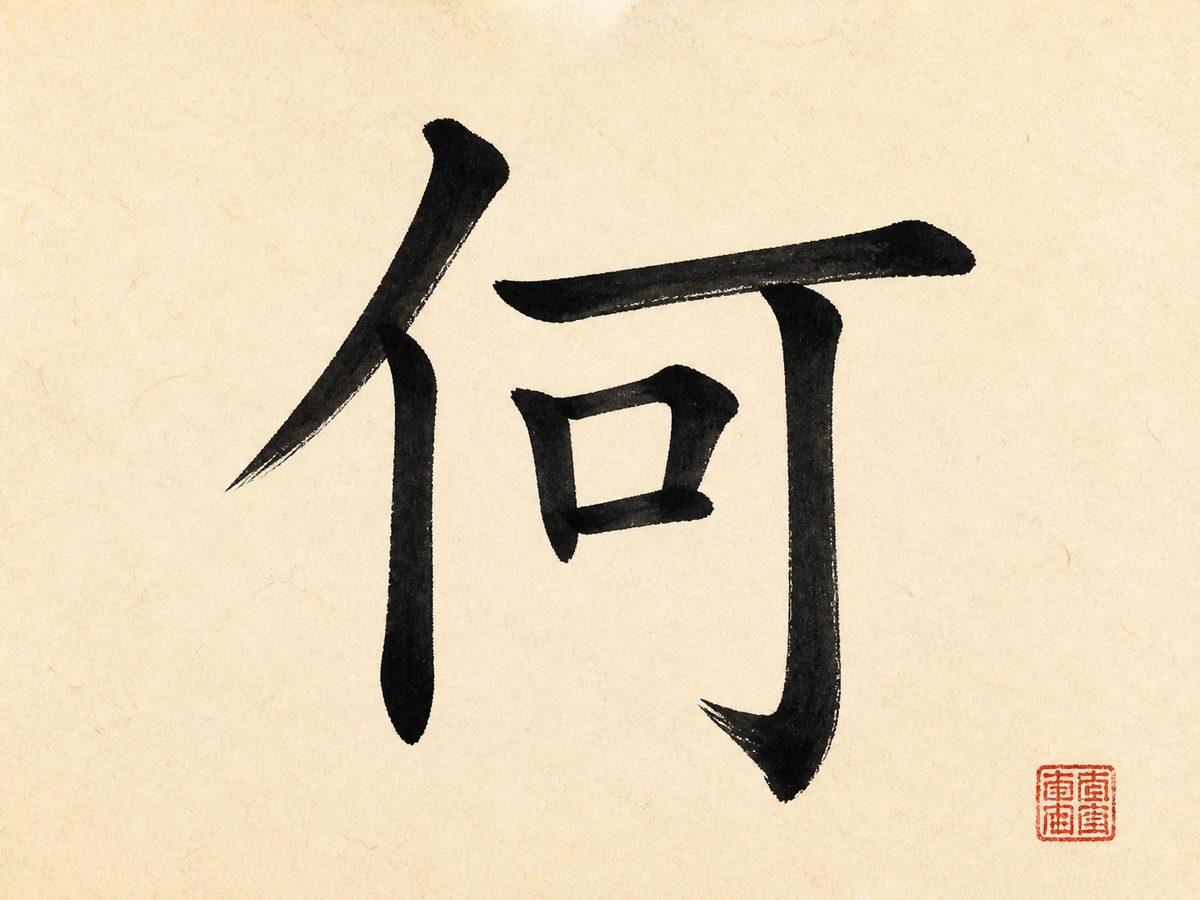
Four different families, one spelling
Search for this surname in English and the first thing you will be handed is a Vietnamese name.
That is not a mistake on anybody's part. Ho really is a Vietnamese surname, and a famous one. It is simply not this surname. Vietnamese Hồ writes the character 胡, which Mandarin reads as Hu, and it belongs to a different family with a different history, including a dynasty that ruled Vietnam for six years at the start of the fifteenth century. When Chinese 何 turns up in Vietnamese it comes out as Hà, with an entirely different vowel.
Then there is Korean Ha, which is usually a third character again, 河, the one that means river.
Then there is 賀, which is Chinese, is also spelled Ho, and is also a real and reasonably common surname, and which we will come back to, because the way it was invented is one of the better stories on this page.
And then there is this one: 何, the seventeenth most common surname in mainland China, borne by somewhere around fourteen million people, and the one you almost certainly want if the Ho you are looking for came from Guangdong, Hong Kong, Macau, Malaysia or Singapore.
Four families, one English spelling, and no way to tell them apart in the Latin alphabet. One look at the character tells you instantly. This is the recurring problem with Chinese names in English, and it is the reason this site puts the character on every page.
How to actually say it
Here is the awkward truth about the two spellings: the older one is better.
Ho is a decent guide. Say the "aw" of "law", keep it short, and you are close enough that nobody will blink. Cantonese speakers say it with a low falling pitch; Mandarin speakers say it with a rising one, like the end of an English question.
He is a spelling that actively lies to you. The vowel in pinyin e is not the vowel in the English word "he". It is closer to the sound in "uh", made further back in the mouth, so the name comes out as something like "huh" with a rising tone. Say the English pronoun at a Chinese person named He and they will be politely baffled.
The name also has an unusually clean way of confirming which one you have got. The rising tone is 何 and the falling tone is 賀, and any Mandarin speaker will separate them without thinking about it. English deletes the tone, and with it the only thing distinguishing two unrelated families.
Fourteen million people named "What?"
Now the part that makes this surname genuinely peculiar.
何 is not a rare or ceremonial character that happens to be used as a name. It is one of the most common function words in the Chinese language. It is the question word. Hé shí, what time. Hé chù, what place. Rú hé, how. Wèi hé, why. Wú kě nài hé, nothing to be done, literally "there is no what-can-be-done about it," which is the exact Chinese equivalent of a shrug.
Nothing in English is quite comparable. The nearest you get is somebody surnamed Which, or How, and even then the English words are not doing a fraction of the work. This character is in the first few hundred that any Chinese child learns and it is in more or less every page of classical prose ever written.
Which produces some very good lines. Su Shi, in the poem more Chinese people can recite than any other, looks up at the moon on a Mid-Autumn night and wonders what year it is in the palaces up there. The word for "what" is this surname. He ends by wishing that people might last, and share the same moon across a thousand miles, and the phrase everyone quotes at the mid-point, that being up there could not possibly beat being down here, has the surname in it too.
For once, a surname whose meaning genuinely is part of daily life rather than a fossil. Every Chinese speaker uses this name several times a day without noticing.
If you want to see it written properly, our calligraphy tool draws 何 in six classical scripts.
The name that used to mean carrying things
Open the Shuowen Jiezi, the dictionary Xu Shen finished around 100 CE, and the entry for this character is three words long. To carry. It is built, the dictionary says, from the person radical with 可 supplying the sound.
So the original picture is not a question at all. It is a man with a load on his shoulder, and the "person" element on the left is doing real work. The interrogative sense came later, as a straight loan of the sound, and it was such a successful squatter that the original meaning had to move out. Today the carrying sense lives in 荷, the same character with grass on top, which also happens to be the word for a lotus.
This kind of eviction is extremely common in Chinese and it is one of the more useful things to understand about the writing system. A character is a sound as well as a shape, and when a very frequent word needs a graph, it will happily take one that already belongs to something else and leave the original owner to find new accommodation.
A surname made by an accent
The origin of the family is not the origin of the character, and this is where most name-meaning pages go quiet.
There was a state called Han, granted, by tradition, to a son of King Wu of Zhou, and it lasted until 230 BCE, when Qin swallowed it on the way to swallowing everything else. Members of the ruling house did what displaced Chinese families always did and took the name of the state they had lost, 韓. A branch of them resettled in the Jianghuai region, the country between the Yangtze and the Huai river, and there they met a dialect that said the syllable differently. Han came out as something closer to He.
Then the written form caught up with the spoken one, and a new surname existed.
That is worth sitting with. Chinese surnames usually come from a place, a title, an office or an ancestor's given name. This one came from a pronunciation. Fourteen million people carry a name that exists because a group of refugees moved somewhere with a different accent, and nobody corrected the spelling.
And a surname made by a taboo
The other Ho, 賀, was invented in an even stranger way, and since it shares this page's English spelling it might as well share the page.
Chinese emperors' personal names were taboo. You could not write them, and if your name happened to collide with one you were expected to do something about it. In the second century CE, a Palace Attendant named Qing Chun, from a family in Kuaiji that traced itself to the ducal house of Qi, found that his surname 慶 was also the personal name of Liu Qing, the father of Emperor An. So he changed it. He picked 賀, a character that means roughly the same thing, to congratulate, and the whole family went with him.
Two of the surnames spelled Ho in English were therefore created by pressure on a name rather than by anything a name means. One was bent by an accent and the other by a dead prince.
The man who was too handsome to be believed
The best story attached to this surname is about a man who was suspected of wearing makeup.
He Yan lived from around 195 to 249, and his position was extraordinary from the start: his father died young, his mother remarried Cao Cao, and he grew up as the warlord's stepson inside the family that would rule northern China. He became one of the two founders of Xuanxue, the Mysterious Learning, the movement that read the Laozi and the Book of Changes back into Confucianism and set the intellectual weather for the next three centuries. His commentary on the Analects stayed the standard one for nearly a thousand years, until Zhu Xi's replaced it.
He was also, by every account, spectacularly good-looking, and he powdered his face, which even in an age when fashionable men did powder their faces was considered a bit much.
The Shishuo Xinyu, that wonderful fifth-century collection of anecdotes about people behaving memorably, records the consequence. He Yan had a fine appearance and a face of extreme whiteness, it says, and Emperor Ming of Wei suspected him of wearing powder. It being high summer, the emperor gave him hot noodle soup. Having eaten it he sweated heavily, wiped his face with his red robe, and his color turned brighter than before.
The emperor of northern China, in other words, conducted an experiment. He made a man eat hot soup in July to see whether his complexion would run, and it did not. The phrase for a beautiful man in classical Chinese has been "powdered Master He" ever since, and it means the opposite of what it says.
The end was not funny. He Yan attached himself to the regent Cao Shuang, took a senior post in personnel, and got heavily into the five-mineral powder, a mineral drug fashionable among the Wei elite that produced burning heat, loose robes and, over time, a great deal of damage. In 249 the Sima family took the government in a coup and executed Cao Shuang's entire faction. He Yan died with it, at about fifty-four.
There is one more He worth knowing from the deep past, and she is a goddess. He Xiangu is the only woman among the Eight Immortals, the group who cross the sea each showing their own powers. She is normally shown carrying a lotus, which given where the carrying sense of her surname ended up is a coincidence too good to pass over.
The Hos who built modern Asia
For a surname of this size the modern roster is unusually concentrated in one corner of the world, and it is the corner the spelling comes from.
Stanley Ho, who died in 2020 at ninety-eight, held the gambling monopoly in Macau for four decades and effectively built the city as it now exists. Edmund Ho, no relation, became the first Chief Executive of Macau when Portugal handed it back in December 1999, which means that for a while the Ho name ran both the territory and its principal industry. Ho Ching led Temasek, the Singapore state investment company, from 2004 to 2021.
And David Ho, born in Taichung and raised in Los Angeles, worked out in the mid-1990s that HIV had to be hit early and with several drugs at once, and turned an inevitably fatal diagnosis into a manageable condition. Time made him its Man of the Year in 1996.
A name that means "what", carried by fourteen million people, produced by an accent. It has done rather well.