Customs

Chinese New Year taboos: what not to do, and the story behind each rule

The main Chinese New Year taboos belong to New Year's Day: no sweeping or taking out the rubbish, no washing your hair, no knives or scissors, no lending money, no breaking things and no unlucky words, tears or quarrels. White and black clothes are avoided all season, and haircuts for the whole first month. Most of the rest lift on the fifth day. The logic behind all of them is one idea: the first day is an omen for the year.

So the rules are puns and stories, and a grandmother watching you pick up a broom is reading the year ahead, not judging your housekeeping. Some are younger than they pretend. The sweeping rule is not: its story was written down fourteen hundred years ago. And the famous one about haircuts turns out to have moved to the New Year from the middle of summer.

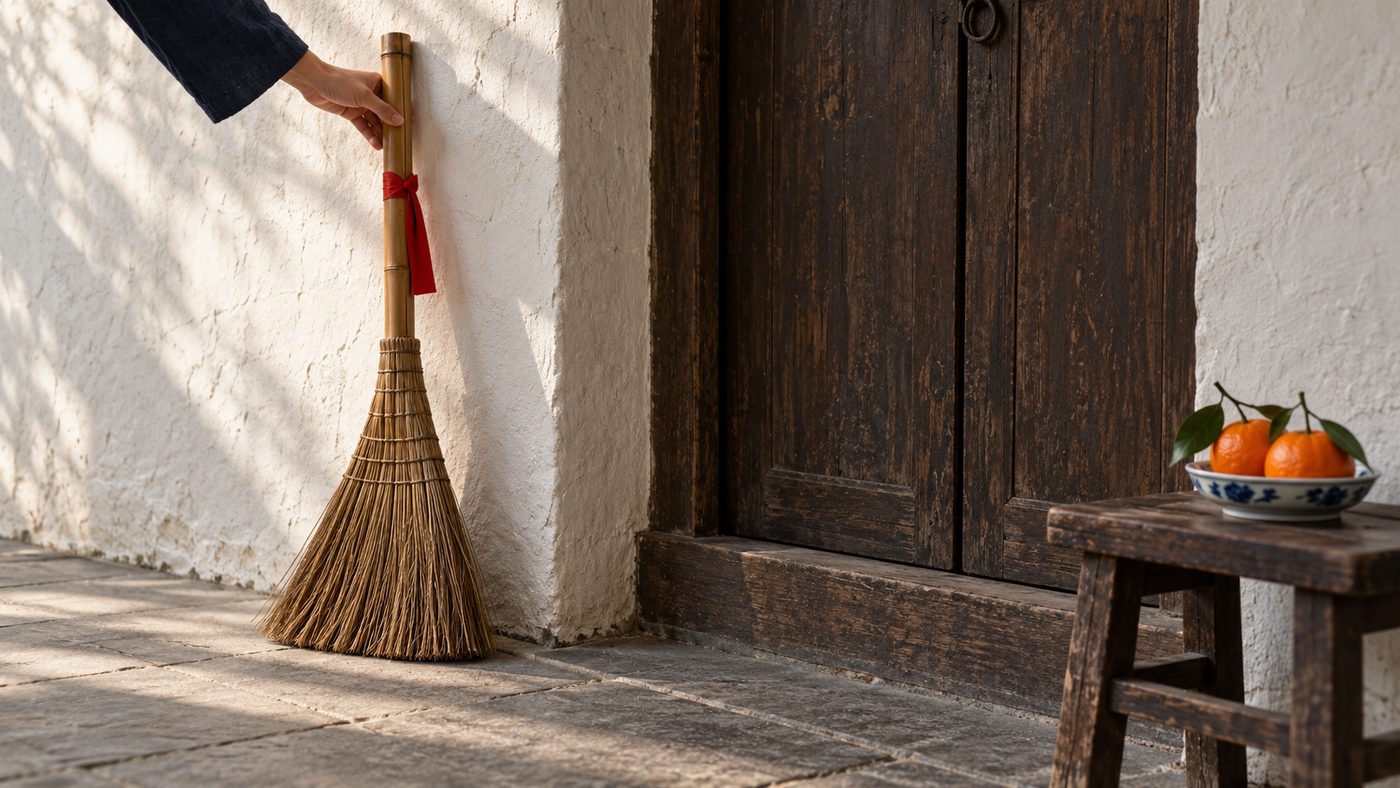
A hand leaning a bamboo broom tied with red ribbon against a whitewashed wall beside a closed wooden door, with two mandarins on a blue-and-white dish, in soft morning light.
The house is swept on the eve, and then the broom is put away until the fifth. Illustration.

Chinese New Year taboos at a glance

Chinese New Year taboos: when each one is kept, the pun or story behind it, and what families do instead.
Don't When Why What people do instead
Sweeping, and taking out the rubbish New Year’s Day; in many homes until the fifth You sweep the new year’s luck out of the door. The story behind it is fourteen centuries old Clean the whole house before the eve. If you must sweep, sweep inward and leave the pile
Washing your hair New Year’s Day Hair, fa, sounds like fa, to prosper: wash it and you wash your fortune away Wash it on the eve
Doing the laundry The first and second days They are the water god’s birthday, in the usual Taiwanese explanation Wash everything before the eve, or wait for the third day
Breaking a bowl, a glass or a mirror The whole season A break is an omen of a broken year Say suisui ping’an at once: "peace year after year," with sui also meaning "in pieces"
Unlucky words: death, illness, poverty, ghosts, the number four The whole season Whatever is said now is heard as a forecast for the year Greetings and good wishes, as many as you like
Scolding, quarreling, crying Above all the first day The first day sets the tone of the year, and a child punished on it will be punished all year Save the argument until after the holiday
Knives, scissors and needles New Year’s Day A blade cuts the year’s luck, and blood is the worst omen of all Chop everything on the eve; the cook gets the day off
Lending, borrowing, collecting a debt New Year’s Day; debts are settled before the eve Money that goes out on the first day keeps going out all year Pay what you owe before the eve
Taking medicine, seeing a doctor New Year’s Day, loosely the whole holiday A year of medicine bottles Take prescribed medicine regardless. Even the people who keep this rule say so
Porridge for breakfast New Year’s Day Thin rice porridge was what poor households ate Dry rice, or dumplings
Napping, or waking someone up New Year’s Day A nap means a lazy year; whoever is shaken awake will be hurried all year Get up on your own, and let others wake on theirs
Killing an animal; meat at the first meal New Year’s Day; in the old texts, each of the first seven days Bloodshed is unlucky, and each of the first days belonged to an animal A vegetarian first meal, in many families
Dressing all in white or all in black The whole season White and black are the colors of mourning Red, or anything bright and new
Buying shoes The holiday Xie, shoe, sounds like xie, evil Buy new shoes before the eve, as everyone does
Getting a haircut The whole first month Folk saying: it will kill your mother’s brother. The rule began in the fifth month Cut it in the twelfth month
New Year visits on the third day The third day The Red Mouth day, when quarrels come easily Stay home and sleep in

The gifts that are never given at the New Year, clocks and pears and anything in fours, have their own list on our page of New Year gifts, and the rules for the money in a red envelope are on that page.

Sweeping: the luck in the rubbish heap

The rule everyone knows is the one with the oldest story. The Jingchu Suishiji, a sixth-century record of the year's customs on the middle Yangtze, notes that on New Year's Day people tied coins to the foot of a stick and threw it onto the rubbish heap, saying "make it as wished." Its commentary explains why. A merchant named Ou Ming, it says, was once given a servant girl called Ruyuan, "As You Wish," by the god of a lake, and from then on whatever he wanted he got, until he was rich. One New Year's morning she was slow to get up and he beat her with a stick. She burrowed into the rubbish heap, disappeared, and the household slowly grew poor. In the commentator's own day, he adds, people in the north still stood by the heap on New Year's night and had it beaten with a stick, which he supposes was done in memory of Ruyuan.

The heap, in other words, is where the luck lives, and on the first day of the year you leave it alone. Taiwan's Ministry of Education dictionary still lists Ruyuan, among the word's senses, as the earliest name of the god of wealth, the god who is received on the fifth day. Hence the modern version: the whole house is cleaned before the eve, the brooms are put away, and nothing is swept or carried out on New Year's Day. Strict households keep it up to the fifth. If something really has to be swept, Taiwanese advice is to sweep from the door inward, so the dust stays in and the fortune with it.

When the rubbish finally goes out, it goes out on purpose, as "sending poverty away." The date depends on where you are. The same dictionary collects three: the third day in Suzhou, where Gu Lu's almanac of local customs has people leave the swept dust and an old broom at a fork in the road; the day before Humans' Day, the sixth, in a Song dynasty record, with seven pancakes laid on top of the pile; and the twenty-ninth of the month in another. Many households today do it on the fifth.
Washing: your hair, your clothes, your fortune

No hair washing on New Year's Day, because hair, fa, sounds like fa, to prosper, as in the New Year greeting gongxi facai. The tones are different and nobody minds: wash your hair on the first morning and you wash your fortune down the drain. The laundry waits too, for the first two days, which in the usual Taiwanese explanation are the water god's birthday. Some families extend the rule to bathing. The practical answer is the one everyone follows anyway: wash everything, yourself included, on the eve, and put on new clothes in the morning.

Words, tears and broken bowls

Over the New Year, anything said aloud is heard as a forecast. So nobody mentions death, illness, ghosts or being broke, and the number four, which sounds like the word for death, is dodged even in conversation; the full story of that avoidance is on our page on the Chinese symbol for death. Children are not scolded, because a child scolded on the first day will be scolded all year, and nobody is supposed to cry. What you should say instead is on our page of New Year greetings.

Breaking something is the classic accident, and it has a classic cure. Say suisui ping'an, "peace year after year," at once. Sui is the year, and sui, written with a different character, is "smashed to pieces," so the pun turns the broken bowl into a blessing. This is not a family improvisation: the Ministry of Education dictionary in Taiwan defines the phrase as exactly that, the lucky words spoken when pottery or glass breaks at the Spring Festival. Then sweep up the pieces quietly, and do not throw them out until the fifth.

Knives, medicine and money

Knives, scissors and needles stay in the drawer on New Year's Day: a blade cuts the year's luck, and blood is the worst omen of all. Taiwanese writers on the custom add a kinder reason, that it gave the women who had cooked for weeks one day off. It is the reason the eve's cooking is so enormous. Everything for the first day is chopped the day before.

Medicine and doctors are avoided on the first day, for fear of a year of medicine bottles, and some families avoid hospital visits for the whole holiday. Even the press that repeats the rule adds the caveat, and so do we: prescribed medicine is taken as usual, and anyone who is really ill sees a doctor.

Money does not leave the house on the first day: no lending, no borrowing, no asking for a debt to be repaid, since money that flows out now flows out all year. The other half of the rule comes earlier. Debts are settled before the eve, so that nobody carries one into the new year.

Porridge, naps and the days of the animals

No rice porridge for breakfast on New Year's Day, because thin porridge is what poor households ate, and nobody wants to start the year poor. No nap, which predicts a lazy year, and nobody is shaken awake, since whoever is woken will be hurried for twelve months. Everyone gets up on their own.

Many families eat no meat at the first meal and kill nothing on the first day. The old texts had a reason that went further. The commentary on the Jingchu Suishiji gives each of the first seven days of the year to a creature: the first to the rooster, then the dog, the sheep, the pig, the ox and the horse, and the seventh to humankind, which is why the seventh is still Humans' Day. "Today," it says, no rooster is killed on the first day, no dog on the second, and so on down the list, and on the seventh no one is executed.

Colors, and shoes

White and black are the colors of mourning, so an outfit entirely in white or entirely in black is what to avoid over the New Year, above all on the first day and when visiting older relatives. A white shirt under a red sweater is fine. Red is the color of the holiday, and new is better than old. Shoes are bought before the eve, not during the holiday, because xie, shoe, sounds like xie, evil.

The haircut that kills your uncle

The strangest of the rules is also the most widely kept: do not cut your hair in the first month, or your mother's brother will die. The barbers of China are busiest in the last weeks of the old year as a result. The explanation you will usually be given is political. When the Manchus forced every Chinese man to shave his forehead and wear the queue, the story goes, people refused to cut their hair in the first month out of "missing the old" dynasty, si jiu, which sounds like si jiu, "uncle dies." It is a good story, and it is probably not true.

The folklorist Wu Yucheng, writing in the Beijing Youth Daily in 2023, traced the rule to the wrong end of the year. The earliest records put it in the fifth month, the "evil month" of the Dragon Boat Festival, when the heat was thought to make everything dangerous. Kong Shangren, the late-seventeenth-century playwright, lists it among the customs of the Dragon Boat day: no haircut, for fear of harming an uncle. Pan Rongbi's eighteenth-century almanac of Beijing customs has people in the fifth month avoid moving house, avoid pasting new paper on the windows and mostly avoid haircuts, "for fear of harming the mother's brother." The same book calls the first month the "good first month," with the same rules about moving and windows. From there the haircut crossed over: a modern local history of Lushan, in Henan, lists "no haircut, no moving house, no pasting windows, no quarrels" as the rules of the good first month, and the summer rule has been forgotten.

Day by day, from the eve to the fifth

  • The eve. Clean the house, settle your debts, wash your hair, cook ahead. Do not go to bed early: staying up to see the year out is the custom, and the eve's rules about breaking things already apply.
  • The first day, next on February 6, 2027. The long list above: no sweeping, washing, blades, money, medicine, porridge, naps, killing, tears or unlucky words.
  • The second day. Married daughters go home to their parents. The laundry still waits.
  • The third day, February 8, 2027. The Red Mouth day, or Red Dog day, when quarrels come easily, so in Hong Kong and Taiwan people stay home rather than pay New Year calls, and many sleep in.
  • The fifth day, February 10, 2027. Breaking the Five. The Beijing almanac of 1900 says that within the five days no raw rice was cooked and women did not go out; on the fifth the rules lapse, the rubbish goes out, the shops reopen and the god of wealth is received.
  • The whole first month. No haircut. Some families add no moving house.

The other rule of the season is personal. If your own sign clashes with the incoming year, the year itself is the thing to be careful with, and that is a different tradition, on our page on Tai Sui. The days themselves, with what each one is for, are on the Chinese New Year page.

Does anyone still keep them?

Selectively, and with a smile. None of this is scripture. There is no book that orders a Chinese family to leave the floor dirty, and the old almanacs record the rules as what people did, not what they had to do. But the core of them is kept in an enormous number of homes, from Beijing to Kuala Lumpur, by people who would tell you they are not superstitious. Nobody is sure the broom matters. Nobody wants to be the one who swept the luck out.

For a guest, four rules cover almost everything: do not tidy up, do not break anything (and if you do, say suisui ping'an), do not talk about death or illness, and do not turn up in all white or all black. Keep those and you will be doing better than most of the family's own children.

Questions people ask

What are the taboos of Chinese New Year? +

On New Year’s Day: no sweeping or taking out the rubbish, no washing your hair or your clothes, no knives or scissors, no lending or collecting money, no medicine unless you need it, no porridge, no nap, and no killing. Through the whole season: nothing broken, no words like death, illness or poverty, no quarrels or tears, no all-white or all-black clothes, and no haircut for the first month. Most of the first-day rules lift on the fifth day. They are folk customs, kept more or less strictly from one family to the next.

What should you not do on Chinese New Year’s Day, February 6, 2027? +

Do not sweep, take out the rubbish, wash your hair or do the laundry; do not use knives, scissors or needles; do not lend, borrow or ask for money owed; do not say anything unlucky, scold anyone or cry; do not eat porridge, nap, or wake anyone up; and do not break anything, but if you do, say suisui ping’an, "peace year after year." The next New Year’s Day is February 6, 2027; the third day, February 8, 2027, is the one for staying home, and on the fifth, February 10, 2027, the rules lift.

Is it okay to wash your hair on Chinese New Year? +

Not on New Year’s Day, if you keep the custom. Hair, fa, sounds like fa, to prosper, so washing your hair on the first morning is washing your fortune away, and in Taiwan the first two days are also called the water god’s birthday, when nothing is washed at all. Wash it on the eve instead, which is when the house is cleaned too. From the third day everything is back to normal.

Can you clean or sweep on Chinese New Year? +

Not on New Year’s Day, and in strict households not until the fifth. The cleaning is done before the holiday, ideally by the eve, so that nothing has to be swept while the new luck is in the house. If something has to be swept, sweep toward the middle of the room and leave the pile indoors. The rubbish goes out on the day of sending poverty away, the third, fifth or sixth day depending on the region.

What is the forbidden color for Chinese New Year? +

White and black, worn on their own, because they are the colors of mourning. A white shirt under a red sweater is fine; an outfit entirely in white or entirely in black is what to avoid, especially on the first day and when visiting older relatives. Red is the color of the holiday, and new clothes are better than old ones.

Why can’t you cut your hair during Chinese New Year? +

The folk saying is that a haircut in the first month will kill your maternal uncle. The usual explanation, that the rule began as a Qing-dynasty protest because "missing the old" sounds like "uncle dies," is a later story. Qing almanacs put the rule in the fifth month, the "evil month" of the Dragon Boat Festival, and only later did it migrate to the first. Either way, people get their hair cut in the last weeks of the old year.

What do you say if you break something during Chinese New Year? +

Suisui ping’an, "peace year after year." Sui means "year" and, written differently, "in pieces," so the phrase turns the broken bowl into a blessing. Taiwan’s Ministry of Education dictionary defines it as exactly that: the lucky phrase said when pottery or glass breaks at the Spring Festival. Then sweep up the pieces quietly, or leave them until the fifth day if your family is strict.

When do Chinese New Year taboos end? +

Most of them on the fifth day, which is called Breaking the Five for that reason: the shops reopen, the rubbish goes out and the house can be swept. The haircut rule lasts the whole first month. The rules are customs rather than scripture, and families keep them selectively; a guest who follows the main ones (no sweeping, no breaking, no unlucky words, no white or black) will be doing better than most of the family’s own children.

Sources and further reading

More of the New Year

Stay in the loop.

Chinese mythology, the zodiac, and the meaning behind names and symbols, rooted in the classics and read back to you. No spam. Unsubscribe anytime.