Festivals

Chinese New Year firecrackers: from burning bamboo to the city bans

Chinese New Year firecrackers are lit to drive bad luck and evil spirits away and to bang the new year in. They began as green bamboo thrown on a fire, which bursts with a crack when its sealed segments heat up, and the Chinese word still says so: 爆竹 baozhu, "exploding bamboo." The oldest New Year text aims them at a one-legged mountain demon. Gunpowder took over in the Song dynasty, and in the late twentieth century Singapore, Hong Kong and Beijing all banned them, Beijing only for twelve years.

If you have only met them as a noise in a Chinatown street, the scale at home is hard to picture. A Hong Kong district officer remembered a market opening in 1951 at which the crackers went on for a good fifteen minutes, and Chinese New Year as "non-stop banging day and night, sounding like a battlefield." For most of the past fifteen centuries, that was simply the sound of the year turning over.

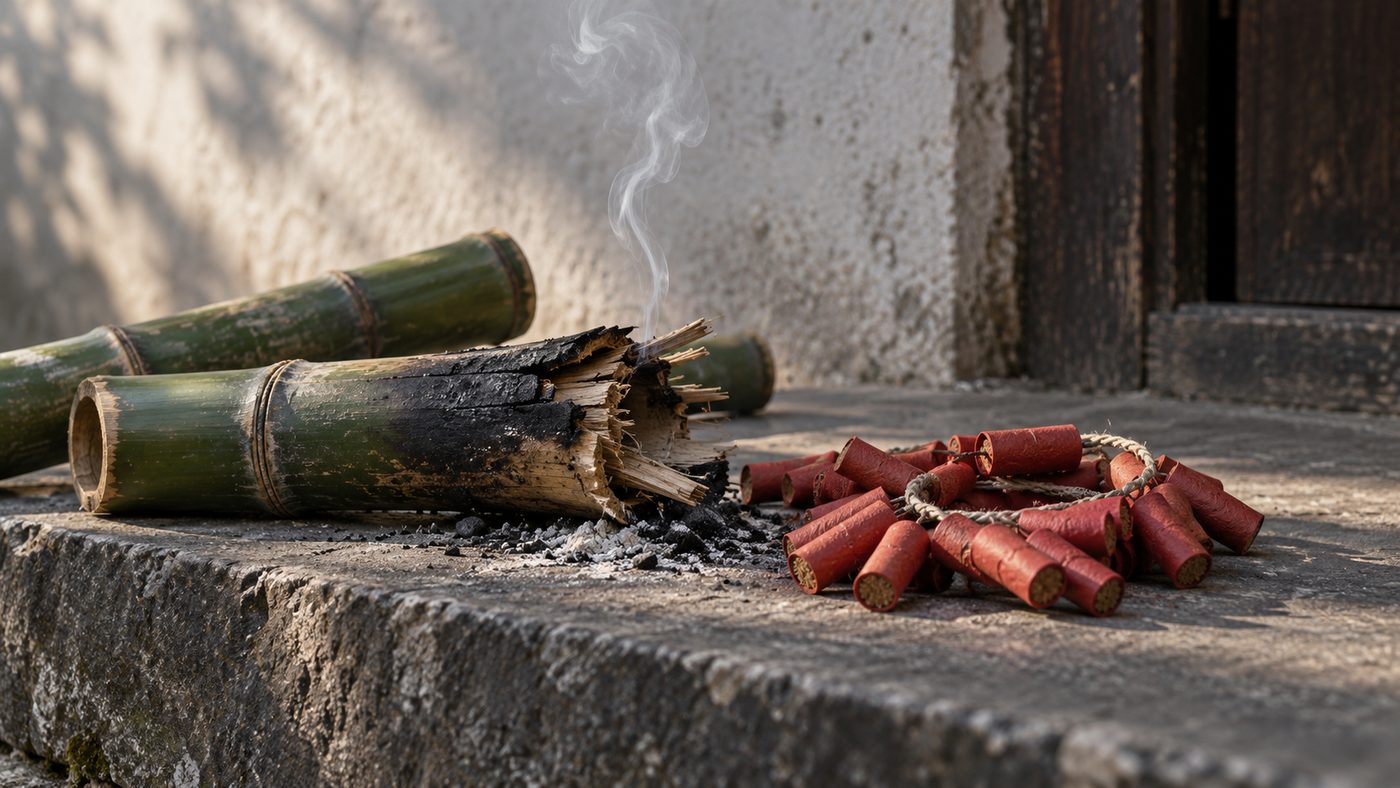
A length of green bamboo split and charred by fire on a stone step beside a pile of small red paper firecrackers tied on a cord, a wisp of smoke rising in winter light.
Bamboo split by the fire, and the paper crackers that replaced it. Illustration.

Firecrackers through the texts

The history can be read in a handful of books, each catching the custom at a different stage. The sections below take them one at a time.

A timeline of Chinese firecrackers from the bamboo of the Shenyijing to the 2023 ruling on city bans, with the text that records each stage and what it says.
When Text What it records
Han name, later book Shenyijing (Classic of Divine Marvels) A foot-tall mountain creature, the Shansao, is frightened off when bamboo is put in the fire and bursts with a bang.
6th century Zong Lin, Jingchu Suishiji On New Year’s Day, rise at cock-crow and set off firecrackers in the courtyard first, to drive off the Shansao and evil ghosts.
1044 Wujing Zongyao (military manual) The first printed gunpowder recipe: sulfur, saltpeter and charcoal, for weapons.
1147 Meng Yuanlao, Dongjing Menghua Lu In Kaifeng’s court shows a bang “like a thunderclap,” called baozhang, cues masked ghosts and a Zhong Kui; on the eve the palace’s firecrackers are heard outside the walls.
1180s Fan Chengda, “Ballad of the Firecrackers” Around Suzhou, five-foot lengths of real bamboo are still roasted and smashed on the steps, on the night of the 25th of the twelfth month.
late 1200s Zhou Mi, Wulin Jiushi Hangzhou’s palace gets firecrackers shaped like fruit and figures, and a screen painted with Zhong Kui hiding a fuse that sets off “a hundred and more without a break.”
1900 Fucha Dunchong, Yanjing Suishiji Beijing lights baozhu after midnight on New Year’s Day and bianpao for the god of wealth “day and night without stopping.”
1972 Singapore, Dangerous Fireworks Act Firecrackers banned after a 1972 attack on two policemen.
1993 to 2005 Beijing A ban that many Chinese cities copied, lifted in September 2005.
2023 NPC Standing Committee, Legislative Affairs Commission National law has no blanket ban; local total bans should be revised.

Exploding bamboo

Bamboo is a row of hollow chambers sealed off from each other at the joints. Put a green length in a fire and the air and sap inside each chamber heat with nowhere to go, until a wall gives way with a sharp report. No chemistry is needed beyond a stove and a bamboo grove, which most of southern China has always had.

The best description of how it was done comes surprisingly late, from the poet Fan Chengda, who retired to Stone Lake outside Suzhou in the 1180s and wrote ten poems on the year-end customs of the farming families around him. The fifth is the "Ballad of the Firecrackers," and it reads like a set of instructions. After the bean porridge has been eaten and the dust swept, you cut lengths of bamboo five feet long and roast them over firewood. When sap starts to sweat out at the joints and the heat has gone right through, a strong servant grabs one and runs; the children step back out of range; he smashes it on the ground at the foot of the steps, and it roars like thunder. "One bang, two bangs, and the hundred ghosts take fright; three bangs, four, and their nests fall in." At ten bangs, a hundred, the gods are at peace, and everything in the eight directions is calm.

Then the detail I like best: the family picks up the scorched ends and stacks them under the bed, where "they still have power enough to drive off sickness." Nothing in the New Year went to waste, not even the spent ammunition.

Fan's preface adds two facts. The custom was found in other prefectures too, but was strongest in Wu, the Suzhou region. And the date had moved: "in the old days it was on New Year's morning, but in Wu it is the night of the 25th" of the twelfth month, the evening after the Kitchen God is seen off. That puts real bamboo in the fire well over a century after gunpowder had a published recipe, which is a useful reminder that inventions do not sweep the countryside overnight.

What the noise was for

The Jingchu Suishiji, Zong Lin's sixth-century record of the year in the middle Yangtze, opens its New Year with the firecrackers. On the first day of the first month, everyone rises at cock-crow, and the first thing they do is set off firecrackers in the courtyard "to drive away the Shansao and evil ghosts."

The commentary on the book explains the Shansao by quoting an older collection of marvels, the Shenyijing, and the full entry there is a treat. Deep in the western mountains, it says, lives a manlike creature a foot or so tall, naked, which catches shrimp and crabs. It is not afraid of people. When it sees travelers stop for the night, it comes to their fire after dark to roast its catch, and when nobody is looking it steals their salt to season it. Anyone who offends it comes down with chills and fever. But people had found its weakness: they put bamboo in the fire, it burst with a crack, and the Shansao fled in terror.

So the loudest custom in the Chinese year was aimed at a knee-high shellfish poacher with a talent for malaria. Our page on the Nian tells how a far grander monster, first written down in 1933, took the credit.

The Shenyijing itself needs a caution. It carries the name of Dongfang Shuo, a wit at the court of Emperor Wu of Han in the second century BC, but the editors of the eighteenth-century imperial library catalogue rejected that outright: the book is not in the Han court's own list of his writings, and the commentary credited to Zhang Hua is not in Zhang Hua's biography either. It is a later book in borrowed clothes. That makes the sixth-century Jingchu Suishiji, not the "Han" marvel book, the first text we can actually date for the New Year bang.

The same commentary records a second explanation, and a pointed one. Some people, it says, held that firecrackers and burning grass came from the great torches lit in the royal courtyard, and that ordinary households had no business copying a king's rite. Whether or not anyone listened, the households won.

From bamboo to gunpowder

Gunpowder is Chinese, and its first printed recipe is a weapon. The Wujing Zongyao, a military manual presented to the Song court in 1044, gives a formula of sulfur, saltpeter and charcoal with pitch, lacquer and oils, packed into incendiary balls. A bang for its own sake comes into the record a few generations later.

Meng Yuanlao, writing in 1147 about the Kaifeng he had lost to the Jin invasion, describes the military displays staged for the emperor. In the middle of mock fights with spears, swords and shields, "suddenly there was a sound like a thunderclap, called a baozhang," and the shield fighters withdrew into a burst of smoke, out of which came performers masked as ghosts, spitting fire. A few bangs later, a masked figure "like the image of Zhong Kui" danced in. The firecracker had become a stage cue. On New Year's Eve the same book has the palace holding its great exorcism procession, after which "that night in the palace there were firecrackers and cheering, heard outside the walls."

The real leap is in Hangzhou, the southern capital, in Zhou Mi's memoir of its last decades. At court at the end of the year, he writes, there were firecrackers made in every shape, some like fruit, some like little figures. And the palace command presented a screen painted on the outside with Zhong Kui catching ghosts, which hid a fuse inside: "light it once, and a hundred and more go off in a row without a break." That is the firecracker string, wrapped in the image of the demon queller, more than seven hundred years ago. In the city outside, households kept up firecrackers and drums all night, and the noise had its own name, "deafening the hall."

Put Zhou Mi beside Fan Chengda and the picture is clear. In the same century, the court had fused strings of gunpowder crackers and the farmers outside Suzhou were still roasting bamboo and running with it. The word stayed with the bamboo.

The string, the red paper and the names

Three words cover the history. Baozhu, exploding bamboo, is the oldest, and it is the word in Wang Anshi's eleventh-century New Year poem that every Chinese schoolchild learns, which opens with the old year ending "amid the sound of firecrackers." Baozhang is the Song word for the gunpowder bang. And 鞭炮 bianpao, roughly "whip-crackers," is the everyday word for the long strings, which go off with the rattle of a cracking whip.

Fucha Dunchong's Annual Customs of Beijing of 1900 uses the words side by side, and shows how much of the year they filled. On New Year's Day, just after midnight, the city lights incense and sets off baozhu to receive the gods, "lane after lane, without pause." On the second day, the god of wealth gets bianpao "in great numbers, day and night without stopping." On Little New Year they are "extremely many." On the 24th of the sixth month, the birthday of Guan Yu, the god of war, "the bianpao are no fewer than at New Year." The same book lists the firework stalls of the Lantern season and the names of their wares, among them the double-kick, which bangs once on the ground and again in the air.

The color is the other half of it. B.D. Wilson, a colonial officer in Hong Kong from 1948 to 1983, describes a big shop opening ending with a long string hung from the end of a bamboo pole held at forty-five degrees and lit from the bottom, so that the explosions climbed the string one by one. Afterward the ground was covered in pieces of red paper, crackers being always red, the lucky color, and the street wreathed in smoke. The bigger and richer the opening, the longer the string had to be.

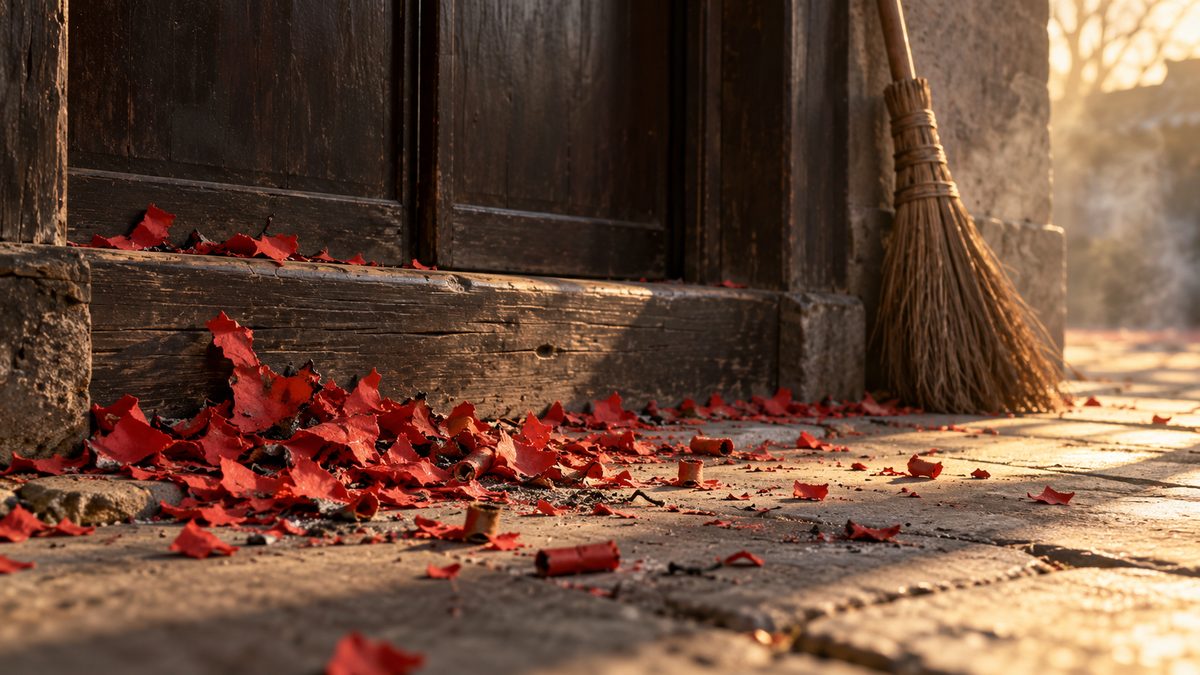
At New Year that red carpet lands on the morning of the first day, which is the one day of the year you are not supposed to sweep, in case the new luck goes out with the dust. Our page on Chinese New Year taboos has the sixth-century story behind that rule.

Scraps of spent red firecracker paper heaped against the wooden threshold of a closed door in low morning sun, a straw broom leaning unused beside it.
The first morning: red paper at the door, and the broom left alone. Illustration.

Not only at New Year

Once the noise meant "evil out," it soon also meant "something good is starting," and the occasions multiplied. Wilson lists them for 1950s Hong Kong: the opening of a new business, births and marriages, "any occasion that was the beginning of a new enterprise." In Beijing the god of wealth was welcomed with them on the second day; in the south he comes on the fifth, and households compete to be the first to set them off at dawn (our page on Caishen has the scramble). The lion dance works the same way, its drums and crackers doing with noise what the lion does with its glare.

Underneath it all is the idea of the very first text. A loud enough bang clears the air, and whatever comes next can start clean.

The bans

The trouble with a custom that is meant to be frightening is that it works. In the twentieth century, the cities with the densest Chinese populations started to count the eyes, hands and houses it cost, and one after another they banned it.

Hong Kong comes through the account of the officer quoted above. In the 1960s Wilson called a meeting of the fire brigade's chief officer and the medical department, and all of them pressed for a ban; the manufacture of fireworks was already illegal in the colony, and explosions at the factories across the water in Macao showed why. He expected the government to refuse, and it did, for fear that, with riots already behind it, a ban would give an excuse for more unrest. It was "several years" before it felt the public would accept one, and then it sweetened the ban with an official fireworks display over the harbor at Chinese New Year.

Singapore had a cracker war. In 1970, according to Culturepaedia, the Singaporean encyclopedia of Chinese culture, the Ming Court Hotel bought over half a million firecrackers to compete with the new Hilton, whose string hung 26 stories high. In 1972 two unarmed policemen were attacked with firecrackers, and that year the Dangerous Fireworks Act banned them for good. When firecrackers were set off in Chinatown on New Year's Eve 2004, with permits and safety precautions, 20,000 people came to hear the first ones in 32 years.

Beijing banned them in 1993, and many cities across China followed. Twelve years later, in September 2005, Beijing gave up and lifted the ban, moving to limits on where and when, though air pollution brought tighter rules again, including a 2017 plan to close everything inside the Fifth Ring Road. In December 2023 the legislative affairs commission of the National People's Congress weighed in: national law, it said, contains no blanket ban on fireworks that meet the standards, opinions on total bans are divided and they are hard to enforce, so local rules should be revised in the spirit of the higher law. The decision has gone back to each city, and every year the argument starts again in the weeks before the New Year.

Both sides of that argument are, in a way, making the same case the Jingchu Suishiji made. The noise is meant to keep harm away from the household. The question a modern city asks is only which harm is closer: the Shansao, or the firecracker.
Questions people ask

Why do Chinese people set off firecrackers at New Year? +

To drive bad things away and to announce the new year. The oldest New Year text, the sixth-century Jingchu Suishiji, says families rose at cock-crow on New Year’s Day and set off firecrackers in the courtyard first of all, to frighten off the Shansao, a one-legged mountain creature that gave people fevers, and other evil ghosts. Over the centuries the bang also became plain celebration: it is set off for weddings, births, shop openings and the god of wealth.

What is the meaning of firecrackers in Chinese New Year? +

Protection first, then luck. The noise is meant to scare off demons and the bad luck of the old year, and the red paper left on the ground is the lucky color. The Chinese word baozhu means "exploding bamboo," because the first firecrackers were lengths of green bamboo thrown on a fire, which burst with a bang as the sealed segments heated.

Were firecrackers invented in China? +

Yes. Before gunpowder there was bamboo: lengths of it roasted until they burst, recorded in Chinese texts from at least the sixth century. Gunpowder, also Chinese, has its first printed recipe in a military manual of 1044, and by the 1100s the court shows in Kaifeng used a gunpowder bang called baozhang. By the late 1200s Hangzhou had strings of a hundred or more crackers on one fuse.

Is the Nian monster the reason for firecrackers? +

That is the popular story, but it is young. The Nian beast frightened by red and noise first appears in print in 1933. The firecrackers are at least fourteen centuries older, and the old texts aim them at a different creature, the Shansao, a foot-tall mountain demon that roasted crabs at people’s fires and stole their salt.

Why are firecrackers banned in Singapore? +

Singapore banned them in 1972 under the Dangerous Fireworks Act. The Chinese New Year bangs had grown into rivalries between businesses (in 1970 the Hilton hung a string of firecrackers 26 stories high), and the last straw was an attack on two unarmed policemen with firecrackers in 1972. The ban still stands, with permitted exceptions such as the Chinatown display on New Year’s Eve 2004, the first in 32 years.

Are firecrackers banned in China? +

Not nationally. Beijing banned them in 1993 and many cities followed, then Beijing lifted its ban in 2005 and moved to limits on where and when. Many cities tightened again over air pollution. In December 2023 the legislative affairs commission of the National People’s Congress said national law contains no blanket ban on compliant fireworks and that total local bans should be revised, so the rules are now set city by city.

What is the difference between baozhu and bianpao? +

Baozhu, "exploding bamboo," is the old word and the literary one; it is the word in Wang Anshi’s famous New Year poem. Bianpao, roughly "whip-crackers," is the everyday word for the long strings that go off in a crackling run. A Beijing book of customs from 1900 uses both: baozhu for New Year’s Day, bianpao for the god of wealth on the second.

Sources and further reading

More of the New Year

  • Chinese New Year All sixteen days, dated and explained, from the eve to the Lantern Festival.
  • The Nian The beast the firecrackers are said to scare, and how young its story is.
  • Lion dance Drums, gongs, crackers and a lion that eats lettuce.
  • New Year taboos No sweeping, no hair washing, no broken bowls, and why.
  • Decorations Why everything is red, and what goes on the door.

Stay in the loop.

Chinese mythology, the zodiac, and the meaning behind names and symbols, rooted in the classics and read back to you. No spam. Unsubscribe anytime.