The Chinese year

The Laba Festival: a bowl of porridge that starts the New Year

The Laba Festival falls on the eighth day of the twelfth lunar month, which next lands on Friday, January 15, 2027. On it, people eat a thick sweet congee of eight or more grains, beans, nuts and dried fruits; temples cook the same porridge in cauldrons and hand it out to anyone who queues; and in the north a jar of peeled garlic goes into vinegar to turn green in time for New Year's Eve. The name means "the eighth of La," La being the old name of the last month and, before that, of a year-end sacrifice to every god at once. It is the smallest festival on this site and the one with the longest shadow, because once Laba is past, every Chinese child knows, the New Year has begun.

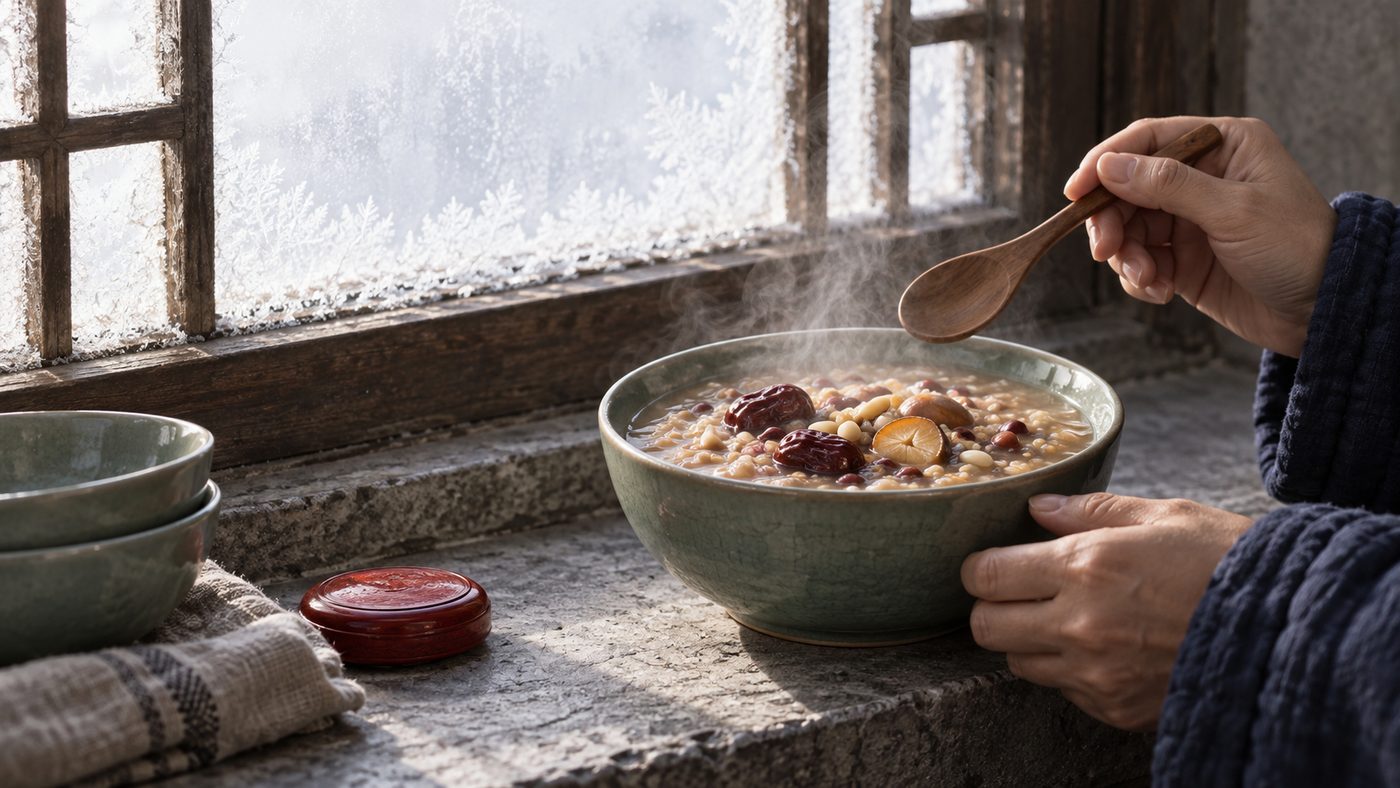
A celadon bowl of thick mixed-grain porridge studded with red dates and chestnuts steams on a frosty stone windowsill in soft winter light while a hand in a padded indigo sleeve holds a wooden spoon above it.
The coldest week of the year and the warmest bowl. Illustration.

When it falls, 2020 through 2036

Always the eighth of the twelfth month on the Chinese calendar, and on the western one anywhere from late December to late January, because the twelfth lunar month straddles the western new year. That produces a wrinkle the other festivals on this site do not have: lunar-year 2022's Laba fell on December 30, 2022, so 2022 had two Labas and 2023 had none. The table is labeled by the western year each date lands in, with the lunar year beside it. The dates are computed from the same engine that runs our calendar converter.

Gregorian date of the Laba Festival for each lunar year from 2019 to 2035.
Year Laba Festival Lunar year
2020 Thursday, January 2, 2020 12th month of 2019
2021 Wednesday, January 20, 2021 12th month of 2020
2022 Monday, January 10, 2022 12th month of 2021
2022 Friday, December 30, 2022 The latest in this table. 12th month of 2022
2024 Thursday, January 18, 2024 12th month of 2023
2025 Tuesday, January 7, 2025 12th month of 2024
2026 Monday, January 26, 2026 12th month of 2025
2027 Friday, January 15, 2027 The next one. 12th month of 2026
2028 Tuesday, January 4, 2028 12th month of 2027
2029 Monday, January 22, 2029 12th month of 2028
2030 Friday, January 11, 2030 12th month of 2029
2031 Wednesday, January 1, 2031 The earliest in this table. 12th month of 2030
2032 Tuesday, January 20, 2032 12th month of 2031
2033 Saturday, January 8, 2033 12th month of 2032
2034 Friday, January 27, 2034 12th month of 2033
2035 Tuesday, January 16, 2035 12th month of 2034
2036 Saturday, January 5, 2036 12th month of 2035

Where you meet it now

In Beijing the day begins in a queue. Yonghegong, the Lama Temple, cooks Laba porridge in quantity and ladles it out to whoever comes, and so do Guanghua Temple, Tanzhe Temple and a dozen others; China Daily's report on the 2026 festival describes the crowds and singles out Yonghegong's as the most anticipated. People post their bowls afterward the way other cities post latte art. The bowl itself varies by region: the northern version is thick and hearty and comes with pickled Laba garlic on the side, the Jiangnan version is lighter and sweeter, and in the northwest they put lamb in it, which sounds wrong until you have stood outside in Lanzhou in January.

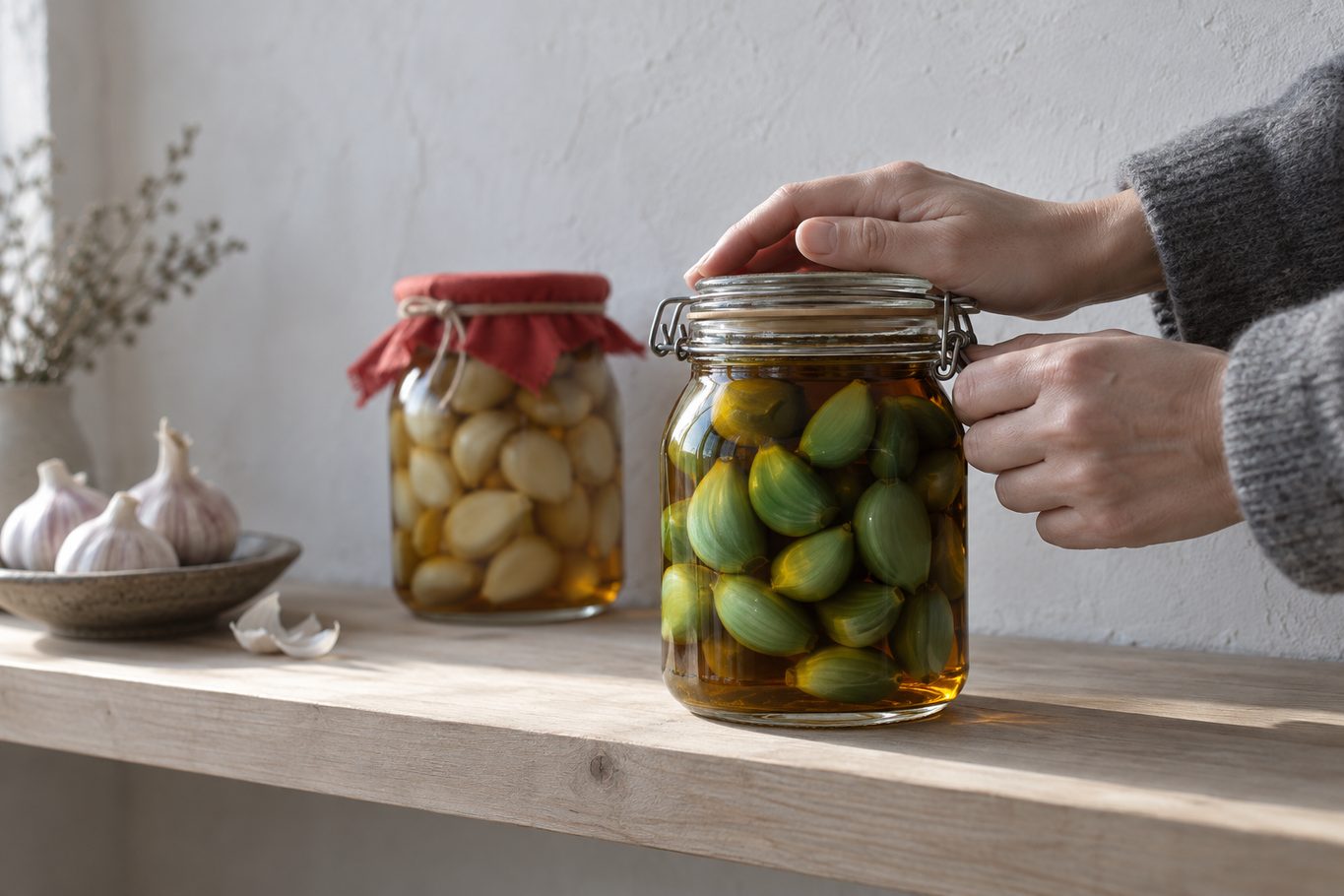
The garlic is the other thing the day is for. On Laba, northern households peel a head or two of garlic, drop the cloves into a jar of vinegar, and put the lid on. Xinhua's explainer gives the schedule: the garlic pickles "for more than 20 days before the Chinese New Year," by which time it "turns emerald green," and it is eaten with dumplings on New Year's Day. The color is the garlic's own reaction to cold and acid, and the jar on the windowsill is a calendar you can watch: when the cloves are jade all the way through, it is time to make the dumplings.

A glass jar of garlic cloves turned translucent jade-green in dark vinegar glows in cold side light on a pale wooden shelf, a hand resting on its lid, a second jar of still-pale cloves out of focus behind it.
Laba garlic: three weeks in vinegar and the cloves go green. Illustration.

And then there is the rhyme, which every Chinese child can finish and which is the real reason a two-hundred-search-a-month festival gets a page here: "Little one, little one, don't be greedy; once Laba is past, it's the New Year." The twelfth month fills up behind the porridge. The kitchen god is sent off on the twenty-third or twenty-fourth, the house is swept, the couplets go up, and New Year's Eve arrives three weeks after the bowl. The festivals page lays the whole sequence out for this year and next; Laba is where it starts, and the sixteen days of the New Year itself are where it ends.

The recipe, from a man who cared

The fullest old description of the bowl is in the Yanjing Suishiji, a record of Beijing's year completed in 1900 by a Manchu official named Fucha Dunchong, and it reads like someone who had been served a bad one. Laba porridge, he says, is made from yellow millet, white rice, glutinous rice, small millet, water-chestnut meal, chestnuts, red beans and peeled date paste, cooked together in water; it is then decorated with walnuts dyed red, almonds, melon seeds, peanuts, hazelnuts and pine nuts, with white sugar, brown sugar and small raisins. Then the sentence that tells you he meant it: "On no account use lotus seeds, hyacinth beans, Job's tears or longan; they spoil the taste." That is the porridge equivalent of an Italian on the subject of cream in carbonara, and it is more than a century old.

He also gives the timetable. On the seventh, households shell the nuts and wash the pots and "work through the night, so that at daybreak the porridge is done." Some of it goes to the ancestors and the Buddha; the rest is sent round to relatives and friends, and "it must not pass noon," because a Laba porridge that arrives in the afternoon is an insult. Skilled households shaped the dates and walnuts on top into lions and little children "to show their ingenuity," and every gift bowl came with a side of pickled cabbage, about which the book makes the most Beijing observation in the whole calendar: "the quality of the cabbage foretells the rise or fall of the house." The court did it too, on a different scale. An older gazetteer he quotes says the emperor "presented porridge to the hundred officials" on the eighth, and at Yonghegong the lamas cooked through the night of the eighth for the Buddha in a pot "big enough to hold several dan of rice," with a minister specially sent to watch and make sure it was done with proper reverence. The temple still cooks. The minister has been replaced by the crowd.

Why the month is called La

The eighth is the easy half of the name. La, the twelfth month, is named for a sacrifice, and the sacrifice is older than the date. The Shuowen Jiezi, the dictionary finished around 100 CE, defines la as "the sacrifice to all the gods, on the third xu day after the winter solstice." Read that again: not the eighth of anything, but a day counted on the sixty-day cycle from the solstice, which means it moved from year to year, a great year-end feast for every spirit at once at which the leftovers, presumably, were considerable. Cai Yong, a Han scholar, listed what each dynasty had called it: jiaping under the Xia, qingsi under the Shang, the great zha under the Zhou, and la under the Han. The same word gives Chinese its name for cured winter meats, làròu, which is what you did with a pig in the La month.

By the sixth century the moving feast had a fixed address. The Jingchu Suishiji, an almanac of the middle Yangzi written by Zong Lin, states flatly that "the eighth day of the twelfth month is La day," and then describes what it looked like in a village: the proverb "when the La drum sounds, the spring grass grows," and the villagers tying on waisted drums, putting on "Hu-gong heads," a kind of mask, dressing as the Buddhist guardian giants, and going out to drum the plague out of the settlement before bathing to wash off the year's sins. That is the festival before it had a porridge: noise, masks and disinfection at the turn of the year, the same instinct that gives you firecrackers three weeks later.

The porridge was already lurking a few weeks earlier in the same almanac. At the winter solstice, Zong Lin says, people made a red-bean congee "to ward off plague," and he explains why: a son of the god Gonggong, a wastrel, died on the solstice and became a plague ghost, and the ghost is afraid of red beans. A warm bowl of beans against midwinter sickness, then, was there in the sixth century, on a different day, for a different reason, waiting for a better story.
Where the porridge came from

The better story was Buddhist, and the first person to write down the name "Laba congee" is Meng Yuanlao, remembering the lost Song capital of Kaifeng in the 1140s. On the eighth of the twelfth month, he says, small bands of monks and nuns went through the streets chanting, carrying a gilt or wooden Buddha seated in a basin of scented water, sprinkling it with a willow branch from door to door and asking for alms; the great temples held bathing-the-Buddha assemblies "and gave a seven-treasure, five-flavor congee to their followers, which is called Laba congee." And then the line that shows it had already jumped the temple wall: "on that day the people of the capital also each boiled a porridge of fruits and mixed ingredients at home and ate it."

Why that day? Because Chinese Buddhism fixed it as the morning the Buddha attained enlightenment. The Chixiu Baizhang Qinggui, the imperially revised rulebook for Chan monasteries compiled in 1336, sets out the liturgy: on "the eighth day of the La month, the day our teacher Shakyamuni Tathagata attained the Way," the abbot leads the monks in laying out "incense, flowers, lamps, candles, tea, fruit and fine foods" as an offering, and the announcement recalls how "before the mountain of perfect awakening he saw the morning star and awoke." The folk version, which Xinhua still tells, adds a village girl who saved the fasting prince with a bowl of milk, which is why the day is kept with a bowl of something warm. No early text records the girl; treat her as the story the porridge tells about itself, and the temple offering as the record.

The mice who robbed the temple

By the eighteenth century the porridge was so ordinary that a novelist could use it for a joke. In chapter nineteen of Dream of the Red Chamber, Baoyu, lying on a bed trying to keep his cousin Daiyu from napping, makes up a story. In a cave in Yangzhou lived a tribe of mouse spirits. "That year, on the seventh of the La month, the old mouse took his seat to hold council and said: 'Tomorrow is Laba, and everyone in the world will be boiling Laba porridge. Our stores of fruit are running low; we had better take this chance to go and plunder some.'" A scout reports that the temple at the foot of the hill has the most, with granaries of rice and beans past counting and five kinds of fruit: red dates, chestnuts, peanuts, water chestnuts and fragrant taro. The old mouse hands out arrows of command, and one by one the mice go off to steal rice, beans, dates, chestnuts.

Only the taro is left, and the smallest, weakest mouse volunteers. The others laugh. The little mouse explains that it will not steal like the rest but will transform itself into a taro, roll into the pile, and carry the store away from the inside; the others demand a demonstration; it shakes itself and turns, not into a taro, but into a beautiful young lady. "Wrong, wrong," cry the mice. "The daughter of Salt Commissioner Lin," says the little mouse, "is the real fragrant jade." Daiyu, whose father is Salt Commissioner Lin and whose name means "black jade," sits bolt upright and attacks him. The pun does not survive translation; the recipe does. Dates, chestnuts, peanuts, water chestnuts, taro: it is Fucha Dunchong's list, a century and a half earlier, minus the things that spoil the taste.

What to say

腊八节快乐

là bā jié kuài lè · roughly “lah bah jyeh kwai luh” · happy Laba

Correct, and slightly formal. What people actually say to each other on the day is "Have you had your porridge?", which is the greeting and the invitation in one.

Questions people ask

When is the Laba Festival in 2027?

Friday, January 15, 2027. Laba is always the eighth day of the twelfth month of the Chinese lunisolar calendar, so on the western calendar it moves, landing anywhere from late December to late January. Across the years in the table on this page it ranges from January 1 (2031) to December 30 (2022), and because the twelfth lunar month straddles the western new year, 2022 had two Labas and 2023 had none.

When was the Laba Festival in past years?

January 26, 2026; January 7, 2025; January 18, 2024; December 30, 2022; January 10, 2022. These are computed from the lunar calendar by the same engine as our calendar converter, not copied from a list, so they agree with it to the day.

What is the Laba Festival?

The eighth day of the twelfth lunar month, called Laba (là bā, "La eighth") because the twelfth month is the La month, named for a year-end sacrifice older than the calendar it sits in. On the day, families eat a thick congee of eight or more grains, beans, nuts and dried fruits, temples hand out the same porridge to anyone who lines up, and northern households drop peeled garlic into vinegar to pickle for the New Year. It is the first date on the road to Chinese New Year; the saying is that once Laba is past, the year has begun.

What is Laba congee, and what is in it?

A sweet porridge of many grains and dried fruits, named in a description of Song-dynasty Kaifeng written in the 1140s, where the great temples gave a "seven-treasure five-flavor congee" to their followers and every household boiled its own from "fruits and mixed ingredients." The fullest old recipe is from a record of Beijing customs completed in 1900: yellow millet, white rice, glutinous rice, small millet, water-chestnut meal, chestnuts, red beans and peeled date paste cooked together, then decorated with dyed-red walnuts, almonds, melon seeds, peanuts, hazelnuts, pine nuts, white and brown sugar and small raisins. The same text bans four ingredients as taste-spoilers: lotus seeds, hyacinth beans, Job’s tears and longan. Modern bowls generally have at least eight ingredients, hence the "eight-treasure" nickname.

Why do people eat congee on Laba?

Two roots, one older than the other. The Chan monastic rulebook compiled in 1336 marks the eighth of the twelfth month as the day the Buddha "saw the morning star and awakened," and the 1140s Kaifeng account already has the temples handing out porridge on that day, so the temple bowl is at least nine hundred years old. Underneath it is an even older habit: a sixth-century almanac records a red-bean congee eaten at the winter solstice, a few weeks earlier, to ward off a plague ghost who was afraid of red beans. A warm bowl against the cold and the sickness of midwinter was there before the Buddhist date gave it a name.

What is Laba garlic?

Peeled garlic cloves dropped into a jar of vinegar on Laba and left for three weeks or so, by which time they have turned a translucent jade green and lost most of their bite. Xinhua describes the practice as the day "to put garlic in vinegar, to pickle for more than 20 days before the Chinese New Year," after which "the garlic turns emerald green" and is eaten with dumplings on New Year’s Day. The green is a natural reaction in the garlic to cold and acid, not a dye, and the habit is mostly northern.

What does the name Laba mean?

Bā is eight, for the eighth day. Là is the name of the twelfth lunar month, and the month is named for a sacrifice. The Shuowen Jiezi, the dictionary finished around 100 CE, defines la as the sacrifice "to all the gods on the third xu day after the winter solstice," a year-end feast for the spirits that moved with the sixty-day cycle before it settled on the eighth. The same word gives Chinese its name for cured winter meats, làròu, which were made in the La month.

Is Laba the start of Chinese New Year?

Not officially, but everyone treats it as the starting gun. The children’s rhyme says that once Laba is past, the New Year has come, and the twelfth month fills up behind it: the kitchen god is sent off on the twenty-third or twenty-fourth, houses are cleaned, couplets go up, and New Year’s Eve arrives three weeks after the porridge. Our festivals page lays out that whole sequence for this year and next.

Do temples really give away Laba porridge?

Yes, and in Beijing the lines are an event. Yonghegong, the Lama Temple, cooks and distributes Laba porridge every year, as do Guanghua Temple, Tanzhe Temple and others, and the crowds are large enough that the city papers cover them. The habit is old: the 1900 record of Beijing customs says the lamas at Yonghegong boiled porridge for the Buddha through the night of the eighth in a pot that held "several dan of rice," with a minister sent by the court to watch.

How do you say happy Laba Festival in Chinese?

Là bā jié kuài lè, roughly "lah bah jyeh kwai luh." Chinese people more often just ask whether you have had your porridge yet, which on the day is the real greeting.

Keep going

Sources

The Shuowen entry, the Jingchu Suishiji, the Dongjing Menghua Lu, the Baizhang Qinggui, the Yanjing Suishiji and chapter nineteen of the novel were read directly in the Chinese; the quotations are our own plain renderings. Festival dates in the table are computed by the site's own lunisolar engine rather than taken from a published list.

Stay in the loop.

Chinese mythology, the zodiac, and the meaning behind names and symbols, rooted in the classics and read back to you. No spam. Unsubscribe anytime.