What goes on the door

Spring couplets: which strip goes on the right, and why

A set of Chinese spring couplets is two vertical strips of red paper for the two sides of a doorway and one horizontal strip for above it, and there is a right way round. The upper couplet goes on the right as you face the door, because classical Chinese is read right to left. The way to tell which strip is the upper one is its last character: the upper couplet ends on a tone that sounds unfinished, and the lower couplet ends on one that sounds like a landing. Almost everyone who buys a set in a shop hangs them backwards, because nobody selling them explains that, and because the shortcut people reach for quietly fails on about one couplet in five.

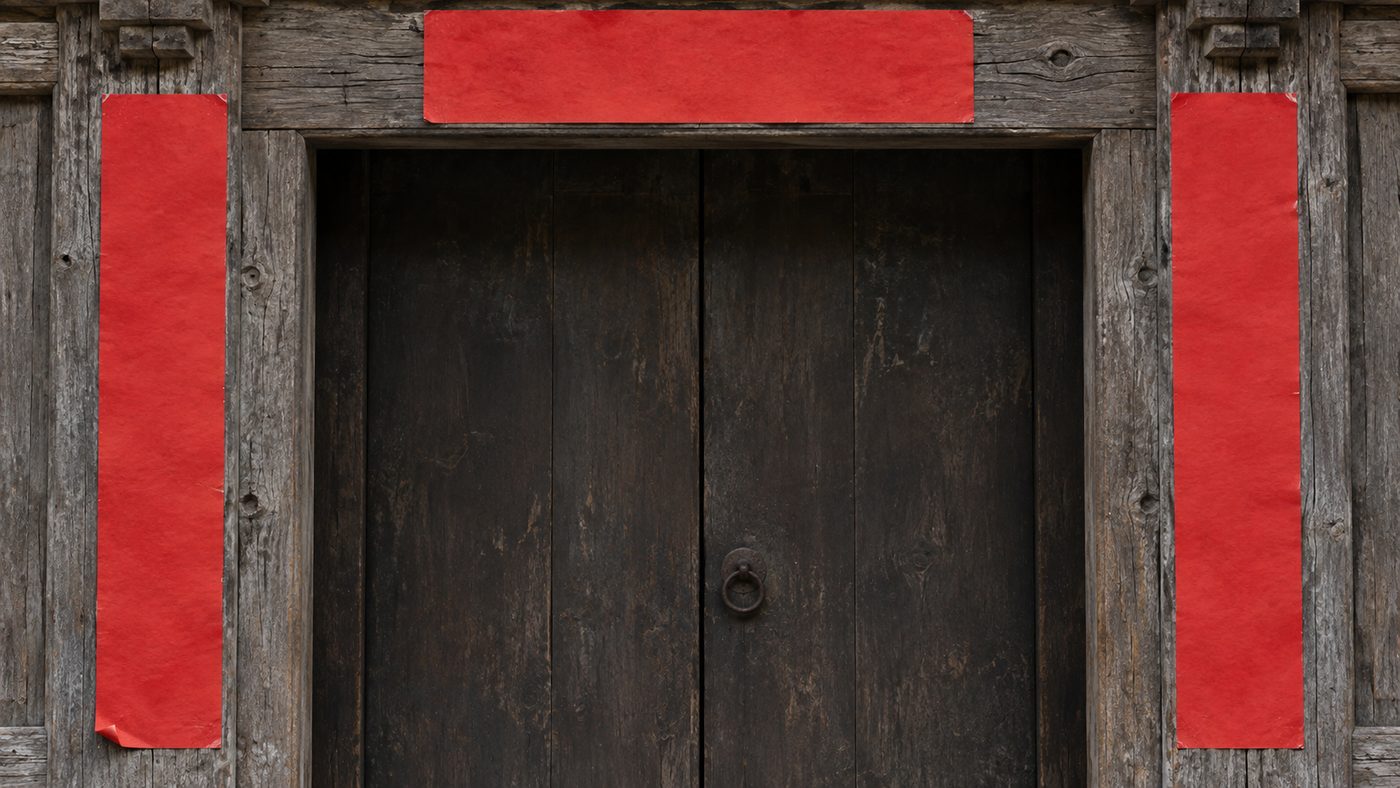
A weathered red door frame with a fresh strip of red paper pasted down each side and one across the top, gold characters brushed on them, seen straight on in flat daylight.
One strip down each side of the frame and one across the top. The right-hand strip is the first line. Illustration.

The rule, in one paragraph

A couplet is a matched pair of lines. The first line is called the upper couplet, the second the lower couplet, and Chinese prosody requires that the two end in opposite tone categories: the upper couplet ends on an oblique tone, the lower on a level tone. The reason is purely musical. A level ending sits flat and finishes the thought; an oblique ending tilts and leaves the ear waiting. You cannot end a couplet on a syllable that leaves the ear waiting, so that syllable has to be the first line.

Translated into the four tones of modern Mandarin, the working test is:

  • Ends in third or fourth tone (dipping or falling): oblique, so this is the upper couplet, and it goes on the right.
  • Ends in first or second tone (level or rising): level, so this is the lower couplet, and it goes on the left.

Say the two final characters out loud, one after the other. One of them will sound like a door left open. That one goes on the right.

Where the test fails

Classical Chinese had a fourth tone category that modern Mandarin lost: the entering tone, a syllable cut short by a hard consonant. Entering-tone syllables count as oblique, and when Mandarin absorbed them it scattered them across all four modern tones, including the two that the test reads as level. The blessing character fu is the common trap: second tone in Mandarin, entering tone classically, and therefore the end of an upper couplet even though the test says otherwise. If both strips end in first or second tone, the tone test has nothing to tell you and you should fall back on the sense: the half that sets the scene comes first.

Cantonese and Hokkien kept the entering tone, which is why a Cantonese speaker can hear the difference instantly and a Mandarin speaker sometimes cannot.

Read the crosspiece first

The horizontal strip above the door, the hengpi, is four characters summarizing the pair below it, and it is the thing to look at before you pick up any glue, because it settles an argument the tone rule cannot.

A traditionally set crosspiece reads right to left, and the couplets below it follow: upper on the right. But a great many modern printed crosspieces are set left to right, like English, because that is how mainland China has printed horizontal text since the middle of the twentieth century. When the crosspiece runs left to right, the couplets should run with it, and the upper couplet goes on the left. Hanging a right-to-left pair under a left-to-right crosspiece is the actual, common, visible mistake, and it is the one a Chinese visitor will notice from the street.

How do you tell which way a crosspiece runs, when both directions use the same four characters? By reading it. Four characters that make sense in one direction and gibberish in the other tell you immediately. If you cannot read it, our calligraphy generator will render any four characters in a real brush font, in order, so you can compare.

Five common couplets, read out

These are the sets sold in every market stall and supermarket aisle in January. For each one: the right-hand strip, the left-hand strip, the crosspiece, and the final character that decides the order.

Right strip, upper couplet

天增岁月人增寿

tiān zēng suì yuè rén zēng shòu

Heaven adds years and months; people add long life

Left strip, lower couplet

春满乾坤福满门

chūn mǎn qián kūn fú mǎn mén

Spring fills heaven and earth; blessing fills the house

Crosspiece 四季平安 sì jì píng ān, peace in all four seasons.

How you know: the right strip ends in 寿 (fourth tone, falling), which is oblique; the left strip ends in 门 (second tone, rising), which is level. The textbook case. Falling tone on the right, level tone on the left, and the modern shortcut gets it right.

Right strip, upper couplet

一帆风顺年年好

yī fān fēng shùn nián nián hǎo

A sail with the wind behind it; good year after good year

Left strip, lower couplet

万事如意步步高

wàn shì rú yì bù bù gāo

Ten thousand things as you wish them; step after step higher

Crosspiece 吉星高照 jí xīng gāo zhào, the lucky star shines high.

How you know: the right strip ends in 好 (third tone, dipping), which is oblique; the left strip ends in 高 (first tone, level), which is level. The most-sold couplet in China, and the easiest to check: third tone against first tone.

Right strip, upper couplet

爆竹声声辞旧岁

bào zhú shēng shēng cí jiù suì

Firecracker after firecracker sees off the old year

Left strip, lower couplet

梅花朵朵迎新春

méi huā duǒ duǒ yíng xīn chūn

Plum blossom after plum blossom welcomes the new spring

Crosspiece 万象更新 wàn xiàng gēng xīn, ten thousand things made new.

How you know: the right strip ends in 岁 (fourth tone, falling), which is oblique; the left strip ends in 春 (first tone, level), which is level. Note the shape as well as the tone: the right half ends the old year, the left half opens the new one. The sense runs right to left too.

Right strip, upper couplet

五湖四海皆春色

wǔ hú sì hǎi jiē chūn sè

Five lakes and four seas, all of it the color of spring

Left strip, lower couplet

万水千山尽得辉

wàn shuǐ qiān shān jìn dé huī

Ten thousand rivers and a thousand hills, all of it caught in the light

Crosspiece 春回大地 chūn huí dà dì, spring returns to the earth.

How you know: the right strip ends in 色 (fourth tone in Mandarin, entering tone in classical prosody), which is oblique; the left strip ends in 辉 (first tone, level), which is level. A near miss. 色 is an entering-tone character, one of the class that vanished from Mandarin; here it happens to have landed in fourth tone, so the shortcut still works. The next one is where it stops working.

Right strip, upper couplet

门迎春夏秋冬福

mén yíng chūn xià qiū dōng fú

The door welcomes the blessing of spring, summer, autumn and winter

Left strip, lower couplet

户纳东西南北财

hù nà dōng xī nán běi cái

The house takes in the wealth of east, west, south and north

Crosspiece 财源广进 cái yuán guǎng jìn, may the sources of wealth flow in widely.

How you know: the right strip ends in 福 (second tone in Mandarin, but an entering tone classically), which is oblique; the left strip ends in 财 (second tone, rising), which is level. The one that breaks the shortcut. Both halves end in second tone in modern Mandarin, so the tone test gives you nothing. 福 was an entering-tone syllable, which counts as oblique, so it is the right-hand half. Cantonese still hears the difference: fuk1 stops dead, coi4 does not.

Want one of these brushed rather than printed? Paste any line into the calligraphy generator and it will render it in a real brush font, vertically, at whatever size you need.

They used to be planks

Before the paper there was wood. Households hung two boards of peach wood on either side of the door, painted with the two spirits who tied up malevolent ghosts and fed them to a tiger, and the boards did the job the red paper does now: they kept things out. Those spirits have their own page, because they later got replaced by two Tang generals and became the door gods.

The changeover is visible in the poem every Chinese schoolchild memorizes. Wang Anshi, writing in the eleventh century, ends his four lines on New Year's Day with a thousand households in the early light "swapping the new peach boards for the old": boards, still, not paper, and the annual replacing of them already a fixed image.

The couplet itself, as a written pair of lines rather than a painted pair of spirits, is usually dated to 964 and credited to Meng Chang, the last ruler of Later Shu, who is said to have had a line brushed on each board: the new year receives the abundance left over; the fine festival is named Everlasting Spring. The detail worth knowing is where that couplet is filed. The Complete Tang Poems does not put it among the poetry. It puts it in book 875, among the portents and prophecies, and the reason is bleak, and both halves of it are in the Song record. Shu fell within months, and the official the Song emperor appointed to govern Chengdu was named Lü Yuqing, whose given name is the same "abundance left over" as the first line. The emperor had already made his own birthday a national festival and called it Changchun, Everlasting Spring, the same two characters that close the second line. The first spring couplet in Chinese history is filed in the anthologies as an accident of prophecy rather than as a piece of writing.

By the Qing the peach board had become the red strip outright. Fucha Dunchong's account of the Beijing year, published in 1906, opens its couplet entry by saying so flatly: the spring couplet is the peach board. He then describes the trade around it, which is the part people forget: from the twelfth lunar month onward, literate men set up under the eaves of the market shops and wrote couplets to order for a fee, and after the kitchen god had been seen off the finished strips went up door by door until the whole city was new.

And one detail that upends the thing everyone knows about couplets. They are red because red is protective, inherited from the boards. But not all of them were. Dunchong records that the imperial household and the imperial clansmen used white paper, bordered in red and blue, and that anyone not of the clan was forbidden to use it. For two and a half centuries the most powerful doors in Beijing were the only ones in the city without red couplets on them.
Hanging them

  1. Read the crosspiece and note which way it runs. That decides everything else.
  2. Find the last character of each vertical strip. Vertical text runs top to bottom, so it is the bottom one.
  3. Say both endings aloud. Dipping or falling means upper couplet. Level or rising means lower couplet. If both come out level, the tone test is exhausted; use the sense, and put the half that sets the scene first.
  4. Hang the upper couplet on the side the crosspiece starts from. Traditional crosspiece, right to left: upper couplet on the right as you face the door. Modern crosspiece, left to right: upper couplet on the left.
  5. Put them on the frame, not the door leaves. The leaves are the door gods' territory, and on a two-leaf gate they swing apart and cut a strip in half.

On timing, custom is looser than the internet suggests. The old Beijing pattern had them going up gradually after the kitchen god's send-off on the twenty-third of the twelfth month, not all at once on New Year's Eve, and they stay up until they fade or until the following year replaces them. Taking them down early is the only thing widely considered unlucky.

The one thing that does not belong on the frame is the blessing character hung on its head. That is a separate object with a separate joke, and it goes on the door, the wall, or a cupboard, never in place of a couplet. Its page explains why it is upside down.

Questions people ask

Which side does the top line of a Chinese couplet go on?

The upper couplet goes on the right as you stand facing the door, and the lower couplet on the left, because classical Chinese is read right to left. The way to tell which strip is the upper one is the last character: the upper couplet ends on an oblique tone and the lower couplet ends on a level tone. In practice that usually means the strip ending in a third or fourth tone goes on the right, and the strip ending in a first or second tone goes on the left.

How do you know which spring couplet is the first line?

Read the final character of each strip. The first line, the upper couplet, ends on an oblique tone, which sounds unfinished, like a question left hanging. The second line ends on a level tone, which sounds like a landing. Say both endings out loud and the one that wants something to follow it is the upper couplet. The exception is a handful of old entering-tone characters, such as the blessing character fu, which are oblique classically but rising in modern Mandarin.

Which way do you read the horizontal scroll above the door?

It depends on when it was printed, and this is where most mistakes happen. A traditional crosspiece is read right to left, matching the couplets below it. A modern one, especially anything printed in the last few decades, is often set left to right like English. Read the crosspiece first, decide which way it runs, and then hang the couplets to match: if the crosspiece reads left to right, the upper couplet goes on the left.

What is the oldest Chinese spring couplet?

The one usually named is from 964, written by Meng Chang, the last ruler of Later Shu, on a peach-wood board: "The new year receives the abundance left over; the fine festival is named Everlasting Spring." The Complete Tang Poems files it not among the poems but among the portents, because after Shu fell to the Song both halves were read as accidental prophecy.

Why are Chinese New Year couplets red?

Red carries the protective function the couplets inherited from the peach-wood boards they replaced, which were hung to keep harm off the door. There was one striking exception. The Qing account of the Beijing year records that the imperial household and the imperial clan used white paper edged in red and blue, and that nobody outside the clan was permitted to use it.

Sources

More of the season: the sixteen days of Chinese New Year, what to say and to whom, and the red envelope.

Stay in the loop.

Chinese mythology, the zodiac, and the meaning behind names and symbols, rooted in the classics and read back to you. No spam. Unsubscribe anytime.