Lucky money

The red envelope: who gives it, how much goes in, and where lucky money came from

A red envelope, hongbao 红包 in Mandarin and lai see in Cantonese, is a small red paper packet with cash inside, handed from the married to the unmarried and from the old to the young at Chinese New Year. The money in it has its own name, yasui qian, "year-pressing money," and the gift is a wish for a safe year, not a payment. How much goes in is the question everyone asks and nobody will answer, so here is the honest version: there is no price list, but there are rules, and the rules are about the number, not the size. Even amounts, eights if you can manage them, never a four, crisp new notes, both hands, and do not open it in front of the person who gave it to you.

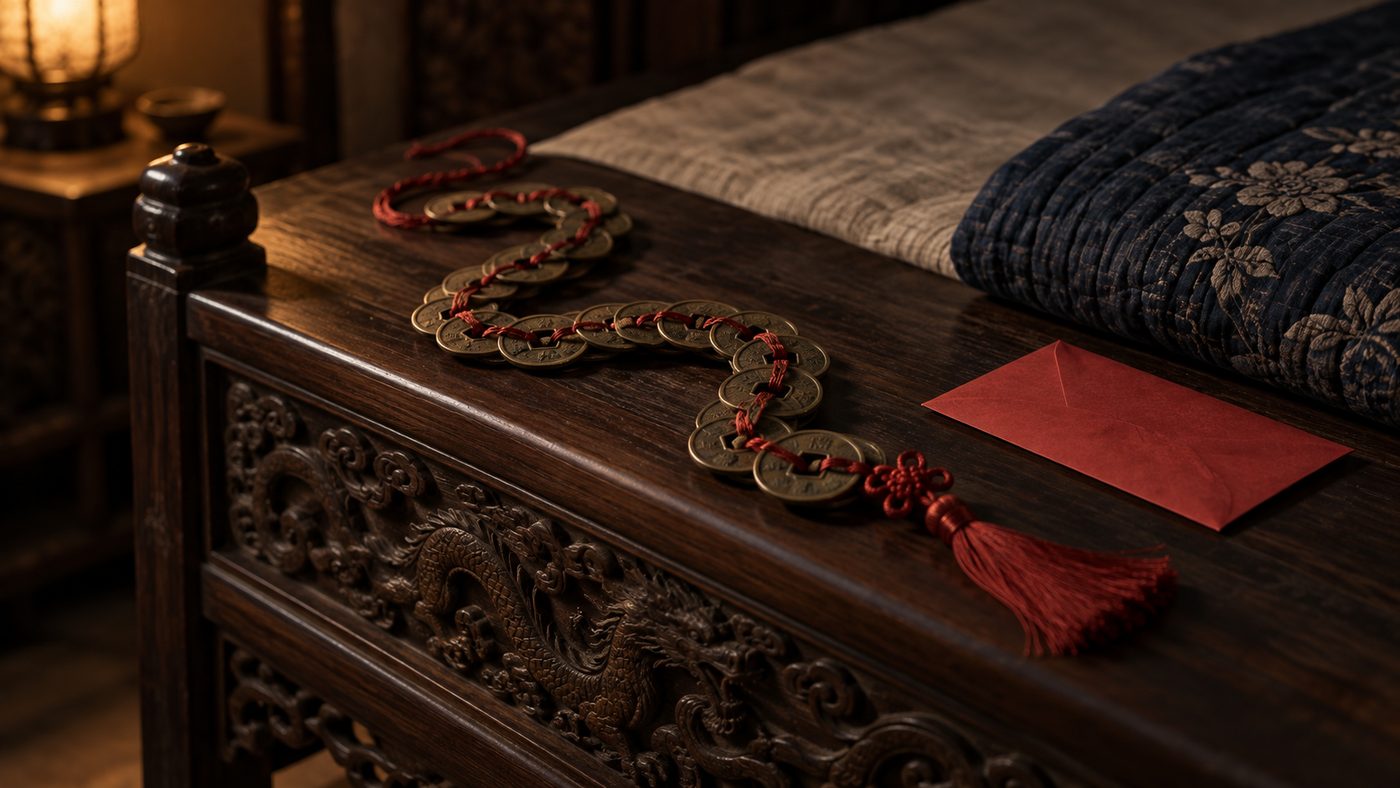
An older pair of hands passing a red paper envelope into a child's cupped hands across a dark wooden table, a stack of red envelopes and a bowl of tangerines beside them, warm side light from a window.
Both hands, always: the envelope is given and received with two. Illustration.

How much goes in

Start with why the question has no answer. The envelope is sealed. It is bad manners to open it in front of the giver, and in Hong Kong the old rule was not to open any of them until the seventh day of the year. The whole design of the custom is that nobody compares amounts in the room, which is what lets an aunt on a pension and an uncle who runs a factory both hand an envelope to the same child without anyone losing face. A fixed rate would break that. So there is none, and any page that gives you one is guessing.

What there is instead is a set of rules about the figure, and they are the same from Harbin to Singapore.

  • Even, not odd. Odd sums are for funerals. The one exception is nine, which sounds like the word for "long-lasting" and is the biggest single digit, so it is welcome.
  • Eights and sixes. Eight sounds like "prosper" in Cantonese, six like "smooth," so 66, 88, 168, 188, 288 and 888 are the amounts that come up again and again.
  • Never a four. Four sounds like "death." No 40, no 400, no 444, and no amount with a four buried in the middle.
  • New notes. Crisp bills, ideally straight from the bank, which is why the queues at Chinese banks in the last week of the lunar year are a national institution. In Malaysia a coin is often added to a child's envelope for extra luck.
  • Notes, not coins, and folded in. The amount should not be guessable from the outside.

Inside those rules, the size scales with closeness, and the table below is the order, not a tariff. Read it as "more than the row below, less than the row above."

Who is receiving From whom Where it sits What the tradition says
Your own children and grandchildrenParents, grandparentsThe largest envelope of the yearThe original gift: the Qing almanac's "elders to children." Given on the eve or the first morning; in Suzhou it goes under the child's pillow or bed and is not spent until the season ends.
Nieces, nephews, cousins' childrenMarried aunts and unclesGenerous but below the parents'The bulk of what a child collects. In the south the giver must be married; in the north the giver must be older.
Your own parentsGrown, working childrenLarge, and rising as you earnThe reversal: once you are earning, the envelope flows up. In Singapore and Malaysia this is the one adults budget for first.
EmployeesThe bossA token, identical for everyoneThe "opening-work" envelope on the first day back. Married managers also hand small ones to junior colleagues.
Friends' children, neighbors' childrenAny married adultSmallA courtesy, not a contribution. The envelope matters, the sum does not.
Doormen, cleaners, helpers, waitersResidents and regularsThe smallest note, many times overCustomary in Hong Kong, Macau, Singapore and Malaysia in the first days of the year; the Hong Kong way is a stack of small envelopes handed out on the way through the lobby.

Two regional facts will save you from the commonest mistakes. In Hong Kong the sums are small and the count is large; a lai see is closer to a tip than to a present, and the same person may hand out dozens between the second day and the fifteenth. In mainland China the sums are the largest in the Chinese world and vary enormously from province to province, with the southeast coast famous for envelopes that would buy a phone and Guangdong famous for the opposite, so a figure that is generous in Guangzhou can look mean in Fuzhou. There is no way around asking someone local, and there is no shame in asking. Hong Kong even legislates the ceiling: under its anti-bribery law a civil servant may accept envelopes from close friends only up to a fixed total per year, and none at all from anyone they deal with at work.

Who gives to whom

The one rule everyone agrees on is direction: the envelope flows from the settled to the unsettled. What "settled" means splits the country in two. In the south, and in Hong Kong, Macau and the Cantonese diaspora, the line is marriage. A married couple gives; an unmarried person receives, at seven and at thirty-seven, which is why the New Year is the season when unmarried adults in Hong Kong are teased about collecting and married ones about paying. Cantonese even has a verb for going round asking, dau lai see, which is what children do to every married adult in reach. In the north the line is generation: elders give to those younger, and the custom is that you stop receiving somewhere around twenty-five, or thirty in the northeast, married or not.

A few other flows are fixed. Employers give staff an envelope for the first working day of the year, the "opening-work" packet, and it is the same for everyone in the office by design. Grown children who have started earning give envelopes upward to their parents, the moment the tradition marks as the real end of childhood. And in the cities of the Chinese south and southeast Asia, the people who keep your building running get one in the first days: the doorman, the cleaner, the helper, the waiter at the restaurant you eat at every week. A lion-dance troupe is paid in red envelopes, so is a temple, so is a doctor who has done you a favor, and so, by an old theatrical superstition, is any actor asked to play a corpse.

The etiquette of the handover is short. Give with both hands, receive with both hands, say the greeting (the page on New Year greetings has the right one for the right person), and put the envelope away unopened. Children used to kowtow for it; a bow, or in a modern family a hug, does the job now.

Hongbao, lai see, ang pow: what it is called

The Mandarin word is plain description: hongbao, "red packet." The money inside, at New Year specifically, is yasui qian 压岁钱, "year-pressing money," and the "pressing" is the interesting part; hold that thought for the history below. In Cantonese the envelope is a lai see, which looks like a different word entirely and is in fact one of the oldest words on this page: it descends from lishi, a term for profitable trade that appears in a merchants' covenant in the Zuo Commentary two and a half thousand years ago, and which survives in the titles of the wealth god. Our page on Caishen follows that word from the covenant to the envelope. In the Hokkien of Singapore, Malaysia and Taiwan it is an ang pow, and in the Philippines, where the custom spread far beyond Chinese families, the word wore down to ampaw.

Where lucky money comes from

The story you will be told, if you ask a Chinese grandmother, involves a demon. A small black creature called the Sui comes on New Year's Eve to touch sleeping children on the forehead and give them fevers; a couple in the south of China frightened it off by wrapping eight coins in red paper and leaving them by the pillow, the coins flashed, the demon fled, and the custom was born. "Pressing the Sui," ya sui, sounds exactly like "pressing the year," and there is your name. It is a good story. It is also a folk tale with no classical source, and the sound-alike is the whole of its evidence, so we will file it where it belongs and go to the texts.

The texts start with coins that were never spent. From the Han dynasty onward, Chinese mints and private casters made amulet coins, cash-shaped pieces with lucky words or zodiac animals on them in place of the reign title, which numismatists call yansheng coins, "coins that press down and overcome." They hung on belts, went into tombs, were tied to cradles. Money as a charm, in other words, is older than money as a New Year present, and the "pressing" in the modern name is very likely this pressing: the weight of a coin holding bad luck down.

The name itself first surfaces in print in the least charming place imaginable. A Qing-dynasty collection of biographies, describing how corrupt officials in the last years of the Yuan dynasty squeezed the people, lists the polite names they gave their bribes by festival: "lantern money" at the Lantern Festival, "dumpling money" at the Dragon Boat, "mooncake money" at Mid-Autumn, and, on New Year's Eve, yasui qian, "year-pressing money." The first lucky money on record was a shakedown.

The custom as we know it is fully described only in the Qing. The Yanjing Suishiji, the almanac of Beijing customs published in 1906, gives it two sentences, and they are worth giving in full because they describe something that no longer exists: coins threaded on colored string, braided into the shape of a dragon and placed at the foot of the bed, and this, it says, is called year-pressing money; what elders give to children, it adds, is called year-pressing money too. So on the eve of a Qing New Year the lucky money was a small dragon of copper cash coiled by the bedpost, a charm first and a gift second. The envelope arrived when the string could not: with the Republic came paper money and coins with no hole in the middle, and the hundred coins on a red cord became a hundred coins wrapped in red paper, then a banknote in a printed red packet. The dragon at the bedpost lived on, shrunk to a coin under a pillow in Suzhou.
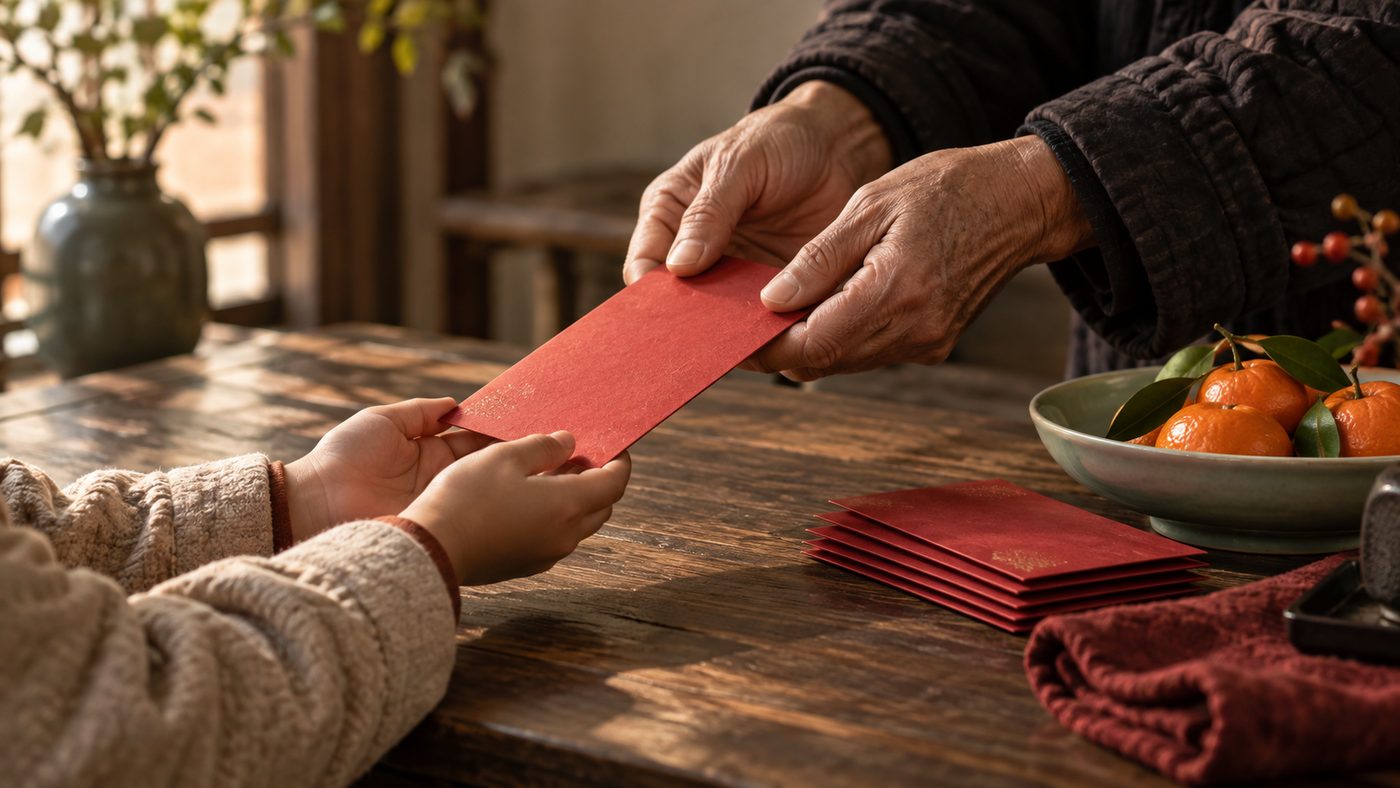
A string of old bronze coins threaded on red silk cord and coiled into a loose dragon shape on the dark wooden foot of a bed, a red paper envelope and a folded quilt beside it in low lamplight.
The Qing original: coins on colored string, braided into a dragon at the foot of the bed. Illustration.

The envelope on your phone

On 17 January 2014, two weeks before the New Year, WeChat added a button that sent a red envelope. It did two things the paper one could not. It let you send a packet to a group chat with the sum split at random among whoever tapped first, which turned a courtesy into a game, and it required a bank card, which turned a chat app into a payment system. The following year Tencent bought a slot in the CCTV New Year's Gala, the most watched broadcast on earth, and told the audience to shake their phones for envelopes; by Wikipedia's account of the figures the shaking peaked at 810 million shakes a minute. Alibaba answered with its own giveaway and its own Gala slot the year after, a contest the Chinese press named the red envelope war. By the New Year of 2016, WeChat users sent some 32 billion virtual envelopes over the holiday.

The paper packet has not gone anywhere. It is still what a child gets from a grandparent, still what the doorman gets, still what goes into the wedding ledger. The digital one took over the long tail: the friend in another city, the group of old classmates, the customer a shop wants to keep. Even Venmo, in 2022, added a "gift-wrapping" animation for sent money and admitted the red envelope emoji was the reason. The custom has now been copied by a company in San Jose, which is about as far from a Qing bedpost as a string of coins can travel.

The wedding red envelope

The same envelope does a different job at a wedding, and the job is arithmetic. A Chinese wedding banquet is expensive, the guests know what a table costs, and the envelope you hand over at the sign-in desk is understood on all sides as covering your seat, plus something for the couple. Closer friends and family give more; a colleague gives roughly the seat. The family keeps a book. The ledger of who gave what is a real document, kept for years, and it is consulted when the giver's own family has a wedding, because the amount you gave is the amount you can expect back. The Book of Rites put the principle in four characters twenty-two centuries ago: courtesy values reciprocity, and to receive without returning, it says, is no courtesy at all.

The number rules carry over, with one twist. Fours are still out and eights still favored, but in some regions an odd amount is preferred at a wedding precisely because it cannot be divided in two, which is the last thing you wish on a marriage. The envelope itself should be a wedding one, printed with the doubled character for joy, which has a page of its own here, rather than a New Year design. Hand it over when you arrive, not at the table, and never bring a red envelope to a household in mourning; a white one is the envelope for a funeral, with an odd sum inside, and the two are not interchangeable in either direction.

Red, white, green and purple: the envelope beyond China

The custom crossed every border the Chinese calendar did. Vietnamese children get li xi at Tet, the same word as lai see, with the same New Year greetings. Japanese children get otoshidama, but in a white envelope with the child's name written on it, the same white that a Japanese wedding gift comes in. Korean children get theirs in an embroidered pouch, no envelope at all. Thailand, Cambodia and Myanmar took the red packet from their Chinese communities. And in Singapore, Malaysia, Brunei and Indonesia the envelope changed religion: Malay families hand out green packets at the end of Ramadan, green being the color of Islam, and Hindu families in Singapore and Malaysia hand out purple ones at Deepavali. If you are reading this in Kuala Lumpur you may get three colors of envelope in a single year, from three different neighbors, and be expected to know the rules for each.

Questions people ask

›How much money should you put in a red envelope for Chinese New Year?

There is no fixed price, and the tradition is built so that there does not have to be one: the envelope is sealed, it is not opened in front of the giver, and the amount scales with closeness. The rules that do exist are about the number, not the size. Give an even amount (odd sums are for funerals), favor eights and sixes, never let a four appear in the figure, and use crisp new notes. Close family gives the most, a friend’s child or a colleague’s child gets a token, and in Hong Kong the custom is many small envelopes rather than a few large ones. Ask a local relative for the going rate in your city; it differs by an order of magnitude between southern China and the northeast.

›Who gives red envelopes at Chinese New Year?

The rule differs by region. In southern China, Hong Kong and Macau the line is marriage: married people give, unmarried people receive, whatever their age. In northern China the line is generation and age: elders give to the young, usually those under about twenty-five, married or not. Everywhere, employers give staff an envelope for the first day back at work, and in Singapore, Malaysia, Hong Kong and Macau it is customary to hand one to the doorman, the cleaner and the domestic helper in the first days of the year.

›What does the red envelope mean?

The money inside is called yasui qian, "year-pressing money," and the gift is a wish for a safe year rather than a payment. The Qing-dynasty almanac of Beijing customs describes coins threaded on colored string, braided into the shape of a dragon and laid at the foot of the bed, and says the same name applied to coins elders gave to children. The red of the envelope is the color of luck and of keeping bad things away; the envelope itself is a twentieth-century convenience that replaced the string.

›Can you give a red envelope with the number 4 in it?

No. Four sounds like "death" in Mandarin and Cantonese, so 40, 400 and any amount with a four in it are avoided the way a Western hotel skips the thirteenth floor. Even amounts are preferred because odd sums go to funerals, with one exception: nine is welcome because it sounds like "long-lasting." Eights are the favorite because eight sounds like "prosper," which is why amounts like 88, 168 and 888 turn up so often.

›How much do you give in a red envelope for a Chinese wedding?

Enough to cover your seat at the banquet, plus goodwill. That is the working rule behind every wedding envelope: the amount is a contribution to the cost of the dinner, scaled up by how close you are to the couple. The family keeps a ledger of who gave what, and the Book of Rites gives the reason: courtesy calls for reciprocity, so what you give is what your family can expect back when it is your turn. Use an envelope printed with the double-happiness character, keep fours out of the figure, and hand it over at the sign-in table when you arrive.

›What is lucky money called in Chinese?

The envelope is a hongbao, "red packet," in Mandarin, a lai see in Cantonese (the word goes back to a Zhou-dynasty term for profitable trade), and an ang pow in the Hokkien of Singapore and Malaysia. The money inside, at New Year specifically, is yasui qian, "year-pressing money." Vietnamese calls it li xi, Japanese children get otoshidama in a white envelope, and Korean children get theirs in an embroidered pouch.

›When are red envelopes given in 2027?

Chinese New Year 2027 falls on February 6, 2027, opening a Fire Goat year, and the envelopes go out from the reunion dinner on the eve through the visits of the first few days. Children traditionally receive theirs on the eve or the first morning; employees get theirs on the first day back at work; in Hong Kong the envelopes are traditionally not opened until the seventh day, "everybody’s birthday."

Sources and further reading

More of the New Year

Stay in the loop.

Chinese mythology, the zodiac, and the meaning behind names and symbols, rooted in the classics and read back to you. No spam. Unsubscribe anytime.