Festivals

Little New Year: the Kitchen God's send-off and the week before Chinese New Year

Little New Year, xiaonian, is the day about a week before Chinese New Year when families see off the Kitchen God, who goes up to Heaven to report on the household. It falls on the 23rd day of the twelfth lunar month in the north and the 24th in the south: next on Saturday, January 30, 2027 and Sunday, January 31, 2027. It is the starting gun for the last week of the old year, the cleaning, the shopping and the cooking that end with the reunion dinner on the eve, February 5, 2027.

Lao She, writing about the New Year in old Beijing, called the 23rd "almost a dress rehearsal" for the New Year, and that is the right way to think of it. Nothing on Little New Year is as large as the eve. But it is the day the holiday stops being a date on the calendar and becomes a list of jobs, with a children's rhyme to tell you which job belongs to which day.
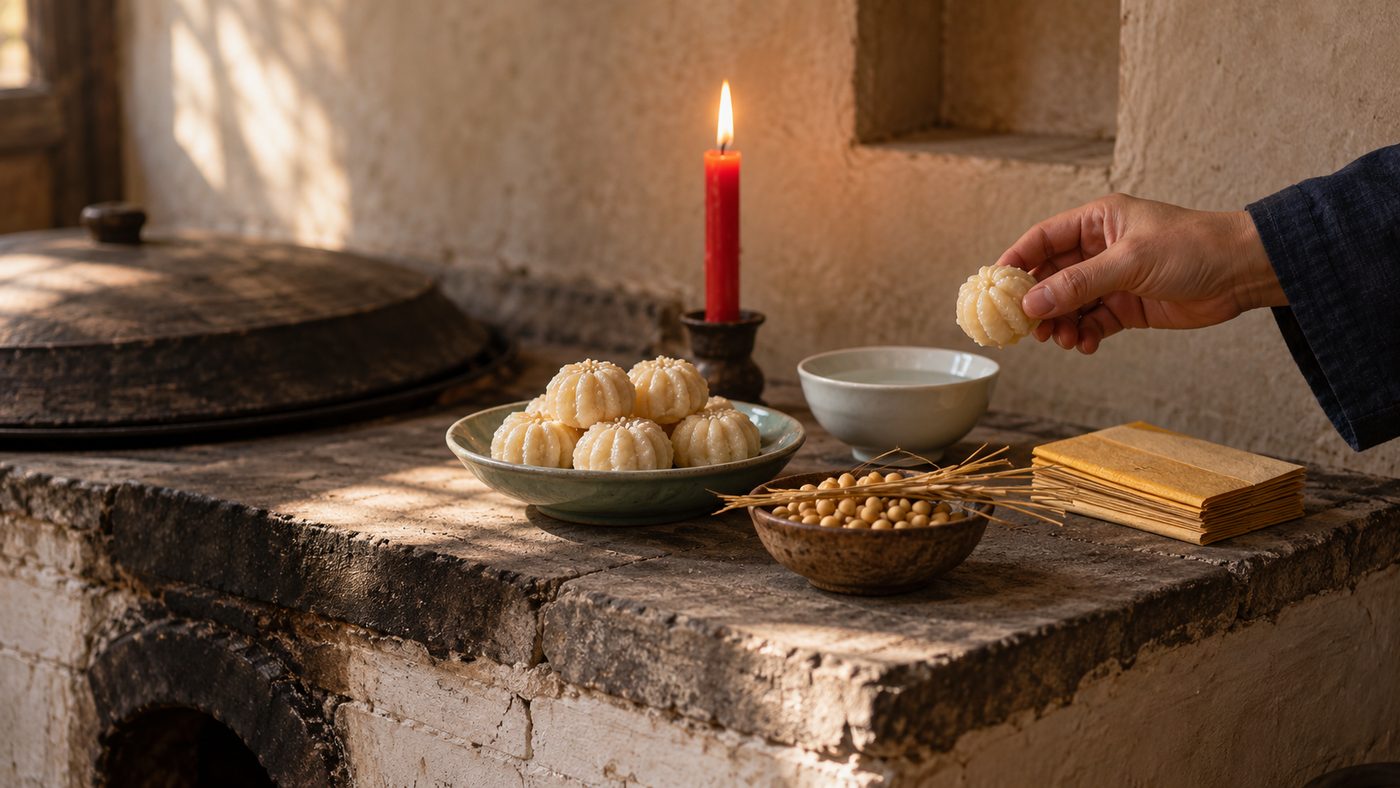
A hand holding a pale malt-sugar sweet over an old brick stove set with a dish of sugar melons, a bowl of water, beans and straw for the Kitchen God's horse, folded joss paper and a lit red candle.
Sugar for the god, water and beans for his horse: the send-off on the 23rd. Illustration.

The countdown, day by day, for 2027

Chinese schoolchildren learn the rhyme; it is printed in the national first-grade textbook. It starts with the Laba porridge of the eighth day of the month and then gives each of the last days of the year its own job. Here it is dated for the 2027 New Year.

The Chinese New Year countdown rhyme from Little New Year to New Year's Eve, with each line's job, the reason behind it and its Gregorian date before the coming New Year.
Date The rhyme says What happens Why
Saturday, January 30 Twenty-third, the sugar melons stick Seeing off the Kitchen God with malt sugar The sugar sweetens his report to Heaven, or glues his mouth shut
Sunday, January 31 Twenty-fourth, sweep the house The big year-end clean, called sweeping the dust The old year’s dirt and bad luck go out before the new year arrives
Monday, February 1 Twenty-fifth, grind the tofu Making tofu for the holiday The fu of doufu is a near-pun on fu, good fortune
Tuesday, February 2 Twenty-sixth, go buy meat Buying the meat for the feast Meat for the reunion dinner and the days after it
Wednesday, February 3 Twenty-seventh, kill the rooster Killing a cockerel Ji, chicken, is a near-pun on ji, lucky
Thursday, February 4 Twenty-eighth, set the dough to rise Starting the dough Fa, to rise, is the fa of facai, to prosper
Friday, February 5 Twenty-ninth, steam the buns Steaming enough buns to last the holiday Food for the first days of the year, when knives are put away
Friday, February 5 The night of the thirtieth, stay up all night The reunion dinner and seeing the year out Keeping watch over the old year until the new one comes in

Before the 2027 New Year the twelfth month has only 29 days, so there is no thirtieth: the buns and the all-night watch share Friday, February 5, 2027, which is New Year's Eve.

When is Little New Year?

On the 23rd or the 24th of the twelfth month of the Chinese lunar calendar, which lands between mid-January and mid-February, six to eight days before New Year's Day. Because the lunar month moves against the Western calendar, the date changes every year. These are the next three, worked out from the same calendar engine as our Chinese calendar converter:

Little New Year dates for the next three Chinese New Years, northern and southern, with New Year's Eve and New Year's Day.
New Year North (23rd) South (24th) Eve New Year's Day
2027 January 30, 2027 January 31, 2027 February 5, 2027 February 6, 2027
2028 January 19, 2028 January 20, 2028 January 25, 2028 January 26, 2028
2029 February 6, 2029 February 7, 2029 February 12, 2029 February 13, 2029

Which of the two days a family keeps depends on where the family comes from more than where it lives now. The folklorist Wang Juan, asked about the split by China News Service, put it plainly: north on the 23rd and south on the 24th in general, but people move, so it is not absolute. A Shanghai household with a grandmother from Shandong may well keep the 23rd.

Why the north keeps the 23rd and the south the 24th

The answer you will be given is a saying: guan san min si chuan wu, "officials the third, commoners the fourth, boat people the fifth." The court and the officials saw the god off on the 23rd, ordinary families on the 24th, and the people who lived on boats on the 25th. Because the Qing emperors kept the 23rd in Beijing, the story goes, the north copied them, and the south, far from the court, kept the commoners' day. China News Service reports this as the common explanation, and Wang Juan broadly accepts it.

The old texts can test the second half. In 1147 Meng Yuanlao wrote down, from memory, the customs of Kaifeng before it fell to the Jin, and Kaifeng is about as northern as a Chinese capital has been. His date is the 24th, which the people of Kaifeng called "crossing the year." Wu Zimu's record of Hangzhou, the southern capital, also says the 24th. The poet Fan Chengda, in the 1180s, calls the 24th "old tradition." Then, in 1906, Fucha Dunchong's Annual Customs of Beijing puts the sacrifice on the 23rd, and adds, "commonly called the little New Year." That is the first text we have found to use the name.

So the 24th was once kept north and south alike, and the 23rd is a later date that took hold around Beijing. That fits the Qing-court story, though nobody has yet shown us the court document that made the change, and the accounts that name an emperor disagree about which one. What the texts do settle is that the southern date is not a deviation. It is the original.

Seeing off the Kitchen God

The god who leaves on Little New Year is Zao Jun, the Lord of the Stove, whose paper portrait has watched the family's kitchen all year and who is now going up to tell the Jade Emperor what he saw. Everything done for him is a way of improving the report. Our page on Zao Jun, the Kitchen God follows him back two and a half thousand years; here is what the day itself looked like.

In Beijing in 1906 the offering was cheap and sticky: southern sugar, the long white sticks of Guandong sugar, sugar cakes, and a dish of clean water with beans and straw, which, Fucha Dunchong explains, were for the god's horse. Then the portrait was peeled off the wall and burned with paper money, the smoke carrying him up, and the firecrackers were, in his words, "extremely many" that day. A new portrait went up on the eve to welcome him home. Lao She, a generation later, gave the reason for the sugar as every Beijing child knew it: with his mouth stuck shut, he cannot tell the Jade Emperor anything bad.

The Song version was wetter. In Kaifeng, Meng Yuanlao says, families invited monks or Daoist priests to chant, set out wine and fruit, and smeared wine lees on the door of the stove, which they called zui siming, "getting the Director of Fates drunk." A god who leaves drunk forgets the details. In Hangzhou, Wu Zimu records, rich and poor alike offered vegetables, malt sugar and beans, and the street sellers cried their "teeth-gluing sugar" all day, a name that says exactly what it was for.

It was men's work. The same Beijing book records the proverb "men do not bow to the moon, women do not sacrifice to the stove": the Mid-Autumn moon was for the women, the stove for the men. That is a curious rule for the god of the room where, in most households, the women did the cooking.

Sweeping the dust

The rhyme gives the 24th to cleaning, and the cleaning has a name, sao chen, sweeping the dust. It is a full spring clean done in winter: the walls brushed down, the windows washed, the bedding aired, the corners that are ignored the rest of the year turned out. The meaning is not hard to read. The old year's grime and the old year's bad luck go out together, and the house is empty and ready for the new.

There is a practical deadline too. On New Year's Day sweeping is forbidden, because you would sweep out the luck that has just arrived, and in many homes the broom stays in the cupboard until the fifth day. Our page on Chinese New Year taboos has the story behind that rule. So the whole house has to be done in the week between Little New Year and the eve, which is why the clean is the second line of the rhyme and not the last.

The Song cities added a stranger custom on the same night. In both Kaifeng and Hangzhou, families lit lamps under the beds, which they called zhao xuhao, "lighting out the wasters": the small spirits that make household things go missing were driven out of the last dark corners along with the dust.

What people eat on Little New Year

Whatever the god is offered, the family eats. In the north that means tanggua, sugar melons, small ribbed balls of malt sugar, some dusted with sesame, and the pale, brittle sticks of Guandong sugar, which are hard when cold and set like glue once they warm in the mouth. They are the original teeth-gluing sugar, and they still behave like it. Northern families often make dumplings for supper. In parts of the south the dish is niangao, sticky rice cake, because its name sounds like "higher every year," and the bowls for visitors fill up with sesame candy and peanut brittle.

Then the rhyme takes over the kitchen. Tofu on the 25th, meat on the 26th, a cockerel on the 27th, dough set to rise on the 28th, buns steamed on the 29th. Several of those carry a wish. Two are near-puns, fu in tofu for fu, fortune, and ji, chicken, for ji, luck; the tones differ, and nobody making the New Year food has ever minded. The third is not a pun at all: fa, the word for dough rising, is the same word as the fa of facai, to prosper. The cooking is front-loaded for a reason: on the first days of the year the knives are put away, and what is eaten is what was made in this week.

The week that follows

After the god has gone, the house goes into a kind of controlled emergency. In old Beijing the spring couplets went up "gradually after the sacrifice to the stove," door by door, until the whole lane was red; our page on New Year decorations has what goes where and when. The markets fill, the travel rush starts, and everyone who has been putting off the year's loose ends finds that they now have about seven days.

The god's niche over the stove stays empty all week. That is part of the point. With the inspector away, the family is briefly unobserved, and the last days of the year belong to them. He comes back on the eve, when the new portrait goes up, and the sixteen days of the New Year begin.

The Vietnamese kitchen gods

Vietnam keeps the same day on the 23rd of the twelfth month as the festival of Ông Công Ông Táo, and it has its own shape. There are three kitchen deities rather than one, and after the offering and the burning of paper goods, families release live carp into ponds, lakes and rivers. The carp stands for perseverance, Voice of Vietnam explains, after the legend of the fish that leaps the falls and becomes a dragon, the same story that gives China its dragon gate. Like Little New Year in China, the day marks the start of the run-up to Tết.

Questions people ask

What is Little New Year in China? +

Little New Year, xiaonian, is the day about a week before Chinese New Year when households see off the Kitchen God, who goes up to Heaven to report on the family's year. It falls on the 23rd day of the twelfth lunar month in the north and the 24th in the south, and it opens the last week of preparations: the big clean, the shopping and the cooking that end with the reunion dinner on the eve. Before the 2027 New Year it falls on January 30, 2027 in the north and January 31, 2027 in the south.

When is Little New Year 2027? +

Saturday, January 30, 2027 for northern China (the 23rd of the twelfth lunar month) and Sunday, January 31, 2027 for most of the south (the 24th). Chinese New Year's Eve follows on February 5, 2027 and New Year's Day on February 6, 2027. The twelfth month has only 29 days that year, so there is no "thirtieth" and the eve falls on the 29th.

Why is Little New Year on the 23rd in the north and the 24th in the south? +

The usual explanation is a saying, "officials the third, commoners the fourth, boat people the fifth": the court kept the 23rd, ordinary families the 24th and people who lived on the water the 25th, and the north followed the Qing court in Beijing. The old texts support the shape of that story. In 1147 a memoir of Kaifeng, a northern capital, puts the send-off on the 24th, as does a record of Hangzhou in the south. By 1906 Beijing keeps the 23rd. So the 24th is the older date everywhere, and the 23rd is a later northern one.

Is Little New Year the same as the Kitchen God festival? +

Yes. The sacrifice to the Kitchen God is the main event of the day, and many English sources use the two names interchangeably. Little New Year is the name of the day; seeing off the Kitchen God is what you do on it, along with the start of the big clean. Our page on Zao Jun, the Kitchen God, covers the god himself.

What do you eat on Little New Year? +

Sugar first: malt-sugar "melons" and the long sticks of Guandong sugar, the same sweets that are offered to the Kitchen God. In the north families often make dumplings; in parts of the south people eat niangao, sticky rice cake, whose name sounds like "higher every year." Sesame candy and peanut brittle fill the dishes for visitors.

What do you do on Little New Year? +

See off the Kitchen God: set out sugar, clean water and beans or straw for his horse, take down his paper portrait above the stove and burn it, usually with firecrackers. Then start the year-end clean, called sweeping the dust, which runs through the following days along with the shopping, the tofu, the meat, the dough and the steamed buns. The new portrait goes up on the eve to welcome him back.

Why do Chinese families clean the house before the New Year? +

To sweep the old year out, and because they cannot do it later. Sweeping on New Year's Day is one of the firmest taboos of the holiday, since it sweeps the new luck out of the door, so the whole house has to be done in the week before. The cleaning traditionally starts on the 24th of the twelfth month, the day after the northern Little New Year.

Does Vietnam celebrate Little New Year? +

Vietnam keeps its own version on the 23rd of the twelfth lunar month, the day of Ông Công Ông Táo, when families send three kitchen deities up to Heaven to report. Paper offerings are burned and live carp are released into ponds and rivers, the carp standing for the fish that becomes a dragon. As in China, it marks the start of the New Year run-up.

Sources and further reading

More of the New Year

  • Chinese New Year All sixteen days, dated and explained, from the eve to the Lantern Festival.
  • The Kitchen God Who Zao Jun is, and why his mouth gets sugared.
  • New Year taboos No sweeping, no hair washing, no broken bowls, and why.
  • Decorations What goes on the door and the window, and when it comes down.
  • Spring couplets The two red strips that go up after the god has gone.

Stay in the loop.

Chinese mythology, the zodiac, and the meaning behind names and symbols, rooted in the classics and read back to you. No spam. Unsubscribe anytime.