Customs

The Chinese lion dance: what it means, where it comes from, and how it differs from the dragon

The Chinese lion dance is a blessing and an exorcism performed by two dancers inside one lion, to drums, gongs and cymbals. The noise and the lion drive bad luck out; in the south the lion also brings wealth in, by eating a lettuce whose name sounds like "prosperity." There are two great styles, the shaggy northern lion and the painted southern one, and the dance is on record from the Tang dynasty, more than a thousand years before the Nian monster it is said to have scared away.

To the shopkeeper who hangs a lettuce over the door, the lion is not a show put on for the street. It is a visitor with a job: it bows to the household gods, inspects the premises, eats the green and spits the luck back over the threshold. Everything about it, from the painted eyes to the color of its beard, is there to make that job work.

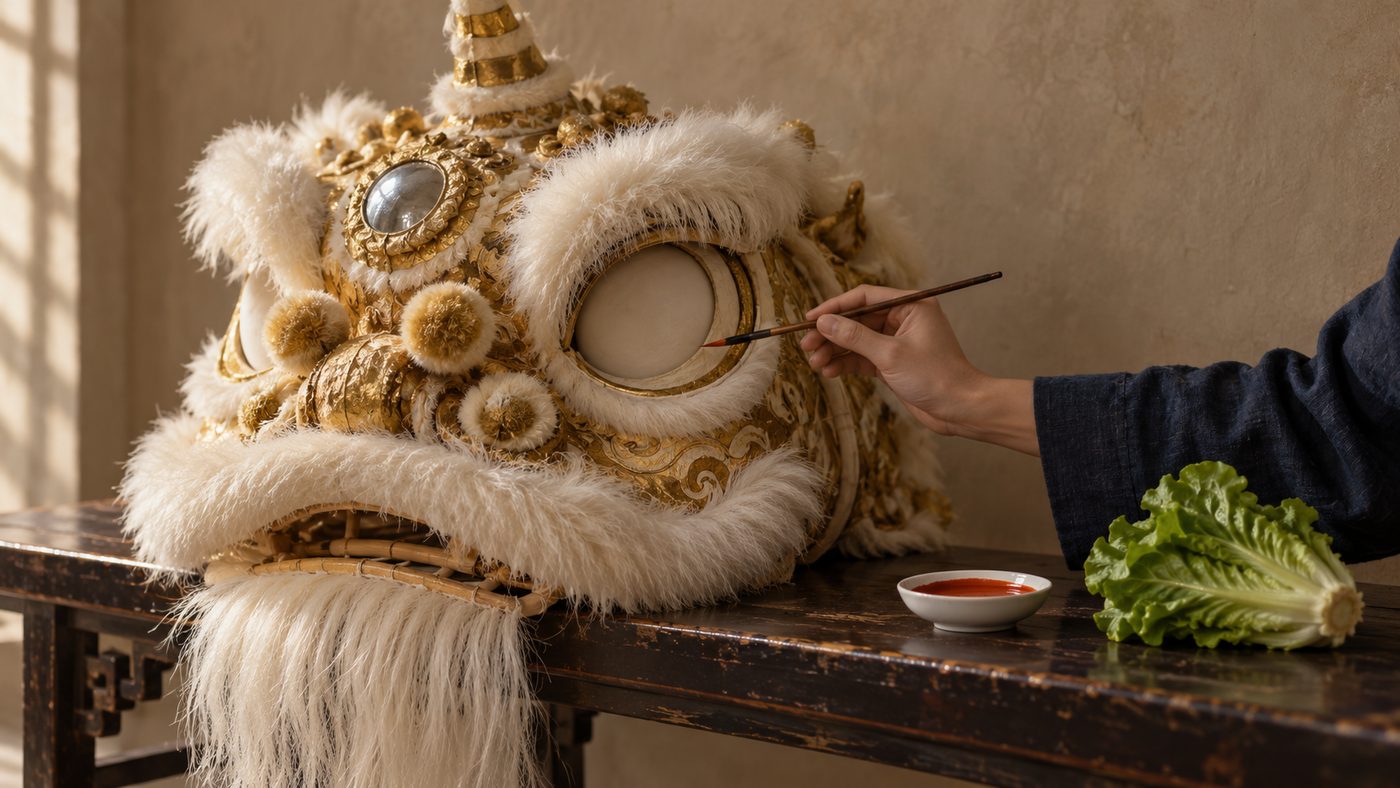
A hand holding a fine brush to the blank eye of a gold and white lion-dance head resting on a lacquered bench, beside a dish of red ink and a head of lettuce.
A new lion is asleep until its eyes are painted. Illustration.

Northern lion, southern lion and dragon at a glance

The northern lion dance, the southern lion dance and the dragon dance compared: dancers, look, leader, signature moves and where each is seen.
Northern lion Southern lion Dragon dance
Dancers Two in an adult lion, one in a cub Two: one works the head, one the body and tail A team on poles, usually about ten
Look Shaggy all over, like a real animal; often a pair, or a family with cubs A painted head with a horn, eyes that turn and teeth that show; a cloth body A long serpent body held high on poles
Who leads it A lion-tamer with an embroidered ball, an acrobat himself The Big Head Buddha, a smiling mask with a palm-leaf fan A dancer spinning a pearl, which the dragon chases
Signature Tumbling, balancing on balls, leaping onto tables and poles Plucking the green; kung fu stances; today, leaps across high poles Waves, coils and spirals made by the whole team
Where you see it North China, temple fairs, the Spring Festival Doors, shops, weddings and openings, worldwide Parades and open squares

Northern and southern lions

China's national list of intangible heritage, which entered the lion dance in its first batch in 2006, sums up the difference in one sentence: the southern lion is fierce and martial and does the hard tricks, the northern lion is charming and endearing and mostly plays. The northern lion looks like an animal. In Xushui, in Hebei, which the listing calls the cradle of the northern style, two dancers make one great lion under a pelt of stitched cow hair, the front one wearing the head, the back one bent double and gripping his waist; a single dancer makes a young lion. In front of them goes the lion-tamer with an embroidered ball, who is expected to somersault over the lion and back-flip onto a table. The village lion society there was founded in 1925.

Beijing's own great lion has a pedigree worth knowing. The Baizhifang lion society says that around 1870 its patron, Chen Zihe, a fourth-rank official of the Ministry of Works' gunpowder bureau, redesigned its lion after the stone lions in front of the Hall of Supreme Harmony in the Forbidden City: twelve Chinese feet long, a head of seventy-odd catties, seven brass bells. The dancing lion was modeled on the guardian lions at the gate, which are a separate creature with their own rules. Since 1956 the troupe has been kept up by the Beijing banknote printing works.

The southern lion is the one the world knows, because southern Chinese carried it abroad. The heritage listing traces it to Nanhai county, around Foshan, in the Ming. The classic head is the Foshan "big-headed lion": a high forehead with a straight horn, big eyes under sharp brows, a wide mouth set in a grin, teeth that show and hide. It is a kung fu animal. In old Foshan every martial arts hall kept a lion society, the dancers' footwork is built on Southern Fist stances, and the saying in Guangdong is "learn the fist before the lion." A performance opens with the dancers running through a set of fist forms before the lion comes on.

Why the southern lion is "the awakened lion"

In Chinese the southern lion is the xingshi, the awakened lion, and the name is younger than it sounds. Its older name was ruishi, the auspicious lion. The scholar Xie Zhongyuan dates the change to the years after 1900, when the idea that China was a sleeping lion that would one day wake was everywhere in nationalist writing, and the Cantonese troupes renamed their lion to perform the waking. China's state broadcaster tells the same story, placing it after the Opium War. Either way, every time a southern lion lifts its head and blinks, it is acting out a political slogan of the late Qing.

Eye-dotting: how a lion is woken

A new lion head does not dance until its eyes have been dotted. Xie Zhongyuan notes that the early troupes did it with a rooster's blood, a descendant of the ancient rite of killing a cock to drive out pestilence; today it is cinnabar ink and a brush, and the ceremony is simpler but has never been dropped. In Foshan the troupes hold their "new lion eye-dotting" a few days before the New Year, so that the whole stable of heads, more than forty in one Shunde troupe's store, can go out on the first morning.

The dotting is done by the troupe's leader or by the sponsor of the dance. Malaysia's national cultural registry records what the brush is giving: the eyes to see far, the ears to hear sounds from heaven and earth, the nose to keep bad luck off, the mouth a roar heard across the universe, the horn to light up the land, the body strength and long life. Ginger for health, a white brush for cleanliness and a red ribbon, "restraining the lion's wild nature," complete the kit.

Plucking the green: why the lion eats lettuce

The heart of the southern lion's visit is cai qing, plucking the green. A head of lettuce, usually with a red envelope tied to it, is hung over the door or set out on a table. Lettuce, shengcai, sounds like shengcai, "to bring in wealth," so a lion that eats the lettuce and spits it back out is scattering prosperity over the house. Be hit by a flying leaf and, Vancouver's lion dancers tell their clients, you will be blessed with plenty in the coming year. The envelope is the fee: in Boston's Chinatown in 1978 the Harvard Crimson watched shopkeepers hand over envelopes "filled with money" as their gift for the performance, along with tangerines, whose name sounds like luck.

It is not a quick snatch. The national heritage listing calls the green the essence of the southern lion, a piece with a beginning, a development, a turn and an ending, and Xie Zhongyuan lists its beats: the lion searches for the green, sees it, is delighted, becomes suspicious, probes it, takes fright, plucks it, plays with it, eats it, gets drunk on it and spits it out. Benches stand in for bridges, three stacked tables for mountains, a high-backed chair for a cliff, and the set pieces have names of their own: the water green, the basin green, the crab, the snake, the centipede. The Crimson's informants said the same in Boston: the way the offering is laid out tells the lion how to dance and for how long. Rush it and you become an idiom of the south. To "grab the green" means to be in an unseemly hurry, from the lion that skips the drama and goes straight for the money.

The greens themselves are old. The commentary on the sixth-century Jingchu Suishiji already mentions raw greens eaten at the start of spring, and by the middle of the Ming, Xie notes, Guangdong had its lettuce fairs, held for the "living breath" the green was thought to carry. The lion took over a custom that was there before it.

What the colors of the lion mean

The southern lion's face is a Cantonese opera face, painted for a hero of the Three Kingdoms, and the color tells you which lion you are getting and what it is for:

  • Yellow, with a white beard: Liu Bei. The eldest of the sworn brothers, also called the colored lion. Steady movements; used to welcome guests and for celebrations.
  • Red, with a black beard: Guan Gong. The general Guan Yu, red-faced on the opera stage. Big, open movements; the lion for shop openings, fittingly for the god merchants pray to.
  • Black, with a short bristly beard: Zhang Fei. The hothead. A green nose, gray-and-white markings, black pompoms, rough and brave in motion; the lion for contests.

The beard carries rank as well. By troupe convention red, white and black beards run from senior to junior, and the short "toothbrush" beard marks the fiercest lion of all; the order governs how lions behave when two troupes meet. In Beijing the great lions come as a yellow and a blue pair. And the oldest color scheme is the Tang court's: five lions, each in the color of its direction, which in the five-element scheme means green for the east, red for the south, white for the west, black for the north and yellow for the center.

Where the lion dance comes from

China has no lions. They arrived as tribute from Central Asia and as the mounts and thrones of Buddhist art, and the lion entered the Chinese imagination as the beast that all other beasts fear. That is the idea behind one of the oldest stories of a man-made lion. On a campaign that set out in 445 against Linyi, a kingdom in what is now central Vietnam, the general Zong Que found his army facing armored war elephants. "I have heard the lion awes all beasts," he said, according to the Song shu, and had lion figures made to meet them. The elephants panicked and fled.

A century later the lions were leading processions. Yang Xuanzhi's record of the Buddhist temples of Luoyang, written in 547, describes the image at Changqiu Temple, the Buddha borne on a six-tusked white elephant, being carried out on the fourth day of the fourth month with lions and evil-repelling beasts going before it, and sword-swallowers and fire-breathers alongside. By the Tang the dance had a place at court. The official history describes the "Lion Dance of the Five Directions": fur stitched into a lion with men inside, "imitating its bowing and rising, its tame and playful manner," two handlers with ropes and whisks pretending to train it, five lions in five colors, and a hundred and forty singers.

The best description is a protest poem. Around 809 the poet Bai Juyi wrote "Western Liang Performance," which he subtitled a rebuke to the ministers of the frontier. It opens on the lion: "a carved wooden head, a tail of silk, eyes gilded with gold and teeth of silver," shaking out its fur and flapping its ears "as if it had come ten thousand li across the shifting sands." Two foreign boys with purple beards and deep-set eyes drum and dance and announce it as the lion the Protector-General of the West sent to court, in the days before Liangzhou fell. Then, in the skit, news arrives that the road home is cut. The boys weep to the lion, and the lion turns its head toward the west and gives one mournful roar. Liangzhou, the frontier region the dance was named for, had by then been lost to Tibet for forty years, and Bai Juyi's point is that the generals sit drinking and laughing at this, never tired of it, while nobody tries to win it back. Read for its props, the poem shows a lion very like today's: a carved head, gilded eyes, moving ears, and a story with feeling in it.

After the Tang the lion moved out of the palace and into the street. Xie Zhongyuan finds soldiers' "lions and leopards with shields" in the Southern Song capital's records of entertainments, and traces the southward migration that split the dance into north and south. In Guangdong, from the Ming, it fused with the Southern Fist, and the awakened lion was the result.
Did the lion dance really scare away Nian?

The story goes that a beast called Nian came down every New Year's Eve to eat the village, until the villagers found it was afraid of red, of noise and of a lion, and the lion dance has been performed ever since to keep it away. It is a good story, and the dates say it came second. The dance is in the Tang court records and in a poem of 809, and lions led Luoyang's processions in the sixth century. The Nian beast, as our page on the Nian monster shows, is first written down in a Shanghai newspaper column in 1933, and even there it is a picture of a chained animal, with no lion in the tale.

If anything the borrowing ran the other way. The modern picture of Nian, with its flat lion's face, its mane and its single horn, looks so much like a southern lion's head because, as that page argues, a lion-dance head is what it was drawn from. What is true in the story is the job. The lion has always been the thing that drives evil out, from the Luoyang procession onward; the Nian legend gave that old job a new villain.

Lion dance vs dragon dance

Count the legs. A lion is two dancers, one carrying and working the head and the other bent behind him as the body and tail, lifting him for the high moves. A dragon is a team, usually about ten, holding a long body high on poles, and it follows a pearl spun by a lead dancer in front. The lion is an animal and plays one: the heritage listing counts its eight moods as joy, anger, sorrow, delight, motion, stillness, fright and doubt. The dragon is closer to weather, all waves and coils, and its effect comes from the whole team moving as one.

The practical difference follows. A lion is small enough to go through a shop door, up the steps of a restaurant or into a living room, so it is the one that visits: it bows to the household shrine, plucks the green and blesses a particular place. A dragon needs a parade route or a square, and blesses a crowd. Both are luck-bringers, and both dance to a drum, gong and cymbals; the Chinese dragon itself is a rain and water power rather than a fire-breathing monster, which is why it moves the way it does.

Watching a lion dance, and hosting one

Watching. It is loud on purpose. The drum, gongs and cymbals, and the firecrackers wherever they are still allowed, are part of the exorcism, and the Crimson's reporters in 1978 thought the noise was the most memorable part of the day. Give the lion room in front of a door, since that is where it works. Touching is a matter of setting: when Foshan's lions parade at the New Year, CCTV filmed people in the crowd laying their hands on the lions' heads and bodies for a year of good luck, and nobody minds. A troupe's lion head at rest is a different thing, a consecrated object that, as one Canadian club puts it, few clubs let outsiders touch at all. If a leaf of lettuce hits you, keep smiling: it is the lucky part.

Hosting. Book early for the New Year, when troupes are busiest. Prepare a head of lettuce and a red envelope tied to it, hung over the entrance or set on a table, and if you like, tangerines alongside; ask the troupe how high to hang the green, since the height decides which routine they bring. The envelope is the troupe's payment, in an even amount, as on our page on red envelopes. Expect the lion to bow at the door, and to the shrine or altar if there is one, before it does anything else; Xie lists bowing to the god's tablet before entering a hall or shop and before plucking the green as a fixed rule. And let it take its time over the green. A lion that hurries is the one the idiom is about.

Questions people ask

What does the Chinese lion dance mean? +

It is a blessing and an exorcism in one. The lion, a beast China only knew from tribute and Buddhist art, is the animal that frightens everything else, so its dance drives bad luck and evil out of a street, a shop or a house, and the drums, gongs and firecrackers do the same with noise. In the south it also brings wealth in, by plucking a lettuce whose name sounds like "bringing prosperity." That is why lions appear at the New Year, at shop openings and at weddings: anywhere a fresh start wants protecting.

What is the difference between a lion dance and a dragon dance? +

A lion is two dancers, one working the head and one the tail, and it moves like an animal: it opens its eyes, washes its whiskers, licks and shakes its fur, takes fright and eats. A dragon is a team of about ten holding a long body up on poles, chasing a pearl spun by a lead dancer, and it moves like water. The lion goes door to door and into shops and homes; the dragon needs a parade route or a square. Both bring luck, but the lion is the one that comes to your door.

Why do lion dancers eat lettuce? +

Because lettuce, shengcai, sounds like shengcai, "to bring in wealth." A head of lettuce is hung over the door or set on a table, usually with a red envelope tied to it. The lion approaches it warily, eats it, and spits the leaves out over the crowd and the doorway, scattering the prosperity; the envelope is the troupe’s fee. The ritual is called cai qing, "plucking the green," and in the south it is the heart of the whole performance.

Why do they dot the lion’s eyes? +

To wake it up. A new lion head is treated as asleep until its eyes are painted, in a ceremony called eye-dotting. Early troupes used a rooster’s blood; today it is red cinnabar ink and a brush, applied by the troupe’s master or an honored guest, often to the eyes, ears, nose, mouth, horn and body in turn, each dot giving the lion that sense or power. Only after this can the lion perform.

Did the lion dance scare away the Nian monster? +

That is the story you will usually be told, but the dates do not fit. The lion dance is described in Tang dynasty texts more than a thousand years ago, and lions led Buddhist processions in Luoyang in the sixth century. The Nian beast is first written down in a Shanghai newspaper in 1933. The Nian story is a modern explanation attached to an old dance, and it has borrowed the lion’s face for its picture of the monster.

What do the colors of the lion mean? +

In the southern lion they are faces from Cantonese opera, each a hero of the Three Kingdoms. A yellow lion with a white beard is Liu Bei, the steady elder, used to welcome guests. A red lion with a black beard is Guan Gong, used for shop openings. A black lion with a short bristly beard is Zhang Fei, the fighter. In the Tang court there were five lions, each in the color of its direction.

How many people are in a lion dance? +

Two inside each lion: the head dancer, who carries and works the head, and the tail dancer, bent at the waist behind him, who also lifts the head dancer for the high moves. A northern cub is danced by one. Around them are the musicians, a drummer, a gong player and cymbals, and in the south the Big Head Buddha who leads the lion in with a fan.

When is the lion dance performed? +

Above all at Chinese New Year, which next falls on February 6, 2027, when troupes go from door to door and shop to shop, and at the Lantern Festival that closes the season, February 20, 2027. Through the rest of the year lions come out for shop and restaurant openings, weddings, temple festivals and to welcome important guests.

Do you give money to lion dancers? +

Yes, in a red envelope, and the custom is to tie it to the lettuce so that the lion "eats" it. That envelope is the troupe’s payment for the performance. Even amounts are the rule, as with any red envelope; our page on red envelopes covers the numbers. At a parade there is nothing to pay, but shops along the route often hang their own green and envelope to draw the lion in.

Sources and further reading

More of the New Year

  • Chinese New Year All sixteen days, dated and explained, from the eve to the Lantern Festival.
  • The Nian monster The New Year beast, and the 1933 newspaper column it first appears in.
  • Foo dogs The stone lions at the gate, and which one goes on the left.
  • Red envelopes Who gives lucky money to whom, and why never a four.
  • Decorations What goes on the door and the window, and when it comes down.

Stay in the loop.

Chinese mythology, the zodiac, and the meaning behind names and symbols, rooted in the classics and read back to you. No spam. Unsubscribe anytime.