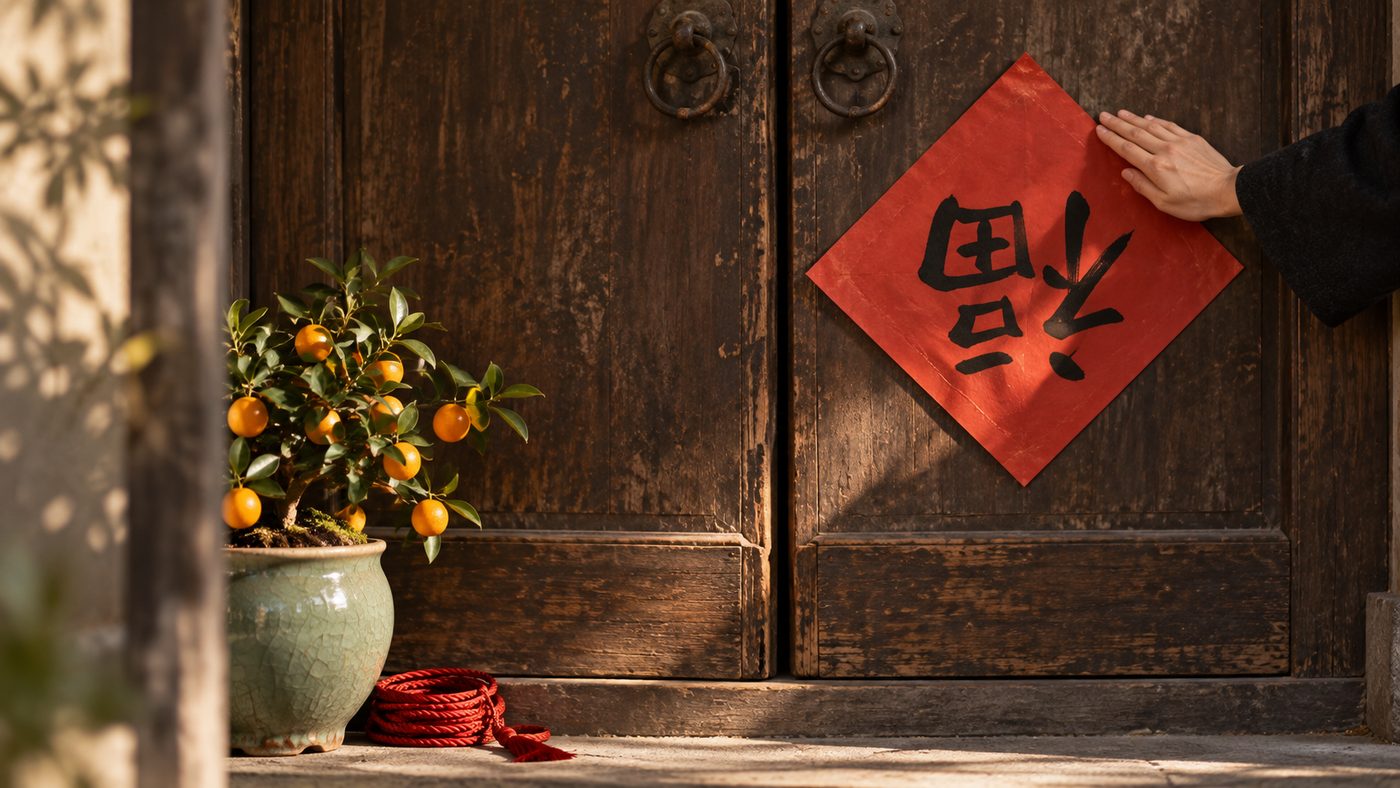
The front door is where the New Year is really kept, and it has been dressed the same way
for a very long time. The Jingchu Suishiji, a calendar of customs from the
sixth century, has households pasting a painted rooster on the door, fixing boards of
peach wood beside it, and painting two gods, one on the left and one on the right, to
stand guard. Five hundred years later the Song capital's markets were printing door gods
and peach boards and selling them by the stack in the last month, and on New Year's Eve,
a Southern Song account of Hangzhou says, every household great or small swept its gate,
changed its door gods, nailed up its peach charms and pasted up its spring placards.
Spring couplets are those peach charms, grown up. The Beijing almanac
says so in its first words on them: couplets are peach charms. By its day they were
written on red paper by scholars who set up tables under the eaves of shops in the last
month to earn a little brush money, and pasted after the offering to the kitchen god.
There was one exception, and it is a good one: the palace and the imperial clan used
white paper, edged in red or blue, and nobody else was allowed to. The two lines go
either side of the frame and a crosspiece over the lintel, and which line goes on which
side is a real rule with a real exception, set out on our page on
spring couplets.
Door gods go on the door leaves themselves, one on each, facing each
other so that they look at whoever approaches. They are armored men with weapons, and
which two men they are is a matter of fierce and cheerful disagreement: the sixth-century
pair were the gods Shentu and Yulü, the popular modern pair are two Tang generals, and
the Beijing almanac's author, with a shrug you can hear across a century, says both
identifications are wrong and one should just call them door gods. Our page on the
door gods sorts out who is who.
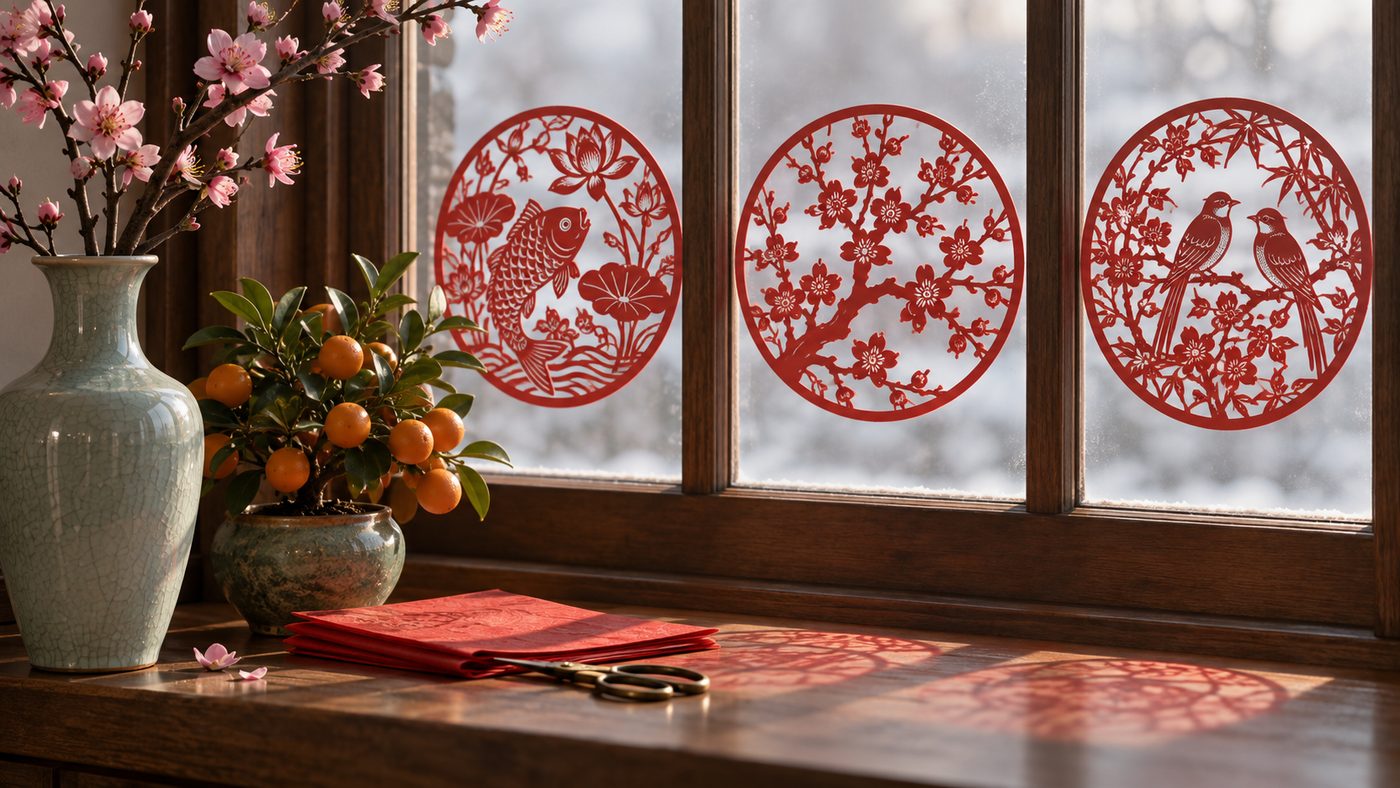
Hanging paper strips are the row of little red banners, each about a
foot long and cut through with lucky phrases, that flutter along the lintel in northern
China. The Beijing almanac calls them guaqian and gives them a class
distinction: ordinary households hung them, great families rarely did, shops used small
yellow ones three inches long, and the ones printed with the Eight Immortals were for
hanging in front of a Buddha, not a door.