Bazi · The fourth pillar

Shichen: the twelve double hours, and the animal your birth time carries

A shichen is a Chinese double hour: the traditional day is cut into twelve blocks of two hours, each named by one of the twelve earthly branches, and since the branches carry the zodiac, each carries an animal. The first block, the Rat, is centered on midnight and runs from 23:00 to 01:00; the Horse is centered on noon; the Pig closes the day at 21:00 to 23:00. Your birth time falls into one of them, and that block is the branch of your hour pillar, the fourth column of a bazi chart, the one that a three-pillar chart is missing.

The table below gives all twelve with their clock spans, branches, animals and the older names people used before the branches were attached, because the hours are older than their names. The rest of the page is about that, about why the animals sit where they sit, and about the one rule you need to turn an hour branch into a full pillar: the five rats.
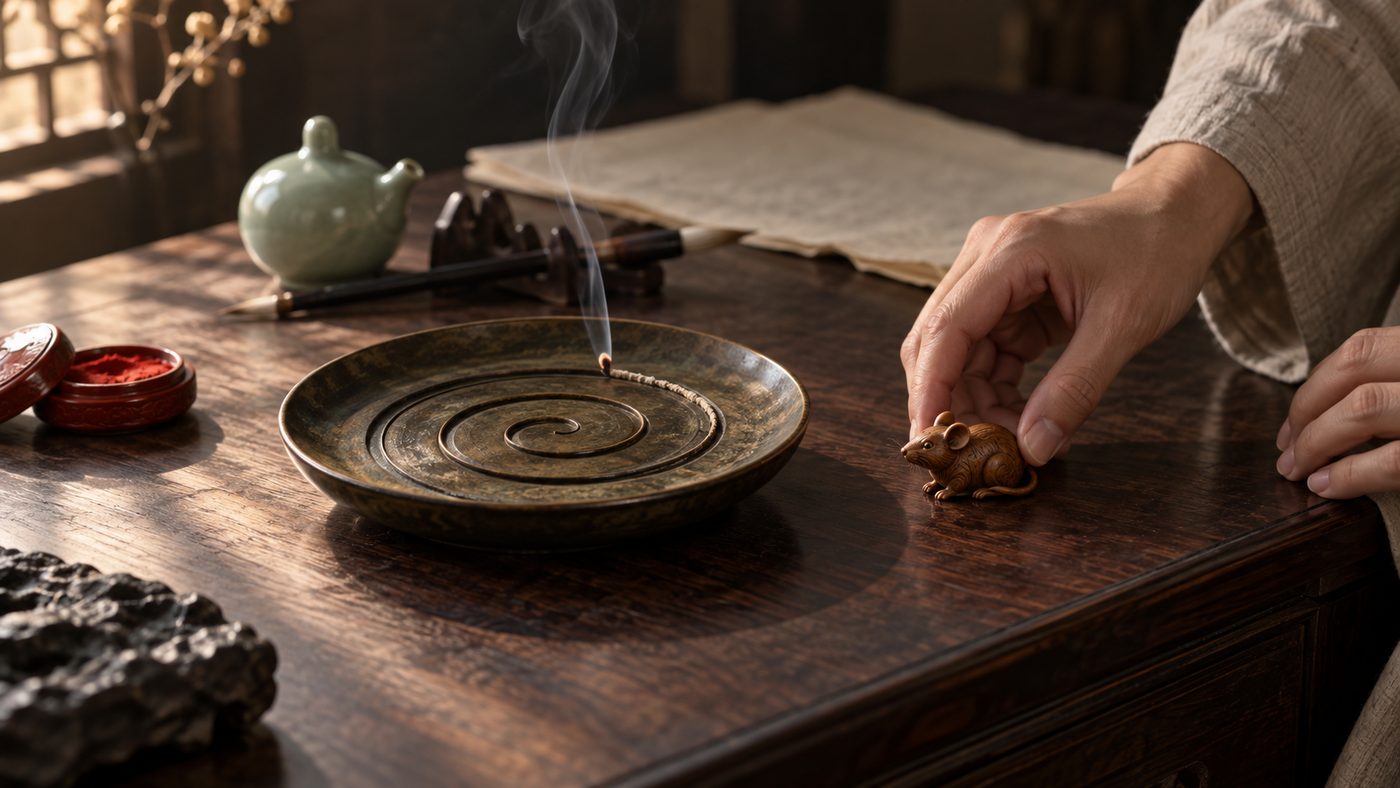
A bronze incense clock shaped like a shallow dish sits on a scholar's desk in low morning light, a single line of incense ash burned partway along its spiral groove, while a hand in a linen sleeve sets a small carved boxwood rat beside it.
An incense clock burned to the first hour, and the animal that names it. Illustration.

Find your shichen

A birth time gives the hour branch and its animal. Add the date and the calculator casts the whole pillar. Nothing you enter is stored.

The twelve, with their clock spans

The spans and branches here are read from the same table our calculator uses to turn a birth time into an hour pillar, so what you see is what it does. The old names are the ones the Han histories dated events by, and they describe a farming day: cockcrow, the morning meal, the afternoon meal, dusk, people settled for the night.

The twelve shichen: clock span, branch, pinyin, zodiac animal and classical name.
Hours Branch Animal Old name
23:00–01:00 Zi Rat 夜半 yèbàn, midnight
01:00–03:00 Chou Ox 鸡鸣 jīmíng, cockcrow
03:00–05:00 Yin Tiger 平旦 píngdàn, daybreak
05:00–07:00 Mao Rabbit 日出 rìchū, sunrise
07:00–09:00 Chen Dragon 食时 shíshí, mealtime
09:00–11:00 Si Snake 隅中 yúzhōng, late morning
11:00–13:00 Wu Horse 日中 rìzhōng, noon
13:00–15:00 Wei Goat 日昳 rìdié, sun past the meridian
15:00–17:00 Shen Monkey 晡时 būshí, the afternoon meal
17:00–19:00 You Rooster 日入 rìrù, sunset
19:00–21:00 Xu Dog 黄昏 huánghūn, dusk
21:00–23:00 Hai Pig 人定 réndìng, people settled

Each two-hour block is sometimes split into an "initial" and a "proper" half (chu and zheng): the wu hour's proper half begins at noon exactly. Bazi does not use the halves; the pillar is the whole block.

Older than their names

The neatest thing about the twelve hours is that the Chinese did not always have them, and did not name them by branches for a long time after they did. The scholar who worked this out was Gu Yanwu, in the seventeenth century, in a short entry of his Rizhilu headed "the ancients did not divide the day into twelve," and his argument is simply a stack of quotations in date order.

First the Zuozhuan, the great chronicle of the fifth century BC, in which a diviner explains that "the sun has ten numbers, so there are ten hours," matching the day to the ten heavenly stems rather than the twelve branches. Then Du Yu, the third-century commentator on that chronicle, who "took it as twelve hours" and gave them their names, midnight, cockcrow, daybreak, sunrise, mealtime, mid-morning, noon, sun-slant, afternoon meal, sunset, dusk, people-settled, "without setting up the twelve branches as headings." Then the Han histories, one after another: a rebellion that broke through the siege "at dusk," a battle "from daybreak to mealtime," troops drawn up "at cockcrow," an earthquake "at the early meal." Every one of them dates the event by the name of the hour, and not one of them by its branch. Then the Huainanzi of 139 BC, which divides the sun's day not into twelve at all but into fifteen stations, from Dawn-Bright where it bathes in the pool of the east to Fixed-Dusk where it enters the valley of the west, "which Yu made into morning, day, dusk and night."

Gu's conclusion is a sentence long: "the Han did not yet call midnight the zi hour," and he adds that he does not know who first did. The double hours, in other words, are a Han institution and the names are farm names; the branch labels that make them part of the stem-and-branch machine, and therefore part of a bazi chart, came later and silently. For a system whose whole appeal is its antiquity that is worth knowing, and it is worth knowing that the Chinese scholarly tradition knew it first.

Why the Rat has midnight

Every English explainer of the zodiac hours has a story for each animal: the rat is busiest at midnight, the ox chews its cud before dawn, the tiger hunts in the small hours, the rabbit comes out at sunrise, the dragon brings the morning rain, and so on round to the pig asleep at ten. They are pleasant and they are all modern. The pairing of animal to branch is at least nineteen hundred years old, and the text that records it attaches no hour to any of them.

That text is Wang Chong's Lunheng, written around AD 80, in a chapter arguing with the five-phase theorists of his day. To show that "wood conquers earth" and the rest of the conquest cycle cannot explain which animals eat which, he runs through the branches: "yin is wood, and its creature is the tiger; xu is earth, its creature the dog; chou and wei are also earth, the ox and the goat," and so on through all twelve, then points out that if the theory held, the rat should chase the horse and the rooster peck the rabbit, which they do not. His point was to embarrass a theory; ours is that the list was already complete, already keyed to the branches, and already familiar enough for a skeptic to use it in an argument, in the first century. The animals belong to the branches; the hours borrowed the branches later; the stories about nocturnal rats were fitted on afterward to explain an order that had another origin. The zodiac pages take each animal on its own.

The five rats: turning an hour into a pillar

The clock gives you the branch of your hour pillar directly. It cannot give you the stem, because ten stems and twelve branches do not divide into each other: the sixty stem-branch pairs cycle through the hours in five days, so the stem sitting on any given hour depends on the day. The traditional fix is a rhyme, and the Ming manual Sanming Tonghui quotes it under "deriving the hour from the day": jia and ji days start again from jia; yi and geng days begin with bing; bing and xin start from wu; ding and ren have geng at zi; and where do wu and gui begin? Ren-zi is the true road. Five pairs of day stems, five starting stems for the Rat hour, hence "five rats." From the Rat, the hour stems simply count forward through the ten.

The manual also says why the count starts at zi rather than at dawn: "heaven opened at zi, the season when one yang is first born." Midnight is where the day's yang begins to return, so the day's first pillar is built around it, which is the same logic that centers the Horse on noon. The table is below, rebuilt from the rule; the site checks it against the calculator's own hour pillars every time this page is built, so the two cannot quietly disagree.

The five-rats table: the hour stem for each of the twelve branches, by day-stem pair.
Day stem Zi
Rat
Chou
Ox
Yin
Tiger
Mao
Rabbit
Chen
Dragon
Si
Snake
Wu
Horse
Wei
Goat
Shen
Monkey
You
Rooster
Xu
Dog
Hai
Pig
Jia / Ji JiaYiBingDingWuJiGengXinRenGuiJiaYi
Yi / Geng BingDingWuJiGengXinRenGuiJiaYiBingDing
Bing / Xin WuJiGengXinRenGuiJiaYiBingDingWuJi
Ding / Ren GengXinRenGuiJiaYiBingDingWuJiGengXin
Wu / Gui RenGuiJiaYiBingDingWuJiGengXinRenGui

Read across: find the row for your birth day's stem, then the column for your hour branch; the cell is the hour stem, and stem plus column is the pillar (a jia day at the Rat hour is Jia-Zi). The month pillar has a twin rule, the five tigers, which starts each year's months from yin; heavenly stems and earthly branches has the ten stems themselves.

The 23:00 problem

Because the Rat hour straddles midnight, a birth between 23:00 and 00:00 is in the zi hour of one day by the clock and, by some reckonings, already in the next day's zi hour. Practitioners have argued for centuries over whether the day pillar should roll at 23:00 with the hour, or wait for midnight, and the two answers give the same person two different day masters. Some schools split the block into a "late zi" belonging to the old day and an "early zi" belonging to the new. Our calculator rolls the day at 23:00, most of the field does not, and the whole disagreement, with eight calculators tested on the same births, is the subject of the conventions page. If your birth time is in that hour, read it before you trust any chart, including ours.

The other correction is the sun. The double hours were built on solar time, with noon in the middle of the Horse, and a modern time zone can put the clock an hour or more off the sun; all of China runs on Beijing time across what would be five zones, so a birth in Urumqi at 13:30 by the clock is still late morning by the sun. The calculator takes an optional birth city and corrects for this before choosing the hour; the methodology page shows the arithmetic.

What the hour pillar is for

The Ming manual's image for the four pillars is a plant: the year is the root, the month the shoot, the day the flower, and the hour the fruit, "for without the flower there is no fruit." In the reading, the hour is the last third of life, and children. Mechanically it is a quarter of the material the day master is weighed against, and it is the column most likely to carry one of the special stars a reading names. All of that is why a chart cast without a birth time is called three-pillar and labeled so: the year, month and day stand, the day master is untouched, and the fruit is missing. The reading order walks a real chart with its hour in place, and the finder above will put yours in.

Questions people ask

What is a shichen?

A Chinese double hour: one of the twelve two-hour blocks the traditional day is divided into, each named by one of the twelve earthly branches and, since the branches carry the zodiac, by one of the twelve animals. The zi hour, the Rat, runs from 23:00 to 01:00, and the rest follow in order around the clock. Shichen is the Mandarin word; "double hour" and "Chinese zodiac hour" are the English ones.

What are the 12 Chinese zodiac hours?

Rat 23:00–01:00; Ox 01:00–03:00; Tiger 03:00–05:00; Rabbit 05:00–07:00; Dragon 07:00–09:00; Snake 09:00–11:00; Horse 11:00–13:00; Goat 13:00–15:00; Monkey 15:00–17:00; Rooster 17:00–19:00; Dog 19:00–21:00; Pig 21:00–23:00. Each two-hour block carries the animal of its branch, so a birth at 21:30 is in the Pig hour whatever the birth year's animal happens to be.

What is my Chinese zodiac hour?

Find your birth time in the table on this page, or type it into the finder above. The block that contains it is your hour branch and its animal is your hour animal; that branch, paired with a stem worked out from your birth day, is the hour pillar of your bazi chart. If you were born between 23:00 and midnight, read the note on the 23:00 problem below before trusting any calculator, ours included.

Why does the Chinese day start at 23:00?

Because the first double hour, zi, is centered on midnight rather than starting there: it runs from 23:00 to 01:00, so that midnight falls in its middle, the way noon falls in the middle of the wu hour. The Ming manuals give the cosmological reason, that "heaven opened at zi, the season when the first yang is born," and midnight is the turning point the hour is built around. Whether the calendar day also rolls over at 23:00, or waits for midnight, is a separate and disputed question with its own page.

Are the zodiac hours the same as the zodiac years?

Same twelve branches, same twelve animals, different clock. The branches are a counting cycle that the Chinese calendar applies to years, months, days and double hours alike; the animals ride on the branches. So the Tiger is the third year of the cycle and also the block from 03:00 to 05:00, for the same reason: both are the branch yin. Your year animal and your hour animal are independent and usually different.

Why is the Rat the first hour?

Because zi is the first branch, and the Rat is the animal that a first-century text already attaches to zi. The popular stories, that rats are most active at midnight, that the ox rises at cockcrow, that the tiger hunts before dawn, are modern etiologies fitted to a pairing that was in place before any of them was written down; Wang Chong, writing about AD 80, lists the branch-animal pairs without giving a single one of them an hour.

What is the hour pillar in bazi?

The fourth column of a bazi chart, made of your hour branch and an hour stem. The branch is read straight off the clock; the stem is not, because the ten stems and the twelve branches run at different lengths, so the stem for a given hour depends on which day you were born. The five-rats rule fixes it: the zi hour of a jia or ji day begins with jia, of a yi or geng day with bing, and so on, and the hours count forward from there. The full table is on this page and the calculator applies it.

What if I do not know my birth time?

Cast a three-pillar chart and say so. The year, month and day pillars do not depend on the hour, the day master never does, and the decade structure of the luck pillars stands; what you lose is the hour column, which the tradition reads as later life and children and which carries about a quarter of the strength calculation. Our calculator casts an honest three-pillar chart when the time is blank rather than quietly assuming noon.

Did the ancient Chinese really use twelve hours?

Not at first, and not by branch names. The oldest reference, in the Zuozhuan, has a diviner count ten hours to match the ten stems; the third-century commentator Du Yu made it twelve and gave the twelve names, midnight, cockcrow, daybreak and the rest; the Han histories date events by those names; and the Huainanzi divides the sun's day into fifteen stations. Gu Yanwu, the seventeenth-century scholar who put those texts side by side, concluded that "the Han did not yet call midnight the zi hour." The double hours are old; calling them by branches is later.

How do you convert a time zone to a shichen?

Use local clock time as a first pass, then correct for the sun if the chart matters. The double hours were built on the sun, with noon in the middle of the wu hour, and a modern time zone can put clock noon an hour or more away from solar noon; China itself runs one zone across five. Our calculator takes an optional birth city and corrects the clock to true solar time before choosing the hour, which is the convention the methodology page explains.

Keep going

Sources

The Rizhilu entry, the Huainanzi, the Lunheng chapter and the Sanming Tonghui passage were read directly in the Chinese. The clock spans, branches, animals and the five-rats table are generated from the site's bazi engine and checked against it at build.

Stay in the loop.

Chinese mythology, the zodiac, and the meaning behind names and symbols, rooted in the classics and read back to you. No spam. Unsubscribe anytime.