Bazi · The method we did not choose

The pattern school 格局: the other way to read the same eight characters

Several pages on this site say, in one form or another, that a pattern-school practitioner would weigh the same chart differently and might reach the opposite conclusion. That is a real limit on everything our calculator prints, and until now we had named the alternative without describing it, which amounts to asking to be taken on trust. This page is the description.

The disagreement is not about the chart. Both schools take the same eight characters, the same ten gods, the same branch tables. They disagree about where the reading starts, and that one difference propagates all the way to the verdict.

Our engine implements the balance school, sometimes called strengthen-and-restrain, and the whole specification is published, weights included. It does not implement patterns, and nothing on this page will compute one for you. What follows is what the other school does, in its own terms, and why one word in particular means two different things depending on which book you are holding.
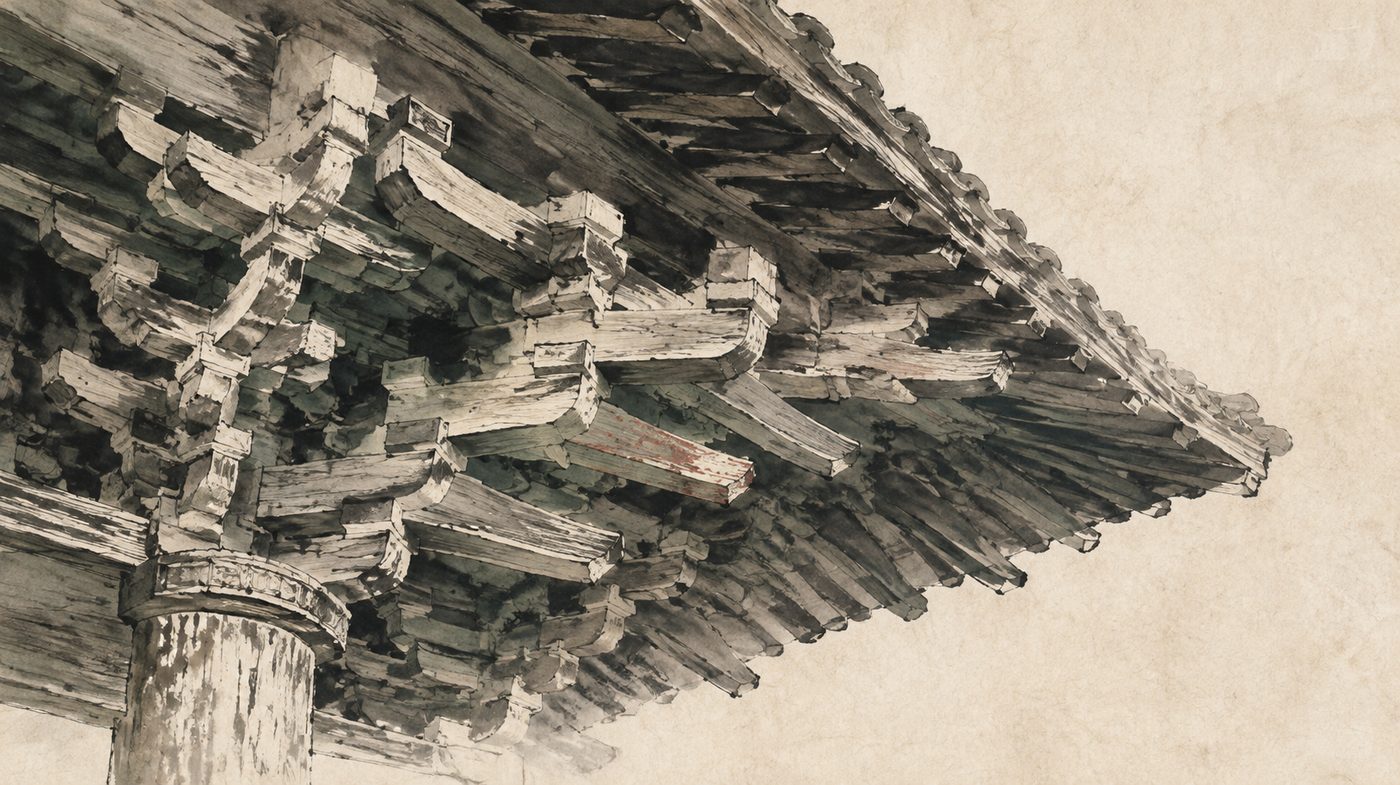
An ink-wash painting of a traditional Chinese dougong bracket set seen from below, its interlocking wooden blocks and arms stepping outward in tiers to carry the eave beam above.
A bracket set, cut and fitted, holding up an eave with no nails in it. The pattern school reads a chart the way you read one of these: not by weighing the timber, but by asking whether the structure is intact and what is holding it up. Illustration, not a depiction of a specific building.

Where the two readings part

The balance school asks a quantity question. Is the day master strong or weak, given the season it was born into and what supports it? Once you have the answer, the prescription follows: a weak day master wants the elements that feed and reinforce it, a strong one wants the elements that drain and restrain it. The output is an element and a direction, and it is arithmetic you can watch happen.

The pattern school asks a structure question. Look at the month command, which is the branch of the month pillar and the single most weighted position in the chart. Work out which of the ten gods its dominant hidden stem is, relative to your day master. That names your chart. A chart whose month command produces Direct Officer is a Direct Officer chart, and from there the questions are about the pattern rather than about you: is it intact, what is holding it up, what in the chart is undermining it.

Notice what has been demoted. In the pattern reading, whether the day master is strong or weak is not the opening question and not always the deciding one. A chart can carry a clean, well-supported pattern with a weak day master and be read as a good chart, which is precisely the case where the two schools return different answers.

The eight standard patterns

Eight of the ten gods form standard patterns. The two Companion relations, which are the day master's own element, do not, because a chart cannot be named after itself. If the ten-god vocabulary is new, that table has its own page; this one assumes it.

The Ziping Zhenquan divides the eight in a way that is the heart of the method. Four are favorable and are handled by following them, meaning you support and protect what they do. Four are unfavorable and are handled by countering them, meaning you supply whatever holds them in check. The text puts it in one line: Wealth, Officer, Resource and Eating God are the useful gods that are good, and are used by following; Seven Killings, Hurting Officer, Rob Wealth and the Blade are the ones that are not good, and are used by countering.

Pattern Handled by What the chart is about
Direct Officerzheng guan Following it The Influence that restrains the day master in an orderly way. The pattern of office, structure and answering to something.
Direct Wealthzheng cai Following it The Wealth the day master controls steadily. Earned rather than seized, and the pattern most associated with a durable livelihood.
Indirect Wealthpian cai Following it Wealth again, taken at the other polarity. Opportunistic, larger swings, the windfall and the venture rather than the salary.
Direct Resourcezheng yin Following it What generates and protects the day master. Learning, credentials, backing, and the risk of being over-protected.
Indirect Resourcepian yin Following it Support at the other polarity, read as unorthodox learning and as help that arrives with conditions attached.
Eating Godshi shen Following it The gentle Output. What the day master produces and enjoys producing: craft, appetite, expression without an edge on it.
Seven Killingsqi sha Countering it Influence at the same polarity as the day master, so it restrains without courtesy. Pressure, and the pattern of people who work best under it.
Hurting Officershang guan Countering it Output with an edge. Brilliance, and the tendency to aim it at exactly the authority the Direct Officer pattern would be serving.

Two more terms come with the method. The supporting god, xiang shen, is the character that makes the pattern work: the thing that protects a Direct Officer from the Hurting Officer that would attack it, or the thing that gives a Seven Killings somewhere to discharge. A pattern reading spends more of its attention there than on the day master. And a chart that fails to form any of the eight cleanly is an irregular pattern, of which the follower chart is the one that comes up most often and the one where the two schools diverge most violently, since in a follower chart the favorable elements invert. Our own limits section flags that case on a real public chart.

One word, two meanings, and we use the newer one

Here is the thing that makes English-language bazi so confusing, and it is not a translation problem. It is that the central term changed meaning in Chinese, inside living memory, and both meanings are still in circulation.

The term is yong shen, usually rendered as the useful god or the favorable element. In the Ziping Zhenquan, Shen Xiaozhan means by it the dominant qi of the month command: the thing that establishes which pattern you have. He is emphatic about it, and the sentence is worth having in full, because it is a direct shot at the practice most modern readers were taught. Anyone reading a chart, he writes, looks first at what category the useful god belongs to, and to seek a useful god anywhere but in the month command, picking one at will, is to grasp the false and lose the true.

On the modern English internet, and in our own calculator, the same term means something else: the element the chart is short of, chosen after judging the day master strong or weak. That is a balance-school object. Shen would not have called it a yong shen at all.

The shift is traceable to a specific book. Xu Leyi annotated the Ziping Zhenquan in the 1930s, and in the chapter on the useful god he divided its selection into four methods, strengthen-and-restrain among them. That annotation is how most twentieth-century readers met the text, and the four-method framing is what propagated. Chinese Wikipedia's entry on the book says plainly that the annotation misread the original on this point and that the misreading shaped later practice.

We are not in a position to be smug about that, because our calculator uses the post-Xu meaning. The method we implement descends from the same Republican-era lineage, by way of Wei Qianli's 1935 textbook, and our methodology page cites him. When our calculator says favorable element, it means the balance-school object, and a reader coming from a Qing text will find that the word does not point at the same thing. That seemed worth writing down on our own site rather than leaving for someone to discover.

Why we implement the balance school anyway

Not because it is more correct. We have no way to establish that and neither does anybody else. The reason is narrower and it is about what can honestly be automated.

The balance reading is fully specifiable. Season weights, root strength, hidden-stem shares, a threshold, an affinity table: every step is a number, every number is published, and anyone can reproduce a year score by hand from the specification and tell us if we got it wrong. That is the only kind of divination tool this site is willing to run, because it is the only kind where the reader can audit the machine.

A pattern reading is not like that. Naming the pattern is easy. Everything that makes the reading worth having comes next: whether the pattern is intact, what is protecting it, what has broken it, whether the chart has slipped into an irregular pattern instead, and those judgments are a large body of rules on which the sources genuinely disagree. A tool that named your pattern and then rendered a verdict would be presenting an unresolved argument as an answer, which is the failure mode the methodology page exists to prevent.

So we compute what we can specify and we print the raw material for the rest. Your chart shows the month command, your day master, and the ten-god relation of every character in it, which is exactly where a pattern reader would start. What we will not do is hand you a pattern verdict our engine cannot defend.

What a pattern reader would do with your chart

If you want to see the other reading, the sequence is short enough to follow by hand from what our calculator already gives you.

Find the month branch and its dominant hidden stem. Read that stem's ten-god relation to your day stem: our chart labels it. That name is your pattern. Then ask which of the two groups it belongs to, following or countering, and look through the rest of the chart for the character that would support it and the character that would break it. That last step is the reading, and it is the step no page and no calculator can do for you in a sentence.

You may well find it agrees with what our engine told you, because on a great many charts the two schools converge. When it does not, that disagreement is real information about your chart rather than a fault in either method, and it is the sort of chart a practitioner would want to look at properly.

One more school is worth naming, since it comes up alongside this one. Blind school practice, mangpai, is a third lineage, transmitted orally among blind practitioners and working from image and technique rather than from either scoring or patterns. It is genuinely different again, we do not implement it either, and we know less about it than we would need to write this page's equivalent for it.

Questions people ask

What is geju in bazi?

Geju means pattern or structure, and it is the name of the major alternative approach to reading a four-pillars chart. Instead of asking whether the day master is strong or weak and prescribing whatever element restores balance, a pattern reader starts from the month command, the branch of the month pillar, works out which of the ten gods it produces relative to the day master, and names the chart after it: a Direct Officer chart, a Seven Killings chart, a Hurting Officer chart. Everything after that is about whether the pattern is intact, what supports it and what breaks it. The founding statement of the approach is the Qing-dynasty Ziping Zhenquan.

What is the difference between the pattern school and the balance school?

Where the reading starts. The balance school, fu yi, judges the day master strong or weak against its season and support, then chooses the element that corrects the imbalance; the answer is a quantity. The pattern school reads the month command first, names the chart after the god it produces, and then asks what that pattern needs in order to hold; the answer is a structure. The two can agree, and on many charts they do, but they can also part company completely, because a chart can carry an excellent pattern while the day master is weak. Our calculator implements the balance school and says so on its methodology page.

What are the eight patterns in bazi?

Direct Officer, Direct Wealth, Indirect Wealth, Direct Resource, Indirect Resource, Eating God, Seven Killings and Hurting Officer. They are simply eight of the ten gods, since the two Companion relations do not form standard patterns of their own. The Ziping Zhenquan splits them into two groups and treats them oppositely: Wealth, Officer, Resource and Eating God are the favorable four and are used by following them, while Seven Killings, Hurting Officer, Rob Wealth and the Blade are the unfavorable four and are used by countering them. Beyond the eight there are irregular patterns, of which the follower chart is the one that comes up most.

Does the useful god mean the same thing in every book?

No, and this is the single most confusing thing in English-language bazi. In the Ziping Zhenquan, the useful god is the dominant qi of the month command, the thing that establishes which pattern you have. In almost every modern source, and in our own calculator, it means the element the chart is short of, chosen after judging the day master strong or weak. The shift is traceable: Xu Leyi, annotating the text in the 1930s, divided the selection of a useful god into four methods, one of which was balance, and that reading is the one that spread. Two books can use the same term and mean different objects.

Can your calculator work out my pattern?

No, and it will not pretend to. Naming a pattern is mechanical enough, but judging whether it is intact, what its supporting god is, and whether a nearby character has broken it is a body of contested rules that we have not implemented, and a partial pattern judgment presented as a complete one would be worse than none. What our calculator does is print your month command, your day master, and the ten-god relation of every character in your chart, which is the raw material a pattern reader starts from. What we compute is the balance reading, specified in full on the methodology page.

Sources

  • • 《子平真诠》卷一·八、论用神 (Ziping Zhenquan, Shen Xiaozhan, Qing dynasty), the founding text of the pattern approach, for the split between the gods used by following and by countering and for the rule that the useful god is sought in the month command: source
  • • Chinese Wikipedia, 子平真诠: Shen Xiaozhan as a Qianlong-era jinshi, the 48 chapters, the month-command method with pattern and supporting god, and the note that Xu Leyi 1930s annotation reinterpreted the useful god into four selection methods and shaped later practice: source
  • • 《渊海子平》 (Yuanhai Ziping, Song-dynasty compilation), the founding manual of the day-master method that both schools build on: source
  • • 《三命通会》 (Sanming Tonghui, Wan Minying, Ming dynasty), the compilation that carries the pattern material into the Ming: source
  • • 韦千里《千里命稿》 (Wei Qianli, Qianli Minggao, 1935), the Republican-era textbook whose strength-and-support method our calculator follows: source

The method we do run

The calculation methodology

Every weight, threshold and rule our engine uses, published so you can reproduce a score by hand.

The vocabulary both schools share

The ten gods

The eight patterns above are eight of these. What each relation is, and why polarity doubles five into ten.

Disagreement inside one method

Where the conventions differ

Hour boundaries, true solar time, leap months: the choices that move a chart before any school gets to read it.

The raw material

Cast your bazi chart

Your month command, your day master, and every character labeled with its ten-god relation.

Stay in the loop.

Chinese mythology, the zodiac, and the meaning behind names and symbols, rooted in the classics and read back to you. No spam. Unsubscribe anytime.