Two systems · One birth moment

Bazi and zi wei dou shu: the same birth moment, read two different ways

Chinese fate analysis has two major systems and they are not variations on each other. They take the same three or four numbers off your birth certificate, run them through unrelated machinery, and hand back objects that do not resemble one another. One returns eight characters. The other returns a ring of twelve rooms with stars in them.

The short version is that bazi tells you what you are made of, and zi wei dou shu tells you where things happen. Bazi weighs the five elements against each other, so its natural statements are about proportion and timing. Zi wei dou shu sorts your life into named departments and reports which stars landed in which, so its natural statements are about subject matter.

This page is about the relationship between the two. It does not teach either one: our bazi method is specified in full elsewhere, and the zi wei calculator walks through how a purple star chart is actually cast, step by step, including the rules it does not implement.
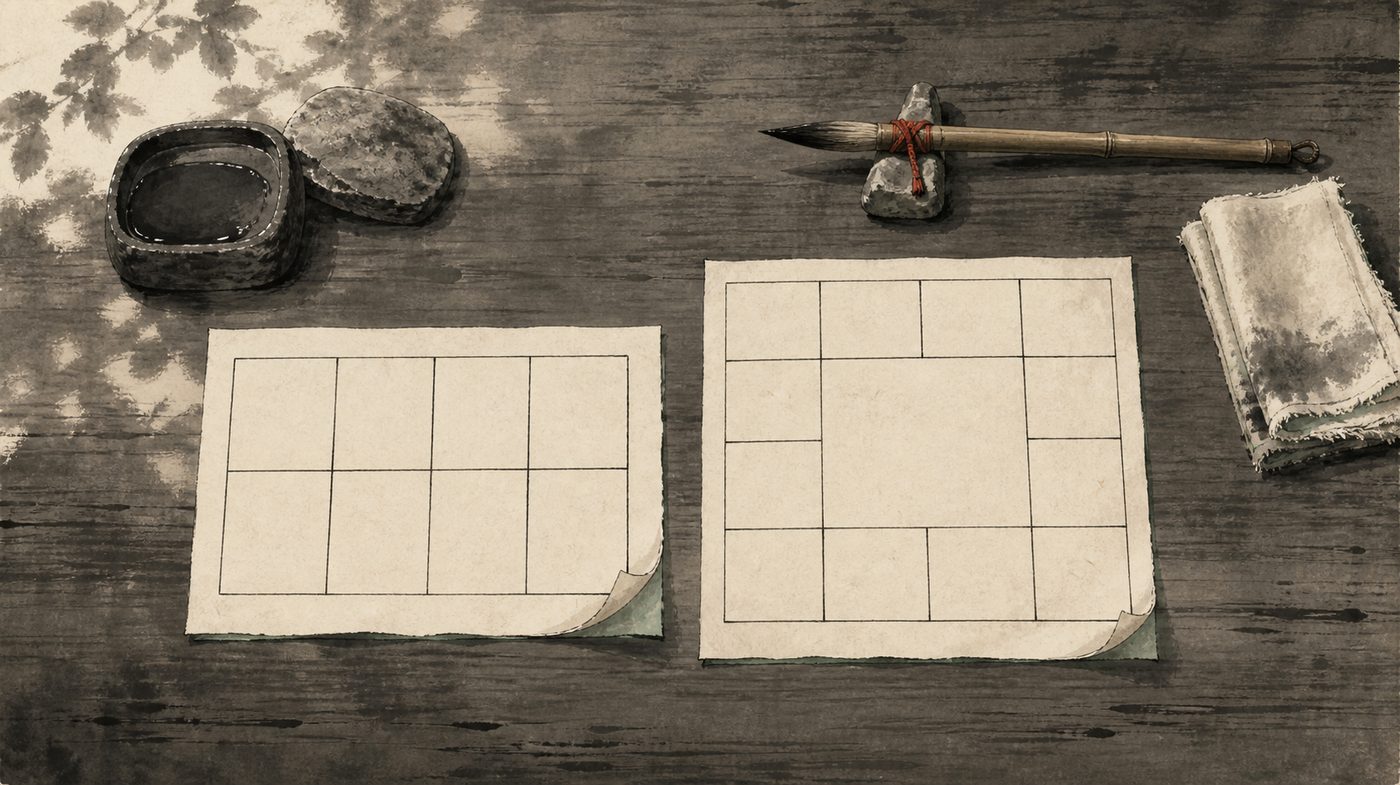
An ink-wash painting of a scholar's desk from above with two blank ruled forms side by side, one a small grid of eight cells and one a ring of twelve cells around an open center, beside an inkstone and brush.
The two forms, before anybody fills them in. Eight cells on the left, twelve around an open center on the right. Both are waiting for the same birth moment, and neither can be read off the other. Illustration, not a facsimile of any particular chart paper.

Side by side

Bazi (four pillars) Zi wei dou shu (purple star)
What it reads off your birth moment The year, month, day and hour as four stem-and-branch pairs, taken from the solar calendar. The lunar month, the lunar day, the hour branch, and your sex. Not the same three numbers, and not from the same calendar.
The object it produces Eight characters. Four stems over four branches, and nothing else. A ring of twelve palaces, each labeled with an area of life, each holding whichever stars landed in it.
The unit of meaning An element, and how much of it there is relative to the rest. A named star, and which palace it is sitting in.
The question it is shaped to answer What are you made of, and what does a given stretch of time do to that. What does each department of your life look like, and which one is the loud one.
How it handles time Ten-year luck pillars plus a score for every single year, both computed from the chart. Decade limits that move the palace ring, so a different palace becomes the Life Palace for each decade.
Where its answers get vague Specific events. It is good on proportion and timing and poor at saying what actually happens. Magnitude. It is good at saying which area of life is charged and poor at saying how strongly.
Its earliest datable text The Song-dynasty Yuanhai Ziping, and the method is credited to Xu Ziping in the tenth century. The Ming-dynasty Ziwei Doushu Jielan of 1581, with a preface to the Quanshu dated 1550.

What each one actually builds

A bazi chart is a small table. Four columns, one each for the year, month, day and hour of your birth, and each column holds one of the ten heavenly stems over one of the twelve earthly branches. That is all eight characters. Every branch also conceals one to three further stems with weights, so the working chart has closer to fifteen pieces than eight, but the visible object is a four-by-two grid you could write on a napkin.

Reading it means weighing. Which element does the day stem belong to, is that element strong or weak in the season it was born into, what is it short of, what is it drowning in. The answer is a judgment about balance, and the judgment is what our day master page works through on a public birth date, arithmetic included.

A zi wei chart is a floor plan. Twelve cells in a ring, each one assigned to a department of life, and the ring is rotated by your birth hour so that different departments sit on different branches for different people. Then the stars are placed.

Palace What it covers
Life character, and the shape of the whole chart
Siblings brothers, sisters, peers
Spouse marriage and the partner
Children children, and what you produce
Wealth money as it moves
Health the body and its weak points
Travel movement, and life away from home
Friends colleagues, subordinates, the crowd
Career office, standing, the work itself
Property land, house, what is held
Fortune inner life, appetites, ease
Parents parents, elders, authority

Nothing in a bazi chart corresponds to that list. Bazi does have positional readings, the year pillar for the wider world and the day branch for the marriage, but they are four rough zones read off a chart that was built for something else. Zi wei dou shu starts from the departments. This is the single largest structural difference between the two and the reason practitioners find them complementary rather than redundant.

One birth moment, two conversions

The two systems ask for nearly the same thing and then do different arithmetic to it, and the difference starts before either chart exists.

Bazi runs on the solar calendar. Your year pillar turns at li chun in early February, not at Chinese New Year, which is why a birthday in that gap can belong to two different animals depending on which rule is applied, a tangle with a page of its own. Your hour becomes one of twelve double hours, and each pillar is a stem-branch pair pulled from the sexagenary cycle.

Zi wei dou shu runs on the lunar calendar and wants your lunar month and lunar day as numbers, which is a conversion in its own right, plus your sex, which bazi uses only to decide which way the luck pillars run. From those it counts around a fixed ring to find your Life Palace, reads a Five Element Bureau off that palace, and uses the bureau to place the emperor star, from which almost everything else follows.

On this site both run off a single birth input, which is a deliberate piece of plumbing rather than a convenience: the same moment feeds the bazi calculator, the zi wei calculator and the feng shui kua number, and none of the three borrows a result from the others. The full life chart puts what they produce in one place.

Which came first, honestly

Both systems claim a tenth-century origin and only one of them can show its work.

Bazi in its modern form is credited to Xu Ziping, which is why the method is often just called Ziping, and its founding manual, the Yuanhai Ziping, is a Song compilation. The Ming Sanming Tonghui then gathers several centuries of practice on top of it. The trail is continuous and it is long.

Zi wei dou shu is traditionally attributed to Chen Tuan, a Daoist of the Five Dynasties, which would make the two systems near contemporaries. The attribution is transmitted lore rather than a documented fact, and Chinese Wikipedia flags it as such; one version of the legend has the immortal Lü Dongbin teaching the system to Chen Tuan, which is a good indication of what kind of claim it is. The earliest datable zi wei text is the Ziwei Doushu Jielan of 1581, with a preface to the better-known Quanshu dated 1550. A zi wei text does appear in the late-Ming supplement to the Daoist canon, and it differs substantially from the modern system in both star names and construction.

None of which makes bazi better. It makes bazi better documented, and it explains why the zi wei tradition carries more visible school-to-school variation: less of it was fixed in print early. Four main schools are recognized today and they disagree about real things, two of which our calculator surfaces rather than resolving quietly.

Which one should you use

We are not going to tell you which is more accurate. There is no comparison to appeal to, the two do not produce the same kind of statement, and a confident answer would be a marketing claim wearing a scholar's coat.

What is answerable is which shape fits your question. If you want to know whether the next few years run with you or against you, bazi has the machinery: it produces a score per year out of the elemental balance, and that is the thing it was built to do. If your question is about one part of your life in particular, your marriage, your money, your health, zi wei dou shu has a compartment for it by construction, and the star sitting in that compartment is a specific answer rather than an inference.

The practical answer in the Chinese-speaking world is that people use both. A working practitioner will often cast both charts, take the timing from the four pillars and the subject matter from the palaces, and treat disagreement between them as information rather than as a contradiction to be resolved. That two systems this different have both survived a thousand years is itself the argument that neither has superseded the other.

Questions people ask

What is the difference between bazi and zi wei dou shu?

They take the same birth moment and build two unrelated objects out of it. Bazi converts your birth into eight characters, four heavenly stems over four earthly branches, and reads the balance of the five elements between them, so its answers are about proportion: what you have too much of, what you are short of, and what a given year does to that. Zi wei dou shu converts your birth into a ring of twelve palaces, one for marriage, one for money, one for career and so on, and places named stars into them, so its answers are about location: which star is sitting in your marriage palace. Bazi says what you are made of. Zi wei dou shu says where things happen.

Which is more accurate, bazi or zi wei dou shu?

Neither of us can tell you, and anyone who answers that confidently is selling something. There is no controlled comparison to appeal to, the two systems do not even produce the same kind of statement, and practitioners of each will tell you theirs is more precise. What can be said is what they are shaped for. If your question is about timing and proportion, bazi has the machinery for it. If your question is about one area of your life in particular, zi wei dou shu is built with a compartment for exactly that. Chinese practitioners routinely cast both and read them together, which is the most honest evidence about how the two are actually regarded.

Do bazi and zi wei dou shu use the same birth information?

Almost, and the almost matters. Both need your date and your hour. Bazi then works from the solar calendar, converting your birth into four stem-and-branch pairs, and the astrological year turns at li chun in early February. Zi wei dou shu works from the lunar calendar and needs your lunar month and lunar day, along with your sex, which bazi uses only to decide which direction the luck pillars run. So the same birthday feeds two different conversions before either system starts, which is why a chart of one kind cannot be read off a chart of the other.

Which system is older?

Bazi, by a wide margin in the surviving record. The day-master method is credited to Xu Ziping in the tenth century and its founding manual, the Yuanhai Ziping, is a Song-dynasty compilation. Zi wei dou shu is traditionally attributed to the Five Dynasties Daoist Chen Tuan, which would make them near contemporaries, but that attribution is transmitted lore rather than a documented one, and one version of the legend has Lü Dongbin teaching it to him. The earliest datable zi wei text is the Ziwei Doushu Jielan of 1581, with a preface to the Quanshu dated 1550, so the textual trail is Ming rather than Song.

Can I use both at once?

Yes, and it is normal practice rather than hedging. Because the two systems read different facts off the same moment, they can disagree in detail without contradicting each other in the way two horoscopes would: one is describing your elemental composition and the other is describing your palace layout. Practitioners who use both typically get the timing from bazi and the subject matter from zi wei dou shu. Our calculators run off one birth input for exactly this reason, so casting the second costs you nothing once you have cast the first.

Sources

  • • 《渊海子平》 (Yuanhai Ziping, Song-dynasty compilation), the founding manual of the day-master method credited to Xu Ziping: source
  • • Chinese Wikipedia, 紫微斗数: the traditional attribution to Chen Tuan treated as lore, the 1581 Ziwei Doushu Jielan as the earliest datable text, the 1550 preface to the Quanshu, and the four main modern schools: source
  • • Wikipedia, Zi wei dou shu: the English-language overview of the twelve palaces and the fourteen major stars: source
  • • 《三命通会》 (Sanming Tonghui, Wan Minying, Ming dynasty), for the state of four-pillars practice at the point where the zi wei texts first appear: source

System one

Cast your bazi chart

Eight characters, the strength judgment, and a score for every year of your life.

System two

Cast your purple star chart

Twelve palaces, the five element bureau, the fourteen major stars, and every placement rule shown.

Both at once

Your full life chart

One birth moment, every reading this site can compute from it, in one place.

Disagreement inside one system

The pattern school

Two schools of bazi read the same eight characters differently. Why we chose one, and what the other would say.

Stay in the loop.

Chinese mythology, the zodiac, and the meaning behind names and symbols, rooted in the classics and read back to you. No spam. Unsubscribe anytime.