Bazi · The alphabet

Heavenly stems and earthly branches: the twenty-two characters a chart is spelled with

A bazi chart is eight characters, and the eight are drawn from an alphabet of twenty-two: ten heavenly stems, which carry the five elements and a yang or yin polarity, and twelve earthly branches, which carry the months, the double hours and, more recently than you would think, the twelve zodiac animals. One stem sits on one branch to make a pillar; four pillars, for the year, month, day and hour of a birth, make the chart. Everything a bazi calculator does is arithmetic on these twenty-two, and everything a reading says is a sentence about them.

Both tables below come straight from the tables our calculator runs on, so the element, animal, month, hour and hidden stems you see are the ones it will assign you. The rest of the page is what the characters meant to the people who first wrote them down, which turns out to be farming, and which of the things we now hang on them, animals included, they picked up later.

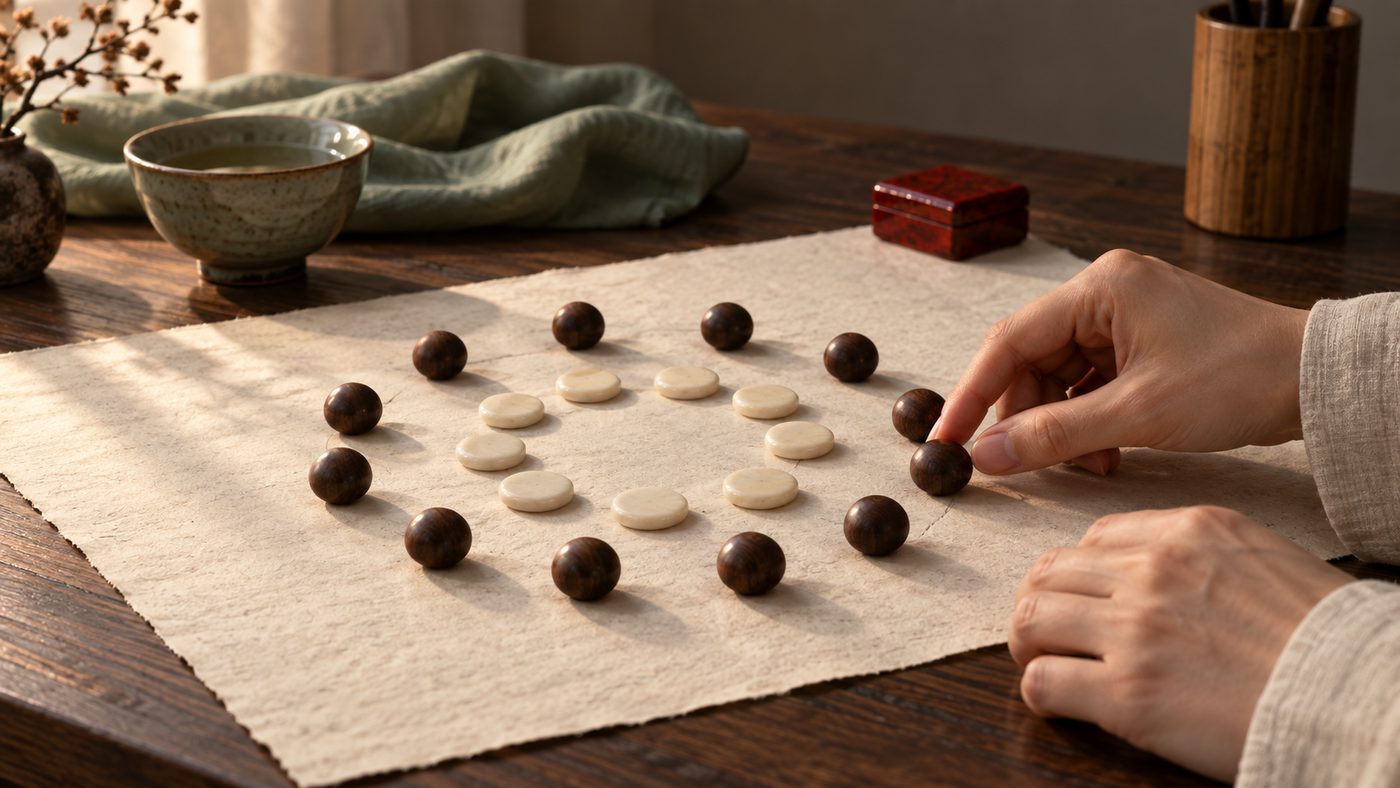
Two rings of counters on a sheet of rice paper in low side light, an inner ring of pale bone discs and an outer ring of twelve dark boxwood beads, while a hand in a linen sleeve nudges one bead forward.
The short wheel inside the long one: they turn together, and it takes sixty steps to come back around. Illustration.

Decode your eight characters

Type the characters of your chart in pillar order, year to hour, in Chinese or pinyin ("jia zi bing yin …"). Each one is decoded here. Nothing you enter is stored.

No eight characters yet? A birth date is enough to cast the year, month and day pillars; add a time for the hour.

The ten heavenly stems

The stems are the short wheel. Ten characters, two to each of the five elements, the first of each pair yang and the second yin, in the fixed order Wood, Fire, Earth, Metal, Water. In a chart the stem is the top character of every pillar, and the stem of your day pillar is the one the whole reading is organized around: the day master, the character that is you.

The first Chinese dictionary, Xu Shen's Shuowen Jiezi of AD 100, defines them as weather. Jia is "the first of the east, the yang breath beginning to stir"; yi is "spring plants pushing up bent and crooked"; bing is "the south, everything formed and bright"; and so on round the year to gui, "winter, water and earth level, everything measurable." Then, entry by entry, Xu Shen does something no English page seems to have noticed: he lays the ten stems onto a human body from the top down. Jia is like the head, yi the neck, bing the shoulders, ding the heart, wu the ribs, ji the belly, geng the navel, xin the thighs, ren the shins, gui the feet. Ten stems, one standing person. The table keeps the body column, because once you have seen it you cannot unsee the day master as the heart of the thing.

The ten heavenly stems: character, pinyin, polarity, element, the Shuowen gloss and the body part it is likened to.
# Stem Polarity · element What the Shuowen says it is Body
1 Jia Yang Wood the first of the east; the yang breath begins to stir 東方之孟,陽气萌動 the head
2 Yi Yin Wood spring plants pushing up bent and crooked 象春艸木冤曲而出 the neck
3 Bing Yang Fire the south; everything formed and bright 位南方,萬物成,炳然 the shoulders
4 Ding Yin Fire summer, when everything is sturdy and full 夏時萬物皆丁實 the heart
5 Wu Yang Earth the central palace 中宮也 the ribs
6 Ji Yin Earth the central palace; things tucked away and bent 中宮也。象萬物辟藏詘形 the belly
7 Geng Yang Metal the west; autumn, everything heavy with grain 位西方,象秋時萬物庚庚有實 the navel
8 Xin Yin Metal autumn, everything ripe; metal, and the taste of sharpness 秋時萬物成而孰;金剛,味辛 the thighs
9 Ren Yang Water the north; yin at its limit, yang born 位北方也。陰極陽生 the shins
10 Gui Yin Water winter, water and earth level, everything measurable 冬時,水土平,可揆度也 the feet

Two of the ten are odd men out, and the oddness is old. Wu and ji, the Earth pair, are the only stems the Shuowen defines by position rather than season: both are simply "the central palace." Sima Qian, writing his Shiji two centuries earlier, explains the stems on a tour of the compass, one wind at a time, hanging jia and yi on the east wind, bing and ding on the south, geng and xin on the west, ren and gui on the north, with a gloss for each: ren "is to bear, the yang breath bearing and nourishing everything below," gui "is to measure, everything now measurable." The tour has no stop at the center. Wu and ji never come up. Earth in this system is not a direction you can face; it is the ground the other four stand on, which is exactly how a bazi reading treats it.

Sima Qian also does not call them stems. His word for the ten is "the ten mothers," and for the twelve "the twelve children," and the treatise signs off with the ten mothers, the twelve children and the pitch-pipes all tuned together since high antiquity. The words we translate as stem and branch, the trunk and the limbs of one tree, are a later gloss, and the section on their history below says how much later.

The twelve earthly branches

The branches are the long wheel, and they do more jobs. Each one is a month of the traditional calendar, with yin as the first month and zi, the month of the winter solstice, as the eleventh. Each is a two-hour block of the day, zi centered on midnight and wu on noon, which is the shichen system and has its own page. Each, since about the second century BC, carries a zodiac animal. And each hides one to three stems, which is the part a reading actually uses and the part the next section is about. The polarity alternates down the twelve like the stems, and the element of a branch is the element of its main hidden stem.

The twelve earthly branches: character, pinyin, polarity, element, zodiac animal, month, double hour, hidden stems and the Shuowen gloss.
# Branch Polarity · element Animal Month Hours Hidden stems What the Shuowen says it is
1 Zi Yang Water Rat 11 23:00–01:00 Gui (Water) the eleventh month; yang moves, everything breeds 十一月,陽气動,萬物滋
2 Chou Yin Earth Ox 12 01:00–03:00 Ji (Earth), Gui (Water), Xin (Metal) a knot; the twelfth month, everything stirring 紐也。十二月,萬物動
3 Yin Yang Wood Tiger 1 03:00–05:00 Jia (Wood), Bing (Fire), Wu (Earth) the first month; yang leaves the Yellow Springs and wants up 正月,陽气動,去黃泉,欲上出
4 Mao Yin Wood Rabbit 2 05:00–07:00 Yi (Wood) to push through; the second month, everything breaks the soil 冒也。二月,萬物冒地而出
5 Chen Yang Earth Dragon 3 07:00–09:00 Wu (Earth), Yi (Wood), Gui (Water) to shake; the third month, thunder, and the farmers go out 震也。三月,靁電振,民農時也
6 Si Yin Fire Snake 4 09:00–11:00 Bing (Fire), Wu (Earth), Geng (Metal) the fourth month; yang all out, yin all hidden, so si is a snake 四月,陽气巳出,陰气巳藏…故巳爲蛇
7 Wu Yang Fire Horse 5 11:00–13:00 Ding (Fire), Ji (Earth) to cross; the fifth month, yin pushes back against yang 啎也。五月,陰气午逆陽
8 Wei Yin Earth Goat 6 13:00–15:00 Ji (Earth), Ding (Fire), Yi (Wood) flavor; the sixth month, when things taste of something 味也。六月,滋味也
9 Shen Yang Metal Monkey 7 15:00–17:00 Geng (Metal), Ren (Water), Wu (Earth) the seventh month; yin complete, bodies tighten 神也。七月,陰气成,體自申束
10 You Yin Metal Rooster 8 17:00–19:00 Xin (Metal) done; the eighth month, millet ripe enough for wine 就也。八月黍成,可爲酎酒
11 Xu Yang Earth Dog 9 19:00–21:00 Wu (Earth), Xin (Metal), Ding (Fire) to go out; the ninth month, yang faint, everything finished 滅也。九月,陽气微,萬物畢成
12 Hai Yin Water Pig 10 21:00–23:00 Ren (Water), Jia (Wood) a root; the tenth month, a faint yang rising under full yin 荄也。十月,微陽起,接盛陰

Read the last column and notice what is not in it. The Shuowen defines every one of the twelve branches as a month and a state of the crops: mao is "to push through; the second month, everything breaks the soil"; chen is "to shake; the third month, thunder, and the farmers go out"; you is "done; the eighth month, millet ripe enough for wine." In all twelve entries there is exactly one animal. It is the snake, under si, and it is there for a reason that has nothing to do with a zodiac: the character 巳 is a drawing of one, and Xu Shen says so. No rat under zi, no ox under chou, no dragon under chen. The dictionary that fixed the meaning of these characters in AD 100 did not know they had animals, because in the sense that matters they did not yet. The animals were bolted on by the second century BC, on the evidence of a set of Qin bamboo slips found in Gansu. The zodiac is real and old; it is simply younger than the branches it rides on.

Hidden stems: the human element

Here is the piece of the alphabet that the English pages leave out, and it is the piece the arithmetic runs on. A branch is not one element; it is a container. The Song-dynasty manual Yuanhai Ziping, the founding text of the day-master method, puts it in a line: the stem is heaven, the branch is earth, and what the branch hides is the human. Then it gives the contents of all twelve in a rhyme that every student of the art once knew by heart, and that our engine's table is checked against every time this page is built:

子宫癸水在其中,丑癸辛金己土同;寅宫甲木兼丙戊,卯宫乙木独相逢。辰藏乙戊三分癸,巳中庚金丙戊丛;午宫丁火并己土,未宫乙己丁共宗。申位庚金壬水戊,酉宫辛金独丰隆;戌宫辛金及丁戊,亥藏壬甲是真踪。

In plain English: zi holds gui alone; chou holds gui, xin and ji; yin holds jia with bing and wu; mao holds yi alone; chen holds yi, wu and gui; si holds geng, bing and wu; wu holds ding and ji; wei holds yi, ji and ding; shen holds geng, ren and wu; you holds xin alone; xu holds xin, ding and wu; hai holds ren and jia. The pattern is not random. The four branches at the cardinal points, zi, mao, wu and you, are pure or nearly so: one element at full strength. The four at the corners, chen, wei, xu and chou, are the Earth branches, and each keeps a residue of the season just ended (the yi inside chen is the last of spring's Wood) plus a third stem the tradition says is stored there, the way a granary holds last year's grain. The remaining four, yin, si, shen and hai, are the growth branches where a season opens, and each carries the element of the season it opens plus the stem of the element said to be born there, so Fire is already inside the first month of spring.

Which is why a chart with, say, no Fire stem at all can still be a Fire-heavy chart: the Fire is in the branches, hidden, and a reader counts it. Our calculator weighs the main hidden stem at six tenths of the branch and the two minor ones at three tenths and one tenth, which is the modern mainland convention rather than anything in the Song text; the text only says what is inside, not how much of it counts. That is the honest limit of the rhyme. It is also why two calculators fed the same birth can call the same person strong and weak, a disagreement the conventions page measures on eight of them.

Older than their names

The twenty-two are among the oldest characters still in daily use anywhere on earth, and the way to feel that is to notice what they were doing before they had names. The Shang kings at Anyang, around 1200 BC, cracked ox shoulder blades and turtle shells to ask their ancestors questions, and every question was dated. The dates are stem-branch pairs. In the translations that Columbia's Sources of Chinese Tradition prints, a diviner named Gu makes his cracks "on yiwei (day 32)," a diviner named Zheng "on renzi (day 49)" and again "on guichou (day 50)," and the questions they ask are whether "Father Yi" or "Grandfather Ding" is the ancestor harming the king. The sixty-day cycle is not being invented on those bones. It is being used as casually as a Tuesday, and Zhang He, in a 2020 comparative study of the Chinese and Mesoamerican cycles, notes that a complete run of all sixty pairs appears "neatly aligned" in the inscriptions by 1200 BC.

Look at those ancestors' names again. Father Yi. Grandfather Ding. The Shang royal house named its dead by stems: Pan Geng, who moved the capital to Anyang; Wu Ding, the king whose reign the oracle bones begin in; Di Xin, the last of the line. Zhang He's list runs to seven kings and the observation that "only the names of the heavenly stems were chosen to bestow upon people." Not one Shang king is named for a branch. The ten were the half that belonged to people, and the reason is probably the plainest one: ten stems made a ten-day week. The Shuowen entry for that week is three characters long, "ten days make a xun," and one of the standard divinations on the bones, cracked on the last day of one xun about the next, is three characters that David Keightley renders "In the next ten days there will be no disasters." Long before anyone put a stem on a branch, the stems were the days you lived through.

The names came a thousand years later. "The system was not clearly named until about 200 BCE," Zhang He writes, when people began calling the ten gan and the twelve zhi. The gloss that stuck is Cai Yong's, from his second-century handbook Duduan, which the Ming manual Sanming Tonghui quotes at the head of its chapter on origins: gan is a trunk, there are ten of them and they are also called the ten mothers, today's jia through gui; zhi is a branch, there are twelve of them and they are also called the twelve children. One tree, a trunk and its limbs; and behind it Sima Qian's older and stranger image of mothers and children, which the Ming author keeps, because the ten do generate the sixty and the twelve are what they generate it on.

Where the twelve came from in the first place nobody knows, and it is worth saying so plainly rather than picking a pretty story. Guo Moruo, the great twentieth-century reader of the oracle bones, suggested that the ten stems were simply ten fingers and that the twelve branches had been borrowed from the Babylonian zodiac; Zhang He points out that the Babylonian constellations were not formalized at twelve stations until 700 BC, five centuries after the branches appear complete on the bones, and files the idea under speculation. So will we.
Why ten against twelve makes sixty

The two wheels turn together, one notch each: jia-zi, yi-chou, bing-yin, and so on. Because both advance at once, a stem in an odd position can only ever land on a branch in an odd position, so the yang stems meet only the yang branches and the yin only the yin. Half the grid of 120 possible pairs is never visited. The sequence closes after sixty steps, comes back to jia-zi, and starts again, which is why a Chinese sixtieth birthday is the one that matters: your birth year has just been called by its full name for the first time since you arrived. The sixty pairs, the old names the Erya gave them, and the way a day pillar is counted through them without ever resetting are the next page in this series. For now, the decoder above will tell you what your own eight are made of, and the calculator will cast them if you do not have them yet.

Questions people ask

What are the heavenly stems and earthly branches?

Two counting cycles that the Chinese calendar has run together for over three thousand years: ten stems (jia, yi, bing, ding, wu, ji, geng, xin, ren, gui) and twelve branches (zi, chou, yin, mao, chen, si, wu, wei, shen, you, xu, hai). Paired one stem to one branch and advanced together, they make the sixty-term cycle that names every year, month, day and double hour, and a bazi chart is simply the four pairs for the moment you were born. Each stem carries a polarity and one of the five elements; each branch carries an animal, a month, a two-hour block and one to three "hidden" stems.

What are the 10 heavenly stems?

Jia (yang Wood), Yi (yin Wood), Bing (yang Fire), Ding (yin Fire), Wu (yang Earth), Ji (yin Earth), Geng (yang Metal), Xin (yin Metal), Ren (yang Water), Gui (yin Water). They run in that order, alternating yang and yin, two to each element in the sequence Wood, Fire, Earth, Metal, Water. The Han dictionary Shuowen Jiezi glosses each as a stage of the year and likens the ten, in order, to a human body from the head (jia) to the feet (gui).

What are the 12 earthly branches?

Zi (Rat), Chou (Ox), Yin (Tiger), Mao (Rabbit), Chen (Dragon), Si (Snake), Wu (Horse), Wei (Goat), Shen (Monkey), You (Rooster), Xu (Dog), Hai (Pig). Each is a month of the traditional calendar (yin is the first month), a two-hour block of the day (zi is 23:00 to 01:00), and, since about the second century BC, one of the zodiac animals. In a bazi chart the branch also hides one to three stems, which is where most of the chart's arithmetic lives.

Which heavenly stem is which element?

Jia and yi are Wood, bing and ding are Fire, wu and ji are Earth, geng and xin are Metal, ren and gui are Water. Within each pair the first is yang and the second yin, so jia is yang Wood and yi is yin Wood, and so on down the ten. The element of your day stem is the one a reading calls your day master.

What is the difference between heavenly stems and earthly branches?

The stems are the shorter cycle of ten, tied to the elements and to polarity, and they are the half a bazi reading weighs directly: your day master is a stem. The branches are the longer cycle of twelve, tied to the months, the hours and the animals, and they work indirectly, through the stems they hide. A second-century scholar, Cai Yong, glossed the two words as trunk and branch of one tree, and the Shiji simply calls them the ten mothers and the twelve children.

What are hidden stems in bazi?

The stems each branch is said to contain. A branch whose energy is a single element hides one stem (zi hides gui, Water); the four earth branches hide three, a main stem and two minor ones, and the four growth branches hide two or three. The Song manual Yuanhai Ziping gives the full list in a twelve-line rhyme and calls the hidden stems the human element, between the stem (heaven) and the branch (earth). Our calculator weighs the main hidden stem at six tenths and the two minor ones at three tenths and one tenth.

Do the earthly branches have animals in the oldest texts?

No. The branches are on Shang oracle bones from about 1200 BC with no animals anywhere near them, and the Shuowen Jiezi of AD 100 defines all twelve as months of the year and names exactly one animal, the snake, only to explain why the character si is drawn the way it is. The twelve animals appear attached to the branches on Qin bamboo slips of the second century BC, a thousand years after the branches themselves.

Why do 10 stems and 12 branches make a cycle of 60, not 120?

Because the two wheels turn together, one step each at a time. A stem in an odd position can only ever land on a branch in an odd position, so yang stems meet only yang branches and yin only yin; half of the 120 possible pairings never occur, and the sequence comes back to jia-zi after sixty steps. That is why a sixtieth birthday is the one the tradition marks: the full name of your birth year has come round again.

How do I read the eight characters of my bazi chart?

Take them in pairs, one stem over one branch, for the year, month, day and hour. The decoder on this page turns each character into its polarity, element, animal, month and hidden stems; the day stem is the one to read first, because it is you. If you do not have your eight characters yet, the calculator casts them from a birth date and time.

What does wu mean in bazi, the stem or the branch?

Both, and they are different characters that happen to share a romanization: wu the stem (戊) is yang Earth, the fifth of ten; wu the branch (午) is the Horse, the seventh of twelve, the noon hour. In a chart the position tells you which: the top character of a pillar is always a stem, the bottom one always a branch. The decoder here reads "wu" by position for that reason; type the character if you want to be certain.

Keep going

Sources

The Shuowen entries, the Shiji treatise, the Yuanhai Ziping rhyme and the Sanming Tonghui chapter were read in the Chinese; the Shuowen glosses in the tables are our own plain renderings of the entries, not a published translation. Both tables and the hidden-stem list are generated from the site's bazi engine and checked against the rhyme at build.

Stay in the loop.

Chinese mythology, the zodiac, and the meaning behind names and symbols, rooted in the classics and read back to you. No spam. Unsubscribe anytime.