Bazi · The reading order

How to read a bazi chart

A bazi chart does not mean anything on its own. Eight characters sit in four columns, and a reading is the act of taking them in a particular order, where each step narrows what the next one can say. Skip a step and the rest is guessing; take them out of order and you get the horoscope-flavored English that gives the subject its bad name. The order has been stable since the Song-dynasty manuals that made the day stem the center of the chart, and it is short enough to hold in your head.

This page walks it once, on a real chart, with nothing hidden. The chart is Taylor Swift's, the same four-pillar chart the calculator backtests: born December 13, 1989, with the early-morning birth time in public circulation, which gives it the hour column a three-pillar chart lacks. Every character, label and number below is computed by the engine as the page is built, so what you read here is exactly what the calculator would print.

Two things this is not. It is not a full interpretation of one person, which would take a practitioner and a conversation; it is the order, made concrete. And it is one school's order, the balance method our calculator implements. The pattern school starts somewhere else, and the last section says where.
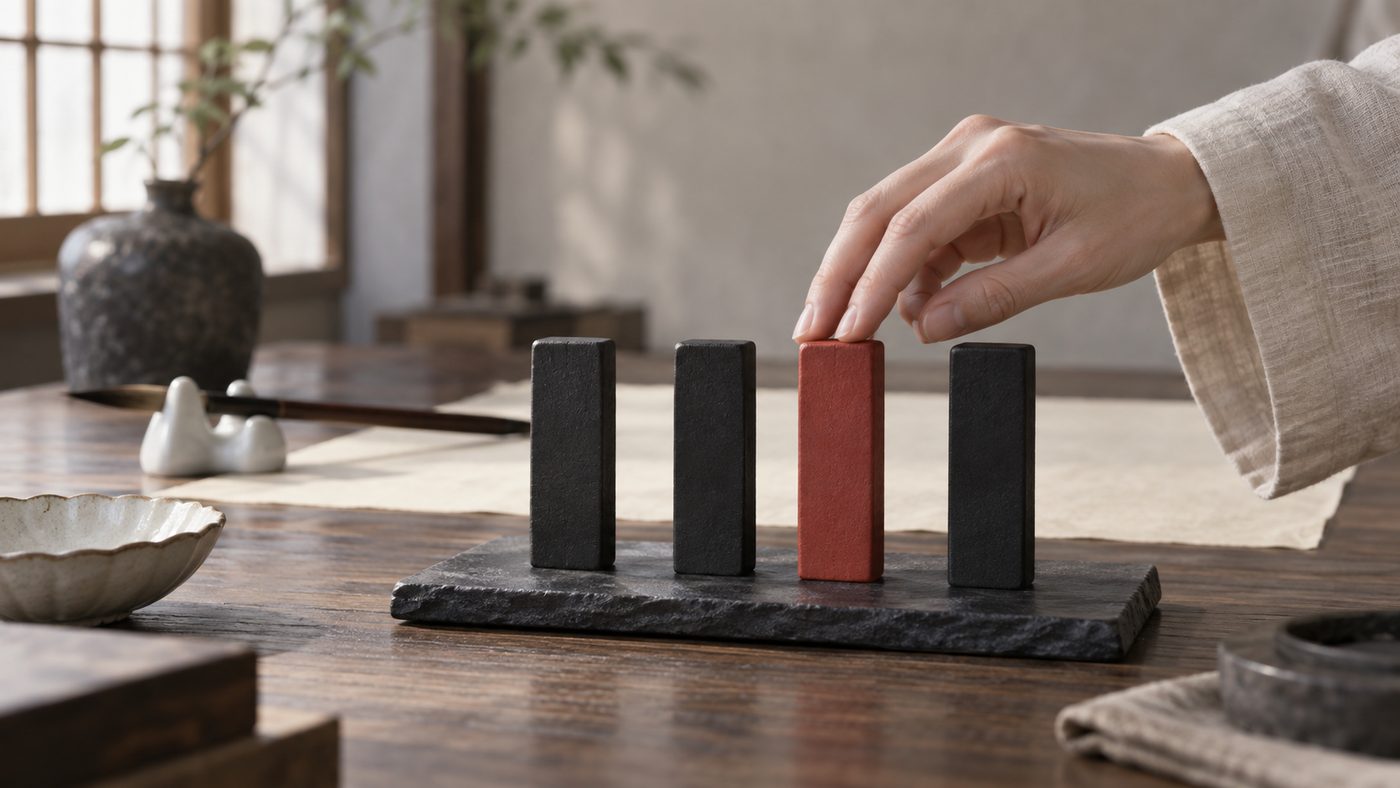
Four ink sticks stand upright in a row on a slate tray, three black and the third one cinnabar red, while a hand in a linen sleeve rests two fingertips on the red one, with blank rice paper and a brush behind.
Four columns, and you start with the third. The day pillar's stem is the character the rest of the chart is read against, which is why every step below begins there.

Before reading: the chart in front of you

Four pillars, one each for the year, month, day and hour of birth. Each pillar is a heavenly stem over an earthly branch: the stem is one of ten characters carrying an element and a polarity, the branch is one of twelve carrying an animal and, hidden inside it, one to three more stems. Chinese charts print the pillars right to left, year on the right; English tools print them left to right, and so does this page.

Year pillarMonth pillarDay pillarHour pillar
Stem Ji
Yin Earth
Bing
Yang Fire
Ding
Yin Fire
day master
Gui
Yin Water
Branch Si
Snake · Fire
Zi
Rat · Water
Wei
Goat · Earth
Mao
Rabbit · Wood
Hidden stems Bing (Fire), Wu (Earth), Geng (Metal)Gui (Water)Ji (Earth), Ding (Fire), Yi (Wood)Yi (Wood)

The year branch is where the zodiac animal comes from: Snake here. Notice how little of the chart that is. One of eight characters, and the one shared with everyone born the same year. Everything a reading actually says comes from the other seven and from how they sit around one character in particular.

Step 1 · Find the day master

The stem of the day pillar is the day master (日主), and in the Ziping method it stands for the person. Every other character in the chart is read by what it does to this one. In this chart the day master is Ding , yin fire.

That the day stem stands for the person is itself the method's founding move. The older Tang-era reading, the one attached to Li Xuzhong's name, took the year pillar as the self; the Song-era reform credited to Xu Ziping moved the self to the day stem, and the Yuanhai Ziping, the manual that carries his name, is built on that one change. Everything on this page follows from it.

The polarity matters as much as the element. Yang fire is the sun and the bonfire; yin fire is the lamp and the hearth, fire that needs fuel and gives close light rather than heat at a distance. The ten stems each carry a picture like this, and the day master page gives all ten. What you take from this step is the one character the rest of the reading measures against. Nothing else in the chart has a meaning yet.

Step 2 · Judge it strong or weak

This is the judgment the whole method turns on, and the one practitioners argue about most. Three questions, in the order Wei Qianli's 1935 textbook gives them: does the season favor the day master's element (得令, de ling, holding the command), does the element have roots in the branches (得地, de di, holding ground), and do the other stems support it or drain it (得势, de shi, holding force).

Here the month branch is Zi, the Rat, which is the depth of winter and belongs to water. Fire born in a water month is out of season before anything else is counted. The roots are thin: the year branch Si is fire by its main qi, but the year branch is the lightest position of the four, and the day branch Wei holds fire only as a secondary hidden stem. The support is real but narrow: the month stem Bing is fire beside fire, and the hour branch Mao is wood, which feeds it.

Modern practice turns those three questions into one weighted count of the positions that help the day master. On this chart that count is 31.2 out of 100, and anything under half reads weak. It is not close to the line, so the verdict would survive most alternative weightings. The position-by-position arithmetic, and the weights behind it, are worked on the day master page and published on the methodology page; the point of this step is the verdict, because step three cannot begin without it.

Step 3 · Name the favorable elements

A weak day master wants feeding; a strong one wants draining. That single rule, stated in the Yuanhai Ziping and repeated by every manual since, converts the verdict into a prescription. The element that generates the day master and the day master's own element are the two that help a weak chart. For a strong chart it is the reverse: the element it produces, the element it controls, and the element that controls it.

The day master here is weak fire, so the favorable elements are fire and wood: wood because it feeds fire, fire because company strengthens it. The unfavorable ones are earth, metal, water. This is what the tradition calls the useful god (用神) and its companions, and it is the single most important output of a reading, because everything that follows, every ten god, every luck pillar, every year, is judged by whether it brings the chart what it needs or takes it away.

Two cautions the five elements page spells out. Counting how many of each element you have is not this step and does not substitute for it: a chart can hold three fire characters and still be weak fire if they are all out of season. And the word useful god means something different in the pattern-school texts, which is one of the reasons two books can read the same chart differently.

Step 4 · Label the other seven characters

Now the rest of the chart gets a vocabulary. Every character is one of five relations to the day master: it feeds it (Resource), it is the same element (Companion), the day master produces it (Output), the day master controls it (Wealth), or it controls the day master (Influence). Polarity splits each of the five in two, giving the ten gods. Stems get the exact god; branches are read by their main hidden stem and take the group.

PositionCharacterElementRelation to the day master
Year stem Ji Earth Eating God (Shi Shen, Output)
Month stem Bing Fire Rob Wealth (Jie Cai, Companion)
Hour stem Gui Water Seven Killings (Qi Sha, Influence)
Year branch Si · Snake Fire Companion (by main qi)
Month branch Zi · Rat Water Influence (by main qi)
Day branch Wei · Goat Earth Output (by main qi)
Hour branch Mao · Rabbit Wood Resource (by main qi)

Read the table against step three and the chart starts to speak. The year stem is Eating God, what the day master produces and enjoys producing; the month stem is Rob Wealth, fire beside fire, company that in a weak chart counts as help; the hour stem is Seven Killings, water controlling fire at the same polarity, which the tradition reads as pressure rather than order. Among the branches, the hour branch's resource is the one that feeds this chart, and the month branch's influence is the one that presses on it.

What the labels do not do is deliver verdicts on their own. Seven Killings is not a curse and Eating God is not a blessing; each is read by whether the chart can use it, which is exactly what the previous step settled. A weak fire chart with pressure in the hour and no Wealth star among the stems reads very differently from a strong one carrying the same labels. The ten gods page walks the same table on a chart with the opposite verdict.

Step 5 · Check the branches against each other

The four branches sit on a ring of twelve, and pairs of positions on that ring have fixed relations: six clashes, six harmonies, six harms, the punishments, and the trines. Before timing enters, a reader checks every pair of natal branches for one of these, because a relation inside the chart is permanent weather.

This chart carries two: a harm between the month branch Zi and the day branch Wei and a punishment between the month branch Zi and the hour branch Mao. Both involve the month branch, the Rat, which is also the character that made the day master weak in step two. When one position keeps turning up, that is itself a finding: the tradition would spend its attention there, on the season and the pressure it brings, rather than spreading it evenly across the chart.

The tables, with what each relation has meant in the classical commentaries and the two stars this site marks, are on the branch relations page. What you carry forward from this step is a short list of positions under stress, because the years will keep striking them.

Step 6 · Only now, timing

Everything so far is fixed at birth. Timing enters through the luck pillars (大运), ten-year chapters that walk the chart forward or backward through the sixty-pair cycle from the month pillar, and through the current year, which is read against the chart the same way. The classical weighting is explicit that the decade outranks the year.

This chart's year stem is yin on a female chart, so the pillars walk forward, and the count to the next month-opening term (Xiaohan, Minor Cold) gives a start at nominal age 9, in 1997. How that age is counted is written out on the methodology page. From there each decade is judged by the same rule as step three: does its stem and branch bring the chart fire and wood, or earth, metal, water.

Luck pillarYearsBranch relationReads as
Ding-Chou 丁丑 1997–2006 (age 9–18) Output Near neutral
Wu-Yin 戊寅 2007–2016 (age 19–28) Resource Near neutral
Ji-Mao 己卯 2017–2026 (age 29–38) Resource Favorable · the peak decade
Geng-Chen 庚辰 2027–2036 (age 39–48) Output Unfavorable
Xin-Si 辛巳 2037–2046 (age 49–58) Companion Near neutral

The decade the method rates highest is 2017–2026, a Mao decade whose wood feeds the weak fire. The decade after it turns to earth and metal and reads unfavorable. Whether that matches the life is the calculator's business, and the hub's backtest exists so you can check it. What matters for the reading order is that the verdict on each decade was already determined at step three; the decade only says when.

A single year is read the same way, in the same order. Take 2026, Bing-Wu 丙午, the Horse year. Element first: the stem is Rob Wealth, fire for a chart that wants fire, and the branch is the Horse, fire again. Then the relations: the Horse clashes with the natal Rat in the month branch, and combines with the Goat in the day branch. So the year brings the element the chart wants and, at the same time, strikes the position step five already flagged. A reading holds both, in that order: what the year gives, then where it lands.

Where the other school would have started

Everything above is the balance school, the reading taught since the 1930s textbooks and the one our calculator implements. The pattern school takes the same eight characters and begins not with the day master's strength but with the month command, the main hidden stem of the month branch, and names the chart after the god it produces. Here that stem is Gui against a Ding day master, which makes it a Seven Killings chart.

Naming the pattern is mechanical, and that is as far as this page goes. What a pattern reader does next, judging whether the pattern is intact and what supports or breaks it, is a body of rules this site has not implemented and will not fake. The pattern school page describes the method in its own terms and says plainly why we chose the other one.

What a reading can and cannot claim

The order above is checkable at every step: the characters are arithmetic, the labels are table lookups, the strength count uses published weights, and any two readers of the same school should reach the same verdict on a chart that is not near the line. That is what makes the reading auditable, and it is more than most English sources offer.

What the order cannot do is prove that the reading means anything. Bazi has no controlled evidence behind it; it is a thousand-year-old interpretive system, taken here as a cultural lens and shown honestly. Use it to see how the tradition would read a life, not to make medical, financial or legal decisions, and treat a reading that skipped a step, or that never told you which school it was using, as guessing.

Questions people ask

How do I read my bazi chart?

In a fixed order, and the order is the whole method. Find the stem of your day pillar first: that character is the day master and it stands for you. Judge whether it is strong or weak against the season it was born in and the support around it. That verdict decides which elements are favorable for the chart. Then label every other character by its ten-god relation to the day master, check the four branches for clashes, harmonies, harms and punishments, and only then bring in timing: the ten-year luck pillars and the current year. A reading that starts with the year animal, or with counting how many of each element you have, has skipped the step everything else depends on.

Which pillar is the most important in bazi?

The day pillar, because its stem is the day master, the character the whole chart is read against. Next in weight is the month branch, which sets the season and carries about forty percent of the strength judgment in the standard weighting; the pattern school goes further and reads the whole chart from it. The year pillar, the one the zodiac animal comes from, is the least specific of the four, since it is shared with everyone born in the same year. The hour pillar matters for the strength test and for the last of the ten gods, which is why a chart without a birth time is honestly a three-pillar chart.

How do I know if my day master is strong or weak?

Three tests, in the classical order: whether the season of the month branch favors the day master’s element, whether that element has roots in the branches, and whether the other stems feed it or drain it. Modern practice turns those into a weighted count of the positions that support the day master; a share above half reads strong, below reads weak, and charts near the line are where practitioners disagree. Our day master page works the arithmetic start to finish on a public chart, and the methodology page publishes the weights.

What is the difference between calculating a bazi chart and reading one?

Calculating is arithmetic: converting a birth moment into eight characters, and any two calculators that agree on the boundary conventions will produce the same eight. Reading is interpretation: deciding what those characters mean for the person, which depends on a method, and the methods disagree. The balance school and the pattern school take the same eight characters and can reach different conclusions. This page teaches the balance-school order, which is what our calculator implements; the pattern school is described on its own page.

Can I read a bazi chart without a birth time?

Partly. The year, month and day pillars do not depend on the hour, so the day master, the season, most of the strength test and three of the four branch positions are all readable. What you lose is the hour pillar: one stem, one branch, roughly a quarter of the strength weighting, and whichever ten god that stem would have added. The luck-pillar timeline is unaffected, since it runs from the month pillar. A three-pillar reading is a real reading with one column missing, and it should say so rather than assume noon.

What does it mean when two branches clash in my chart?

A clash is one of the six opposing pairs on the branch ring, such as Rat and Horse or Ox and Goat. When two branches in the natal chart clash, the tradition reads friction between the two positions they occupy: between family of origin and career, for instance, if the year and month branches clash. When an incoming year clashes with a natal branch, the friction is dated, which is why the yearly reading checks the current year against all four branches before it says anything else. The full tables, and the harmonies, harms and punishments that sit beside the clashes, are on the branch relations page.

Sources

  • • 《渊海子平》 (Yuanhai Ziping, Song-dynasty compilation), the founding manual of the day-master method: the day stem as the self, the other characters read by relation to it, and the luck-pillar rule: source
  • • 韦千里《千里命稿》 (Wei Qianli, Qianli Minggao, 1935), the three-factor strength test this page applies at step two: season, roots, and support: source
  • • 《子平真诠》 (Ziping Zhenquan, Shen Xiaozhan, Qing dynasty), the founding text of the pattern school, for the alternative starting point noted at the end: source
  • • 《三命通会》 (Sanming Tonghui, Wan Minying, Ming dynasty), for the branch-relation tables and the luck-pillar direction and starting-age rule: source

Read your own

Cast your bazi chart

Your day master, its strength worked in the open, every character labeled, and the decades scored, in the order this page reads them.

Steps one and two, in full

The day master

All ten day masters, and the strength test worked position by position on a public chart.

Step four, in full

The ten gods

Five relations, doubled by polarity: what each one is, and what it tells you and does not.

The order, applied at length

A complete Deep Reading, published

What the full written report looks like when every step above is carried through one chart.

Stay in the loop.

Chinese mythology, the zodiac, and the meaning behind names and symbols, rooted in the classics and read back to you. No spam. Unsubscribe anytime.