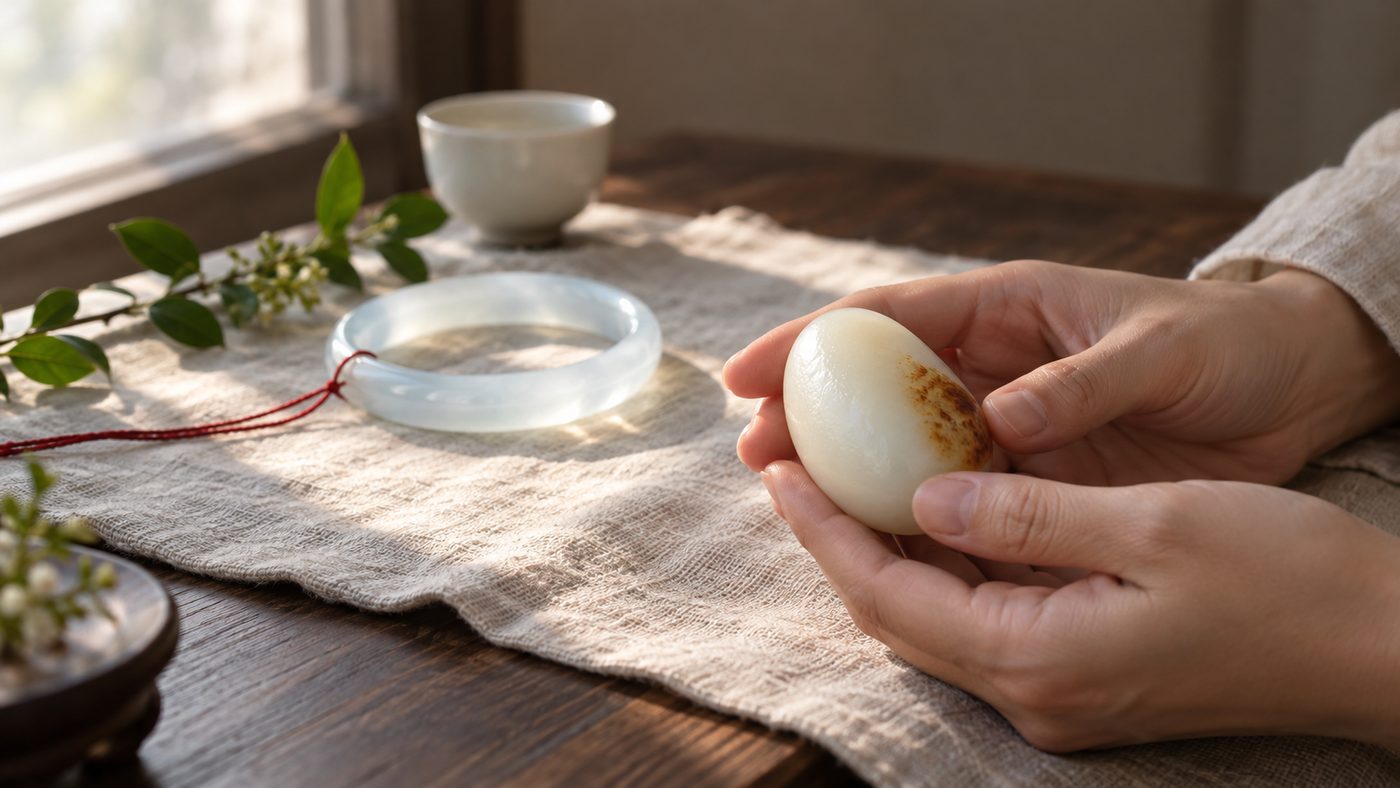
The finest white nephrite is called mutton-fat jade, and the name is a description, not a
brand. It means a white that is warm rather than chalky, a texture so fine that no grain
shows, and a soft greasy luster like fat that has set in a cold pan. Song Yingxing already
used the word, praising a boulder from Korea that held mutton-fat jade inside it as fine as
anything from the western mountains. It is a grade of nephrite, and every dealer's
judgment of it is a judgment, not a measurement.
The word that does carry a technical meaning is Hetian, the modern spelling of Khotan, and
it does not mean what most buyers assume. At a 2018 meeting in Beijing organized by the
Xinjiang Hetian jade trade association, the experts described the term as having moved
through three meanings: traditional Hetian jade from Khotan itself, Xinjiang Hetian jade
from anywhere in the province, and what they called national-standard Hetian jade, defined
by its tremolite composition. The specimen set they released covered material the market
sells under the name from Qinghai, Liaoning, Russia and South Korea. A 2016 article carried by
the website of the CPPCC's own newspaper put it in one sentence: under the
national identification standard, Hetian jade does not specifically mean jade produced in
Hetian, but is the general name for a class of tremolite jade.
That is not a scandal. White nephrite from Siberia or Qinghai is real nephrite. It just
means that "Hetian white jade" on a
certificate tells you the mineral, and if you are paying for a story about the Khotan
rivers, the origin is a separate question you have to ask. The
real or fake page covers what else a certificate
should and should not say.