Feng Shui
Feng Shui Crystals: What's Traditional, What Isn't, and Where They Go
Crystals are not part of classical Chinese feng shui. That is not a put-down, and it does not mean you should throw yours away; it means the crystal grids, the sector-by-sector stone charts and the wealth-corner citrine all belong to a twentieth-century Western layer, and the old manuals are silent on them. China does have a deep and serious stone tradition. It is jade, it is about character rather than luck, and Confucius explains it in a passage most crystal guides have never met.
The short version, before you buy anything
Search for feng shui crystals and you will find a great deal of confident instruction. Citrine in the wealth corner. Black tourmaline by the front door. Rose quartz in pairs in the southwest. A grid of six stones laid out at measured points to make a room work.
Almost none of that is Chinese, and none of it is old.
This needs saying carefully, because the internet only has two settings for a sentence like that, and neither is right here. The first is debunking, which treats the whole business as a scam. The second is the shrug, which says everything is valid if it makes you happy. What is actually true is more interesting than either.
Chinese feng shui, in both its major branches, works on landscape, orientation and direction. The form branch reads the shape of the ground: where the hills sit, where the water runs, which way a building faces. The compass branch reads direction against a set of correspondences that come out of the Book of Changes. Neither branch has a doctrine of placed stones. When the Qing-dynasty manuals discuss a house they are discussing its siting, its gate, and the way its rooms are arranged, and they have nothing at all to say about what mineral you keep on a shelf.
Crystals arrived later, from somewhere else, and we can name the somewhere.
Where crystal feng shui actually comes from
The version of feng shui most English speakers meet is a specific thing with a specific history. Black Hat Sect Tantric Buddhist feng shui, usually shortened to BTB or Black Sect, is the twentieth-century Western form, and it is a deliberate adaptation rather than a transmission. It dropped the compass, which is the technically demanding part, and replaced it with a grid you lay over a floor plan from the front door, so anyone could do it without an instrument or a birth date.
That change is why English-language feng shui talks about the wealth corner of the room while Chinese practice talks about your favorable directions. It is also the doorway through which crystals came in. Once feng shui was being taught in the same rooms and to the same audiences as Western energy-work, the stone vocabulary of that world attached itself, and within a couple of decades the two were being sold as one thing.
None of this is hidden. The general reference literature describes BTB plainly as a westernized method not based on the classical teachings, and practitioners in that lineage do not usually claim otherwise. It becomes a problem only at the next step, when a page about citrine cites ancient Chinese wisdom and hopes you will not check.
So here is the fair sorting, and it is the same sorting this site applies to plants, mirrors and everything else:
| The claim | How old, and from where |
|---|---|
| Stone belongs to the Earth element, white and metallic stone to Metal | Classical. The element correspondences are the compass school's working system |
| Directions carry elements, and material should suit its direction | Classical. The trigram seats are set out in the Book of Changes commentary |
| Jade carries moral meaning and is worn on the person | Ancient, and pre-feng-shui. Neolithic in practice, Confucian in its explanation |
| Specific stones for specific outcomes: citrine for money, black tourmaline for protection | Modern and Western. Twentieth-century crystal practice, attached to feng shui through BTB |
| Crystal grids laid out at set points in a room | Modern. No classical antecedent of any kind |
| Charging or cleansing stones in moonlight | Modern and not Chinese in origin |
China's stone is jade, and the reason is not what you would guess
Here is the part the crystal guides skip, and it is much better material than the thing they are selling.
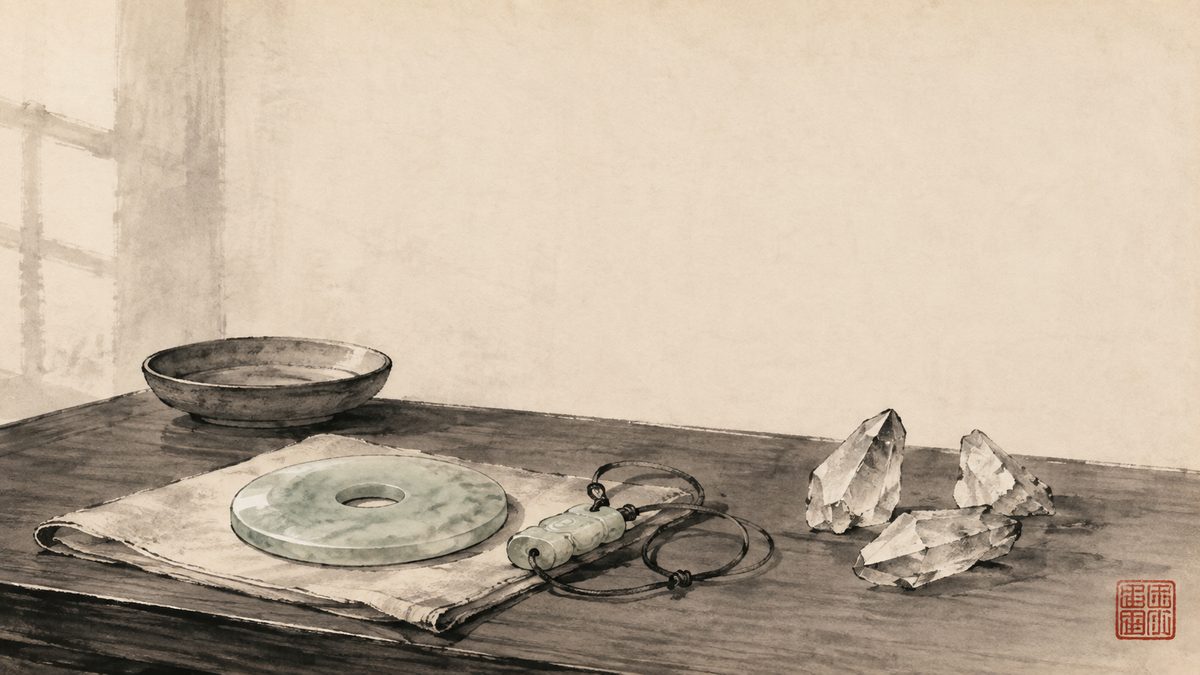
China has one of the longest and most serious stone traditions on earth, and it is about jade. Chinese jade working starts in the Neolithic, thousands of years before anyone wrote the word feng shui, and produces two of the most recognizable ritual objects in world archaeology: the flat perforated disc and the squared tube. Jade is buried with the dead, presented between states, carved into badges of rank, and worn against the skin.
So when a Chinese thinker gets asked why the stone matters, the answer carries real weight. In the Book of Rites, in the chapter on ceremonial visits, the disciple Zigong asks Confucius a blunt and rather modern question: why do gentlemen value jade and think little of the lesser stone that looks similar? Is it just that jade is rare and the other is common?
Confucius says no, and the denial is emphatic. It is not because the lesser stone is plentiful that it is thought little of, nor because jade is scarce that it is prized. And then he explains what jade is actually for, by listing what it resembles:
Warm and glossy, that is benevolence. Fine-grained and firm, that is wisdom. Edged but not cutting, that is righteousness. Hanging down as though it would fall, that is ritual propriety. Struck, its note is clear and carries far, ending crisply, that is music. Its flaws do not hide its beauty, nor its beauty its flaws, that is loyalty. Its brightness shows through from every side, that is good faith.
He goes on: its vapor is like a white rainbow, and that is heaven; its spirit shows in mountains and rivers, and that is earth. Eleven qualities, and every one of them is a description of a person you would want to be.
Read that against a chart telling you which stone attracts money and you can feel the distance. The oldest Chinese statement about why a stone is worth having explicitly refuses the market answer and gives a moral one. The stone is a standard you hold yourself to, worn where it touches you, and it is prized because of what it is like, not because of what it will do for you.
That passage is the reason jade belongs in a page about crystals at all, and it is as far as this page follows it. The rest of the story sits on Chinese jade: the Neolithic city whose graves were full of worked jade two thousand years before anyone wrote any of this down, the six ritual shapes the Rites of Zhou assigns to heaven, earth and the four directions, the seal an emperor's legitimacy lived inside, and the awkward fact that the same tradition counts jade's virtues as eleven in one book and five in another.
That is a genuinely Chinese thing to do with a stone. It is also, quietly, a better idea than the one on the sales page.
If you want to place stones anyway, place them the Chinese way
You can take all of the above on board and still want a piece of amethyst in the corner of the room, and there is no reason not to. The tradition's own instinct is to work with what the household already has and cares about. But if you want the arrangement to follow Chinese logic rather than a diagram someone drew in California, the logic is available and it is not hard.
Work by element, not by stone name. In the compass system every direction belongs to a trigram, and every trigram to one of the five elements. Stone in general reads as Earth: settled, heavy, stabilizing. White and metallic stone reads as Metal. So earthy, opaque, warm-colored material sits comfortably in the northeast and the southwest, which are the two Earth seats, and pale or metallic material in the west and northwest, which are Metal. The full seating is on our bagua map guide, and the element cycles that make it work are set out on the colors page.
Use your own directions, not a universal chart. Which of the eight sectors are good for you comes from your birth year, and it differs between two people born a year apart. The kua number calculator does that arithmetic. A stone in a direction that suits you is a more traditional idea than a stone in a room's supposed wealth square.
Keep the wealth question separate. If money is the actual reason you are here, the wealth corner has three competing answers and a very common mistake attached to it, and that argument lives on the wealth page rather than here.
Match the room's job. A study wants stones that are quiet and dense. A living room can take something with presence. A bedroom wants small and calm, and nothing sharp aimed at the pillow.
And keep the count low. This is the one piece of advice the old texts and the modern practitioners genuinely agree on, arrived at from opposite directions. A room with three considered objects reads as cared-for. A room with thirty reads as anxious.
What the tradition would actually tell you to do first
Every page in this cluster ends up at the same unglamorous place, and it is worth saying plainly on the page most likely to be read by someone about to spend money.
Nothing you place in a room outranks the things you cannot buy. Where the bed goes. Whether the front door opens onto a wall or a view. Whether light gets in. Whether the corridor is clear. The classical manuals spend their pages on siting, orientation and gates because those are the decisions with the largest effect and the longest life, and a Qing geomancer handed a photograph of a modern flat would go straight for the door and the windows and would not ask what was on the shelf.
Buy the amethyst if you love it. Put it where you will see it. Then go and look at your front door.
Find your own four directions in a few seconds with the kua number calculator, and if you would rather start with something the classics do talk about, the feng shui plants guide sorts that shelf the same way this page sorted this one.
Questions people ask
What is the luckiest crystal to have?
There is no classical Chinese answer to this, and any page that gives you one is quoting the modern crystal trade rather than the tradition. Chinese feng shui allocates by direction and element, not by stone: an earth sector wants earthy, settled material and a metal sector wants metal or white stone, so the honest answer depends on where you intend to put it. If you want the genuinely traditional Chinese stone, it is jade, and its associations are moral rather than lucky. If you want the modern practitioner's short list, it is amethyst, citrine, rose quartz and clear quartz, all four of which reached feng shui through its twentieth-century Western adaptation rather than from any Chinese source.
What is the best crystal to keep in my bedroom?
Whichever one you find calming, kept small and kept off the bed. There is no classical rule here to obey, so the sensible criteria are the ordinary ones: nothing sharp pointing at the pillow, nothing heavy on a shelf above your head, and nothing so eye-catching that it becomes the last thing you look at. Practitioners who work with stones usually suggest rose quartz or amethyst for a bedroom on the grounds that both are restful, and warn against large clear-quartz points near the head. Get the bed itself right first; the rules that actually matter in a bedroom are about the bed, the door and the wall behind you.
What crystals should not be in your bedroom?
The warnings you will find are practitioner convention rather than classical ruling, and they are consistent about two things. Large clear-quartz clusters and other spiky, many-pointed pieces get warned away from the head of the bed, on the same reasoning that keeps cactuses out of a bedroom: sharp radiating forms are read as cutting energy. And selenite or other bright stones on a bedside table get warned against as too stimulating for a sleeping room. Neither worry appears in any classical text. If you sleep well with a geode on the windowsill, no old manual condemns you.
How do you arrange crystals in your home for feng shui?
By direction and element, if you want the classical logic, which is the same logic that governs colors and plants. Each of the eight compass sectors belongs to a trigram and an element, and stone reads as Earth, with white and metallic stones read as Metal. So earthy stones sit comfortably in the northeast and southwest, which are the Earth seats, and white or metallic ones in the west and northwest, which are Metal. Your own four favorable directions come from your birth year rather than from a chart, and our kua number calculator works them out. The crystal-grid layouts sold online, where stones go in a geometric pattern at set points in a room, are not from this system and have no classical basis.
Is jade the same thing as a feng shui crystal?
No, and the difference is the most useful thing on this page. Jade is the Chinese stone, with four thousand years of ritual, burial and personal use behind it, and its meaning in Chinese thought is moral: the Book of Rites has Confucius list eleven virtues that jade resembles, and explicitly deny that its value comes from scarcity. It is traditionally worn on the body or kept as a ritual object, not placed in a room to work on the room. Crystals in the modern feng shui sense are quartz-family stones placed in a space to affect it, an idea that reached feng shui from Western New Age practice in the twentieth century.
Do feng shui crystals actually work?
Nobody can tell you that, and this site will not pretend otherwise. What can be said precisely is where the practice comes from: crystal placement is not in the classical manuals, it arrived with the twentieth-century Western adaptation of feng shui, and it is the layer of the tradition most entangled with selling you something. That does not make it worthless. Arranging a room with care changes how you live in it, which is most of what the old texts were ever asking for. It does mean you should be suspicious of any chart that assigns a specific stone to a specific problem for a specific price.
Sources
- • Book of Rites, Pin Yi (the Meaning of the Ceremonial Visit): Confucius on why the gentleman prizes jade, with Legge's translation, at the Chinese Text Project
- • Shuo Gua (Book of Changes commentary; seats the eight trigrams by direction and assigns their elements)
- • Feng shui: the Form School and Compass School branches, and Black Sect (BTB) described as a westernized method not based on classical teachings, Wikipedia
- • Wikipedia, Chinese jade: the Neolithic jade cultures and the ritual bi disc and cong tube
Get your kua number and full direction chart
Enter your birthday and we work out your kua, your group, and all eight directions, with the February boundary handled for you. Open the calculator