One color

Lavender jade: natural vs dyed, and why it fades in daylight

Lavender jade is real, it is jadeite and only jadeite, its purple comes from manganese, and GIA ranks it second in value after green. It is also the jade color with the two most specific problems. It is dyed more often than almost any other, and a natural piece has a well-known habit of looking magnificent under a jeweler's lamps and washed out in the street, which the Chinese trade describes with a phrase that translates as seeing the light and dying. This page is about both problems, what a laboratory can settle and what you can settle yourself, and about the odd fact that purple had fourteen centuries of arguments in China before there was any purple jade to argue about.

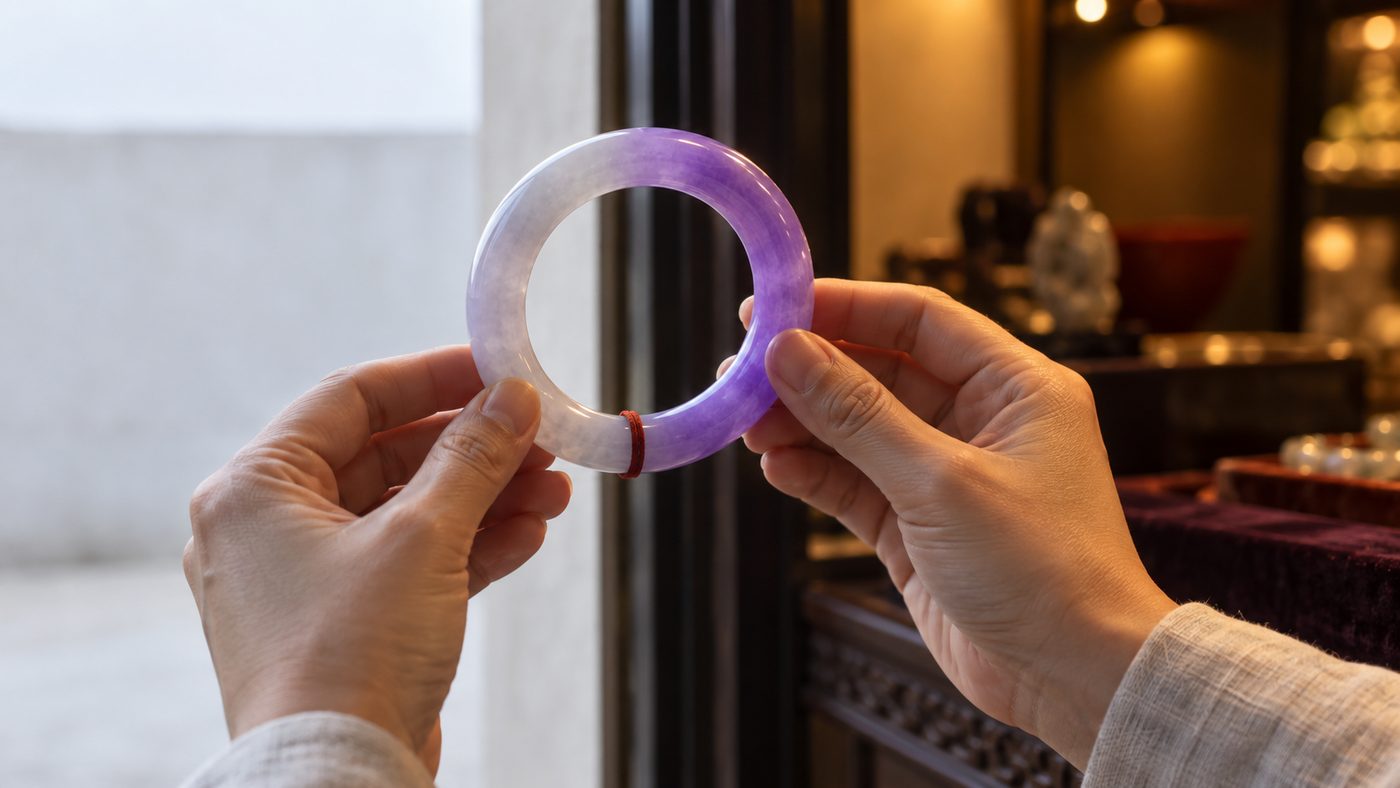
Hands hold a lavender jadeite bangle at a shop doorway where warm spotlight meets cool daylight, and the half of the ring in the shop light is a saturated violet while the half in daylight has faded to a pale grayish lilac.
The same bangle, half in shop light and half in the doorway. The stone has not changed. Illustration, not a photograph of a specific object.

A color the old texts never had a word for

Every other jade color has some kind of classical pedigree. White is the emperor's stone in the Book of Rites; the Han dictionary has words for red jade and for the black stone that ranks next to jade; green is the vegetable jade that Song Yingxing described in 1637 as one of the only two colors jade comes in. Purple has none of this, and the reason is mineralogical rather than cultural. Lavender is a color of jadeite alone. GIA's list of the colors nephrite takes runs light to dark green, yellow, brown, black, gray and white, with no purple on it, and nephrite is the only jade China knew until Burmese jadeite began arriving in quantity in the late 1700s.

So lavender jade is, in Chinese terms, a modern stone. It has no ritual role, no rank, no line in the Songs. What it had waiting for it was the trade name it still carries, ziluolan, which is simply the Chinese word for the violet flower, and an emperor, Qianlong, who according to the Gems & Gemology history of the Burmese mines preferred the rich hues of the new jade. The lavender cabochons Hughes and his co-authors saw in the boulders of the Myanmar jade tract were, they note, much sought after in China, and they still are.

Nephrite color range: GIA, Jade Description. Jadeite's arrival and the demand for lavender cabochons: Hughes et al., Gems & Gemology 2000. Two colors only: Song Yingxing, Tiangong Kaiwu.

What makes it purple, after thirty years of argument

For most of the time gemologists have studied jadeite, they did not agree on what put the purple there. When Hughes and his co-authors surveyed the stone in 2000, they attributed lavender to an exchange of charge between two forms of iron, following a study from 1974. Other researchers had proposed manganese in one form, manganese in another, titanium, iron on its own, vanadium, or pairings of these. Ren Lu, writing in Gems & Gemology in 2012, put it plainly: the origin of the lavender color had been a subject of debate for thirty years.

Lu's approach was to find a stone that is chemically almost the same as jadeite but grows as a single clean crystal instead of a felt of grains, so that it could be measured properly. Pink spodumene, the gem called kunzite, fit, and its pink is unarguably manganese. Measured against it, Burmese lavender jadeite told the same story: green is chromium, lavender is manganese, and the two do not mix. Lu's samples ran from about four parts per million of manganese in the whitish matrix to nearly two hundred in the most saturated lavender patches, which is why the color in a lavender bangle so often drifts and clouds rather than sitting evenly. It is a map of where the manganese went.

A useful consequence: because chromium makes green and manganese makes lavender, a stone that is strongly both in the same spot is chemically unlikely, which is one reason a fine natural piece with lavender and green side by side, the combination the trade calls spring with color, is expensive, and one reason a too-perfect one deserves a certificate.

Lavender attributed to iron charge transfer, citing the 1974 study: Hughes et al., Gems & Gemology 2000. Thirty years of debate, the kunzite comparison, manganese confirmed, 4 to 195 parts per million, chromium and manganese not coinciding: Lu, Gems & Gemology Winter 2012.
The three lavenders, in the trade's words

Lu also records that the trade uses lavender loosely for a whole run of hues from pinkish through purplish and violetish to bluish. Chinese dealers sort that run into three, and the names are worth knowing because they change the price and, as the next section explains, they change how the stone behaves in daylight.

Pink-purple (fen zi)

The warm, rosy end. Sweet in shop light, and the shade most prone to going pale in daylight.

Eggplant purple (qie zi)

Deeper and grayer, the color of eggplant skin. Reads as rich rather than bright.

Blue-purple (lan zi)

The cool end, toward violet. Holds up best outdoors, and the rarest of the three when it is clean.

These are dealers' words with no authority behind them, exactly like the green grades on the types page. GIA's own description is more modest and more honest: lavender is often a light purple or a light grayish violet. The word grayish is doing real work there. Most natural lavender has gray in it, the market pays steeply for the little that does not, and dye exists precisely to fake that difference.

Pinkish to bluish as the trade range: Lu, Gems & Gemology 2012. Light purple or light grayish violet: GIA, Jade Description.

Seeing the light and dying

Every jade market in the Chinese-speaking world has a phrase for what happens to lavender outdoors, and it is not a gentle one. Jian guang si: it sees the light and dies. A bangle that was a saturated, glowing violet under the counter's spotlights is walked to the door and turns, in the space of three steps, into a pale grayish thing with a faint lilac cast. New buyers assume they have been swapped. They have not. The stone in the doorway is the stone they were shown, in the only light that does not flatter it.

The trade's explanation, which we pass on as trade explanation, is that shop lighting is warm and low in color temperature and it pushes a weak purple toward richness, while daylight is cooler and shows the gray and white in the stone as they are. That fits what Lu measured: lavender is a faint color even at its best, made by a chromophore that reaches only a couple of hundred parts per million, so it has very little to lose. The pink-purple shades, the trade says, die first; the eggplant and blue-purple shades hold up better. We have not found a study that tests the saying stone by stone, so treat the mechanism as the market's folk physics and the effect itself as real, because every dealer will confirm it and most will demonstrate it if asked.

A note in Song Yingxing's 1637 survey shows this is not a new kind of complaint. Among the jades of the far west, he records a strange stone that is white in ordinary conditions, shows red when looked at under a clear sun, and turns blue-green in rain, and he gives it the name yu yao, the jade demon. The court, he adds, had one. A stone that changes with the weather struck a Ming naturalist as faintly supernatural, and it strikes a modern buyer as a reason to walk to the window. Do that. It is the only test on this page that costs nothing and cannot be argued with.

Manganese at up to about 195 parts per million: Lu, Gems & Gemology 2012. The white stone that shows red in sun and blue-green in rain, the jade demon: Song Yingxing, Tiangong Kaiwu, the section on jade.

Natural against dyed

Dyed lavender is old enough to have its own literature. The standard field tell goes back to a 1982 study by John Koivula in Gems & Gemology, and Lu's 2012 paper summarizes what it found: the dyed lavender jadeite of that era tended to show obvious concentrations of color, pooled where the dye had soaked in along cracks and grain boundaries, and an orangy reaction under long-wave ultraviolet light. For a generation, a cheap ultraviolet torch and a loupe were most of what a careful buyer needed.

It is a weaker tell now. Lu's 2012 paper reports that the obvious color concentrations and the orangy ultraviolet reaction of earlier dyed jadeite are often much less pronounced in the dyed material that has reached the market since, especially in fine-textured stones. What the laboratory sees instead is the spectrum: dyed lavender shows broad absorption bands near 530 nanometers, sometimes several of them because dyes vary, where natural lavender shows the single broad band of manganese near 570. And Lu adds a positive test that works the other way around: a reddish fluorescence under deep ultraviolet is the signature of manganese, and therefore a likely indication that the color is natural.

Test Natural lavender Dyed lavender Who can run it
Where the color sits Through the body of the stone, uneven but not following cracks Pooled along fractures and grain boundaries, darker at the cracks You, with a loupe
Long-wave ultraviolet Inert, or a weak reaction Often an orangy glow, in older dyed material You, with a 365 nm torch; weaker in modern dyes
Absorption spectrum A broad band from manganese near 570 nm Broad bands near 530 nm, sometimes several, from the dye A laboratory
Deep ultraviolet fluorescence Reddish, the signature of manganese Absent where the color is not from manganese A laboratory

Read the last column carefully, because it is the honest one. The two tests you can run yourself can only make you suspicious. Color pooled in the cracks or an orange glow under a cheap ultraviolet torch means walk away; the absence of either means nothing, since modern dyes have learned not to show. The two tests that settle the matter need a spectrometer. That is the same conclusion the real or fake page reaches for every kind of jade treatment, and it carries the same advice: for a lavender piece at any real price, the certificate should say in words that the color is natural, and the laboratory that issued it should be one you can look up.

Koivula's 1982 color-concentration and orange ultraviolet tells, the weakening of those tells in current dyed material, the 530 and 570 nanometer bands, and reddish deep-ultraviolet fluorescence as a sign of natural color: Lu, Gems & Gemology Winter 2012, which reports and cites the Koivula study.

Purple before the stone: Confucius, the Tang court, and a complaint about blue

There was no purple jade in classical China, but there was a great deal of feeling about purple. The Analects records Confucius saying that he hated the way purple was taking the place of vermilion, in the same breath as hating the music of Zheng for corrupting the classical music and glib talkers for overturning states. Vermilion was a proper, primary color; purple was a mixed one, an upstart, and its popularity was a small sign of a world coming apart.

The upstart won. The Old Book of Tang, in its treatise on dress, records that in 630 the court fixed the colors of official robes by rank: purple for the third rank and above, crimson below that, green for the sixth and seventh ranks, and blue for the eighth and ninth. The color Confucius disliked had become the color of the highest officials in the empire, and it stayed there.

And then, in 662, a petition that any lavender-jade dealer would recognize. An official complained that the old rule put the lowest two ranks in blue, that deep blue was being confused with purple, and that this was not a color low officials should be seen in. The court agreed and moved the eighth and ninth ranks into a bluish green instead. The worry that a blue could pass for a purple, and that the difference between them was a difference of rank and price, is at least fourteen centuries old. The stone that made it a shopping problem arrived eleven centuries later.

Analects 17.18. Old Book of Tang, juan 45, the treatise on carriages and dress: the fourth year of Zhenguan rank colors, and the Longshuo second-year petition on deep blue confused with purple.

Where lavender sits in the market

GIA's ordering is the one to trust: green first, then lavender as the next most valuable color, with intense colors commanding a substantial premium over lighter and weaker ones. Within lavender, the market pays for saturation, for the absence of gray, for a blue lean over a pink one, and, as with every jadeite, for transparency, which GIA lists as the second of the three price drivers after color. A pale pink-purple that is opaque and a clean blue-purple that glows are both lavender jade, and they are not the same purchase.

What nobody can give you is a price per gram, for the reason the price page spends its whole length on: jade has no index. What you can insist on is a natural-color certificate, a look at the stone by a window, and, if it is a bangle, a size you have measured rather than guessed, since a lavender bangle bought in a hurry under warm lights is the classic jade regret.

Lavender as the next most valuable color, and the premium for intensity: GIA, Jadeite Jade Quality Factors.

Keep going

Common questions

Is lavender jade real?

Yes. Lavender is a genuine natural color of jadeite, and GIA ranks it as the next most valuable color after green. Its cause is manganese, confirmed by a 2012 study in Gems & Gemology after thirty years of competing explanations. It is also one of the most frequently dyed jade colors on the market, so real and natural are two separate questions, and only the second one needs a laboratory.

What is lavender jade worth?

GIA puts lavender second in value after green and notes that intense colors carry a substantial premium over pale and weak ones. Beyond that there is no index. A blue-purple bangle with glass-like transparency and no gray can cost many times what a pale pink-purple one does, and a dyed one, however vivid, is worth what plain white jadeite is worth. Ask for a certificate that states the color is natural.

How can you tell if lavender jade is dyed?

At home you can only raise a suspicion. Look with a loupe for color pooled along cracks rather than running through the stone, and shine a long-wave ultraviolet torch on it, because older dyed lavender tends to glow orange. Neither test can clear a stone: the 2012 Gems & Gemology study notes that modern dyes show these signs far less. Conclusive answers come from a laboratory spectrum, and the certificate should state the color is natural.

Why does lavender jade look different in daylight?

The Chinese jade trade calls it seeing the light and dying: a bangle that looked richly violet under a shop’s warm spotlights turns pale and grayish outdoors. The stone has not changed; the light has. Lavender is a weak color to begin with, and warm low-temperature lighting flatters it. The practical rule is simple: never judge a lavender piece under shop lights alone, and walk it to a window or a doorway before you decide.

What does lavender jade mean?

Nothing in the classical record, because the classical record never saw it. Lavender is a color of jadeite only, and jadeite did not reach China in quantity until the late 1700s. Purple as a color has a long history in China, from Confucius complaining that it was displacing the proper red to the Tang court reserving it for the three highest ranks, but none of that was ever said about a stone. The modern meanings attached to it come from the crystal trade.

Sources

The Analects, the Tang history and the Ming text were read directly in the Chinese. The color science and the dye tests come from the gemological sources listed here.

Stay in the loop.

Chinese mythology, the zodiac, and the meaning behind names and symbols, rooted in the classics and read back to you. No spam. Unsubscribe anytime.