The spectrum

Jade colors: every shade the stone comes in, and what each is worth

Jade comes in green, white, lavender, black, red, orange, yellow, brown and gray, and in 1637 the most authoritative book on Chinese technology said it came in two. Both statements are true. The gap between them is the whole story of jade color: which shades belong to which of the two jade minerals, what physically puts the color there, and how a tradition that put white at the top ended up with a market that puts green there. Here is the spectrum, one color at a time, with the tradition's own words alongside the gemologists'.

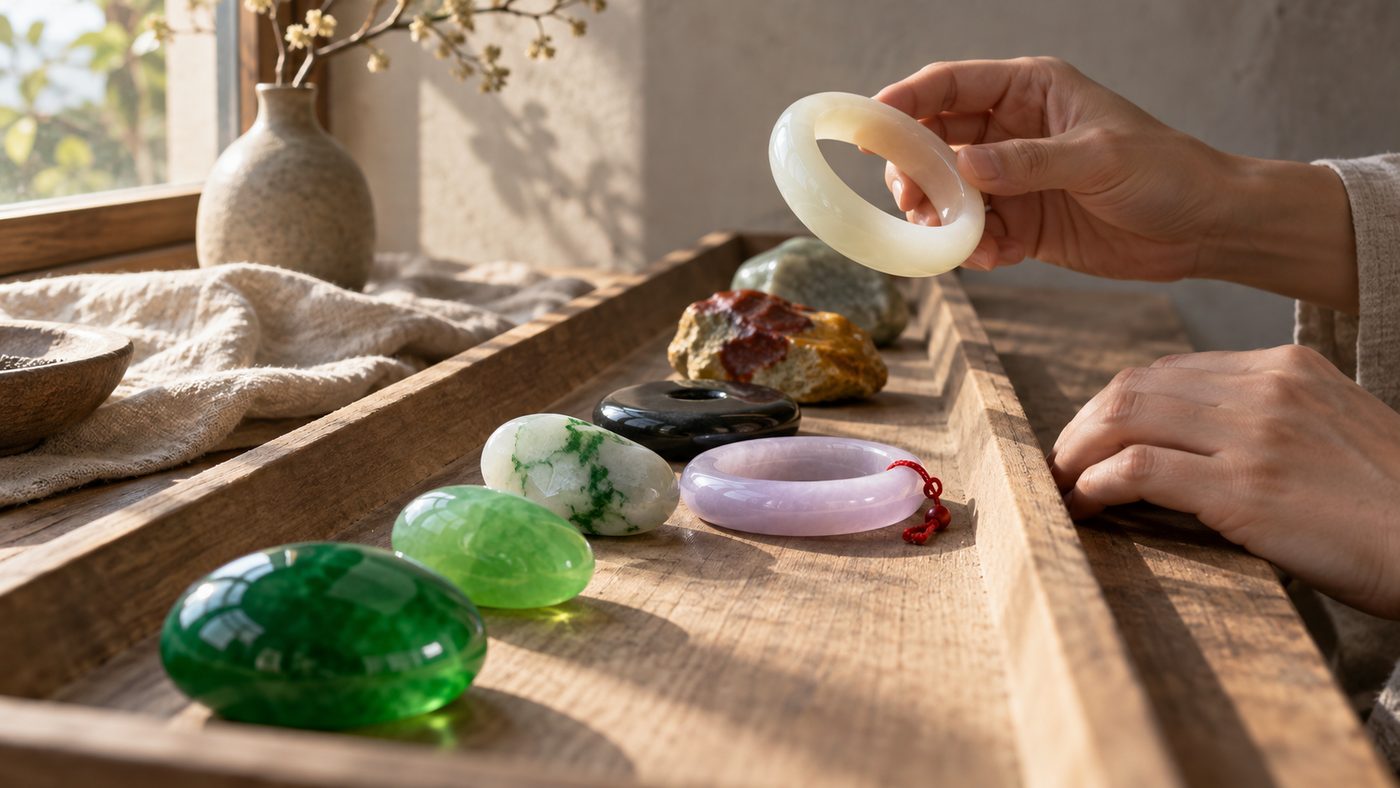
A low raking view along a wooden tray of polished jade pieces in every color, from glassy emerald and apple green through veined white, mutton-fat white, pale lavender and inky black to a rough boulder with a rust-red skin, with a pair of hands lifting the white bangle toward window light.
All of it is jade. None of it is the same color, and for most of Chinese history the white piece in the hand was the one that outranked the rest. Illustration, not a photograph of specific objects.

The spectrum on one table

Two things to hold onto while reading it. First, jade is two unrelated minerals, jadeite and nephrite, and most colors belong to one of them rather than both. Second, color in jade is almost never the stone itself; it is a trace of something else that got into the stone as it formed, or stained it afterward.

Color Which jade What puts it there Where it sits
Imperial green Jadeite A trace of chromium The top of the whole market
Grassy and apple greens Jadeite (and dark green nephrite) Iron, in larger amounts than chromium ever needs Common; priced on how clean the green is
White, mutton-fat Nephrite The absence of iron in the fiber felt The top of the nephrite market
White, icy Jadeite Pure jadeite is colorless; light scattering makes it white Priced on transparency, not on color
Lavender Jadeite only Manganese, settled in 2012 after thirty years of argument Second to green, per GIA
Black Nephrite, or a jadeite cousin called omphacite Graphite in nephrite; heavy iron in the jadeite cousin Popular, and sold under three different names
Red, orange, brown Jadeite Iron oxide staining the weathered skin of the boulder Prized when it is not brownish
Yellow Jadeite; also a nephrite variety Iron, in the skin layer or in the stone itself A niche, and a good one for carvers

Color causes per Hughes et al., Gems & Gemology Spring 2000, and Lu, Gems & Gemology Winter 2012; market ordering per GIA's jadeite quality factors.

In 1637, jade had two colors

Song Yingxing was a minor Ming official with an enormous curiosity, and in 1637 he published the Tiangong Kaiwu, usually translated as The Exploitation of the Works of Nature, a survey of every craft in China from rice to gunpowder. His chapter on jade is the fullest description of the stone written before modern geology, and it is worth reading for what it does not contain.

Jade, he writes, comes in only two colors, white and green, and the green one the Chinese call vegetable jade. As for the red jade and yellow jade people talk about, those are curious stones of other kinds, worth as much as jade perhaps, but not jade. He locates all of it in the rivers of Khotan, at the far western edge of the empire, and names the two rivers where it is fished out: the White Jade River and the Green Jade River. He adds, with a collector's confidence, that the outer skin of a jade boulder is good for inkstone stands and worth next to nothing, and that a thousand-year boulder in Korea was said to hold mutton-fat jade inside it as fine as any from the west.

Every word of that describes nephrite. Song Yingxing was writing in the 1630s, and the bright green Burmese jadeite that now defines the word for most of the world did not reach China in quantity until the late 1700s. The Gems & Gemology account of the Burmese mines dates the turning point to 1784, when the Qianlong emperor extended Chinese jurisdiction into northern Burma and Chinese adventurers found the source of the green stone. So the two-color rule is not a mistake. It is an accurate description of a palette that was about to double.

Song Yingxing, Tiangong Kaiwu, the section on jade: only white and green, red and yellow are not jade, the skin is worth little. Hughes et al., Gems & Gemology 2000, on 1784.

The dictionary had more colors than the craftsman

Here is the twist. Fifteen centuries before Song Yingxing, the first Chinese dictionary had a richer color vocabulary for jade than he allowed. The Shuowen Jiezi, from around 100 CE, gives the jade radical more than a hundred characters, and a handful of them are pure color words.

There is a character for red jade, qiong, glossed simply as red jade. There is a second red, men, glossed as jade the color of the red sprouts of grain. There is cuo, jade of a bright white color, and its neighbor ci, jade of a bright color in general. There is even wu, jade of three colors at once. And there is jiu, defined not as jade but as the black stone that ranks next to jade, with a line from the Book of Songs attached to prove people wore it.

The one to remember is xia, written 瑕. The dictionary glosses it as jade with a small patch of red. That is the character in xiaci, the everyday Chinese word for a flaw or a blemish, and it is a small window into how the tradition saw color: a spot of red in a white stone was not a feature, it was a defect, and the defect became the word for defects in general. Song Yingxing was being a good classicist when he threw red jade out of the category. The dictionary had done it first.

Shuowen Jiezi, jade section: the entries for red jade, grain-red jade, bright white, three-colored, the black stone next to jade, and the red-flawed jade that became the word for flaw.

Green, and the several greens

The green that sets auction records is jadeite, and the thing that makes it is chromium. Hughes and his co-authors in Gems & Gemology are precise about this: imperial green is produced by chromium, only a very small percentage of it is needed, and nephrite, they note, never duplicates the color. The chromium comes from black chromite crystals in the rock the jade formed in, which is why the finest green tends to occur as clots and late veins inside white or lavender-white boulders rather than as whole green stones.

The other greens, the grassy and apple greens and the dark spinach green of nephrite, come from iron, and iron needs to be present in far larger amounts to color a stone at all. That is the chemistry behind a fact every dealer knows: a green that is slightly yellowish or slightly gray is an iron green, and it is common; a green that is pure and penetrating with no gray in it is a chromium green, and it is not. GIA's trade names sort the top of the range into imperial, then kingfisher green a shade less vivid, then apple green, then moss-in-snow with its green veins on a white ground. Those names and what they mean have their own section on the types page; the point here is that all of them are one chemistry or the other.

One more thing about green, which the types page reads at length from the Book of Rites and this page will only point at: the chapter on court dress assigns each rank of the Zhou nobility its own jade, and white goes to the Son of Heaven while the greener stones go down the order. The tradition put green in third place. The market put it first, and called the top of it imperial.

Chromium for imperial green, iron for the grassy greens, chromite as the chromium source: Hughes et al., Gems & Gemology 2000. The green trade names: GIA, Jadeite Jade Quality Factors.

White, which used to be the top

Two whites, and they are not the same white. The white of the classical record is nephrite, the dense, warm, faintly greasy white that the trade calls mutton-fat and that Song Yingxing already named as the prize inside the Korean boulder. It is white for a simple reason: nephrite's felt of fibers is colored by iron, and mutton-fat is what you get when there is almost none. Hold a good piece and it does not glow; it holds the light in, like a candle that has just been blown out.

The white of the jadeite window is a different thing. Pure jadeite, Hughes explains, is actually colorless, and it looks white only because light scatters off the countless grain boundaries and tiny fluid inclusions inside it. That is why white jadeite is priced on transparency rather than color: the less scattering, the closer it comes to colorless glass, and the trade's word for the best of it is ice.

If you want the difference in one gesture, hold each up to a window. The nephrite stays creamy and opaque; the jadeite lets the daylight through. The types page makes this the first thing it shows you, because it is the difference a buyer most needs to be able to see.

Jadeite is colorless when pure and appears white from light scattering: Hughes et al., Gems & Gemology 2000.

Lavender, the color the old texts never saw

Lavender is the one color that belongs to jadeite alone. GIA's list of nephrite colors runs light to dark green, yellow, brown, black, gray and white, and there is no purple on it. Which means that every lavender bangle in the world is a post-1784 object in Chinese terms, a color that arrived with the Burmese stone and had no classical name waiting for it.

What makes it purple was, for thirty years, an argument. Hughes in 2000 was still attributing it to iron, following a 1974 study. Ren Lu's 2012 paper in Gems & Gemology settled the question with quantitative analysis: green is chromium, lavender is manganese, and the more manganese, the deeper the lavender. GIA ranks it second in value after green. It is also one of the most frequently dyed colors on the market, and it has a habit of looking richer under shop lights than in daylight, which the trade has a name for. All of that has its own page.

Nephrite color range: GIA, Jade Description. Manganese as the lavender chromophore: Lu, Gems & Gemology Winter 2012. Lavender as the next most valuable color: GIA, Jadeite Jade Quality Factors.

Black, which is three different stones

Black jade is the color most likely to be something other than what the label says, because three unrelated materials share the name. There is black nephrite, the oldest of the three, whose color comes from graphite grown through the stone. There is the black jadeite of the Burmese trade, which is not black at all but a very dark green jadeite cousin called omphacite, so heavy with iron that it only shows its green when a torch is pressed to it. And there is obsidian, a volcanic glass with no jade in it whatsoever, which has become the default material of the black bracelets sold with a protective creature on them.

The Han dictionary, as noted above, filed black under the stone next to jade rather than jade itself, and the Book of Songs has a lover return a plum with a black jade pendant. The three stones, the dictionary's verdict and the penlight test that separates them are on the black jade page.

Graphite for gray-to-black jadeite, and the darkest iron colors sitting closer to omphacite: Hughes et al., Gems & Gemology 2000.

Red and yellow: the skin of the boulder

Now back to the two colors Song Yingxing threw out, because the market has thrown them back in, and the reason is worth knowing before you pay for one.

Red, orange and brown jadeite are not colored through the body of the stone the way green and lavender are. Hughes is specific: reddish orange to brown jadeite is found only in boulders recovered from iron-rich soil, and the color is a natural iron-oxide staining of the porous skin of the boulder, which is sometimes intensified with heat. Yellow, in jadeite, is the same story at a lower dose of iron. In other words, the red and yellow in a jadeite carving are usually the weathered rind that Song Yingxing said was fit for inkstone stands, and the very layer the dictionary called a flaw.

What changed is not the stone but the carver. Modern jadeite carving treats a red or yellow skin as a gift: the carver keeps the stained layer where a goldfish or a persimmon or a lucky bat wants to be, and cuts the white or green body around it, so that one piece carries two or three colors that seem to have been placed on purpose. The Chinese trade calls this clever color, and a well-judged piece of it can outsell a plain green stone of the same size; a stone with three of them is sold as fu lu shou, one color for each of the three star gods. That is a genuine reversal of the classical taste, and unlike the inversion of white and green, nobody pretends otherwise. A skin-colored carving is sold as ingenuity, not as heritage.

The buyer's caution follows directly from the chemistry. Because red is a surface stain, it is shallow, and because heat intensifies it, a suspiciously vivid red on an otherwise ordinary piece is a question worth asking. The real or fake page covers what a certificate says about treatment.

Iron-oxide staining of the skin, only in boulders from iron-rich soil, sometimes intensified with heat: Hughes et al., Gems & Gemology 2000.
Ice, glass and bean: how transparency changes a color

One reason two green bangles of apparently the same green can differ in price by a factor of a hundred is that color is only the first of three things GIA says move the price of jadeite. The second is transparency, and the trade has a vocabulary for it that you will hear before you hear any color word at all.

Glass type

Semitransparent. Text held behind it blurs rather than disappears.

Ice type

Translucent with a cool, watery look, like a clear ice cube with a little cloud in it.

Glutinous-rice type

Translucent but milky, as if the light is passing through cooked rice.

Bean type

Opaque or nearly so, with visible grains, like the inside of a split bean.

These are trade words, not grades, and like the color words nobody issues them. But they explain something about color that the color names alone cannot. A pale green with glass-type transparency will usually cost more than a strong green that is bean-type and opaque, because the light passing through the stone is what makes the color look alive. GIA's own test is the one to carry to the counter: hold the piece over printed text. If the text blurs, the stone is semitransparent; if the text vanishes, it is not. Color first, then transparency, then texture, in that order of impact, is GIA's ranking of what you are actually paying for.

Color, transparency and texture as the three price drivers, and the printed-text test: GIA, Jadeite Jade Quality Factors.

Which color is worth the most

GIA's answer is short and we will not improve on it: green is the most valuable, a specific vivid green above all others; lavender is the next most valuable; black is popular, and so is orange to red, especially when the color is not brownish. Intense colors carry a substantial premium over pale and weak ones in every hue.

What GIA does not give, because nobody can, is a number. Jade has no price index and, for reasons that have to do with the stone rather than the market, cannot have one. So a color ranking tells you the order of the queue, not the price of the ticket. Two lavender bangles can differ by more than a lavender and a green, if one is glass-type and one is bean.

And if you find that you prefer the white, you are in good company. It is the color the Son of Heaven wore, the color Song Yingxing wrote down first, and the one the dictionary had a word for meaning bright and clean. The market moved. The tradition did not.

Keep going

Common questions

What colors does jade come in?

Green in many shades, white, lavender, black, red, orange, yellow, brown and gray. GIA lists all of these for jadeite, and light-to-dark green, yellow, brown, black, gray and white for nephrite, whose colors run more muted. Lavender is the one color that belongs to jadeite alone; there is no purple nephrite.

What is the most valuable jade color?

A vivid, pure, semitransparent green that the trade calls imperial. GIA puts that green first, lavender second, and describes black and orange-to-red jadeite as popular when the color is not brownish. In the nephrite world the order is different: the dense, warm white called mutton-fat has been the top of that market since long before green jadeite reached China.

What is the rarest jade color?

Rarity and price are not the same question. Fine imperial green is the rarest thing on the market because the chromium that makes it is only present in a few late-stage veins of a few Burmese boulders. Strong, even lavender is rare too. A stone that is simply an unusual color, such as a clean yellow, is uncommon without being expensive, because demand is what sets jade prices and there is no index.

Is white jade real jade?

Yes, and for most of Chinese history it was the jade that mattered. White nephrite from the rivers at Khotan is the stone of the ritual discs, the seals and the burial suits. In 1637 the Ming author Song Yingxing wrote that jade came in only two colors, white and green, and named mutton-fat white as the finest. White jadeite is also real jade; pure jadeite is colorless and looks white because light scatters inside it.

What does the color of jade mean?

In the classical texts, almost nothing by color alone. The virtues Confucius reads off jade in the Book of Rites belong to the stone as a substance, not to a shade, and the one place the tradition assigns colors is the six ritual jades of the Zhou li, where each color faces a direction of the compass. Modern charts that give lavender or black jade a meaning of their own are the language of the crystal shop, not the Chinese record.

Sources

The Ming text and the Han dictionary were read directly in the Chinese. The color chemistry and the market ordering come from the gemological sources listed here.

Stay in the loop.

Chinese mythology, the zodiac, and the meaning behind names and symbols, rooted in the classics and read back to you. No spam. Unsubscribe anytime.