One color, three stones

Black jade: nephrite, omphacite or obsidian? Three stones, one name

Black jade is the only jade color that is more often a different material than the one on the label. Three things are sold under the name, and they have nothing to do with one another. One is real jade, black nephrite, colored by graphite. One is a very dark green cousin of jadeite that only admits to being green when you put a light behind it. One is obsidian, a volcanic glass with no jade in it at all, which has quietly become the default material of the black bracelets sold with a lucky beast on them. A small flashlight sorts all three in ten seconds, and the rest of this page explains what the flashlight is showing you.

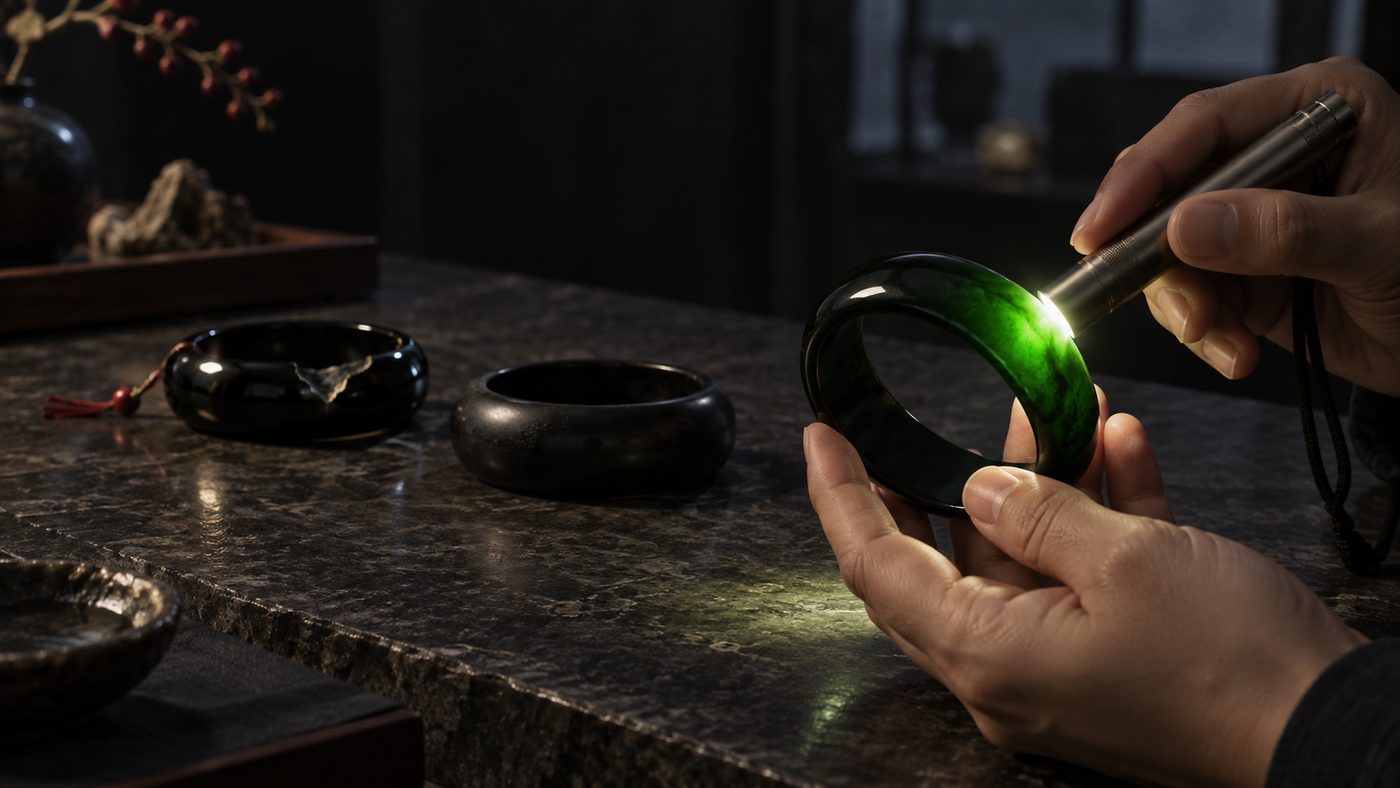
In a dim shop, a hand presses a penlight to the edge of a black bangle and the stone flares translucent green from within, while two other black bangles behind it stay opaque, one waxy and one glassy with a chipped edge.
Three black bangles, identical on the counter. Under a penlight, the one in the hand turns out to be green. Illustration, not a photograph of specific objects.

The three, side by side

Black nephrite"Black" jadeiteObsidian
Sold as mo yu, "ink jade"; Hetian black jademo cui, "ink kingfisher"; inky black jadeSold as black jade, "black obsidian jade", or with no mineral named
What it is Real jade. Nephrite shot through with graphite.A jadeite cousin, omphacite, so heavy with iron and chromium it reads black.Volcanic glass. Not a mineral, not jade, no relation.
Under a penlight Stays dark. At most a dull brown-gray at a thin edge.Glows a deep green from within. This is the whole test.Translucent smoky brown or gray at the edges, like dark bottle glass.
Hardness Mohs 6 to 6.5, and extremely toughMohs 6.5 to 7About 5.5, and brittle
Other tells Waxy sheen, dense, warm to the hand. Sometimes a faint metallic glint of graphite.Greasy-to-glassy luster; the green flares wherever light gets in.Mirror polish, feels light, chips with a curved shell-like fracture.

Graphite in black nephrite: Zheng et al., Minerals 2023. Omphacite and its behavior in transmitted light: GIA, Jade Description; Xu et al., Gems & Gemology Fall 2023. Obsidian: Geology.com.

The old one: black nephrite, and the river a Ming author said did not exist

Start with the one that is unambiguously jade. Black nephrite has been coming out of the rivers at Khotan, on the southern edge of the Taklamakan desert, for as long as white nephrite has, and the Gems & Gemology survey of the jade trade records that the Chinese recovered nephrite from both the White Jade River and the Black Jade River there.

Which makes a passage in the Tiangong Kaiwu, the great 1637 survey of Chinese crafts, rather funny. Its author, Song Yingxing, describes the two rivers at Khotan as the White Jade River and the Green Jade River, and then adds that an earlier envoy's account of the western regions mentions a Black Jade River, and that this is nonsense. It is not nonsense. The river is there, and black nephrite comes out of it. Song Yingxing's mistake tells you something true, though: in his two-color scheme of jade, white and green, black simply had no seat at the table.

What makes it black is not a mystery anymore. A 2023 study in the journal Minerals of black nephrite from Xinjiang, the region Khotan sits in, found the stone to be essentially two things, tremolite and graphite: the ordinary fibrous felt of nephrite, with crystals of the same carbon that goes into a pencil grown all through it. That is why a good piece of black nephrite sometimes shows a faint metallic glint when you tilt it, and why it stays black under a torch. Graphite does not transmit light. Hughes and his co-authors note that graphite is also what darkens some of the gray-to-black jadeite, so the pencil-lead explanation covers a good deal of the black in the market.

The Chinese trade calls this mo yu, ink jade, and the best of it has the same dense, warm, waxy hand as the mutton-fat white it comes out of the same rivers with. Everything on our page about what jade has meant in China is nephrite, and the black kind has been part of that story from the start.
The White Jade and Black Jade rivers at Khotan: Hughes et al., Gems & Gemology 2000. Song Yingxing on the Green Jade River and the "nonsense" of a black one: Tiangong Kaiwu, the section on jade. Tremolite and graphite: Zheng et al., Minerals 2023.

The dictionary put black one step below jade

The classical record is candid about where black stone stood. The Shuowen Jiezi, the first Chinese dictionary, compiled around 100 CE, has an entry for a character pronounced jiu and written 玖, and it does not define it as jade. It defines it as the black stone that ranks next to jade. Not jade: next to jade. The same dictionary has a separate word for red jade and another for bright white jade, both filed as jade outright. Black got the second tier.

And yet people wore it, and gave it, and the dictionary proves this by quoting the Book of Songs. The line it cites, from a poem about waiting for someone, says that the person waited for gave the speaker a pendant of black stone. There is a more famous poem in the same collection, the one every Chinese schoolchild knows, in which the speaker is given a quince and repays it with a fine jade, is given a peach and repays it with a fine jade, and is given a plum and repays it with qiongjiu, the black jade. Each stanza ends by saying the jade is not a repayment at all but a way of keeping the friendship forever, which makes it the tradition's founding image of a gift returned many times over, and the third jade in it is the stone this page is about.

So the honest cultural position of black jade is this: in the oldest Chinese poetry it is a love token, and in the oldest Chinese dictionary it is a near-jade. Both are true and neither is what a modern bracelet listing will tell you.

Shuowen Jiezi, jade section, the entry for 玖 and its quotation from the Songs. Book of Songs, Odes of Wei, Mu Gua: the third stanza returns the plum with a black jade.

The expensive one: "black" jadeite, which is green

Now the stone that fetches real money, and the reason for the penlight. The Burmese jadeite trade sells a lacquer-black stone it calls mo cui, ink kingfisher, using the same kingfisher word that names green jadeite. The name is a small confession. This stone is not black. Hold it to a window or press a torch against it and it lights up a deep, saturated green, sometimes a green good enough that, if it could be seen in ordinary light, it would be worth a great deal more.

Gemologically it is usually not even jadeite, strictly speaking. Hughes and his co-authors explain that the darkest iron-colored jadeites, the bluish blacks and blue-blacks, contain a few percent of iron oxide and sit closer to a related pyroxene called omphacite than to pure jadeite. GIA's own description of jade says omphacite has typically been thought of as dark green to black, and that modern gemologists now use the word jade for nephrite, jadeite, and, under certain conditions, green omphacite. A 2023 report in Gems & Gemology on a new Guatemalan material that has entered the Chinese market describes the effect exactly: blackish green with a greasy luster under reflected light, similar to Burmese inky black jade, and bright green under transmitted light. The authors' analysis put the stone at about 98 percent omphacite.

None of which makes it fake. It is a real stone from the jade family, it is tougher than it looks, and the good pieces are genuinely beautiful. It just means that when a dealer shows you a black bangle and reaches for the flashlight before you ask, you are being shown the one thing about the stone that sets its price: how green it secretly is.

Dark iron jadeites closer to omphacite: Hughes et al., Gems & Gemology 2000. Omphacite as dark green to black, and jade as a term now covering green omphacite: GIA, Jade Description. Blackish green in reflected light, bright green transmitted, about 98 percent omphacite: Xu et al., Gems & Gemology Fall 2023.

The one that is not jade at all: obsidian

Obsidian is what you get when lava cools so fast that its atoms never manage to line up into crystals. It is glass, natural glass, and Geology.com files it not as a mineral but as a mineraloid, a material with no crystal structure. It has been made into blades, mirrors and small carvings for as long as there have been people near volcanoes, and it is a perfectly respectable stone. It is also, as far as the Chinese record goes, silent: there is no classical Chinese literature on obsidian as a charm, a point we make at length on the page about lucky charms, because the black obsidian bracelet with a winged beast on it is now the single most common object sold as Chinese jade jewelry that contains no jade.

The physical differences are large enough that you do not need a laboratory. Obsidian has a hardness of about 5.5, which Geology.com notes makes it easy to scratch, and it lacks toughness, so it chips and breaks on impact; the same source describes it as an inappropriate stone for rings and bracelets, which is a sentence worth reading twice given what it is mostly sold as. Nephrite sits at 6 to 6.5 and is among the toughest materials in nature. Obsidian breaks with the curved, rippled, shell-like fracture of glass, takes a mirror polish, and feels noticeably light. And under a torch it does the thing no jade does: it goes translucent at the edges in a smoky brown or gray, exactly like the base of a dark beer bottle.

Volcanic glass, mineraloid, conchoidal fracture, hardness about 5.5, easily scratched and chipped, inappropriate for rings and bracelets: Geology.com, Obsidian.

Ten seconds at the counter

Everything above collapses into one test and two confirmations.

The penlight. Press a small bright light against the edge of the piece in a dim spot, and watch the color that comes through. Green means the omphacite the trade calls black jadeite. Smoky brown or gray glass means obsidian. Nothing, or a dull dark edge, means black nephrite, or means something opaque and worth a second look.

The hand. Both jades are dense and feel heavier than they look; obsidian feels light for its size and warms fast. Nephrite has a waxy, almost oily surface; the omphacite is glassier; obsidian is a true mirror.

The edge. Look at any chip or drill hole. Obsidian's breaks are curved and rippled. Nephrite's are fibrous and splintery. If there are round bubbles inside the stone, it is glass of one kind or another, natural or otherwise.

What none of this tells you is whether a genuine black nephrite or omphacite has been treated, waxed or dyed, or what a certificate should say. That is the real or fake page's territory, and the same rule from there applies here: every home test can rule a stone out, and none of them can rule it in.

Does black jade protect you?

You will be told that it absorbs negative energy, wards off harm, or belongs on the right wrist to release what it has soaked up. Our page on the pixiu traces that right-wrist rule and finds it to be trade convention with no classical source, and the same is true of the wider claim. Nothing in the Book of Rites, the Shuowen or the Songs gives black jade a protective job. The idea comes from the modern crystal trade's account of black obsidian, and it attached itself to black jade when obsidian bracelets began being sold as jade.

The Chinese sources give it something else, and arguably something better: it is the stone a lover sends back for a plum. Whether you would rather wear a bodyguard or a love letter is up to you, but only one of those readings is in the record. The broader question of what a worn piece of jade means, black or otherwise, is on the jade bracelet meaning page.

Keep going

Common questions

Is black jade real jade?

Sometimes. Three different materials are sold under the name. Black nephrite, colored by graphite, is genuine jade and the oldest of the three. The stone the trade calls black jadeite is usually omphacite, a close chemical cousin of jadeite that GIA now counts as jade in its green form; it is not truly black but a green too dark to read without a light behind it. Obsidian, a volcanic glass, is sold as black jade constantly and is not jade at all.

How can you tell black jade from obsidian?

Press a small flashlight to the edge. Obsidian goes translucent smoky brown or gray, like dark bottle glass, because it is glass. Black nephrite stays dark. The trade’s black jadeite flares deep green. Obsidian is also lighter in the hand, takes a mirror polish, and chips with a curved, shell-shaped fracture; it is softer than either jade, around 5.5 on the Mohs scale against 6 or more.

What makes black jade black?

Two different things, depending on which stone it is. In black nephrite the color is graphite: a 2023 study of black nephrite from Xinjiang found the stone to be essentially tremolite and graphite. In the trade’s black jadeite the color is not a pigment at all but an overload of iron in a jadeite-omphacite mix, which absorbs so much light that a green stone looks black until you shine a light through it.

What does black jade mean in Chinese culture?

Less than the shops suggest. The Han dictionary Shuowen Jiezi defined the black stone, jiu, as the stone that ranks next to jade rather than as jade itself, and the Book of Songs has a lover repay a gift of plums with a pendant of it. The idea that black jade absorbs negative energy or protects the wearer has no classical source; it is borrowed from the modern crystal trade, mostly by way of black obsidian bracelets.

Which is more valuable, black jade or green jade?

Green, by a wide margin, and GIA ranks black among the popular colors rather than the valuable ones. Within black, the omphacite that shows a fine green under a torch commands the most, and its price rises with how bright and clean that hidden green is. Black nephrite is priced on texture and finish. Obsidian is priced as obsidian, which is to say cheaply, however it is labeled.

Sources

The dictionary, the Songs and the Ming text were read directly in the Chinese. The mineralogy comes from the gemological and geological sources listed here.

Stay in the loop.

Chinese mythology, the zodiac, and the meaning behind names and symbols, rooted in the classics and read back to you. No spam. Unsubscribe anytime.