Chinese Symbol
Chinese Symbol for Righteousness (义): Meaning, Origin, and Its Two Forms
The Chinese symbol for righteousness is 义 (yì, said like the "ee" in "see"). It comes in two forms, and the strange part is that they are not two versions of one character. The traditional 義 is thirteen strokes and shows a sheep standing on a weapon. The simplified 义 is three strokes, and until somebody borrowed it for the job it was a completely different word meaning "to mow." Between them sits the virtue Mencius said was worth dying for.
- Strokes
- 3
- Radical
- 丶 (dot; Kangxi 3) in the simplified form. The traditional 義 is filed under 羊 (sheep; Kangxi 123)
- Formation
- Traditional 義 is a phono-semantic compound (羊 for the sense, 我 for the sound). Simplified 义 is a borrowed homophone, 乂 with a distinguishing dot, and not a reduction of 義
Trace 义 yourself, or watch it drawn
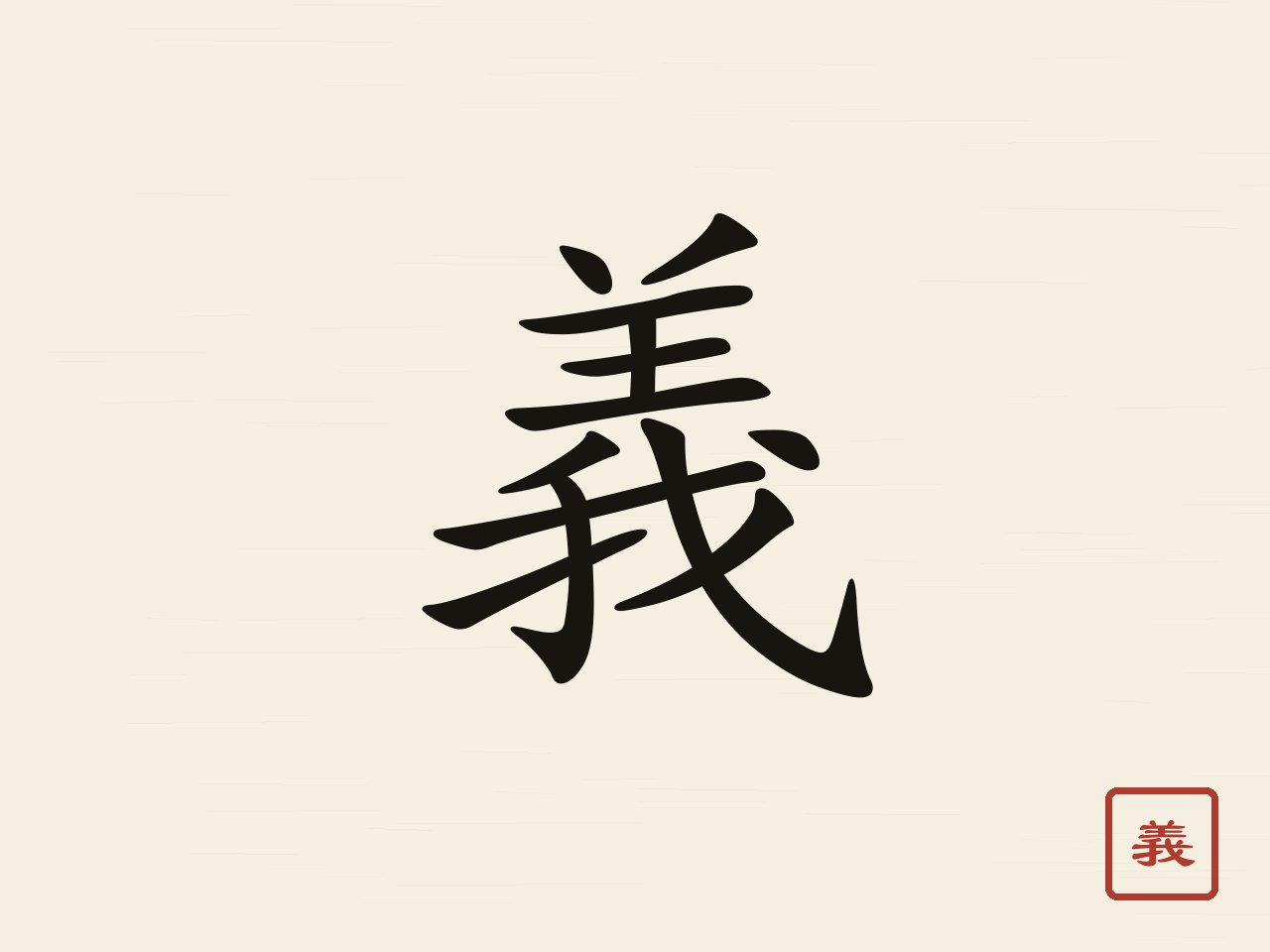
See 义 in seal, brush & cursive Try it
How it's written
Take the two forms one at a time, because they have nothing to do with each other.
義 is thirteen strokes in a stack. On top sits 羊 (yáng), the sheep, the same sheep that stands on top of 美, "beautiful". Underneath sits 我 (wǒ), which today is the ordinary word for "I" and one of the first characters any learner meets. It did not start out that way. 我 began as a picture of a weapon, a dagger-axe with a saw-toothed blade, and only later drifted into meaning "myself." So the traditional character for righteousness is, read straight off the page, a sheep standing on a blade: the animal you offer, and the thing you offer it with.
义 is three strokes. A dot goes on first, then two diagonals cross beneath it, and that is the entire character. It is not a trimmed-down 義. It is a different character wearing a hat. Those two diagonals on their own are 乂 (yì), a genuinely ancient sign that turns up in oracle-bone inscriptions as a picture of a cutting tool, a sickle or a pair of shears, and it meant "to mow" or "to weed." Because 乂 happened to sound the same as 義, writers borrowed it as shorthand, and because that got confusing, somebody added the dot on top to keep the two apart. That is the whole story. The sheep, the blade, and two thousand years of philosophy were not simplified. They were replaced by a homophone.
There is a coincidence buried in there, and it is worth naming as a coincidence rather than dressing it up. The traditional form holds a weapon. The simplified form is a harvesting hook. And in the old correlative scheme that sorts the virtues into the five elements, righteousness belongs to metal. Three blades, arrived at three separate ways, not one of them on purpose.
What it means
义 (yì) is righteousness, and the most useful thing to know about it is that it is not a warm virtue. Chinese ethics sets it beside benevolence, rén, which starts from how you feel about other people. 义 is the other thing entirely: what is right, what is owed, what a decent person does whether or not the feeling is there. The English word "righteousness" has picked up a faint whiff of the self-satisfied over the centuries, and the Chinese word has none of that. It is closer to "the fitting thing," and closest of all to that moment when you know exactly what you ought to do and would very much rather not.
Mencius, who did more than anyone to make it a cornerstone, traced it to a root nobody expects. In his famous list of the four sprouts from which the virtues grow, benevolence starts in pity and propriety starts in deference. Righteousness starts in shame. James Legge's translation, still the standard English one, gives the line as "The feeling of shame and dislike is the principle of righteousness." Not love of the good, then. Revulsion at the bad.
A second sense runs right alongside, and modern Chinese leans on it constantly: 义 also means "meaning." The word for the sense of a sentence, the word for a dictionary definition, and the word for what a gesture signifies all use this character. It is a short walk from "what is fitting" to "what a thing properly amounts to," and Chinese made it early.
One distinction worth holding onto, because English blurs it. Loyalty, 忠 (zhōng), binds you to a person. Righteousness binds you to what is right. Most of the time they point the same way, and Chinese pairs them so often that the two-character compound reads almost as one word. They come apart the instant your lord is wrong, and the whole tragic literature of the Chinese official lives in that gap.
- 正义 justice, righteousness (the everyday abstract noun, as in social justice)
- 义气 the code of loyalty among friends and sworn brothers; personal honor
- 意义 meaning, significance (the sense branch of the character)
- 定义 a definition; to define
- 义务 duty, obligation (义务教育 is compulsory education)
- 主义 doctrine, ideology, the -ism suffix (社会主义, socialism)
- 仁义 benevolence and righteousness, the Confucian virtue pair
- 义工 a volunteer; unpaid public-service work
- 义父 an adoptive or sworn father (the bond-by-agreement sense)
- 义肢 a prosthetic limb (the standing-in-for-the-real-thing sense)
Idioms
- 舍生取义“give up life, take righteousness”to lay down your life rather than abandon what is right. (《孟子·告子上》, the fish and bear's paw passage)
- 大义灭亲“great righteousness destroys kin”to put justice above family, even at the cost of your own relatives. (《左传·隐公四年》, the chronicler's verdict on Shi Que of Wei)
- 见义勇为“see what is right, act on it bravely”to step in when you see something that ought to be done; the standard modern phrase for good-samaritan courage. (built on 《论语·为政》, where seeing what is right and not doing it is called a want of courage)
- 义无反顾“righteousness does not look back”to press ahead without hesitation because the cause is right. (Sima Xiangru's proclamation to Ba and Shu, preserved in the Records of the Grand Historian)
- 忘恩负义“forget kindness, betray righteousness”rank ingratitude; to turn on someone who helped you.
Right vs wrong forms
| Form | Type | Note |
|---|---|---|
| 义 | simplified ✓ | The standard simplified form and the mainland default, three strokes: a dot, then two crossing diagonals. Historically it is a borrowed homophone rather than a reduction of 義, which is why it looks nothing like the traditional character. Correct everywhere simplified Chinese is used. |
| 義 | traditional | The traditional form, thirteen strokes, 羊 (sheep) stacked over 我 (originally a saw-toothed weapon). Standard in Taiwan and Hong Kong and the form used in nearly all calligraphic, martial, and classical contexts. Fully correct, and the form that still carries the character's history where you can see it. |
| 乂 (the dot dropped) | wrong | Not a variant, and the classic slip. Take the dot off the top of 义 and you are left with 乂 (yì), an ancient character meaning 'to mow' or 'to weed.' The dot was added precisely to keep the two apart, so a dotless 义 reads as the wrong word. |
| 义 (mirrored or rotated) | mirrored | Not a variant. With only three strokes there is no redundancy to absorb an error, so a flipped or rotated 义 from a low-resolution stencil reads as an obvious mistake. Check it against a dictionary at full size before inking. |
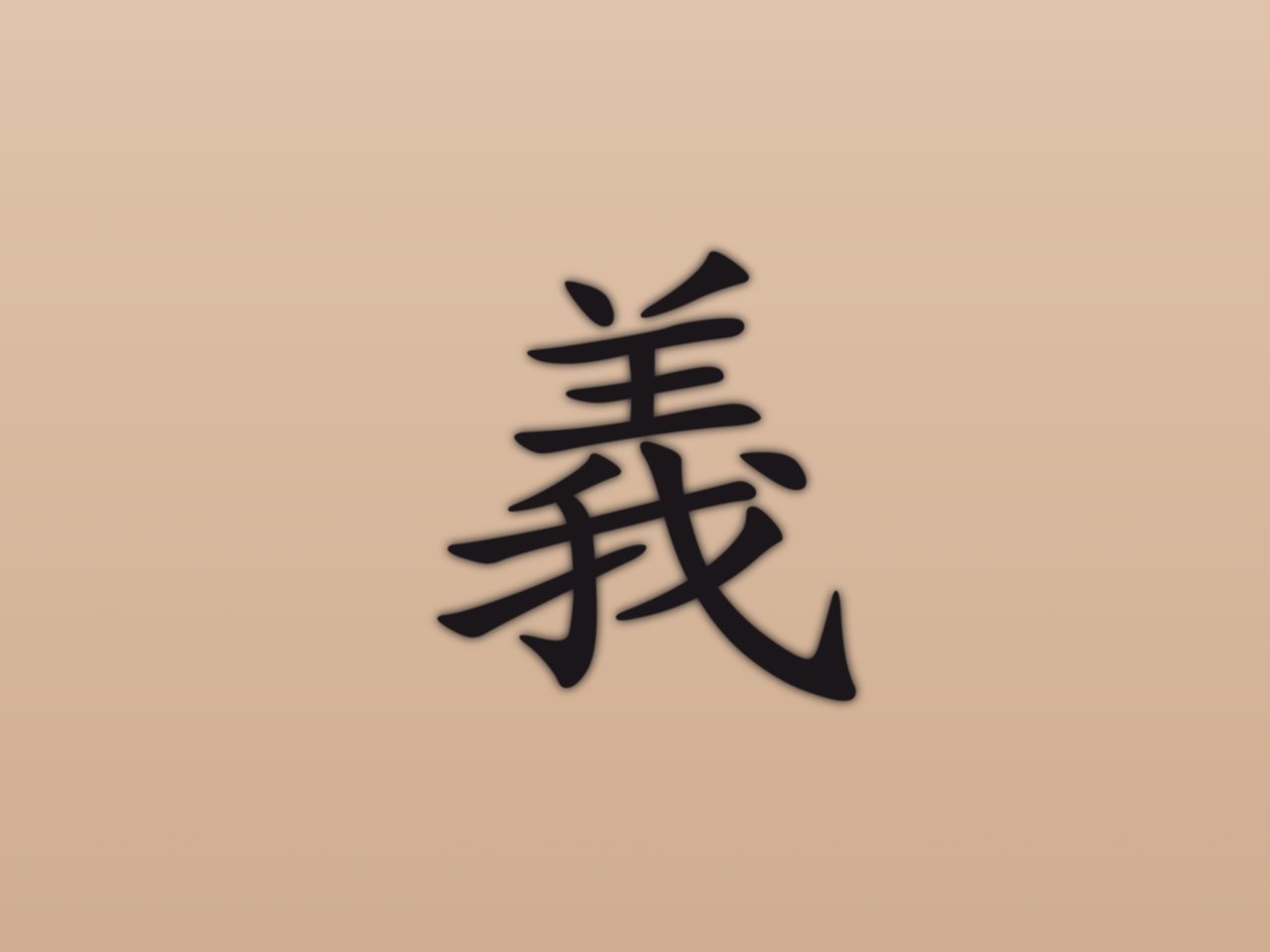
For a tattoo
义 is a real and reasonable tattoo, and this page's central fact is also its most useful piece of tattoo advice: you are not choosing between two styles, you are choosing between two unrelated characters.
義, the traditional form, is thirteen strokes with visible internal logic, the sheep set over the blade. It is standard in Taiwan and Hong Kong, it is the form on essentially every piece of martial-arts calligraphy, and it gives a tattoo artist something to work with. If you want the character's history legible in the design, this is the one.
义, the simplified form, is three strokes, a dot over a cross. It is the mainland standard and it is completely correct, but understand what three strokes means for ink. There is nowhere to hide. A slightly wrong angle on either diagonal, or a dot set a little off center, and it stops reading as a character and starts reading as a scratch. If the minimal version is what you want, take it from a real font or a calligrapher, print it at full size, and do not let anyone freehand it.
On phrases: 忠义, loyalty and righteousness, is the classic pairing and a common piece of ink, and it is the pair Guan Yu is worshipped for. 义气, the brotherhood code, is the other popular choice, and it comes with one honest caveat. It is a genuinely warm and widely admired quality, and it is also the signature virtue of the martial underworld, in fiction and sometimes outside it. A Chinese reader seeing 义气 on a stranger will not assume anything bad. They will notice.
One thing you can stop worrying about: the prosthetic sense only exists inside compounds. A single 义 will never read as "false teeth" to anybody. As always, print the design at full size and have someone who reads Chinese confirm it before the needle comes out.
Before you commit to any character, the eight ways a Chinese tattoo goes wrong covers the failure modes that are not specific to this one, including the stroke-density arithmetic that decides whether a traditional form survives at small sizes.
Righteousness in life today
Every -ism in Chinese ends in righteousness
Capitalism, socialism, feminism, Marxism, perfectionism, romanticism. In Chinese every one of them ends in the same two syllables, zhǔyì, and the second of those syllables is this character. The word does triple duty as "-ism," "doctrine," and "the principle a person holds." It also did not come from China. It was assembled in Meiji Japan out of Chinese characters by translators hunting for a way to render the European "-ism," then carried back into Chinese on the wave of borrowings that followed the war of 1894 and 1895. Chinese readers almost never notice, because it looks exactly like a native word. Which means the standard Chinese suffix for a political creed is, at the root, "what you take righteousness to be."
The character on the denture advertisement
This is the branch nobody warns you about. Because 义 carries the sense of a bond made by agreement rather than by blood, it became the standard prefix for a relationship that is entirely real but not biological: an adoptive father, an adopted son, a sworn brother. From there it took one more step, into "standing in for the real thing," and it is now the ordinary medical prefix for prosthetics. False teeth are righteousness-teeth. An artificial limb is a righteousness-limb. A Chinese dental clinic advertises dentures under the character Mencius said was worth dying for, and nobody in the country finds this remarkable.
义气, the code
The compound worth learning is 义气 (yìqì), and English has no clean equivalent for it. It is the loyalty-to-your-people code: showing up, taking the hit, refusing to sell out a friend when selling out would be easy and sensible. To say that someone has 义气 is real praise, the kind that gets a nod rather than a compliment. It is the governing virtue of every martial-arts novel and every gangster film ever made in Chinese, which is also why it carries a faint edge worth knowing about before you have it tattooed.
Righteousness on the school enrollment notice
The dullest branch is the most common one. The word for duty or obligation is built on this character, which makes compulsory education literally "obligation education." A volunteer is a righteousness-worker, a charity performance a righteousness-performance, a charity sale a righteousness-sale. So the character turns up on the blood-donation van and the primary-school enrollment notice, doing quiet municipal work.
Want to see 义 and 義 side by side in real brush script, at a size where you can actually
judge them? Our Chinese calligraphy generator will render either
form for you.
Where the character comes from
The Shuowen Jiezi, the first Chinese character dictionary, compiled around the year 100, offers a definition that stops you cold. It glosses 義 as "one's own dignified bearing." Not justice. Not morality. Deportment. How you carry yourself. It then notes that the character is built from 我 and 羊.
The Song-dynasty editors who prepared the received text of the dictionary left a note about that sheep, and it is the most useful line anyone has written about this character. The sheep is there, they say, because 義 shares its sense with 善 (shàn), goodness. The sheep is not livestock, in other words. It is the standing Chinese sign for good, fine, and auspicious, and it does exactly the same duty on top of 美, "beautiful," whose own sheep has been argued over for two millennia.
How a word for good posture became a word for justice was worked out by the Qing scholar Duan Yucai, whose commentary on the Shuowen is still the one specialists reach for. 義, he explains, originally covered ceremonial bearing. Then two other characters took pieces of the job away from it: 儀 (yí) picked up ceremony and decorum, and 誼 (yì) picked up what is fitting between people. 義 was left holding the one thing nobody else had claimed, the moral abstraction. The character for righteousness became the character for righteousness by having everything else stripped off it.
By then Confucius had already put the word to work as a test. In the Analects he sets it against profit, in a line Legge renders as "The mind of the superior man is conversant with righteousness; the mind of the mean man is conversant with gain." That opposition, rightness against gain, still frames the way Chinese talks about business ethics two and a half thousand years later. Two books earlier he ties the same word to nerve, in a line that reads like a rebuke across the centuries: "To see what is right and not to do it is want of courage."
Han cosmology then filed the whole set. The Five Constants, benevolence and righteousness and propriety and wisdom and trustworthiness, were mapped onto the five elements, and righteousness went to metal, and with metal came the west and autumn, the direction and the season Chinese thought assigned to blades, judgment, and the harvest.
History & roots
The fish and the bear's paw
The most famous thing anyone in China ever wrote about dying for a principle opens with a menu. Mencius begins the passage like this, in Legge's translation: "I like fish, and I also like bear's paws. If I cannot have the two together, I will let the fish go, and take the bear's paws." Having established that a person can want two things and only have one, he turns: "So, I like life, and I also like righteousness. If I cannot keep the two together, I will let life go, and choose righteousness." Four characters lifted out of that sentence, shě shēng qǔ yì, "give up life, take righteousness," became the standard Chinese phrase for a principled death, and they are still carved on war memorials. Only Mencius would arrive there by way of the bear.
The minister who had his own son executed
In 719 BCE, in the state of Wei, a man named Zhouyu murdered the ruler with the help of an accomplice called Shi Hou. Shi Hou's father, Shi Que, was a senior minister of the state, and he did not shield his son. He arranged for both men to be taken and put to death, Zhouyu at Pu and his own son over in the state of Chen. The Zuo Zhuan, the great narrative commentary on the Spring and Autumn Annals, delivers its verdict in four characters that became one of the heaviest idioms in the language, dà yì miè qīn, putting righteousness above kin. It is the coldest thing this virtue is capable of, and the chroniclers recorded it as praise.
The oath in the peach garden
The founding scene of 义气 is three men in a peach orchard swearing to be brothers: Liu Bei, Guan Yu, and Zhang Fei, in the opening chapter of Romance of the Three Kingdoms. Worth being straight about its status, because most retellings are not. The novel is fourteenth-century historical fiction, and the oath does not appear in the third-century records of the period it dramatizes. It has not mattered in the slightest. Guan Yu went on to be worshipped as the deified embodiment of loyalty and righteousness, and the peach-garden oath is the template that every sworn brotherhood in Chinese fiction has copied since.
The word everybody claims
One honest closing note. A virtue this central gets claimed, constantly. The uprising that English speakers know as the Boxer Rebellion called itself the Militia United in Righteousness and put the character in its own name. Rebel armies, secret societies, and organized crime have all reached for the same word, because 义 is precisely what you say when you want to insist that what you are doing is not merely permitted but right. Which is the built-in weakness of the word, and probably why Confucius kept using it as a test rather than a label. In his hands 义 is always the thing you do when it costs you something, never the thing you call yourself.
Questions people ask
What is the Chinese symbol for righteousness?
It is 义 (yì) in simplified Chinese and 義 in traditional Chinese. It means righteousness in the sense of what is right and fitting, the duty you owe others whether or not you feel like it, and it is one of the Five Constants of Confucian ethics alongside benevolence, propriety, wisdom, and trustworthiness. The simplified form is three strokes; the traditional form is thirteen.
Why does the Chinese symbol for righteousness have two completely different forms?
Because they are two different characters, not two versions of one. The traditional 義 is a sheep (羊) over 我, which originally pictured a saw-toothed weapon. The simplified 义 comes from 乂, an ancient sign for a sickle meaning 'to mow,' which was borrowed because it sounded the same, with a dot added on top to keep the two apart. Most simplifications keep part of the original character. This one replaced it with a homophone.
How do you write righteousness in Chinese?
The simplified character 义 takes three strokes: the dot goes on first, then the two diagonals cross beneath it. The traditional 義 takes thirteen, writing the sheep 羊 across the top before 我 underneath. It is pronounced yì, in the falling fourth tone, and sounds like the 'ee' in 'see.' The everyday word for justice is zhèngyì (正义).
Is the Chinese symbol for righteousness a good tattoo?
Yes, with one decision to make first. Because the two forms are unrelated characters, choosing between them is not a style choice. 義 (thirteen strokes) shows the sheep over the blade, is standard in Taiwan and Hong Kong, and suits calligraphic and martial designs. 义 (three strokes) is the mainland standard and completely correct, but three strokes leave nowhere to hide a bad angle, so take it from a real font at full size.
What is the difference between righteousness (义) and loyalty (忠)?
Loyalty binds you to a person, a ruler, or a cause; righteousness binds you to what is right. They usually point the same way, and Chinese pairs them so often that 忠义 reads almost as a single word. They separate the moment the person you are loyal to is in the wrong, which is the tragedy at the heart of most Chinese historical drama. Guan Yu is worshipped for holding both at once.
Why does the Chinese character for righteousness also mean artificial, as in false teeth?
Because of a chain of sense that starts with bonds made by agreement rather than blood. 义 marks an adoptive father or a sworn brother, a relationship that is genuine without being biological, and from there it slid to mean standing in for the real thing. That is why prosthetic limbs and dentures both carry the character. The sense only works inside compounds, so a single 义 never reads as 'artificial' on its own.
Sources
- Shuowen Jiezi entry for 義: 己之威儀也,從我、羊, with Xu Xuan's note 此與善同意,故从羊 and Duan Yucai's commentary (hancibao.com)
- Wiktionary: 義 (羊 as semantic, 我 originally a dagger-axe, cognate with 儀, the adoptive and artificial senses)
- Wiktionary: 义 (derived from 乂, borrowed for homophony, a stroke added on top to distinguish)
- Wiktionary: 乂 (oracle-bone pictogram of a cutting tool, to mow or weed, original form of 刈)
- Character data for 义: three strokes, radical 丶, stroke order dot then the two diagonals (hancibao.com)
- Analects 4.16 (里仁): 君子喻於義,小人喻於利, in James Legge's translation (ctext.org)
- Analects 2.24 (為政): 見義不為,無勇也, Legge's 'to see what is right and not to do it is want of courage' (ctext.org)
- Mencius 6A.10 (告子上): the fish and bear's paw, and 舍生而取義, in Legge's translation (ctext.org)
- Mencius 2A.6 (公孫丑上): 羞惡之心,義之端也, Legge's 'the feeling of shame and dislike is the principle of righteousness' (ctext.org)
- Zuo Zhuan, Duke Yin year 4: Shi Que of Wei and the verdict 大義滅親 (ctext.org)
- Wasei-kango: 主義 as a Japanese coinage re-imported into Chinese after the Meiji Restoration (Wikipedia)
- Wuxing (Five Phases): the Han mapping of the Five Constants onto the five elements, righteousness to metal
Make Righteousness your own
See 义 in calligraphy
From ancient seal script to flowing cursive. Pick a look before a tattoo or a card.
 Name
Name Get a Chinese name
A name matched to the sound of yours, with a meaning that fits.
Start yours Chinese Almanac
 Try the Chinese Gender Predictor
A different corner of Chinese culture: the old Qing-palace birth chart, worked out from your lunar birth date, with the math shown and its coin-flip odds honestly weighed.
Open the tool 义 There is a whole mythology behind Righteousness.Related: benevolence, loyalty, warrior, wisdom, courage, beautiful
By Julian 祝君瑜, sourced from the classics and from modern life, updated 2026-08-02