Chinese Symbol
Chinese Symbol for Benevolence: Meaning, Origin, and Why It Takes Two People
The Chinese symbol for benevolence is 仁 (rén, said like the "run" in "running," with the tongue curled back). It is four strokes: a person on the left, the number two on the right. It is the highest virtue in Confucian thought and the hardest word in the language to put into English, and the character makes the reason plain. Whatever this is, you cannot do it by yourself.
- Strokes
- 4
- Radical
- 亻 (person; Kangxi 9)
- Formation
- 会意 by the traditional analysis, a meaning-compound of 人 (person) and 二 (two). Modern paleography often reads it as phono-semantic instead, with 人 supplying the sound, since 人 and 仁 are homophones
Trace 仁 yourself, or watch it drawn
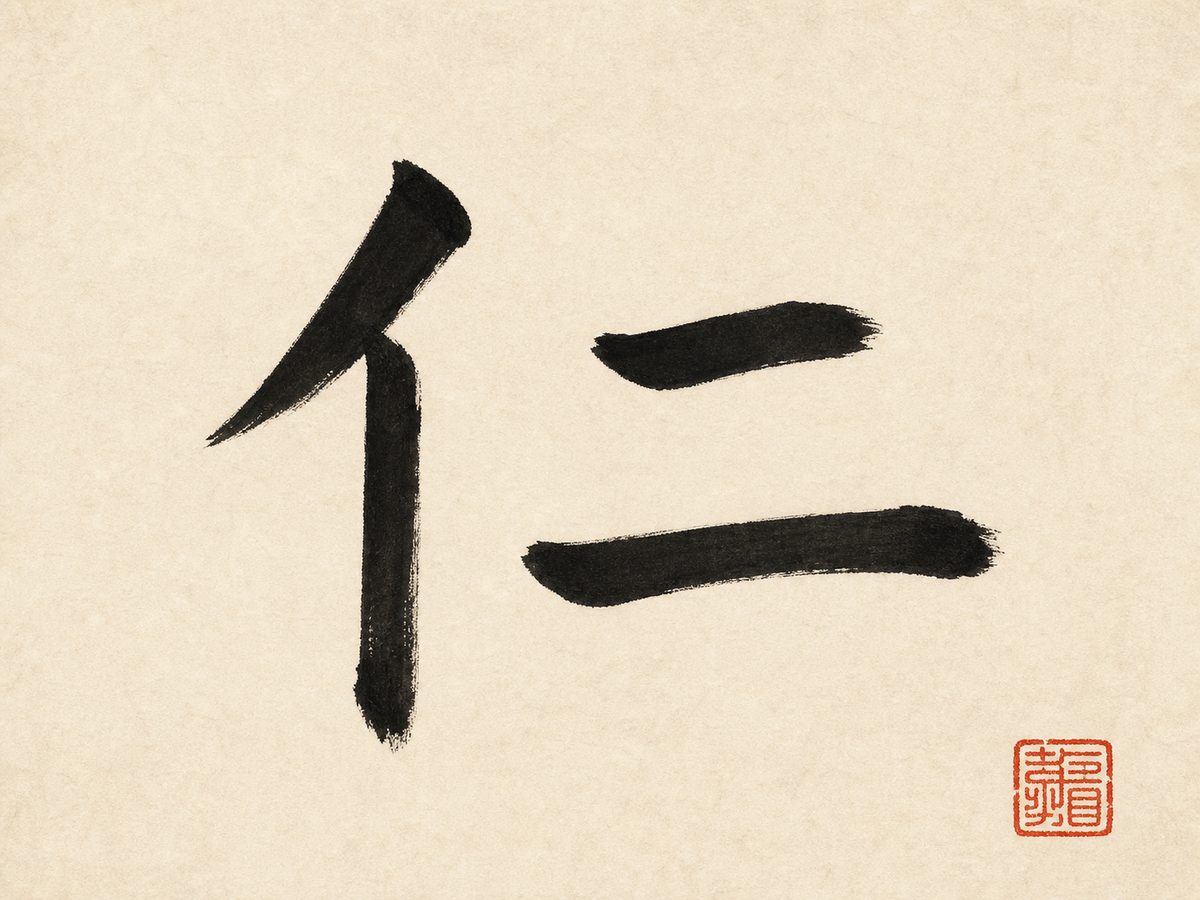
See 仁 in seal, brush & cursive Try it
How it's written
Four strokes, two parts, and the whole argument of the character sits in the second one.
On the left is 亻, the standing form of 人 (rén), a person, written as two legs. On the right is 二 (èr), the number two. That is the entire character. The Shuowen Jiezi, the first Chinese dictionary, compiled around the year 100, spells the analysis out: from person, from two.
Xu Xuan, the Song-dynasty editor of the received text, adds the reading that made it famous. The benevolent love broadly, he says, and that is why the character takes the two. Duan Yucai, the Qing commentator specialists still reach for, sharpens it into the best sentence anybody has written about this character: alone there is no pair, and where there is a pair there is closeness. One person is not enough to be good with. 仁 is the only one of the Five Constants whose character contains a headcount.
Modern paleographers usually offer a second reading, and it is worth knowing because it is probably the technically correct one. 人 and 仁 are homophones. So the person on the left may be carrying the sound rather than the sense, which would make this an ordinary sound-plus-meaning compound rather than a picture-idea. Both readings are alive in the scholarship. The received analysis is the older and the more useful, and the Shuowen is where it comes from, so this page reports it as what the tradition says rather than as settled paleography.
There is one more thing in the Shuowen that nobody quotes, and it complicates the tidy story in a good way. The dictionary records two older ways of writing the same word. One is a form built on a seated body. The other is 忎, which stacks a heart underneath the number a thousand. So at the point where the character was still being fixed, at least one hand was writing benevolence with a heart in it. The version that won is the one that counts people instead.
What it means
仁 (rén) is the master virtue of Confucian ethics, the one the other four are arranged around. Confucius returns to it more than a hundred times in the Analects and never once defines it. He tests for it, refuses to award it, and answers the same question differently depending on who is asking.
English has never settled on a word. James Legge, whose Victorian translation is still the standard reference version, uses three inside a single book: "perfect virtue" when Yan Yuan asks, "benevolence" when Fan Chi asks, plain "virtue" elsewhere. Later translators have tried humaneness, goodness, co-humanity, and authoritative conduct. None of them is wrong and none of them fits, which is a fact about the concept rather than about the translators.
The distinction worth holding onto is the one against love, 爱 (ài), because the two get run together constantly in English writing about Chinese values. Confucius did once answer the question with "love people." It was to Fan Chi, the most literal-minded of his students, and it is the shortest thing he ever said on the subject. Every other time he was asked, he gave a procedure instead of a feeling. Wanting to stand yourself, help others stand. Wanting to get there, get others there. What you do not want done to you, do not do to anyone else. Then the line that holds all of it together, which Legge renders as "to be able to judge of others by what is nigh in ourselves."
That is the actual content of 仁, and it is not an emotion. It is an operation: taking your own case as the measuring stick and running the measurement on somebody who is not you. Love is the feeling. This is the arithmetic you can do whether or not the feeling shows up.
- 仁慈 kind, merciful (the everyday word when English would say kindness)
- 仁爱 benevolence and love; humanitarian feeling, often in institutional names
- 仁义 benevolence and righteousness, the Confucian virtue pair
- 仁者 a person of benevolence; the one Confucius says finds pleasure in mountains
- 仁心 a benevolent heart; the standard half of the phrase praising a good doctor
- 仁政 benevolent government, Mencius's program for how a state should be run
- 杏仁 almond (literally apricot-kernel); the grocery-shelf sense of the character
- 花生仁 peanut kernel, the shelled nut
- 不仁 unfeeling; in Chinese medicine, numb or without sensation
- 同仁 colleagues, fellow members; literally those regarded alike
Idioms
- 杀身成仁“kill the body, complete benevolence”to give your life rather than betray what is right; the standard phrase for a principled death, and the twin of Mencius's 舍生取义. (《论语·卫灵公》, where the determined scholar will not live at the expense of his virtue)
- 麻木不仁“numb, wooden, not benevolent”callous, apathetic, unmoved by other people's suffering. The literal medical sense, a limb with no sensation, is still current. (the medical usage Cheng Hao cites in 《二程遗书》)
- 一视同仁“one look, the same benevolence”to treat everyone by the same standard, without favor; the formal Chinese way of promising not to discriminate. (韩愈《原人》, Han Yu, Tang dynasty)
- 当仁不让“facing benevolence, do not yield”to step up without deferring when the right thing needs doing; the one situation Confucian etiquette says you should not be modest about. (《论语·卫灵公》)
- 仁至义尽“benevolence to the limit, righteousness exhausted”to have done absolutely everything one decently could for someone. Usually said just before giving up on them. (《礼记·郊特牲》)
Right vs wrong forms
| Form | Type | Note |
|---|---|---|
| 仁 | simplified ✓ | The standard form, four strokes: 亻 (person) on the left, 二 (two) on the right. Identical in simplified and traditional Chinese and correct everywhere Chinese is written, including Japan, where it is read jin or, in names, hito. |
| 忎 | traditional | An ancient form recorded in the Shuowen Jiezi itself, built from 千 (thousand, supplying the sound) over 心 (heart). Genuinely attested and genuinely obsolete: nobody has written it for around two thousand years, and a modern reader will not recognize it. Historically interesting, not a usable alternative. |
| 什 (the strokes run together) | wrong | The failure mode for a four-stroke character. Close the gap between the person and the two, or let the upper horizontal drift into a vertical, and 仁 turns into 什 (shí), a filler word meaning 'what' or 'ten'. Check the spacing at full size, not on a phone. |
| 仁 (mirrored) | mirrored | Not a variant. The person goes on the left and the two on the right, always. Flipped, it is not a stylistic choice, it is simply not the character, and every Chinese reader clocks it instantly. |
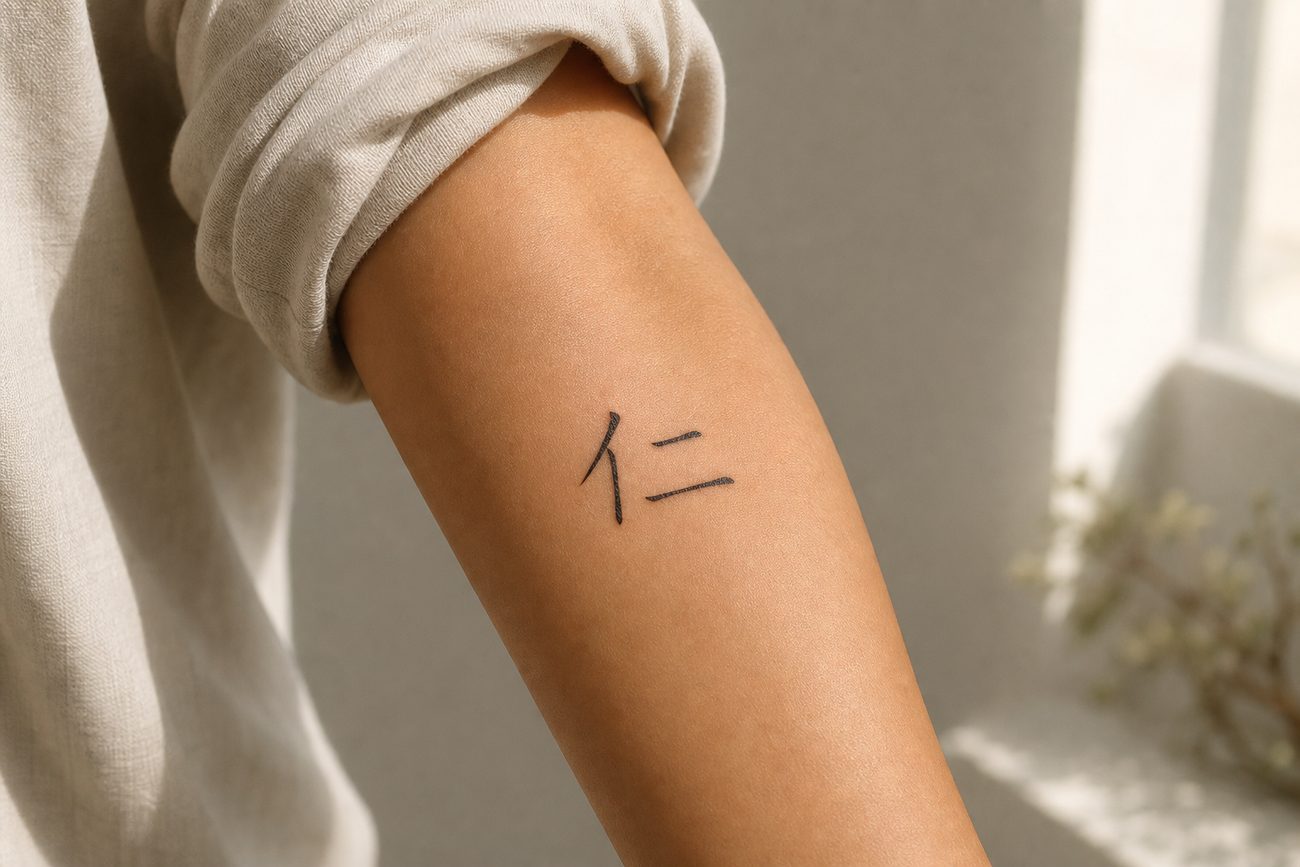
For a tattoo
仁 is a good tattoo for a plain reason: it is one of the few Chinese characters where the meaning is legible in the shape. Four strokes, a person and the number two, and once someone tells you what it says you cannot unsee the argument.
There is nothing to choose between forms. 仁 is identical in simplified and traditional Chinese, so unlike 义 and 義 there is no mainland-versus- Taiwan decision to get wrong, and the same design is correct everywhere Chinese is read.
The real risk is the one every short character has. Four strokes means no redundancy. If the two horizontal lines on the right are unequal in the wrong direction, or the gap between the person and the number closes up, it stops reading as 仁 and starts reading as 什 or as nothing at all. Take it from a real font or a calligrapher, print it at full size, and do not let anyone reproduce it freehand from a phone screen.
On pairings: the two-character compound with righteousness is the classic Confucian phrase and a common piece of ink, and it reads to a Chinese eye as a claim about your ethics rather than a decoration, which is either exactly what you want or worth knowing first. Avoid the four-character phrase about numbness, for reasons the modern-life section above makes embarrassingly clear. And nobody will read a single 仁 as "almond." The kernel sense only operates inside compounds.
Before you commit to any character, the eight ways a Chinese tattoo goes wrong covers the failure modes that are not specific to this one, including the stroke-density arithmetic that decides whether a traditional form survives at small sizes.
Benevolence in life today
The almond is a benevolence
Walk into any Chinese supermarket and the character is on the snack shelf. An almond is an apricot-rén. A peanut kernel is a peanut-rén. Walnut meat, pine nuts, melon seeds, the soft edible part inside any shell or stone: all of them take this character. The word for the highest virtue in Confucian ethics is also the ordinary grocery word for the bit of the nut you actually eat.
It is not a pun and it is not a coincidence anybody planned. But the sense is the same sense. A kernel is the live part, the part that is not shell, the part that could still become a tree.
The medical word for a dead foot
Here is the branch that turns the whole page. In Chinese medicine, a limb that has lost sensation is described as 不仁, not-rén. A hand you cannot feel is a hand that is not being benevolent. The everyday modern phrase for moral callousness, for a person who watches something terrible and feels nothing, is built directly on that medical term and uses the same four characters. Chinese has never needed two expressions for a numb foot and a numb conscience.
On the clinic wall
Chinese medical ethics runs on this character. The set phrase praising a good doctor pairs a benevolent heart with benevolent skill, in that order, and versions of it are still framed in hospital corridors. The idiom for treating everyone by the same standard, without favor, also uses it, which is why it turns up in company handbooks and school admission policies as the formal way of promising not to discriminate.
The name on the throne
仁 is one of the most common characters in Chinese given names, and it traveled. Every Japanese emperor of the modern era carries it at the end of his name: Hirohito, Akihito, and the current emperor Naruhito are all written with this character in final position, where it is read hito. If you have ever wondered whether Japanese kanji are Chinese characters, this is one of the tidier answers.
Want to see 仁 in real brush script before you commit to a shape?
Our Chinese calligraphy generator will render it in seal, regular,
running, and cursive hands.
Where the character comes from
Start with what the Shuowen actually says, because the definition is stranger than the translations suggest. It glosses 仁 in a single word: closeness. Not kindness, not love, not virtue. Kinship, intimacy, the state of being near to someone. It is a relation word, and it describes a position rather than a feeling, which is exactly what the two on the right of the character had already said.
Confucius, five centuries earlier, had used the word as a standard so high he would not apply it to himself. Asked whether he was a sage or a man of 仁, he answered, in Legge's version, "how dare I rank myself with them," and offered instead that he worked at it without getting bored and taught without getting tired. He declined, elsewhere, to say whether his best students had it. The word functions in the Analects less like a description than like a qualification nobody has yet been awarded.
Mencius, a century after that, did the thing Confucius never did and located where it starts. In his account of the four sprouts, each of the great virtues grows from a specific reflex, and the reflex under benevolence is pity. Legge translates the line as "the feeling of commiseration is the principle of benevolence." Its companion is on the righteousness page, where the sprout is shame, and the fourth is on the wisdom page, where it is the sense of right and wrong. Four reflexes, four virtues, one paragraph.
Then the Han dynasty filed the whole set. At the White Tiger Hall conference of 79 CE, called by the emperor to settle disputed readings of the classics, the Five Constants were mapped onto the five phases. Righteousness went to metal, wisdom to water, and benevolence went to wood, and with wood came the east and the spring: the direction the sun comes from and the season things start growing in. It is the gentlest slot in the scheme and, for once, the assignment needs no explaining.
History & roots
The child at the well
The most famous thought experiment in Chinese philosophy is one sentence long. Mencius asks you to imagine that you suddenly see a small child about to fall into a well. Everyone, without exception, he says, will feel a stab of alarm and distress. Then he closes the exits one at a time: it is not because you want to get in with the child's parents, not because you want a good name among your neighbors, and not because you dislike the sound of a child crying. The feeling arrives before any of that can be calculated, which is his proof that it is native equipment rather than social training. Everything Confucian ethics claims about human nature rests on that half-second.
The doctors named it best
Eleven centuries later, the philosopher Cheng Hao wrote the line that makes sense of the grocery shelf, the numb hand, and the ethics all at once. The medical books, he observes, call a paralyzed hand or foot 不仁, and no phrase describes it better. Then the turn: the person of benevolence takes heaven, earth, and the ten thousand things as one body, and none of it is not himself. If your hand goes numb the blood has stopped reaching it, and it stops being yours. Cruelty, on this reading, is not wickedness. It is a circulation problem. Somebody has stopped registering a part of the world that was always attached to them.
Cheng Hao ends the passage by quoting Confucius on wanting to stand and helping others stand, the same line from the Analects that this page opened with. Two thousand years apart, and the argument closes.
The one that costs
The Analects contains the sentence that fixed the character in the Chinese moral vocabulary for good. Legge gives it as: the determined scholar and the man of virtue will not seek to live at the expense of injuring their virtue, and will even sacrifice their lives to preserve it complete. Four characters lifted out of that line became a standing phrase for dying for a principle, and it has a twin. Mencius produced the matching phrase about righteousness, and Chinese has used the two of them together ever since, on war memorials and in obituaries.
The virtue with a constitutional clause
What English writing about 仁 almost always leaves out is that it is a political term. Mencius built an entire theory of government on it, benevolent rule, and then drew the conclusion that made him dangerous to read. Legge translates the line as: the people are the most important element in a nation, the spirits of the land and grain are next, and the sovereign is the lightest. A ruler who is not benevolent, on this argument, is not a bad ruler. He has stopped being a ruler, and removing him is not treason. That sentence has been quoted at Chinese power by its critics for 2,300 years.
One honest limit to set against it. Confucian benevolence is not free-floating goodwill, and the Analects says so in the answer given to Yan Yuan: to master yourself and return to ritual propriety, that is 仁. It is a virtue expressed through a specific social order with specific obligations, not a warm feeling operating on its own recognizance, and modern readings that turn it into general niceness have quietly dropped the harder half. Whether the affection it radiates should thin with distance, and what the philosopher Mozi said about that, is a separate argument taken up on the love page.
Questions people ask
What is the Chinese symbol for benevolence?
It is 仁 (rén), four strokes, written the same way in simplified and traditional Chinese. It is the first and highest of the Five Constants of Confucian ethics, ahead of righteousness, propriety, wisdom, and trustworthiness. The character is built from a person and the number two, which is the tradition's own way of saying that this is a virtue you cannot practice on your own.
What is the Chinese symbol for kindness?
Most sources will give you 仁 (rén), and it is a defensible answer, but it is worth knowing that it aims higher than the English word. 仁 is the whole Confucian project of treating other people as though their case were your case. If you want plain everyday kindness, the ordinary word is réncí (仁慈), which uses this character plus one meaning compassionate, and shàn is the general word for good and kind. For a single character, 仁 is the strongest choice and the one with the most behind it.
How do you pronounce and write 仁?
It is pronounced rén, second tone, rising. The vowel is close to the 'u' in 'run' and the initial r is made with the tongue curled back, closer to a soft English 'r' than to anything else. Four strokes: write the two strokes of the person radical 亻 first, top to bottom, then the upper horizontal of 二 and the lower one, which is the longer of the pair.
What is the difference between 仁 and 爱 (love)?
爱 is the feeling; 仁 is what you do with it. Confucius answered 'love people' exactly once, to his most literal-minded student, and it is the shortest thing he ever said on the subject. Every other time he gave a method rather than an emotion: help others stand as you would want to stand yourself, and do not do to others what you would not want done to you. 仁 is that operation, taking your own case as the measure. It works on days when the feeling does not show up.
Why does 仁 also mean the kernel of a nut?
Because it is the same idea in a different register. An almond is an apricot-rén and a peanut kernel is a peanut-rén: the soft living part inside the shell, the part that could still grow. Chinese medicine runs the sense the other way and calls a numb limb 不仁, not-rén, which is where the modern phrase for moral callousness comes from. Kernel, sensation, and benevolence are three settings of one word, and the eleventh-century philosopher Cheng Hao argued the medical one names the virtue best.
Is 仁 a good tattoo?
Yes, and it is one of the safer choices. It is identical in simplified and traditional Chinese, so there is no form to get wrong, and the meaning is visible in the shape once you know that the right-hand part is the number two. The one risk is that four strokes leave no room for error: if the spacing closes up it reads as a different character. Take the design from a real font at full size and do not let it be drawn freehand.
Sources
- Shuowen Jiezi entry for 仁: 親也。从人从二, with Xu Xuan's note 仁者兼愛,故从二, Duan Yucai's 獨則無耦,耦則相親, and the two 古文 forms 忎 (从千心) and the 尸 form (hancibao.com)
- Wiktionary: 仁 (four strokes, radical 人, the phono-semantic reading, and the kernel sense)
- Analects 6.30 (雍也): 夫仁者,己欲立而立人,己欲達而達人。能近取譬,可謂仁之方也已, in James Legge's translation (ctext.org)
- Analects 12.1, 12.2, 12.22 (顏淵): Yan Yuan, Zhong Gong, and Fan Chi each asking about 仁, and Legge rendering it 'perfect virtue' twice and 'benevolence' once (ctext.org)
- Analects 7.34 (述而): 若聖與仁,則吾豈敢, Confucius declining the title (ctext.org)
- Analects 15.9 and 15.24 (衛靈公): 殺身以成仁, and 己所不欲,勿施於人 as the answer about reciprocity (ctext.org)
- Mencius 2A.6 (公孫丑上): the child at the well and 惻隱之心,仁之端也, in Legge's translation (ctext.org)
- 二程遺書 卷二上: 醫書言手足痿痺為不仁,此言最善名狀。仁者以天地萬物為一體,莫非己也 (Chinese Wikisource)
- Wuxing (Five Phases): the Han mapping of the Five Constants onto the five elements, benevolence to wood
- Bai Hu Tong (the White Tiger Hall discussions of 79 CE): the imperial conference that fixed the five-phase correspondences
- Mencius 7B.14 (盡心下): 民為貴,社稷次之,君為輕, in Legge's translation (ctext.org)
- Japanese imperial family: the given names Hirohito (裕仁), Akihito (明仁), and Naruhito (徳仁) all end in this character
Make Benevolence your own
See 仁 in calligraphy
From ancient seal script to flowing cursive. Pick a look before a tattoo or a card.
 Name
Name Get a Chinese name
A name matched to the sound of yours, with a meaning that fits.
Start yours Chinese Almanac
 Try the Chinese Gender Predictor
A different corner of Chinese culture: the old Qing-palace birth chart, worked out from your lunar birth date, with the math shown and its coin-flip odds honestly weighed.
Open the toolRelated: righteousness, wisdom, love, loyalty, courage
By Julian 祝君瑜, sourced from the classics and from modern life, updated 2026-08-02