Chinese Symbol
Chinese Symbol for Warrior (武): Martial Arts, Meaning, and 'Stop the Spear'
The Chinese symbol most people mean by "warrior" is 武 (wǔ), the character for everything martial: the military, fighting, and the martial arts. It is built from a weapon and a foot, a soldier striding out to war. But the oldest Chinese account of it turns that on its head, reading the same two pieces as "stop" plus "spear" and declaring that the truest warrior is the one who ends the fighting.
- Strokes
- 8
- Radical
- 止 (foot; Kangxi 77)
- Formation
- Ideographic compound (戈 dagger-axe + 止 foot)
Trace 武 yourself, or watch it drawn
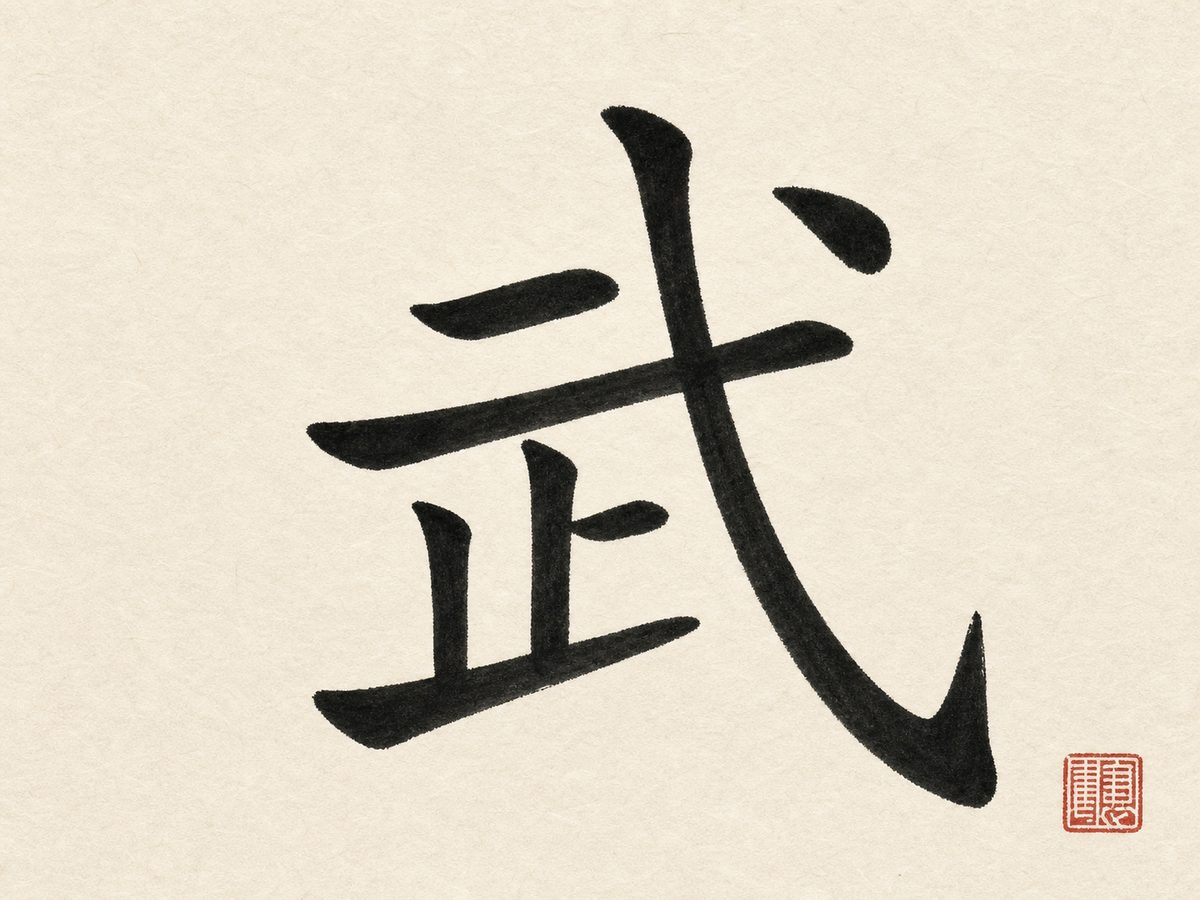
See 武 in seal, brush & cursive Try it
How it's written
武 is eight strokes, and its two halves are really a small argument about what war is for. The lower left is 止 (zhǐ), a foot, the element that elsewhere in the language means to walk or to march. Wrapped over the top and right is 戈 (gē), a dagger-axe, the hooked bronze polearm that was the standard weapon of ancient China. Put a marching foot together with a weapon and you have the plain first meaning: to take up arms and go, to make war.
One thing worth flagging for anyone about to write or ink it. The character has no extra left-falling slash cutting across its lower right, and adding one is such a common slip that Chinese teachers drill a little rhyming rule against it. 武 is identical in simplified and traditional Chinese, so there is only one form to learn.
What it means
武 (wǔ) is the root word for everything martial: military, warlike, to do with force and arms, and by extension the martial arts. It helps to know that a "warrior" as a person is usually a wǔshì or a zhànshì, a fighter or soldier, the second built on 战, war itself; 武 is the deeper thing they are made of, the martial itself, the quality more than the man.
Its whole meaning comes from what it stands against. 武 is the counterweight to 文 (wén), the civil and the literary, everything to do with the brush, the book, and good government. For most of Chinese history a person, a minister, even a dynasty was read on both scales at once, the martial and the civil, the sword and the pen. To be wén wǔ shuāng quán, "complete in both the civil and the martial," was the very definition of a whole and capable person.
- 武术 martial arts (the general term)
- 武侠 martial chivalry; the wuxia genre of fiction and film
- 武功 martial skill; fighting prowess
- 武器 weapon (literally 'martial implement')
- 武力 (military) force; armed might
- 武装 to arm; armed forces
- 武林 the martial-arts world (literally 'martial forest')
- 武士 a warrior; the Japanese samurai
- 威武 mighty, powerful, awe-inspiring
- 武将 a military general (opposite of 文官, a civil official)
Idioms
- 止戈为武“to stop the spear is 武”true martial greatness lies in ending conflict, not in slaughter. (《左传·宣公十二年》, the words of King Zhuang of Chu)
- 文武双全“complete in both the civil and the martial”accomplished in both scholarship and fighting; a well-rounded person.
- 威武不能屈“might cannot bend him”not to be cowed by force; unshakable moral integrity. (《孟子·滕文公下》, Mencius on the 'great man' (大丈夫))
- 穷兵黩武“exhaust the troops, abuse the martial”to wage war recklessly; warmongering militarism (a criticism).
- 武艺高强“martial skills high and strong”highly skilled in the martial arts.
Right vs wrong forms
| Form | Type | Note |
|---|---|---|
| 武 | simplified ✓ | The standard form everywhere, identical in simplified and traditional Chinese: eight strokes, 戈 (dagger-axe) wrapped over 止 (foot). It was never simplified, so there is only one form to learn. |
| 武 (with an added slash) | wrong | The classic miswriting. The correct 武 has NO left-falling slash cutting across its lower right; adding one is the single most common mistake, drilled against in Chinese schools. Keep the lower right clean. |
| 武 (mirrored or rotated) | mirrored | Not a variant. A flipped or rotated 武 from a low-resolution stencil reads as an error to anyone literate. Check against a dictionary at full size before inking. |
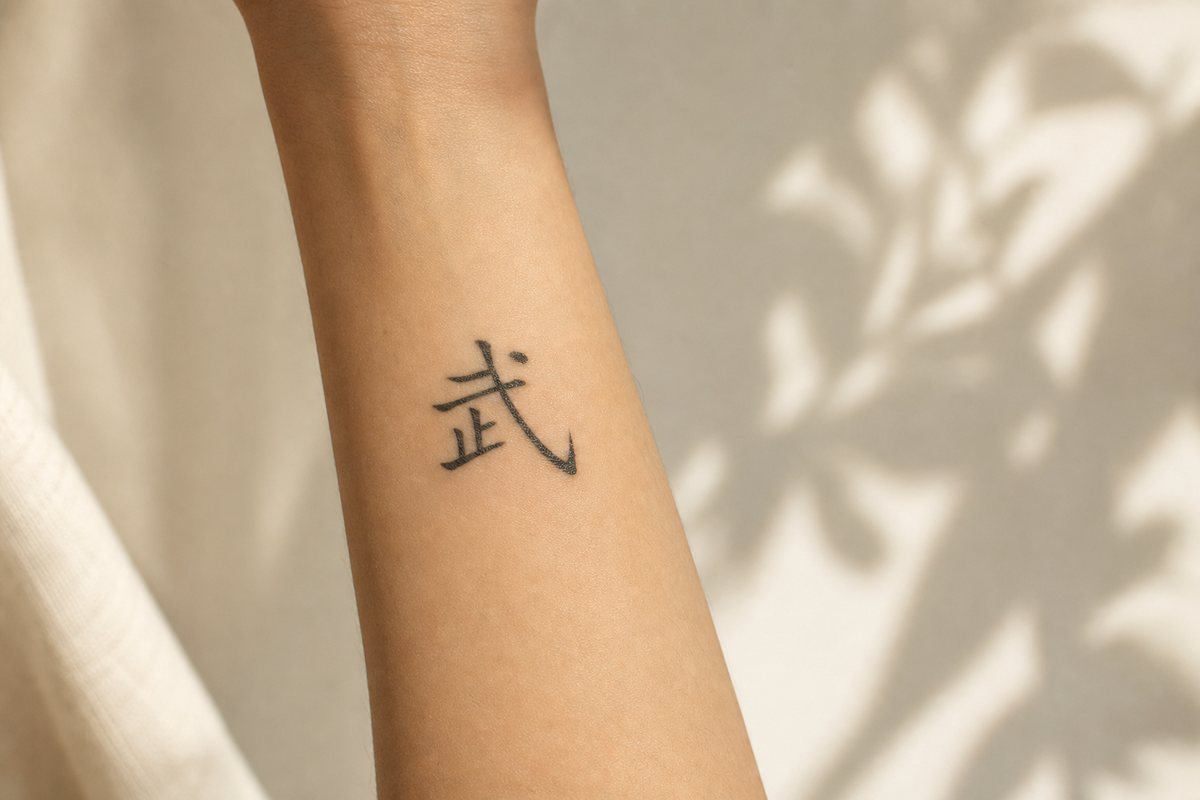
For a tattoo
武 is a strong, popular tattoo, and it carries more than "fighter." As a single character it holds the whole martial world, the fighting arts, military valor, the discipline of the warrior, and, thanks to its most famous reading, a note of restraint: strength that knows when to stop. For many people that paradox is the whole appeal.
A few practical notes. It is eight strokes, and the one real trap is adding a stray left-falling slash across the lower right, which no correct 武 ever has, so give your artist a clean dictionary reference and check it against one yourself. If you want "warrior" in the sense of a person, the two-character wǔshì is more literally that, though 武 on its own is the more striking single glyph. As always, print it at full size and have someone who reads Chinese confirm the design before the needle comes out.
Before you commit to any character, the eight ways a Chinese tattoo goes wrong covers the failure modes that are not specific to this one, including the stroke-density arithmetic that decides whether a traditional form survives at small sizes.
Warrior in life today
The most exportable Chinese word of all
If any part of 武 has gone global, it is the fighting arts. Wǔshù is the umbrella term for them, the whole sprawling family from Shaolin kung fu to tai chi; wǔgōng is the skill itself, the thing a hero spends a lifetime perfecting. Around them grew wǔxiá, the martial-chivalry genre of novels and films that writers like Jin Yong turned into a national literature and movies like Crouching Tiger, Hidden Dragon carried worldwide. Its heroes roam the wǔlín, the "martial forest," a shadow society of clans, masters, and secret manuals. When the video game Black Myth: Wukong sold twenty million copies in 2024, this was the world it was selling.
Two mountains, two schools
Ask where kung fu comes from and Chinese culture hands you two answers, forever set against each other. Shaolin, the Buddhist temple in the north, stands for the "external" arts: hard, fast, and powerful. Wudang, the Taoist mountain in the south, stands for the "internal" arts, soft and slow, turning an opponent's force back on him, the tradition tai chi belongs to and the semi-legendary master Zhang Sanfeng is said to have founded. Hard against soft, Buddhist against Taoist: the two poles every martial-arts story is strung between.
A name for power
武 has always been a good thing to carry in a name. China's only female emperor took it as her surname, ruling as Wu Zetian in the seventh century; the tiger-killing strongman of the classic novel Water Margin is Wu Song. As a given name it promises valor, and it marks the map too, most famously in the city of Wuhan. Even the guardian of the northern sky is a warrior, the Xuanwu or "Dark Warrior," a coiled tortoise and snake who is one of the four beasts watching over the Chinese heavens.
Curious what your own name becomes in Chinese, matched to its sound and a good
meaning? Our Chinese name generator builds one for you.
Where the character comes from
The single most quoted thing anyone has ever said about 武 is a piece of creative misreading, and it is glorious. In 597 BC, having just crushed a rival army, King Zhuang of Chu was urged to heap the enemy dead into a victory mound. He refused, and gave an etymology lesson to explain why. The character 武, he said, is 止, "stop," set over 戈, "spear": 止戈为武, "to stop the spear is what martial power truly means." Real greatness in war, he argued, is not the slaughter but the ending of it, and he listed seven marks of true 武, from restraining violence to enriching the people. The speech is preserved in the Zuo Zhuan and echoed in the Shuowen Jiezi, and it became the founding text of Chinese thinking about force.
Here is the twist King Zhuang could not have known. The oracle-bone forms, older than his speech by six centuries, show that the 止 in the character is not "stop" at all but a foot in mid-stride, and the 戈 is the weapon it carries: the picture first drew a soldier marching to battle, not one laying down his arms. His beautiful pacifist reading is, by the paleographers' account, a folk etymology, a moral rereading of a picture that first meant almost the opposite. And almost nobody minds. The rereading was simply too good, and it has shaped how China talks about war ever since.
History & roots
The seven virtues of a warlord
It is worth staying with King Zhuang of Chu a moment longer, because his refusal is one of the strangest things a victorious general ever said. Standing over a battlefield he had just won, asked to build the customary mound of enemy corpses to advertise the triumph, he turned it down flat. True martial power, he said, has seven marks: it restrains violence, puts away weapons, preserves the great, secures achievement, gives the people peace, harmonizes the masses, and enriches their livelihood. He had done none of these here, only killed; so this was no achievement of 武 at all, and deserved no monument. It is one of the earliest and most quoted anti-militarist arguments in any language, and it comes not from a philosopher but from the man holding the sword.
The pen and the sword
In everyday Chinese life 武 has always run in harness with 文 (wén), the civil and literary, and the pairing shaped everything. Courts kept two columns of officials, civil and military; heroes were praised for mastering both; the ideal was the person "complete in both." But the balance was rarely even. Confucian China tended to seat the scholar above the soldier, the brush above the blade, which is one reason so many of its greatest warriors, from doomed loyalists to wronged generals, are remembered as tragic figures. The culture admired 武 and quietly distrusted it in the same breath.
The god of war
Loyalty and war, in the end, share a face. Guan Yu, the Three Kingdoms general already met on our page for loyalty, was raised after death into the god of war, honored as the 武圣 (Wǔshèng), the "Saint of War," a rank deliberately set level with Confucius, the 文圣 (Wénshèng), the "Saint of Culture." The soldier and the scholar, deified as equals. That the same red-faced figure is worshipped as both the god of loyalty and the god of war tells you how tightly, in the Chinese imagination, the warrior's strength and the warrior's faithfulness are bound together.
Questions people ask
What is the Chinese symbol for warrior?
The usual single character is 武 (wǔ), eight strokes, made of 戈 (a dagger-axe) over 止 (a foot): a soldier marching to war. It means martial, military, and the martial arts. Strictly, a 'warrior' as a person is 武士 (wǔshì), while 武 is the martial idea itself. It is written identically in simplified and traditional Chinese.
What does 武 (wǔ) mean?
武 means martial, military, and warlike, and by extension the martial arts (wǔshù). It is the counterpart to 文 (wén), the civil and literary. A person or a state was traditionally judged on both, the martial and the civil, and mastering both, wén wǔ shuāng quán, was the ideal.
What is the Chinese word for warrior?
For a warrior as a person, the word is wǔshì, built from 武 plus a second character meaning a man of standing. The single character 武 on its own is an attribute rather than a person, martial or military, which is why a one-character tattoo of it reads as 'martial' and not 'warrior.' Nearby words divide the sense: zhànshì is a soldier or fighter, and yǒngshì is a brave one, closer to 'champion.' Read in Japanese, the two characters behind wǔshì are bushi, the samurai.
Is 武 a good tattoo?
Yes. As a single character it carries the whole martial world plus a note of restraint, from its famous reading that true strength knows when to stop. Two things to watch: 武 has no extra left-falling slash across the lower right (a common error), and if you mean 'warrior' as a person, 武士 (wǔshì) is more literal. Always verify the design at full size.
What does 止戈为武 mean?
止戈为武 (zhǐ gē wéi wǔ) means 'to stop the spear is true martial power.' It comes from King Zhuang of Chu in the Zuo Zhuan, arguing that real greatness in war lies in ending conflict, not in killing. Paleographers note it is actually a folk etymology, since the character first pictured a soldier marching to war, but it remains the most beloved thing ever said about 武.
What is the difference between 武 and 文?
武 (wǔ) is the martial and military; 文 (wén) is the civil, literary, and cultural. They are the two great poles of traditional Chinese life, the sword and the pen, and every court, official, and accomplished person was measured on both. Someone masterful at both is 文武双全 (wén wǔ shuāng quán).
Sources
- Wiktionary: 武 (oracle-bone 戈+止 = marching soldier; 止戈為武 as folk etymology; meanings)
- Shuowen Jiezi entry for 武: 夫武,定功戢兵,故止戈爲武 (hancibao.com)
- Zuo Zhuan, Xuan 12 (宣公十二年): 止戈為武 and the seven virtues of 武 (zuozhuan.5000yan.com)
- Mencius, Teng Wen Gong II (滕文公下): 威武不能屈 — might cannot bend the great man (ctext.org)
- Wuxia: the martial-hero genre, the wǔlín, Jin Yong, wǔshù (Wikipedia)
- Guan Yu deified as the 武聖 (Saint of War), level with Confucius the 文聖 (Wikipedia)
- Four Symbols: the Xuanwu (Black/Dark Warrior) guards the north (Wikipedia)
Make Warrior your own
See 武 in calligraphy
From ancient seal script to flowing cursive. Pick a look before a tattoo or a card.
 Name
Name Get a Chinese name
A name matched to the sound of yours, with a meaning that fits.
Start yours Chinese Almanac
 Try the Chinese Gender Predictor
A different corner of Chinese culture: the old Qing-palace birth chart, worked out from your lunar birth date, with the math shown and its coin-flip odds honestly weighed.
Open the toolBy Julian 祝君瑜, sourced from the classics and from modern life, updated 2026-09-11