Chinese Symbol
Chinese Symbol for Faith: Meaning, Origin, and What It Really Says
Xin, written 信, is the character people mean when they ask for the Chinese symbol for faith. It carries trust, honesty and keeping your word, and it is the fifth of the Five Constants of Confucian ethics. One thing to know before it goes on skin: on its own it does not mean religious faith. That is a two-character word. What 信 means is narrower, older and arguably better. Your word is good.
- Strokes
- 9
- Radical
- 亻 (person, the standing form of 人; Kangxi radical 9)
- Formation
- Compound ideograph by the Shuowen Jiezi's reading, person beside speech; modern glyph scholarship reads it instead as a phono-semantic compound
Trace 信 yourself, or watch it drawn
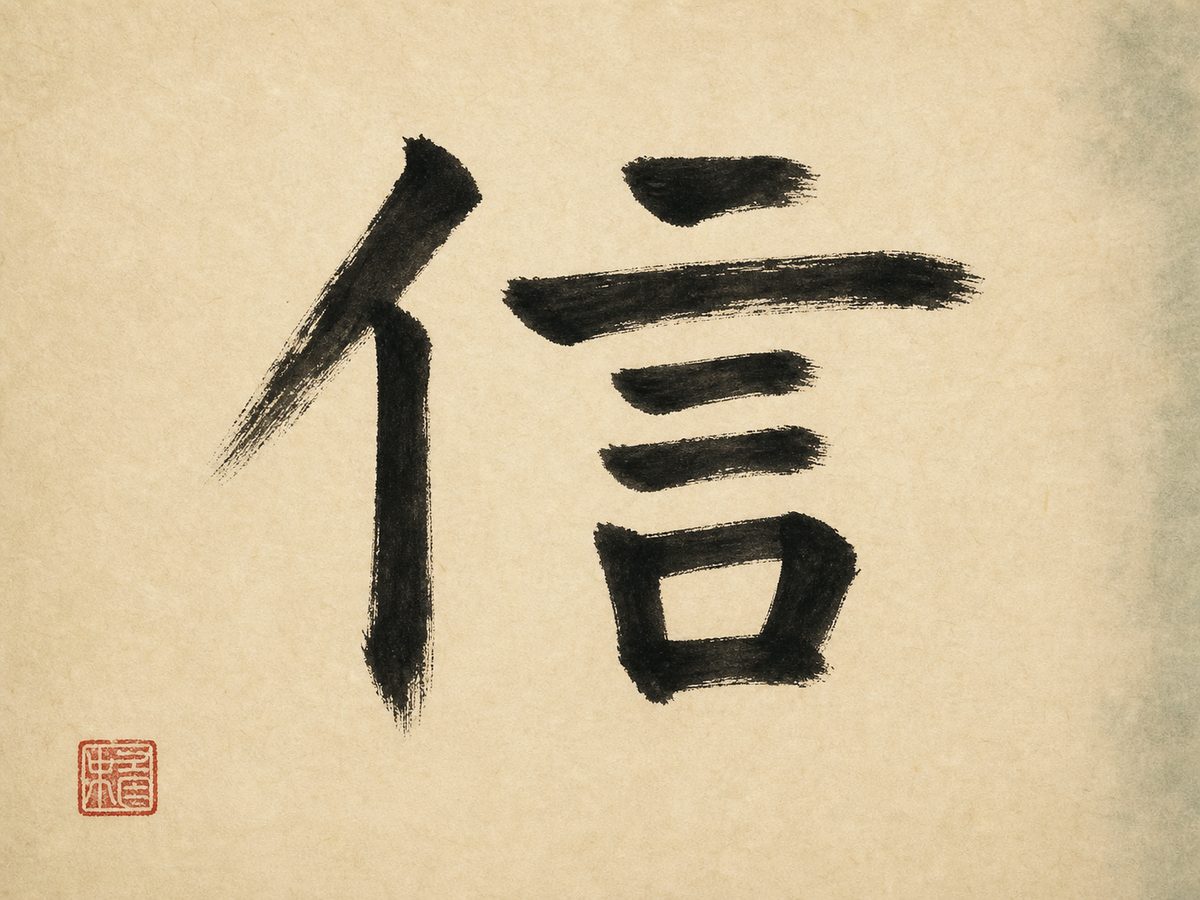
See 信 in seal, brush & cursive Try it
How it's written
Nine strokes, in two parts standing side by side. On the left, 亻, the compressed standing form of the character for a person, written as a short slanting stroke with a vertical dropping from its middle. On the right, 言, speech: a short mark on top, a long horizontal under it, two shorter horizontals stacked below that, and a small closed square, the mouth, at the bottom.
Two things worth knowing before you write it or wear it. First, 信 is identical in simplified and traditional Chinese. Nothing about it was simplified, so unlike righteousness or propriety there is no version to choose between and no way to pick the wrong one. Second, the four marks above the mouth are where mistakes happen. Three or five instead of four is not a stylistic liberty; it is a different character or no character at all.
Stroke order runs left component first, top to bottom, then the right component top to bottom, mouth last. If you want to see it built stroke by stroke in a real script rather than a font, our calligraphy generator will draw it in regular, running and cursive hands.
What it means
English uses "faith" for several different things, and Chinese does not. That is the single most useful fact on this page, so here it is as a table before anything else.
| What you actually mean | Chinese | Pinyin | What the Chinese says |
|---|---|---|---|
| Religious faith, belief in God, a creed you hold | 信仰 | xìnyǎng | Something you trust and look up to. This is the word for faith as a religion |
| Faith in a person, confidence they will not let you down | 信 | xìn | Your word is good. The single character, and the sense the Confucian virtue means |
| Trust, as a thing you place in someone | 信任 | xìnrèn | To trust and appoint. Trust with responsibility attached |
| To believe that something is true | 相信 | xiāngxìn | To believe. What you do with a claim, not with a person |
| A letter, the kind in an envelope | 信 | xìn | The same character. In daily Chinese this is its commonest job |
So the honest answer to "what is the Chinese symbol for faith" is that 信 is the right character and slightly the wrong word. It does not point upward at a god. It points sideways at other people, and it says that what you told them will hold. Xu Shen's dictionary glosses it in one word, chéng, which is sincerity in the sense of being actually the case rather than merely felt.
Faith, loyalty, and the character people confuse it with
The other virtue tattooed for roughly the same reasons is 忠, zhōng, and the two are not interchangeable. Zhong is loyalty: it runs upward and inward, to a ruler, a country, a cause, a person you have committed to. Xin runs outward and horizontally, to anyone at all, including strangers, and it is about the reliability of what you say. You can be loyal to someone and still lie to them. You cannot be xin and lie to anybody. If loyalty is what you are after, our loyalty page has that character.
- 信任 to trust someone, with responsibility attached
- 相信 to believe that something is true
- 信心 confidence, self-belief
- 信仰 religious faith, a creed (the two-character word English means by 'faith')
- 诚信 integrity, honesty in dealings
- 信用 credit, both the reputation and the banking sense
- 信封 envelope (from the letter sense of the character)
- 微信 WeChat, literally 'micro-message'
Idioms
- 言而有信“to speak and have trust”To keep your word; to be as good as what you said. (《论语·学而》)
- 一诺千金“one promise, a thousand gold”A promise worth more than money. From a proverb about the Han general Ji Bu, whose word was held to be worth more than a hundred catties of gold. (《史记·季布栾布列传》)
- 信誓旦旦“sworn vows, earnest and clear”Promises made in complete apparent sincerity. In modern use it is almost always faintly sour, because the original poem is spoken by a woman whose husband broke them. (《诗经·卫风·氓》)
- 尾生抱柱“Wei Sheng clasping the pillar”Keeping a promise to the death. Used both as praise and, following the passage it comes from, as a warning about stubbornness. (《庄子·盗跖》)
- 半信半疑“half believing, half doubting”Skeptical; not sure whether to buy it. The everyday modern idiom built on this character.
Right vs wrong forms
| Form | Type | Note |
|---|---|---|
| 信 | simplified ✓ | The standard form, and identical in traditional Chinese: nine strokes, 亻 beside 言, never simplified. The same character is used in Japanese, where it is read shin or makoto, and in Korean, where it is sin. |
| 言 | wrong | Not a variant of 信 but its right-hand half. This is what a cramped or badly copied design leaves behind when the person radical on the left is dropped or crushed. On its own 言 means 'speech' or 'words', which is a reasonable thing to have on you but is not what you asked for. |
| 㐰 | traditional | An archaic variant recorded in the dictionaries, written with a mouth rather than the full speech component. Of historical interest only; a modern Chinese reader will not recognize it, so it should never be tattooed or used in a design. |
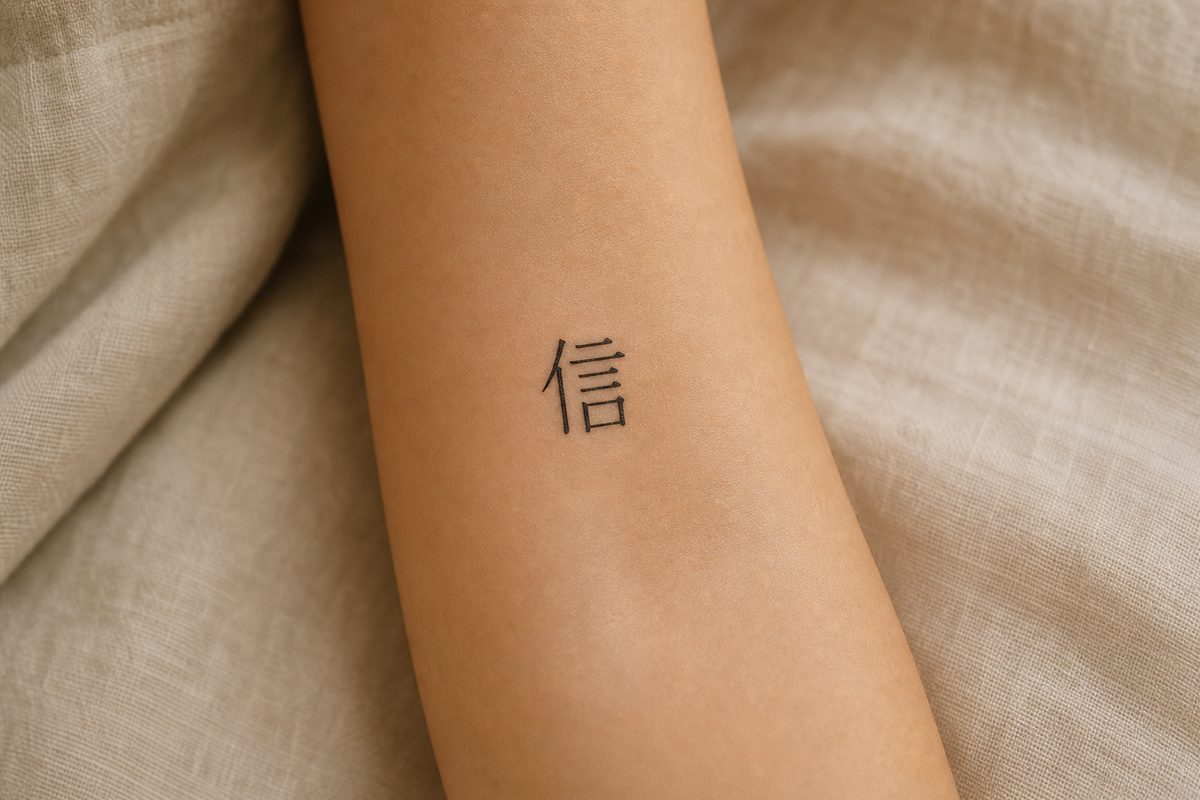
For a tattoo
This is a good tattoo character and an unusually low-risk one, with a single real caution.
The caution first. If what you mean is religious faith, a single 信 does not say it. A Chinese reader sees trustworthiness, reliability, or, depending on context, a letter. The word for faith as a creed is xìnyǎng, 信仰, two characters. If your meaning is closer to "I keep my word" or "I can be relied on", the single character is exactly right and is the stronger design. If your meaning is "I believe", get the two.
The good news. 信 is identical in simplified and traditional Chinese, so there is no version to choose and no chance of the mismatch that catches people with other virtue characters. It reads the same in Japanese, where it is shin, and in Korean. Nine strokes is a comfortable amount of detail: enough to look like something, not enough to blur.
What actually goes wrong. Two failure modes, both about the right-hand component. It needs exactly four marks above the mouth and a mouth that closes. Drop the left-hand person radical and you are left with 言, which means "speech" and is a different character. Shrink the whole thing below about three centimeters and the four marks start to merge as the ink spreads over the years; ask for a size that leaves clear white between them.
Vertical or horizontal both work, since it is a single character. Avoid mirroring it, which usually happens when a design is flipped to suit a placement, and check the stencil against the character rather than against a font on a screen. And if the artist has not written Chinese before, that is fine, but have someone who reads it look at the stencil, not the finished arm.
Before you commit to any character, the eight ways a Chinese tattoo goes wrong covers the failure modes that are not specific to this one, including the stroke-density arithmetic that decides whether a traditional form survives at small sizes.
Faith in life today
Mostly, it means mail
Here is the thing that would surprise anyone who has this tattooed as an abstract virtue. In everyday Chinese, 信 spends most of its working life meaning a letter. Xiě xìn is to write one, xìnfēng is the envelope, xìnxiāng is the mailbox. The sense goes back a long way: a message, and then the person carrying the message, and then the paper it was written on. Trust and correspondence are the same word because a letter is a promise you cannot take back once it is sealed.
Which leads somewhere unexpected. The app more than a billion people use to message their families is 微信, wēixìn, and it means, literally, "micro-message". Tencent released it in 2011, and by 2018 it was the largest standalone mobile app in the world. The character an American gets inked on a forearm for "faith" is, to most of the people who read it daily, the second half of the name of the app on their home screen. Neither reading is wrong. They are both what the word has always done: something said, carried to someone else, and expected to arrive intact.
Trust with a number on it
The other everyday life of this character is financial. Xìnyòng is credit, in the exact double sense English has: your reputation for paying, and the thing a bank extends to you on the strength of it. A credit card is a xìnyòng card. To lose xìn, shīxìn, is what a debtor does when the money does not arrive, and the phrase is ordinary commercial vocabulary rather than a moral flourish. Two and a half thousand years after Confucius used the word for the thing that holds a state together, it is printed on a plastic rectangle in your wallet.
As a name
Xin is a common element in given names, for both men and women, and it means what you would hope. It also carries into the two-character names built on it, where it usually pairs with a second character for a quality or a wish. If you want to see what your own name looks like built out of characters chosen for sound and sense, our name generator will make one.
Where the character comes from
Every English page about this character tells the same story, and it is a good story: 信 is a person standing next to their own words, so trust is what happens when a human being and what they said are in the same place. That reading is not invented. It comes from the Shuowen Jiezi, the first Chinese dictionary, compiled by Xu Shen around the year 100, and the entry is four words long: sincerity; from person, from speech; a compound ideograph.
What almost nobody adds is that modern scholarship does not agree. Read the character phonetically rather than pictorially and the left-hand person is not a picture at all but a sound: the reconstructions treat 信 as a phono-semantic compound, with 言 supplying the meaning and 人 supplying the pronunciation. Schuessler's 2007 dictionary minimally reconstructs the Old Chinese as sin. Sagart and Baxter go further and propose s-niŋ-s, derived with an s- prefix from another word entirely: 仁, rén, the benevolence that heads the same list of Five Constants.
Hold that lightly, because Old Chinese reconstruction is a field of competing systems and not a settled record. But if it holds, the first and the fifth of the Confucian virtues are not merely related in doctrine. They are the same word, one derived from the other, and the Han scholars who filed them at opposite ends of a five-part scheme were separating something that started out joined. The benevolence page has the other half of that pair.
The competing readings are not really a contradiction. Xu Shen was doing what a lexicographer of his era did, explaining a character by what its parts show; the reconstruction explains it by how it sounded. Both are on this page because a reader deciding whether to wear a character deserves to know that the beautiful version is the older account, not the last word.
History & roots
Why trustworthiness is the element earth
Three of the sibling pages on this site will tell you that in the Han dynasty scheme the Five Constants were mapped onto the five elements and trustworthiness went to earth. None of them says why, because the reason lives here.
In 79 CE the emperor Zhang summoned the empire's scholars to the White Tiger Hall to settle what the classics meant, and the record of that conference is where a great deal of this cosmology got fixed. On the virtues it is blunt. Xin, it says, is sincerity: single-minded and unmoving. Then it explains the assignment through the body, pairing each virtue with an organ and each organ with an element, and when it reaches this one the reasoning is worth quoting: earth takes on the nourishing of the ten thousand things, and it brings things to life with no partiality, and that is trustworthiness at its highest.
That is a real argument, not a filing decision. Fire is dramatic, water is clever, metal cuts, wood grows. Earth just holds still and treats everything the same, which is exactly what a person whose word is good does. And it is why this virtue sits at the center of the scheme rather than at one of the four compass points: the other four stand on it. The Black Tortoise holds the north for water and the White Tiger the west for metal, but earth has no quarter, because it is the floor.
A cart with no yoke-pin
Confucius made the case for this virtue with a piece of hardware.
In the Analects he says he does not know how a person without xin gets along, and then gives the image: a large cart with no crossbar for the yoke, a small cart with no fitting to attach the horses. Legge's translation has stood since the nineteenth century. What the image says is precise and slightly brutal. The yoke-pin is a small part. It is not the wheels, the axle, the bed or the oxen. It is the fitting that connects the animal to the load, and without it every other component can be flawless and the cart is furniture. A person can be clever, capable, well-read and generous, and if nothing they say can be relied on, none of it transmits.
It is a very Chinese way to argue for a virtue: not by describing the soul, but by pointing at a cart.
Give up the food first
The most severe thing said about xin in the tradition is a ranking.
Zigong asks about government and is told it needs three things: enough food, enough weapons, and the trust of the people. Asked what to drop if one has to go, Confucius says the weapons. Asked to drop one more, he says the food, and adds the line that has been quoted in Chinese political writing ever since: from of old, death has been the lot of all; but without the trust of the people there is no standing.
Read that slowly. He is not saying trust matters more than lunch as a figure of speech. He is saying a starving state that still believes its government is a state, and a fed state that does not is already over.
The pole at the market gate
Then there is the story of a man who did not believe any of that and had to buy trust anyway.
Shang Yang was the architect of the Qin reforms in the fourth century BCE, a Legalist with no patience for Confucian virtue talk, and Sima Qian records what he did before publishing his new laws. The laws were drafted but not yet posted, and he was afraid nobody would believe them. So he had a pole about three zhang long set up at the south gate of the capital market and announced that anyone who carried it to the north gate would be paid ten measures of gold. People thought it was strange and nobody moved it. He raised the offer to fifty. One man picked it up and carried it, and was paid fifty on the spot, which Sima Qian says was done to make clear that the state did not deceive. Only then were the laws issued.
The point is not the reward. The point is that even a government that despised the language of virtue could not operate without the substance of this one, and understood that credibility is not declared but purchased, once, in public, at a price that hurts.
The man who drowned keeping an appointment
The tradition also argued with itself about this, which is the part most pages leave out.
In the Zhuangzi there is a passage where Robber Zhi runs through the men the world calls virtuous and points out how each of them died. One of them is Wei Sheng, who arranged to meet a woman under a bridge. She did not come. The water rose. He would not leave, and he drowned holding onto one of the pillars.
The story is told admiringly in some later sources, and 尾生抱柱 became a set phrase for keeping a promise to the death. Zhuangzi is not telling it admiringly. He is asking what exactly was served by that, and whether a virtue held past the point of sense is still a virtue or just a man in a river. Both readings survive in Chinese, which is the honest state of the matter: xin is the constant the tradition most admired and the one it most suspected of turning into stubbornness. The same quarrel has run for fifteen hundred years over a drowned girl turned bird, Jingwei, whose vow to fill the sea one twig at a time Chinese poets have called foolish and magnificent by turns.
Questions people ask
What is the Chinese symbol for faith?
It is 信 (xìn), nine strokes, written identically in simplified and traditional Chinese. It puts the person radical 亻 beside 言, 'speech', and the Shuowen Jiezi, the first Chinese dictionary, glosses it in a single word: sincerity. It means trustworthiness, honesty and keeping your word, and it is the fifth of the Five Constants of Confucian ethics alongside benevolence, righteousness, propriety and wisdom.
Is the Chinese symbol for faith the same as religious faith?
No, and this is the one thing to get right before a tattoo. A single 信 means trustworthiness: that what you say can be relied on. Religious faith, the kind you hold in a god or a creed, is xìnyǎng, written with two characters, 信仰. A Chinese reader looking at a lone 信 will see reliability, or, in ordinary daily context, a letter in an envelope. If you want 'I keep my word', one character is right. If you want 'I believe', you need both.
What does xin mean in Chinese?
Xìn covers a connected family of meanings that English splits up: to trust, to believe, trustworthy, true or verifiable, and a letter or message. The thread running through all of them is something said that turns out to hold. That is why the same character appears in xìnrèn (to trust a person), xiāngxìn (to believe a claim), xìnyòng (credit) and xìnfēng (envelope), and why the Chinese name of WeChat, wēixìn, literally means 'micro-message'.
What is the Chinese symbol for trust?
The same character, 信 (xìn). For trust as a thing you place in a particular person, everyday Chinese uses the two-character word xìnrèn (信任), which adds a sense of entrusting someone with responsibility. Do not confuse either with 忠 (zhōng), loyalty, which is a different virtue: loyalty runs upward to a ruler, a country or a cause, while xin runs outward to anyone at all and concerns whether your word holds.
Is the Chinese symbol for faith a good tattoo?
Yes, with one caveat. It is identical in simplified and traditional Chinese, so there is no version to pick wrongly, and at nine strokes it is detailed without being fragile. The caveat is meaning rather than form: on its own it says trustworthiness, not religious faith, which is the two-character xìnyǎng. The most common design failure is the right-hand component, which needs exactly four marks above a closed mouth; anything much smaller than three centimeters will let those marks merge as the ink spreads.
Why is xin one of the Five Constants of Confucianism?
Because Confucian ethics treats reliability as structural rather than optional. In the Analects a person without xin is compared to a cart with no yoke-pin: every other part can be perfect and the thing still will not move. When Han scholars mapped the Five Constants onto the five elements at the White Tiger Hall conference of 79 CE, xin was assigned to earth, and the stated reason is that earth nourishes everything without partiality, which the record calls trustworthiness at its highest. That is why it sits at the center of the scheme rather than at one of the four compass directions.
Sources
- Wiktionary: 信 (glyph origin, the phono-semantic reading, Schuessler and Sagart-Baxter Old Chinese reconstructions, and the full sense list including 'letter')
- Shuowen Jiezi, the entry for 信 in the speech section (Chinese Text Project)
- Analects, Wei Zheng 2.22: a person without trustworthiness is a cart with no yoke-bar (Chinese Text Project, Legge translation)
- Analects, Xue Er 1.4 and 1.7: Zengzi's daily self-examination, and the line that became the idiom 言而有信 (Chinese Text Project, Legge translation)
- Analects, Yan Yuan 12.7: give up the weapons, then the food, but without the people's trust there is no standing (Chinese Text Project, Legge translation)
- Bai Hu Tong, Xing Qing: the Five Constants defined, and the reason trustworthiness is assigned to earth (Chinese Text Project)
- Records of the Grand Historian, Biography of Lord Shang: the pole at the south gate of the market and the fifty gold (Chinese Text Project)
- Records of the Grand Historian, Biographies of Ji Bu and Luan Bu: the proverb behind the idiom 一诺千金 (Chinese Text Project)
- Zhuangzi, Robber Zhi: Wei Sheng drowned holding the bridge pillar (Chinese Text Project, Legge translation)
- Book of Poetry, Mang: the line 信誓旦旦 and Legge's rendering of the broken vows (Chinese Text Project)
- WeChat, Wikipedia (released by Tencent in 2011; by 2018 the world's largest standalone mobile app, with over a billion monthly active users)
- Weixin and WeChat, Tencent's own product page
Make Faith your own
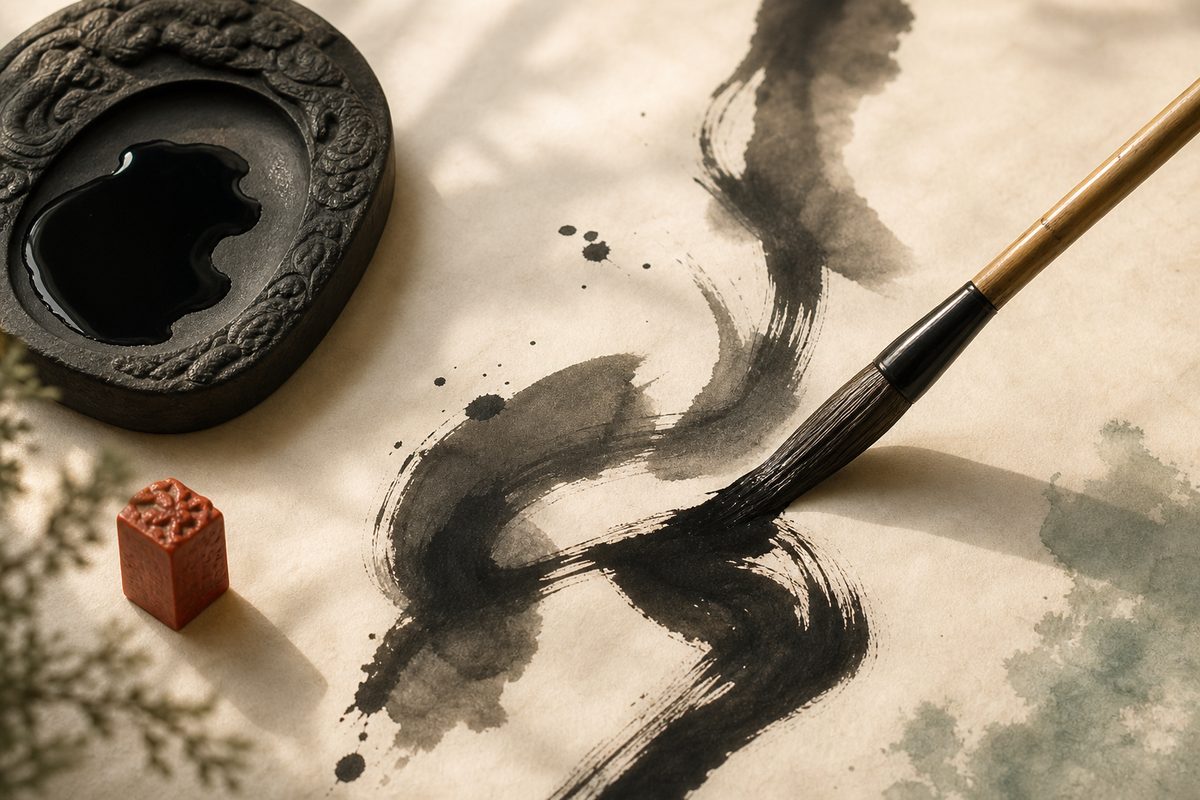
See 信 in calligraphy
From ancient seal script to flowing cursive. Pick a look before a tattoo or a card.
 Name
Name Get a Chinese name
A name matched to the sound of yours, with a meaning that fits.
Start yours Chinese Almanac
 Try the Chinese Gender Predictor
A different corner of Chinese culture: the old Qing-palace birth chart, worked out from your lunar birth date, with the math shown and its coin-flip odds honestly weighed.
Open the toolRelated: benevolence, righteousness, propriety, wisdom, loyalty
By Julian 祝君瑜, sourced from the classics and from modern life, updated 2026-09-30