Chinese Symbol
Chinese Symbol for Loyalty (忠): Meaning, Origin, and Yue Fei
The Chinese symbol for loyalty is 忠 (zhōng, said a little like "jong"), and it is built from two pieces you can read straight off: a "center" sitting on top of a "heart." A centered heart, one that does not tilt. For two and a half thousand years it has named the highest public virtue in Chinese life, the thing a minister owed his ruler and a general owed his country, right down to the most famous tattoo in Chinese history, four words cut into a soldier's back.
- Strokes
- 8
- Radical
- 心 (heart; Kangxi 61), sitting at the foot of the character
- Formation
- Phono-semantic compound (heart + 中 as the sound)
Trace 忠 yourself, or watch it drawn
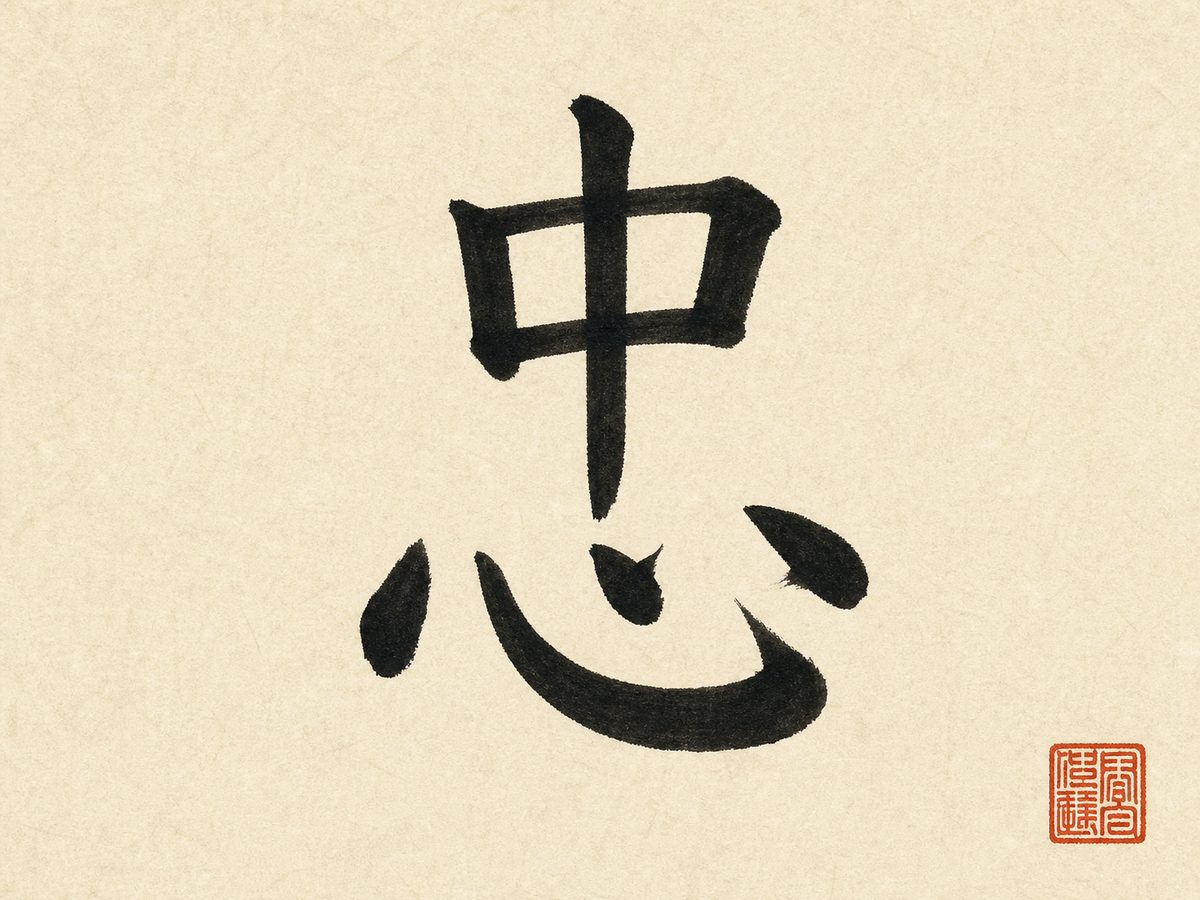
See 忠 in seal, brush & cursive Try it
How it's written
忠 is eight strokes in two clean halves. On top sits 中 (zhōng), "center" or "middle," a box with a line drawn straight through it, the same character that names the Middle Kingdom. Underneath sits 心 (xīn), "heart," the four-stroke pictograph of the organ that in Chinese does the work of both head and heart at once, the seat of thought and feeling alike. Read the two the way Chinese schoolchildren are taught to, and the whole character is a "centered heart": a heart held straight and true, not leaning to one side.
Strictly, scholars file it as a phono-semantic compound, with the heart supplying the meaning and 中 the sound. But the folk reading is so neat, and so close to what the word actually means, that almost everyone keeps it anyway. 忠 is written identically in simplified and traditional Chinese, so there is only ever one form to learn.
What it means
忠 (zhōng) is loyalty, but a particular kind, and it helps to know which. It is not the hot loyalty of a fan or a football crowd; it is the steady, dutiful loyalty of someone who gives their whole heart to a person, a ruler, or a cause and does not waver. From there it widens into devotion, faithfulness, and sincerity, the quality of being wholehearted in what you owe to others.
The character carries a moral weight that the English word "loyalty" only half catches. For most of Chinese history it was the cardinal public virtue, the one that held the state together, and it came paired with filial piety, 孝 (xiào), the virtue that held the family together. Loyalty upward to the country, devotion inward to the parents: between them they covered a person's whole duty. And the two could collide. The classic Chinese name for an impossible choice is the saying that loyalty and filial piety can rarely both be kept whole, the cruel bind of a person called at once to serve the state and to care for aging parents.
- 忠诚 loyalty, fidelity, faithfulness (the everyday abstract noun)
- 忠实 faithful, loyal, true (忠实粉丝, a loyal fan)
- 效忠 to pledge allegiance; to serve loyally
- 忠臣 a loyal official or minister (opposite of 奸臣, a traitor)
- 忠告 sincere advice (literally 'loyal telling')
- 忠孝 loyalty and filial piety, the two great Confucian duties
- 忠犬 a loyal dog; a faithful, devoted person
- 忠贞 loyal and steadfast, especially in love or principle
- 尽忠 to do one's utmost in loyalty; to die for one's country
- 忠厚 honest, sincere, and kind-hearted
Idioms
- 忠言逆耳“loyal words grate on the ear”honest, well-meant advice is unpleasant to hear but good for you. (《史记·留侯世家》, where Zhang Liang advises Liu Bang)
- 精忠报国“pure loyalty, repay the country”to serve one's country with utmost, unswerving loyalty. (associated with Yue Fei; the History of Song records his actual tattoo as 尽忠报国)
- 赤胆忠心“a red gall and a loyal heart”wholehearted, utterly sincere loyalty and devotion.
- 忠心耿耿“a loyal heart, bright and steadfast”loyal and devoted, unwaveringly faithful.
- 忠贞不渝“loyal and steadfast, never changing”faithful and unwavering, whether in love or in duty.
Right vs wrong forms
| Form | Type | Note |
|---|---|---|
| 忠 | simplified ✓ | The standard form everywhere, identical in simplified and traditional Chinese: eight strokes, 中 (center) stacked over 心 (heart). It was never simplified, so there is only one form to learn. |
| 中 (heart dropped) | wrong | Not a variant, but the classic slip. Drop the heart 心 from the bottom and you are left with 中 (zhōng), 'center/middle,' the phonetic component and a completely different, very common word (as in the name for China itself). 忠 must always keep its heart. |
| 忠 (mirrored or rotated) | mirrored | Not a variant. A flipped or rotated 忠 from a low-resolution stencil reads as an error to anyone literate. Check against a dictionary at full size before inking. |
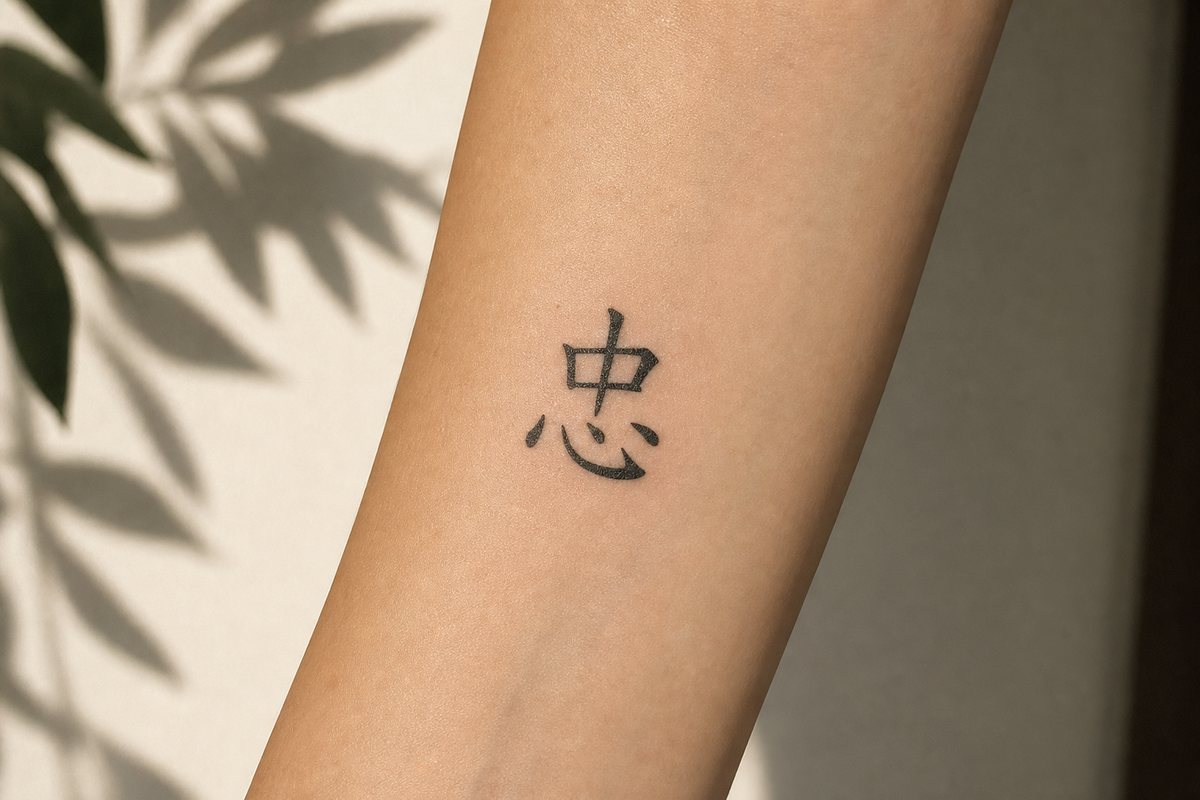
For a tattoo
忠 is a natural tattoo, and it comes with the finest pedigree any Chinese character can offer: the most famous tattoo in Chinese history, Yue Fei's four-character vow to serve his country, was built on it. As a single character it reads cleanly as "loyalty," with a quiet undertone of "devotion" and "faithfulness" a Chinese reader will feel.
A few things to weigh. It is eight strokes in a top-and-bottom stack, center over heart, so at small sizes keep the heart at the base open and legible rather than letting it clot into a dark blob. Some people ink Yue Fei's full four-character phrase down the spine or forearm as a direct homage; it is powerful, but it reads to any Chinese speaker as that specific historical quote, so mean it. And decide who the loyalty is to. To a Chinese eye this character leans public and dutiful, loyalty to a country, a lord, or a cause, more than romantic fidelity, for which the two-character word for steadfast faithfulness, zhōngzhēn, or simply the character for love may fit better. As always, print it at full size and have someone who reads Chinese confirm the design before the needle comes out.
Before you commit to any character, the eight ways a Chinese tattoo goes wrong covers the failure modes that are not specific to this one, including the stroke-density arithmetic that decides whether a traditional form survives at small sizes.
Loyalty in life today
Loyalty you can buy a subscription to
The everyday modern word is zhōngchéng, loyalty or fidelity, and it has slid comfortably into the language of business and dating. Companies chase your brand loyalty; an app wants loyal users; a singer thanks their loyal fans. A faithful partner has it; a cheating one does not. What is nice is that the word kept its seriousness even as it went commercial. To call someone loyal, in this old and heavy sense, is still a real compliment, not a throwaway.
The most loyal dog in the world
Chinese has a lovely compound, zhōngquǎn, "loyal dog," and the most famous loyal dog of all is not Chinese at all. The Akita who waited nine years at a Tokyo station for a master who had already died is known across the Chinese internet as loyal-dog Hachikō, a byword for devotion that outlasts everything. From there the phrase leapt into fiction as a character type: the loyal-dog love interest, usually a man, is the one who is faithful to a fault, patient, steadfast, and just a little heartbreaking.
Pledging allegiance
The political charge never fully left. The formal word for pledging allegiance, to a country, a leader, a flag, is xiàozhōng. A loyal official, zhōngchén, is the hero of a thousand Chinese historical dramas, forever set against the scheming traitor whispering in the emperor's ear. And the ordinary word for sincere, well-meant advice, zhōnggào, means literally "loyal telling," the kind a true friend gives you even when you would rather not hear it. Loyalty is a common thread in men's given names too, a parent quietly wishing the virtue onto the child.
Curious what your own name becomes in Chinese, matched to its sound and a good
meaning? Our Chinese name generator builds one for you.
Where the character comes from
The oldest dictionary is brisk about it. The Shuowen Jiezi, compiled around the year 100, glosses 忠 in a single word, reverence (敬), and notes that it is built from the heart with 中 for the sound. So at the character's first written definition, loyalty and reverence are already the same feeling: an attitude of the heart, not a contract.
What is striking is how much the word narrowed over time. In its earliest and highest use, in the mouth of Confucius, it did not mean "loyalty to a ruler" at all. It meant doing your absolute utmost for other people, conscientiousness, giving of yourself completely. When Confucius's disciple Zengzi boiled the whole of the master's teaching down to two ideas in the Analects, he chose 忠恕: to exhaust yourself for others, and to extend yourself to others, reciprocity. Loyalty here is not obedience; it is wholeheartedness. Only later, as the imperial state grew and grew, did the word harden toward the narrow political sense, loyalty to the throne, that most people reach for first today.
History & roots
The four words on Yue Fei's back
The most famous tattoo in Chinese history is a loyalty tattoo. Yue Fei (1103 to 1142) was a Song-dynasty general fighting to hold the north against Jin invaders when he was recalled, framed, and executed on false charges by the minister Qin Hui. According to the official History of Song, when Yue Fei was interrogated he tore open his robe to show the questioner his back, where four characters had been cut deep into the skin: 尽忠报国, jìn zhōng bào guó, "serve the country with utmost loyalty." Those words, and that spine of loyalty to the state above his own life, made Yue Fei the eternal model of the virtue and Qin Hui the eternal traitor, still spat at in effigy nine centuries later.
Two things most retellings get wrong, and a Chinese reader will catch them. First, the popular form of the phrase is jīng zhōng bào guó, "pure loyalty," which comes not from the tattoo but from a banner the emperor personally brushed for him; the words actually cut into his back began with jìn, "utmost." Second, the beloved scene of Yue Fei's mother stitching the characters into his skin herself appears nowhere in the histories. It was invented centuries later, in a Qing-dynasty novel; the older records simply say Yue hired a tattooist. The loyalty was real. The tender bedside tableau is fiction.
Loyalty that talks back
Chinese never let the virtue mean blind obedience, and it has a proverb to prove it. One of the most common sayings about honest advice, zhōng yán nì ěr, means "loyal words grate on the ear," and it travels with a line about medicine: good medicine tastes bitter but cures the illness; loyal words grate on the ear but improve the conduct. A version of it is preserved in Sima Qian's Records of the Grand Historian, where the strategist Zhang Liang uses it to talk a victorious warlord out of looting a captured palace. True loyalty, in the Chinese view, is the friend or minister brave enough to tell you what you do not want to hear.
The red heart of the doomed
Even loyalty in defeat has its poem. When the Song loyalist Wen Tianxiang was captured by the Mongols and refused, under every pressure, to change sides, he wrote a couplet every Chinese schoolchild still learns, ending on the image of a loyal cinnabar-red heart he would keep to light the pages of history even after the cause was already lost. Kublai Khan offered him high office; Wen answered that a minister of Song could not serve another dynasty, and was executed rather than bend. The poem outlived the throne he died for.
The god of loyalty
Loyalty is the one virtue that got its own god. Guan Yu, a general of the Three Kingdoms famous for turning down wealth and rank to return to his sworn brother, was worshipped after death as the deified embodiment of loyalty and righteousness. His red-faced statue still stands in temples, in shops, in police stations, and, notoriously, in the back rooms of gangsters, both sides burning incense to the same virtue. That a culture would raise loyalty into a deity, and that cops and criminals would agree on him, tells you how near the center of the moral world it sits.
Questions people ask
What is the Chinese symbol for loyalty?
It is 忠 (zhōng), an eight-stroke character made of a 'center' (中) stacked over a 'heart' (心), read as a centered heart, a heart held straight and true. It means loyalty, devotion, and faithfulness, and for most of Chinese history it was the highest public virtue. It is written identically in simplified and traditional Chinese.
How do you write loyalty in Chinese?
The single character is 忠 (zhōng), written with 中 (center) on top and 心 (heart) on the bottom, eight strokes in all. The everyday abstract noun 'loyalty' is zhōngchéng (忠诚). It is pronounced zhōng, roughly 'jong,' in the first (high, level) tone.
Is 忠 a good tattoo?
Yes, and it has the best pedigree of any Chinese character: the most famous tattoo in Chinese history, the Song general Yue Fei's four-character vow to serve his country with utmost loyalty (尽忠报国), was built on it. As a single character 忠 reads as 'loyalty' with an undertone of devotion. Note that it leans toward public, dutiful loyalty rather than romantic fidelity, and always verify the design at full size.
What is the difference between loyalty (忠) and filial piety (孝)?
忠 (zhōng) is loyalty directed outward and upward, to a country, ruler, or cause; 孝 (xiào) is filial piety, devotion to one's parents and ancestors. Together they were seen as covering a person's entire duty in traditional Chinese ethics, and a famous saying holds that loyalty and filial piety can rarely both be kept whole, naming the tragic clash between serving the state and caring for family.
Where does the character 忠 come from?
The Shuowen Jiezi (around the year 100) glosses 忠 as 'reverence,' built from the heart with 中 for the sound. In its earliest use, by Confucius, it meant wholehearted conscientiousness, doing one's utmost for others (paired with reciprocity as 忠恕). Only later, under the empire, did it narrow toward loyalty to the ruler.
Sources
- Wiktionary: 忠 (structure 中+心, phono-semantic, meanings, Confucian usage)
- Shuowen Jiezi entry for 忠: 敬也,从心中聲 (hancibao.com)
- Analects 3.19 (八佾): 君使臣以禮,臣事君以忠 — loyalty is reciprocal (ctext.org)
- Analects 4.15 (里仁): 夫子之道,忠恕而已矣 — 忠 as wholehearted conscientiousness (ctext.org)
- Yue Fei and the 尽忠报国 tattoo; the mother-tattoo legend from Shuo Yue Quanzhuan (Wikipedia)
- Records of the Grand Historian, House of Marquis Liu: 忠言逆耳利於行 (ctext.org)
- Wen Tianxiang and 過零丁洋: 留取丹心照汗青 — the loyal heart in defeat (Wikipedia)
Make Loyalty your own
See 忠 in calligraphy
From ancient seal script to flowing cursive. Pick a look before a tattoo or a card.
 Name
Name Get a Chinese name
A name matched to the sound of yours, with a meaning that fits.
Start yours Chinese Almanac
 Try the Chinese Gender Predictor
A different corner of Chinese culture: the old Qing-palace birth chart, worked out from your lunar birth date, with the math shown and its coin-flip odds honestly weighed.
Open the toolRelated: courage, family, friendship, strength
By Julian 祝君瑜, sourced from the classics and from modern life, updated 2026-07-23