Chinese Symbol
Chinese Symbol for Wisdom (智): Meaning, Origin, and the Water Element
The Chinese symbol for wisdom is 智 (zhì, said like "jr" on a falling tone), twelve strokes that stack "to know" on top of "sun." It is one of the five cardinal virtues of Confucianism, the one Mencius said begins the moment you can tell right from wrong. It is also, unexpectedly, the character inside the modern Chinese words for smartphone, IQ, and artificial intelligence.
- Strokes
- 12
- Radical
- 日 (sun; Kangxi 72)
- Formation
- Phono-semantic compound (形声), with 知 supplying both the sound and the sense
Trace 智 yourself, or watch it drawn
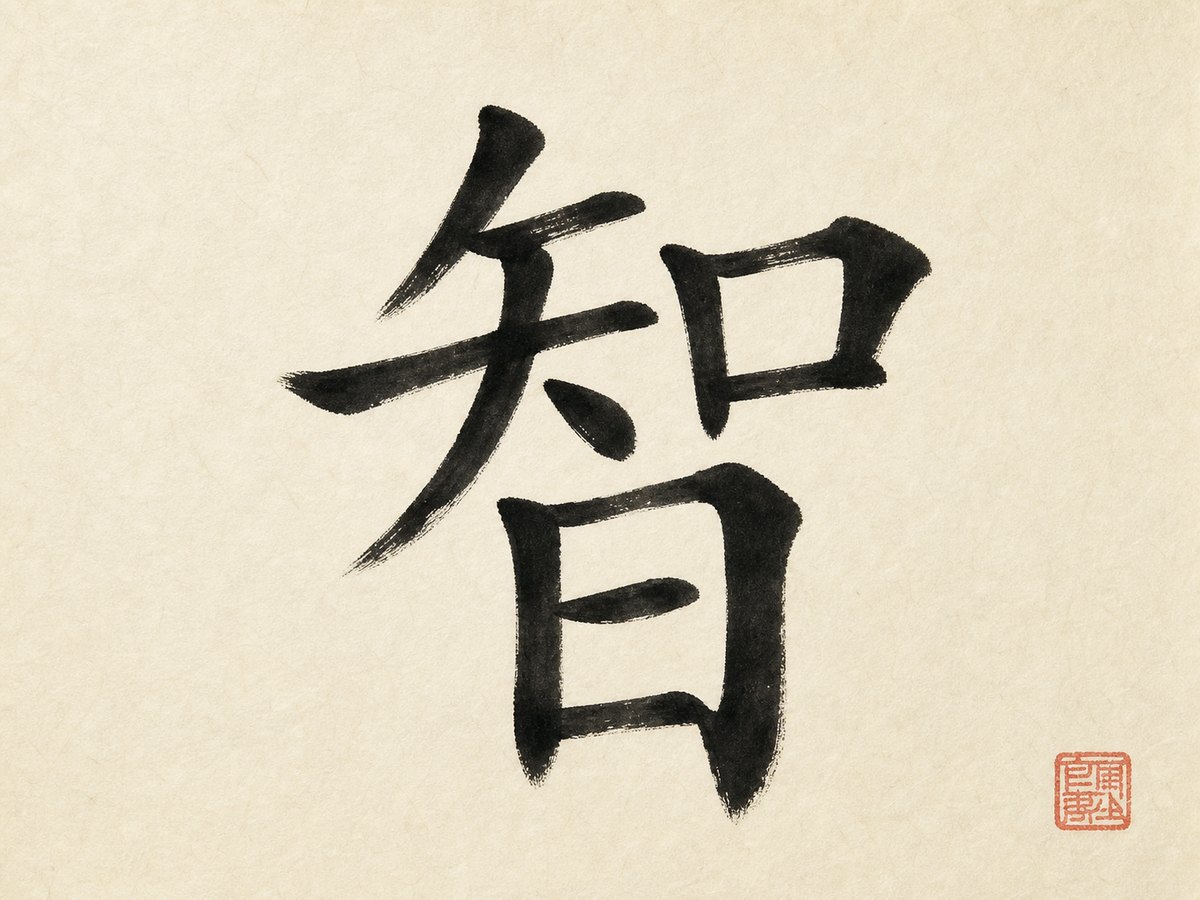
See 智 in seal, brush & cursive Try it
How it's written
智 is built in two floors. The upper floor is 知 (zhī), "to know," which is itself two parts: 矢 on the left, an arrow, and 口 on the right, a mouth. The lower floor is 日, the sun, a rectangle with a bar through it, one of the first characters anyone learns.
The arrow and the mouth are not decoration. The Shuowen Jiezi, the first Chinese dictionary, defines 知 as speech, and its great Qing-dynasty commentator Duan Yucai explains the arrow: understanding is quick, so what leaves the mouth of someone who understands flies out as fast and as straight as an arrow. Knowing, in the oldest reading of the character, is measured by how fast you can say the answer.
Then 智 puts all of that under the sun. Whether the sun is doing semantic work (knowledge brought into daylight) or is a worn-down form of 曰, "to say," is a question specialists still argue about, and anyone who tells you flatly that 智 means "the sun of knowledge" is selling you a mnemonic rather than a history. The mnemonic is a good one. It just is not evidence.
The character is written identically in simplified and traditional Chinese. Stroke order runs 矢 first, then 口, then 日 last, top-left to bottom.
What it means
智 (zhì) is wisdom in the practical sense: good judgment, the ability to see a situation clearly and act well in it. It is not learning, and it is not cleverness. Chinese keeps three words carefully apart here, and English blurs all three into one.
| Character | Reading | What it actually is |
|---|---|---|
| 知 | zhī | To know. Facts, information, awareness that something is the case. |
| 智 | zhì | Wisdom. Judgment applied to what you know. |
| 慧 | huì | Quick insight, the flash of understanding. Arrived with Buddhism. |
The modern word for wisdom, 智慧 (zhìhuì), simply welds the last two together: steady judgment plus quick insight. And 智 sits fourth in the wǔcháng, the Five Constants of Confucian ethics, the moral spine of Chinese culture for two thousand years: benevolence, righteousness, propriety, wisdom, and trustworthiness. In that scheme wisdom is a duty, ranked alongside honesty, and a person can fail at it the way they can fail at telling the truth.
- 智慧 wisdom (the everyday modern word)
- 智能 intelligence; 'smart' as a product prefix
- 人工智能 artificial intelligence (literally 'man-made wisdom-ability')
- 智商 IQ (literally 'wisdom quotient')
- 机智 quick-witted, resourceful
- 明智 sensible, judicious (literally 'bright-wise')
- 智力 mental ability, intellect
- 智库 think tank (literally 'wisdom storehouse')
- 智齿 wisdom tooth
- 益智 brain-training; educational, as of a puzzle or toy
Idioms
- 大智若愚“great wisdom appears foolish”the truly wise do not display it; deep understanding can look like slowness. Often misattributed to Laozi, whose chapter 45 supplies the pattern but not this line. (Su Shi, letter to Ouyang Xiu on his retirement (11th century))
- 智者千虑,必有一失“the wise, thinking a thousand times, must still have one loss”nobody is right about everything; even the best judgment fails somewhere, so listen to other people. (Sima Qian, Records of the Grand Historian, Biography of the Marquis of Huaiyin)
- 足智多谋“ample in wisdom, rich in schemes”highly resourceful; the standard compliment for a strategist.
- 急中生智“in the crisis, wisdom is born”to think of a way out under pressure; the flash of an idea when you have no time left.
- 仁者见仁,智者见智“the benevolent see benevolence, the wise see wisdom”people read the same thing differently according to what they are; a polite way to say we will have to disagree. (Book of Changes, Great Commentary)
Right vs wrong forms
| Form | Type | Note |
|---|---|---|
| 智 | simplified ✓ | The standard form, and identical in traditional Chinese: twelve strokes, 知 over 日, never simplified. Same character in Japanese and Korean, where it is read tomo/chi and ji. |
| 知 | wrong | Not a variant of 智 but the top half of it, and the mistake a cramped tattoo makes on its own. 知 means 'to know', i.e. facts and awareness, rather than wisdom. If the 日 at the base is crushed or dropped, the word changes. Keep the bottom square and open. |
| 𣉻 | traditional | The archaic form the Shuowen Jiezi actually describes, built from three components rather than two. Of scholarly interest only; it is unreadable to a modern Chinese speaker and should never be tattooed or used in design. |
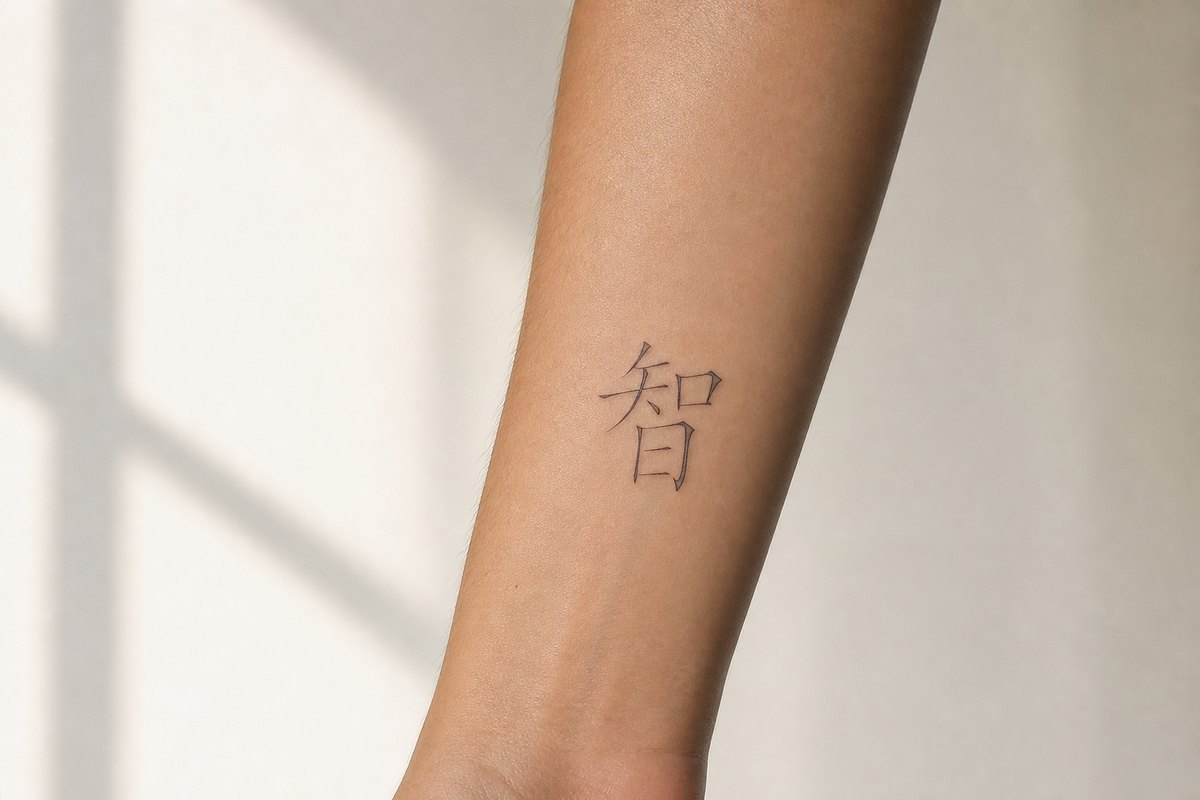
For a tattoo
智 is a strong, uncommon choice for a tattoo, and it is a much better one than the vague English "wisdom" suggests: it carries a specific, sourceable philosophical claim, that wisdom is moral discernment rather than cleverness. It is identical in simplified and traditional Chinese, so there is no fork to choose between.
The one thing to watch is the bottom. 智 at twelve strokes wants vertical space, and a design squeezed into a narrow band tends to crush the 日 at the base until it disappears — at which point you are wearing 知, "to know," which is a different and considerably weaker word. Insist on enough height, keep the sun square and open rather than a filled blob, and check the finished stencil at full size.
If you want more than one character, the natural pair is 智慧 (zhìhuì), the ordinary modern word for wisdom, which reads as completely normal Chinese rather than as a foreigner's single-character tattoo. And as with any character you cannot yet read, have a Chinese reader confirm the design before the needle comes out.
Before you commit to any character, the eight ways a Chinese tattoo goes wrong covers the failure modes that are not specific to this one, including the stroke-density arithmetic that decides whether a traditional form survives at small sizes.
Wisdom in life today
The character inside artificial intelligence
If you want to know how alive an old character is, look at what a technology company does with it. 智 is now the standard Chinese morpheme for "smart," and it is everywhere. Artificial intelligence is réngōng zhìnéng, literally "man-made wisdom-ability." A smartphone is a zhìnéng shǒujī, a "wisdom-ability hand-machine." Smart cities, smart homes, smart locks, smart driving: zhìnéng in front of all of them. A think tank is a zhìkù, a "wisdom storehouse." Your IQ is your zhìshāng, your "wisdom quotient."
So a character Mencius used for the moral capacity to tell right from wrong is now stamped on the box of every internet-connected rice cooker in China. Mencius was a contemporary of Aristotle, which puts that journey at roughly the distance from the Lyceum to the iPhone, carried the whole way by the same twelve strokes. Nobody finds this strange.
Wisdom teeth, in every language apparently
Chinese calls the third molars zhìchǐ, "wisdom teeth," for exactly the reason English does: they arrive in your late teens or twenties, when you are supposedly old enough to have acquired some. Two cultures, no contact, same joke.
A name, and a wish
智 is a common element in given names, particularly for boys, and it carries into Japanese and Korean names as well, where the same character is read tomo or chi and ji. A parent choosing it has judgment in mind: the hope that the child will see a situation clearly and choose well in it.
Curious what your own name could look like in Chinese, matched for both sound and
meaning? Our Chinese name generator builds one for you.
Where the character comes from
The Shuowen Jiezi, compiled around the year 100, does not describe the character we write today. Its entry is for an older form built from three parts rather than two, and it glosses the word as shìcí, roughly "a word of discernment." Duan Yucai's commentary then says the thing that unlocks half of classical Chinese: 智 and 知 had the same sound and the same meaning, and the two were used interchangeably.
That is not a footnote. It means that when you read a classical text and see 知, you cannot assume it means "know" — it may well mean "wise." The most famous case in the language sits in the Analects, and we come back to it below. Which of the two characters came first is genuinely disputed among Chinese paleographers; some argue 知 is an abbreviation of 智, others the reverse. The honest answer is that they separated slowly, over the Warring States period, into the division a modern reader takes for granted.
History & roots
Wisdom begins with knowing right from wrong
The single most important thing anyone ever said about 智 in Chinese is Mencius's, and it is short. Laying out the four innate moral sprouts he believed every human is born with, he assigns one feeling to each virtue, and to wisdom he assigns this: shìfēi zhī xīn, zhì zhī duān yě. In James Legge's translation, "the feeling of approving and disapproving is the principle of knowledge." Compassion is the seed of benevolence, shame the seed of righteousness, deference the seed of propriety, and the sense of right and wrong is the seed of wisdom.
Note what this does. It cuts wisdom loose from cleverness entirely. In the Confucian scheme, the wise person is not the one who calculates fastest but the one whose moral discrimination works: who can look at a situation and see which part of it is right. A brilliant swindler, on this definition, has no 智 at all.
Why wisdom belongs to water
Here is the thing almost no English page about this character will tell you. In Han-dynasty cosmology the Five Constants were mapped onto the Five Elements, and wisdom was assigned to water: the north, winter, the color black, and the kidneys. Benevolence went to wood, righteousness to metal, propriety to fire, and trustworthiness to earth.
This mapping was fought over. Dong Zhongshu, the Han thinker who did most to fuse Confucianism with five-phase cosmology, put wisdom with fire and the south. The Qian Zuo Du, an apocryphal classic, put it with earth and the center. The version that stuck was settled by committee. In 79 CE the Han emperor Zhang gathered the empire's senior scholars in the White Tiger Hall and chaired the argument himself: a room of the most learned men alive, convened by the throne, to decide which element wisdom belonged to. They gave it to water. It has stayed there ever since, which is why a bazi chart heavy in water gets read as a clever, adaptable person.
And it is why Confucius, in the Analects, could say what he said about the wise and water — a line so well known that we have given it its own treatment on the water page. One detail nobody mentions, though: in the received text of the Analects, that line is written with 知, not 智. The two characters had not yet parted company. The most quoted sentence in Chinese about the wise does not contain the character for wisdom.
Great wisdom looks like stupidity
The best-loved thing Chinese says about intelligence is that it hides. Dà zhì ruò yú, "great wisdom appears foolish," is the compliment paid to the person who says little, claims nothing, and turns out to have understood everything. You will very often see this attributed to Laozi. It is not his. The line belongs to Su Shi, the Song-dynasty poet, who wrote it in a congratulatory letter to the retiring statesman Ouyang Xiu, praising him with the pair "great courage looks like timidity, great wisdom looks like foolishness."
What Su Shi was doing was applying a much older pattern. Chapter 45 of the Dao De Jing runs through it: great straightness looks bent, great skill looks clumsy, great eloquence sounds like a stammer. Laozi supplied the shape; Su Shi, a thousand years later, slotted wisdom into it, and the phrase he made has outlived the letter it came from.
There is a companion proverb with the opposite bedside manner. "Even the wise, thinking a thousand times, will make one mistake" comes from Sima Qian's Records of the Grand Historian, where a captured strategist offers it to the general Han Xin before giving him advice. The full version continues: and even a fool, thinking a thousand times, will get one thing right. It is the most sensible sentence in classical Chinese about listening to people less clever than you.
The man who became the word
Every culture picks one person to mean "intelligence," and China picked Zhuge Liang, the third-century chancellor of Shu Han who has been the national shorthand for strategic brilliance for seventeen centuries. When the Qing critic Mao Zonggang wrote his commentary on the Romance of the Three Kingdoms, he named three characters as the novel's three superlatives: Cao Cao the supreme schemer, Guan Yu the supreme man of honor, and Zhuge Liang the supreme intellect. The label stuck so hard that "you're a real Zhuge Liang" is still a compliment, "A Zhuge Liang after the fact" is still what Chinese calls the person who explains what everyone should have done once it is over.
Questions people ask
What is the Chinese symbol for wisdom?
It is 智 (zhì), twelve strokes, written identically in simplified and traditional Chinese. It stacks 知 ('to know') on top of 日 ('sun'), and it means wisdom in the sense of good judgment rather than knowledge or cleverness. It is one of the Five Constants of Confucian ethics, alongside benevolence, righteousness, propriety, and trustworthiness.
What is the difference between the Chinese characters for wisdom and knowledge?
知 (zhī) is knowledge: facts, information, being aware that something is the case. 智 (zhì) is wisdom: judgment applied to what you know. The two were once the same word and were used interchangeably in classical Chinese, which is why the famous line in the Analects about the wise loving water is written with 知. They separated during the Warring States period. A third character, 慧 (huì), covers quick insight and arrived with Buddhism; the modern word 智慧 combines the last two.
Is the Chinese symbol for wisdom a good tattoo?
Yes, and a less common one than strength or love, which works in its favor. It is identical in simplified and traditional Chinese, so there is no version to choose between. The one risk is vertical crowding: 智 needs height, and if the 日 at the bottom gets squeezed away you are left wearing 知, 'to know,' a different and weaker word. Give it room, keep the base square and open, and have a Chinese reader check the stencil at full size.
What does the Chinese symbol for wisdom have to do with water?
In Han-dynasty cosmology the five Confucian virtues were mapped onto the Five Elements, and wisdom was assigned to water, along with the north, winter, and the color black. That assignment was disputed for a century before it was settled at the White Tiger Hall conference of 79 CE. It is the reason Confucius could pair the wise with water in the Analects, and the reason a water-heavy Chinese birth chart is read as clever and adaptable.
Is 'great wisdom appears foolish' a saying of Laozi?
No, though it is constantly credited to him. 大智若愚 was written by Su Shi in the eleventh century, in a letter congratulating the statesman Ouyang Xiu on his retirement. Su Shi was applying a pattern that does come from Laozi: chapter 45 of the Dao De Jing says great straightness looks bent, great skill looks clumsy, and great eloquence sounds like a stammer. Laozi supplied the shape, Su Shi supplied the line.
Why is the Chinese character for wisdom used for artificial intelligence?
智 became the standard Chinese morpheme for 'smart' in technology. Artificial intelligence is 人工智能 (réngōng zhìnéng), literally 'man-made wisdom-ability,' and the same 智能 prefix marks smartphones, smart homes, and smart cities. Your IQ is your 智商, 'wisdom quotient,' and a think tank is a 智库, a 'wisdom storehouse.' The Confucian virtue and the product label are the same character.
What is the Asian symbol for wisdom?
A Chinese character, 智 (zhì). No script spans Asia, so an Asian symbol is not something that can be looked up; what English means by the phrase is a Chinese character nearly every time. For this word specifically, 智 is one half of the ordinary two-character word 智慧 (zhìhuì). 智 leans toward quickness and sound judgment, 慧 toward insight. A single-character design picks one of the two and gives up the other.
Sources
- Wiktionary: 智 (composition, readings, senses)
- Shuowen Jiezi entry for 智, with Duan Yucai's commentary that 智 and 知 shared sound and meaning (hancibao.com)
- Mencius, Gongsun Chou I: 'the feeling of approving and disapproving is the principle of knowledge' (Chinese Text Project, Legge)
- The Analects, Yong Ye: the wise find pleasure in water, written with 知 (Chinese Text Project, Legge)
- Dao De Jing, chapter 45: great skill looks clumsy, the pattern behind 大智若愚 (Chinese Text Project, Legge)
- 大智若愚: attributed to Su Shi's letter to Ouyang Xiu, not to Laozi (Baidu Baike)
- Wuxing (Five Phases): the Han mapping of the Five Constants onto the five elements
- Bai Hu Tong (the White Tiger Hall discussions of 79 CE): the imperial conference that fixed the five-phase correspondences
- Mao Zonggang's Three Kingdoms commentary naming Zhuge Liang the supreme intellect of the novel
Make Wisdom your own
See 智 in calligraphy
From ancient seal script to flowing cursive. Pick a look before a tattoo or a card.
 Name
Name Get a Chinese name
A name matched to the sound of yours, with a meaning that fits.
Start yours Chinese Almanac
 Try the Chinese Gender Predictor
A different corner of Chinese culture: the old Qing-palace birth chart, worked out from your lunar birth date, with the math shown and its coin-flip odds honestly weighed.
Open the toolRelated: benevolence, water, listening, patience, strength
By Julian 祝君瑜, sourced from the classics and from modern life, updated 2026-08-02