Chinese Symbol
Chinese Symbol for Honor (荣): Meaning, Origin, and Tattoo
The Chinese symbol for honor is 荣 (róng, rhymes with "song"), and it is a tree in full bloom. The oldest Chinese dictionary defines it as the parasol tree, the one the phoenix lands on, and the character still keeps a tree at its root. Honor in Chinese is flourishing so visibly that everyone can see it, and its opposite is not shame but disgrace, a pairing that runs from Mencius to the phone in your pocket.
- Strokes
- 9
- Radical
- 艹 (grass; Kangxi 140), the three strokes across the top
- Formation
- Phono-semantic compound (a tree, with an abbreviated 'glimmering lights' for the sound)
Trace 荣 yourself, or watch it drawn
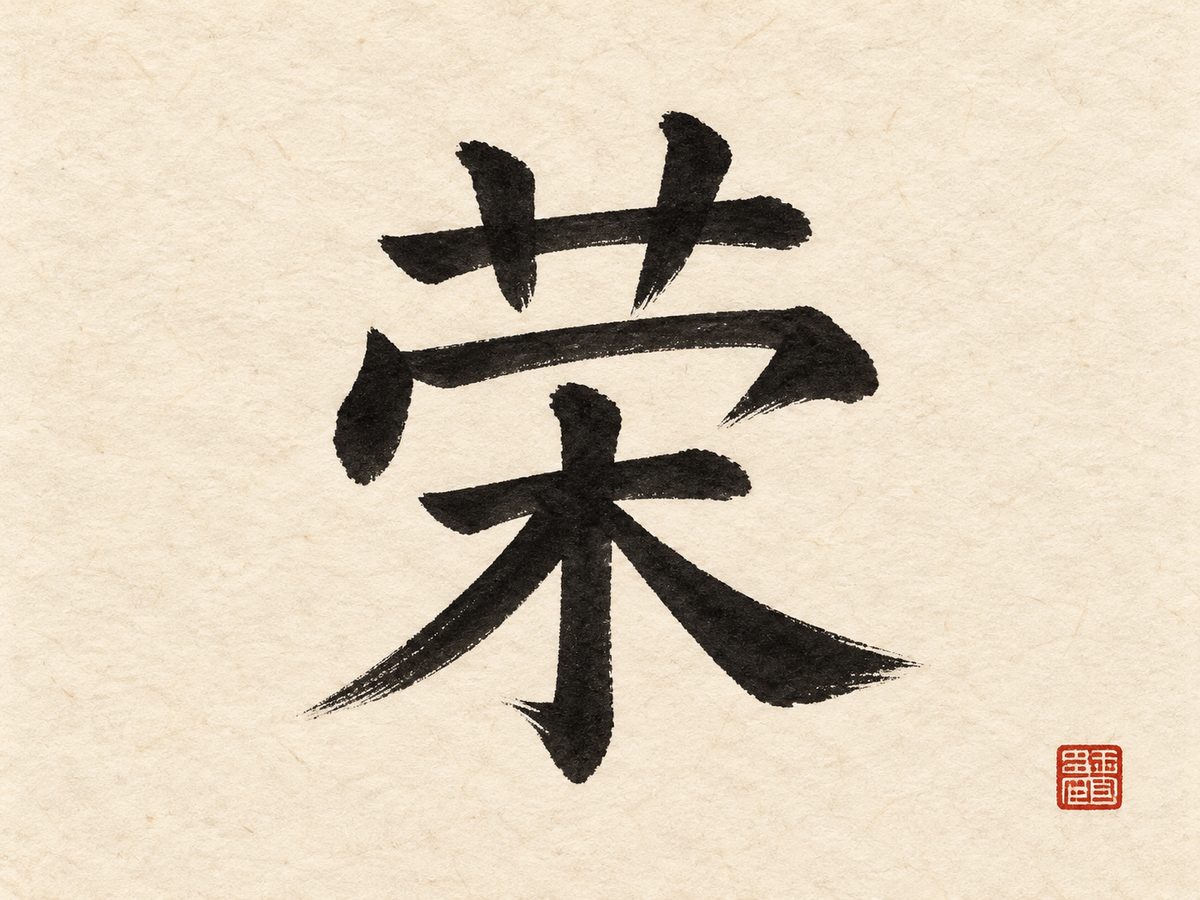
See 荣 in seal, brush & cursive Try it
How it's written
荣 is nine strokes in three stacked parts, written top to bottom. On top sit the three strokes of the grass radical, 艹, a horizontal line crossed by two short verticals. Under it lies a flat cover, 冖, a lid drawn wider than the grass above it. And at the bottom stands 木 (mù), "tree," the four-stroke picture of a trunk with spreading roots that Chinese children learn in their first week: a horizontal for the branches, a vertical for the trunk, two diagonals splaying down from the crossing.
The traditional form, 榮, is the same tree under the same lid, but the crown is different: two fires, 火火, where the simplified form has grass. That pair of fires is the original, and it is the whole secret of the character (see the etymology below). The mid-twentieth-century simplification replaced the two fires with the grass radical, which is why a mainland Chinese reader sees a plant and a Taiwanese or Hong Kong reader sees a blaze.
One thing to know before you write it anywhere permanent: the grass-and-lid cap is shared by a whole family of characters that differ only in what sits underneath. Put earth, 土, under the lid and you have 茔 (yíng), a grave. Put silk under it and you have "to wind around"; put a fire and you have "glimmer"; put strength and you have "labor." Everything that makes the character mean honor is in the tree at the bottom. Draw that tree cleanly.
What it means
荣 (róng) covers the ground that English splits between honor and glory. It is the public, visible kind of honor: the medal, the title, the promotion, the name on the board at the front of the school. The everyday noun is róngyù, "honor" or "reputation," the word on a certificate; róngyào is "glory," with more shine to it; guāngróng, "light and honor," is the adjective for a glorious deed or a proud family; and róngxìng, the one you will hear most, is the polite "I am honored," said at the start of every speech and the acceptance of every award.
What makes the word tick is its opposite. Honor in Chinese is one half of a pair, róngrǔ, honor and disgrace, and the second character, 辱 (rǔ), is not the inner blush of shame but the outward fact of being disgraced. You are honored or you are disgraced, in front of people, and the whole moral vocabulary of the classical philosophers is organized around which of the two you end up with. Modern Chinese still says it as one breath: to share honor and disgrace, to know honor from disgrace, to take something as an honor rather than a disgrace.
A reader hunting for "honor" in Chinese usually has one of four words in mind, and they are not interchangeable.
| Word | Reading | What it means | Reach for it when |
|---|---|---|---|
| 荣 | róng | honor as glory: flourishing, distinction, the honor conferred on you | you mean recognition, a proud achievement, "an honor" |
| 誉 | yù | honor as reputation: a good name, praise | you mean what people say about you |
| 尊 | zūn | to honor someone: respect, esteem, "honored guest" | you mean the verb, the honoring of elders or guests |
| 义 | yì | honor as doing right: integrity, righteousness | you mean a code of honor, a person of honor |
So a soldier's honor, the kind you keep, is closer to yì, which has its own page here. The honor that is given to you, and that can be taken away, is róng. This page is about that one.
- 荣誉 honor, reputation (the word on certificates and awards)
- 荣耀 glory; also the Chinese name of the Honor phone brand and of Honor of Kings
- 光荣 glorious, honorable (of a deed, a family, a tradition)
- 荣幸 to be honored; 'it is an honor to…'
- 繁荣 prosperous, flourishing, booming
- 荣辱 honor and disgrace, the classical pair
- 荣获 to be honored with, to win (an award)
- 荣归 to return in glory (to one's hometown)
- 荣升 to be promoted (politely, 'honored to rise')
- 虚荣 vanity, literally 'empty glory'
Idioms
- 欣欣向荣“eagerly growing toward bloom”thriving, flourishing; the standard phrase for a booming economy or a growing enterprise. (Tao Yuanming, Returning Home (归去来兮辞), 405 CE: 木欣欣以向荣)
- 荣华富贵“glory, splendor, wealth, and rank”worldly success in full; often said with a raised eyebrow about what it costs.
- 荣归故里“return to the old village in glory”to come home successful and be seen to be; the medalist stepping off the train. (the idea is Xiang Yu's in the Records of the Grand Historian: wealth without going home is embroidered robes worn at night)
- 一荣俱荣,一损俱损“one flourishes, all flourish; one is damaged, all are damaged”the fortunes of a network rise and fall together. (Dream of the Red Chamber, chapter 4, on the four great families: 一損皆損,一榮皆榮)
- 引以为荣“take it as an honor”to be proud of something; to count it an honor.
- 荣辱与共“share honor and disgrace together”to stand together through good and bad; of partners, allies, a team.
Right vs wrong forms
| Form | Type | Note |
|---|---|---|
| 荣 | simplified ✓ | The standard mainland form: nine strokes, grass radical over a cover over a tree. What a mainland Chinese reader writes and expects. |
| 榮 | traditional ✓ | The classical and Taiwan / Hong Kong form: fourteen strokes, two small fires over the cover over the tree. Carries the original 'tree lit up' image; the form in every classical text. |
| 茔 (earth under the cover) | derogatory | Not a variant, a different character: 茔 (yíng) means a grave or burial ground. It shares the grass-and-cover cap with 荣 and differs only in the bottom component (earth instead of tree). A blurred bottom on a stencil can turn 'glory' into 'grave.' |
| 萦 / 荧 / 莹 / 劳 | wrong | Same cap, different bottom: 'to wind around,' 'to glimmer,' 'lustrous,' 'labor.' None means honor. The tree 木 at the bottom is what makes it 荣. |
| 荣 (mirrored or rotated) | mirrored | Not a variant. A flipped or rotated character from a low-resolution stencil reads as an error to anyone literate. Check against a dictionary glyph at full size before inking. |
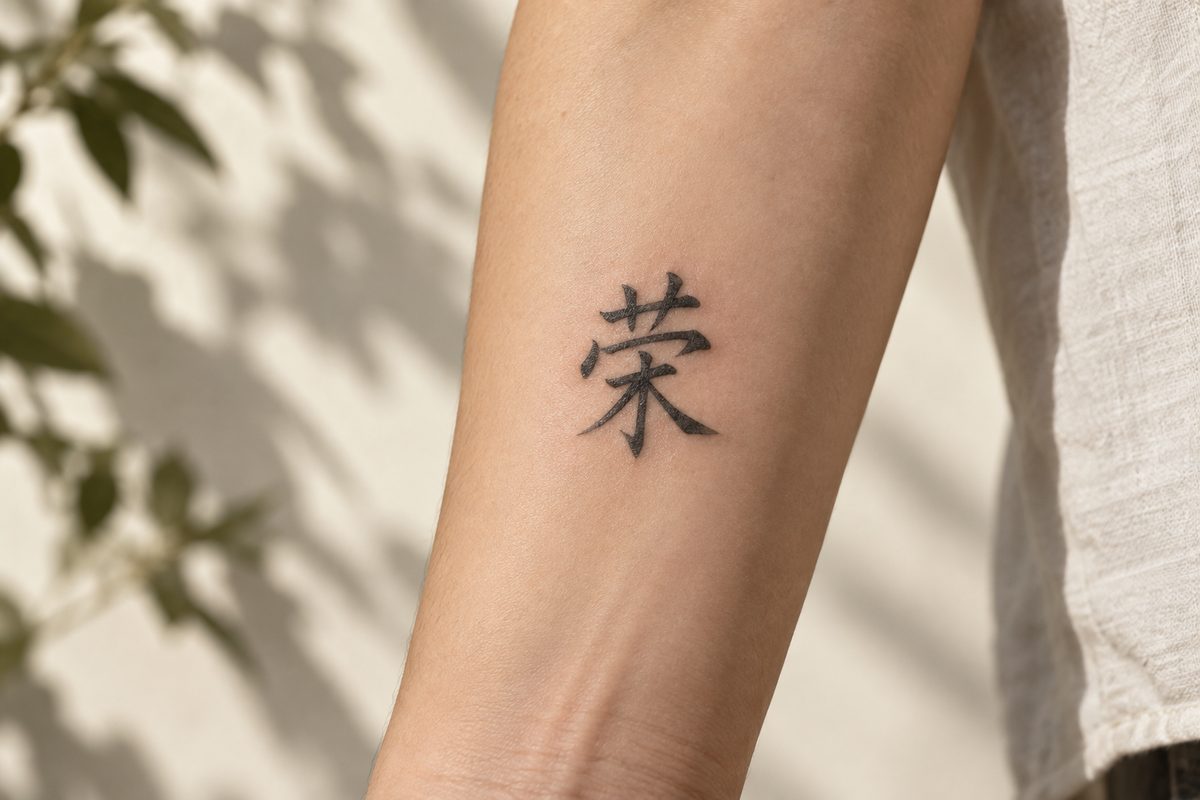
For a tattoo
荣 makes a clean, handsome tattoo, and a Chinese reader will read it instantly as "glory" or "flourishing," with honor close behind. Three things to decide before the needle comes out.
First, which form. The simplified 荣, nine strokes with the grass cap, is what a mainland reader writes; the traditional 榮, fourteen strokes with two small fires in the crown, is what Taiwan, Hong Kong, and every classical text use, and it carries the original meaning in its shape. Either is correct. The traditional form is denser and wants a little more skin.
Second, the bottom stroke. The grass-and-lid cap is shared by half a dozen characters, and the one to fear is 茔 (yíng), which puts earth where the tree should be and means "grave." A stencil that blurs the four strokes of the tree at the bottom can turn glory into a burial plot. Make sure the trunk and both diagonals are there.
Third, which honor you mean. As a lone character this one leans toward honor that is given: glory, distinction, a flourishing life. If what you want is honor as a code, the thing you keep when nobody is watching, a Chinese reader would point you to the character for righteousness instead, and for "honor" as a noun on a certificate the two-character róngyù reads more naturally than the single glyph. Print it at full size and have someone who reads Chinese confirm the design before it goes on; our guide to Chinese tattoo symbols walks through the checks.
Before you commit to any character, the eight ways a Chinese tattoo goes wrong covers the failure modes that are not specific to this one, including the stroke-density arithmetic that decides whether a traditional form survives at small sizes.
Honor in life today
The honor in your pocket
Two of the most-used pieces of software and hardware in China carry the word. Honor, the smartphone brand, is róngyào in Chinese, "glory"; it began as a Huawei sub-brand and was sold off in November 2020, amid American sanctions on its parent, and now sells phones worldwide under an English name that is the literal translation of its Chinese one. And Honor of Kings, the mobile game from Tencent's TiMi studio, is Wángzhě Róngyào, "the glory of kings." Released in October 2015, it had passed 100 million daily players by 2020 and was, by Wikipedia's tally of the industry figures, the highest-grossing mobile game in the world in 2024, at 2.6 billion dollars. Its heroes are a roll call of the people on this site, Sun Wukong and Nezha and Guan Yu among them, which means a fair share of the world's teenagers have spent more hours with the character for glory than with any other on this page.
"It is an honor"
Róngxìng is the word you will hear most often, and it is the reflex politeness of any speech, toast, or job interview: it is an honor to be here, an honor to meet you, an honor to be chosen. Beyond that the word runs through the machinery of public praise. Every award is rónghuò, "honored to receive." Every promotion is róngshēng, "honored to rise." The board at the front of a school or factory listing the best students and workers is the guāngróng bǎng, the honor roll, with the same word Chinese uses for a glorious deed. An honorary citizen is a róngyù citizen; a disabled veteran is, officially, a róngyù soldier, an "honored soldier." And the athlete or graduate who comes back to a small town with a medal or a degree is said to róngguī, to return in glory, a phrase that is more than two thousand years old and has a boiling in its history (see below).
Eight honors and eight disgraces
The honor-and-disgrace pair is still the grammar of public morality. In 2006 the Chinese leader Hu Jintao issued a moral code known as the Eight Honors and Eight Shames, officially the Socialist Concept of Honor and Disgrace: eight things to take as an honor, from loving the country to hard work, each paired with the disgrace of doing the opposite. It went up on classroom walls across the country in exactly the same róng-versus-rǔ form Mencius used twenty-three centuries earlier, which tells you how little the word's shape has moved.
A surname and a wish
Róng is also a surname, not a common one, but a distinguished one. Rong Yiren, of a Shanghai industrial family, was the rare pre-1949 capitalist who stayed on and thrived, ending up Vice President of China from 1993 to 1998 and known on both sides of the Pacific as "the Red Capitalist." As a given name, 荣 is a wish for a flourishing life, common in the generation born mid-century, when a boy named Róng was being told to bloom.
Curious what your own name could become in Chinese, chosen for its sound and its
good meaning together? Our Chinese name generator matches the sound
of your name to a real, well-omened character.
Where the character comes from
Open the Shuowen Jiezi, the first Chinese dictionary, compiled around the year 100, and honor turns out to be a tree. The entry for 榮 reads, in full, that it is the tong tree, built from the tree radical with an abbreviated 熒 (yíng, "glimmering lights") for the sound, and adds a second, older sense: the upturned ends of a roof's eaves. No honor, no glory, not a word about virtue. Xu Shen, the dictionary's compiler, was describing a plant, and the plant was the wutong, the Chinese parasol tree with the enormous leaves.
The Erya, an even older glossary of classical terms, explains how a tree became a feeling. In its chapter on plants it lays down a rule of vocabulary: the blossom of a tree is called huá, and the blossom of a grass is called róng; a plant that flowers and fruits is called xiù, and one that flowers without fruiting is called yīng. So róng was a word for blossoming, the moment a plant is at its most visible, and from there it slid, the way words do, to "flourishing," then "prospering," then the human version of being in full bloom in front of everyone: honor. Chinese never lost the botanical sense. Rónghuā, "glory and splendor," is literally "blossom and blossom," and the standard adjective for a booming economy is still a phrase about trees.
The two fires in the crown of the traditional form are what the dictionary means by the abbreviated "glimmering lights": the sound component 熒 is a pair of flames under a cover, and 榮 keeps the flames and swaps in a tree. Handian, the standard online Chinese dictionary, reads the bronze-age form as two flower-heads shining at each other like torches, which is a fair description of a parasol tree in bloom. The folk version you will meet online, that the grass radical "shows it is a plant word," is true only of the simplified character, and only by accident: the grass arrived with the mainland script reform, which rebuilt the top of the character. The fires are original. Honor, in its oldest written form, is a tree lit up.
History & roots
The tree the phoenix lands on
The tree inside the character is not just any tree. The wutong, the Chinese parasol tree, is the one tree in Chinese lore that the phoenix will consent to perch on, and the pairing is as old as the Book of Songs, where a poem in the "Greater Odes" sets the phoenix singing on a high ridge while the parasol tree grows on the sunny slope below. Later writers made it a rule: the bird eats nothing but bamboo seed, drinks nothing but sweet spring water, and lands on nothing but the wutong. So when the Shuowen defines honor as the tong tree, it is defining it as the tree a phoenix chooses. There is a whole theory of honor folded into that: it is not something you grab, it is something that alights on you if you are the right kind of tree. Our page on the Chinese phoenix has the bird's side of the story.
Honor and disgrace
Mencius, the tradition's second sage, made the pair into a law of politics. In the chapter named for his disciple Gongsun Chou he says, in James Legge's translation, "Benevolence brings glory to a prince, and the opposite of it brings disgrace," and then adds the image every Chinese student remembers: a ruler who hates disgrace and yet governs cruelly is like a man who hates damp and insists on living in a hollow. The "glory" in Legge's English is róng. Xunzi, a generation later and a good deal harder headed, gave the pair its own chapter, titled simply "Honor and Disgrace," and boiled the whole distinction down to an order of priorities: the person who puts what is right ahead of what is profitable ends up honored, and the person who puts profit first ends up disgraced; the honored get their way in the world, and the disgraced are pushed around by it. Note what neither philosopher says. Honor is not rank, not wealth, not birth. It is what conduct earns, in public, over time.
Brocade in the dark
The phrase for coming home in glory has a body count. In 206 BCE the warlord Xiang Yu had just burned the capital of the fallen Qin dynasty, and an adviser suggested he stay and rule from there, since the region was rich and walled in by mountains. Xiang Yu, homesick, refused, and Sima Qian's Records of the Grand Historian preserves his reason: to become rich and powerful and not go home to show it, he said, would be like walking about at night in embroidered robes. Who would ever know? The adviser muttered that people were right to call the men of Chu monkeys in hats, and Xiang Yu had him boiled. The embroidered robes became the four-character phrase for returning to your hometown in brocade, and the version built on this character, róngguī gùlǐ, "return to the old village in glory," is what Chinese newspapers still write over the photograph of an Olympic medalist stepping off the train.
The House of Glory
Chinese readers meet the character on the gate of the most famous house in fiction. Dream of the Red Chamber, the great eighteenth-century novel, is set in two adjoining compounds of the aristocratic Jia clan: the Ningguo House and the Rongguo House, the "Glory of the State" mansion, where the hero Jia Baoyu grows up among his cousins. In the fourth chapter a wily clerk explains to a new magistrate how the four great families of the capital are all intermarried, so that if one is damaged all are damaged, and if one flourishes all flourish. The line, built on this character, became a proverb for any network of interests bound together, and the whole novel is the slow proof of its first half: the House of Glory, in the end, does not stay glorious.
Trees flourishing toward glory
The most beautiful use of the word is not about honor at all. In the year 405 the poet Tao Yuanming quit his government post after eighty days, went home to his farm, and wrote the essay "Returning Home," in which he walks his own land in early spring and sees the trees flourishing toward róng, growing eagerly into bloom, while a stream begins to trickle. That line gave modern Chinese its standard phrase for anything thriving, xīnxīn xiàng róng, which today is what an economist says about a booming province. Sixteen centuries on, the word still means what the Erya said it meant: a plant that has decided to flower.
Questions people ask
What is the Chinese symbol for honor?
The usual single character is 荣 (róng), which covers honor and glory: distinction, recognition, a flourishing life. It is built from a grass radical over a cover over a tree, and the oldest Chinese dictionary defines it as a tree, the parasol tree, because the word began as 'blossoming' and grew into 'honor.' The traditional form is 榮, with two small fires in place of the grass.
How do you say honor in Chinese?
The single character is róng (荣), pronounced to rhyme with 'song' in a rising tone. The everyday noun 'honor' or 'reputation' is róngyù (荣誉); 'glory' is róngyào; and 'it is an honor' is róngxìng, the polite phrase that opens most Chinese speeches and toasts.
Is the Chinese symbol for honor a good tattoo?
Yes. 荣 reads clearly to a Chinese speaker as glory or flourishing, with honor close behind, and it works in both the simplified (nine strokes) and traditional (榮, fourteen strokes) forms. The one real risk is the bottom component: 荣 shares its cap with 茔, which means 'grave,' so the tree at the bottom must be drawn cleanly. If you mean honor as a personal code rather than honor that is given, the character for righteousness (义) is what a Chinese reader would suggest instead.
What is the difference between honor and glory in Chinese?
Chinese mostly does not split them. 荣 (róng) covers both, and its compounds lean one way or the other: róngyù is honor or reputation, róngyào is glory. The sharper distinction in Chinese is between honor that is given to you (荣) and honor as doing right (义, yì, righteousness), and between both of those and honoring someone else (尊, zūn, respect).
Why is the phone brand called Honor?
Because its Chinese name is róngyào (荣耀), which means 'glory' or 'honor,' and the English brand name is a direct translation. Honor began as a sub-brand of Huawei and was sold off in November 2020. The same word names Honor of Kings (Wángzhě Róngyào, 'glory of kings'), the Tencent game that was the highest-grossing mobile game in the world in 2024.
What does Rong mean in a Chinese name?
As a given name, 荣 (róng) is a wish for the child to flourish: to have a glorious, thriving life. It was especially common for boys born in the mid-twentieth century. Rong is also a surname, best known through Rong Yiren, the Shanghai industrialist who became Vice President of China in 1993 and was called 'the Red Capitalist.'
Sources
- 汉典 zdic: the entry for 荣 (strokes, radical, Shuowen and Erya citations, the bronze-form reading)
- Shuowen Jiezi, chapter 6, the tree radical: 榮:桐木也。从木,熒省聲。一曰屋梠之兩頭起者爲榮 (Wikisource)
- Erya, chapter on plants: 木謂之華,草謂之榮 (Wikisource)
- Mencius, Gongsun Chou I: 仁則榮,不仁則辱 (ctext.org)
- James Legge, The Works of Mencius: 'Benevolence brings glory to a prince, and the opposite of it brings disgrace' (Wikisource)
- Xunzi, chapter 4, Honor and Disgrace: 先義而後利者榮,先利而後義者辱 (Wikisource)
- Tao Yuanming, Returning Home: 木欣欣以向榮 (Wikisource)
- Records of the Grand Historian, chapter 7, Xiang Yu: 富貴不歸故鄉,如衣繡夜行 (Wikisource)
- Book of Songs, Greater Odes, Juan A: the phoenix on the ridge and the parasol tree on the sunny slope (Wikisource)
- Dream of the Red Chamber, chapter 4: 一損皆損,一榮皆榮 (Wikisource)
- Honor (company): the former Huawei sub-brand, sold November 2020 (Wikipedia)
- Honor of Kings: release, 100 million daily players, highest-grossing mobile game of 2024 (Wikipedia)
- Socialist Concept of Honor and Disgrace, the Eight Honors and Eight Shames, 2006 (Wikipedia)
- Rong Yiren, Vice President of China 1993–1998, 'the Red Capitalist' (Wikipedia)
Make Honor your own
See 荣 in calligraphy
From ancient seal script to flowing cursive. Pick a look before a tattoo or a card.
 Name
Name Get a Chinese name
A name matched to the sound of yours, with a meaning that fits.
Start yours Chinese Almanac
 Try the Chinese Gender Predictor
A different corner of Chinese culture: the old Qing-palace birth chart, worked out from your lunar birth date, with the math shown and its coin-flip odds honestly weighed.
Open the toolRelated: righteousness, loyalty, prosperity, courage
By Julian 祝君瑜, sourced from the classics and from modern life, updated 2026-09-21