Chinese Symbol
Li in Confucianism: The Chinese Character for Rites, Propriety, and Manners
Li, written 礼 (and 禮 in traditional Chinese), is the fourth of the Five Constants of Confucian ethics, and English needs about five words to carry it: rites, ritual, propriety, courtesy, manners. It is also the ordinary modern word for a gift. The character shows an altar beside a vessel of offerings, and the oldest definition we have says its purpose is to serve the spirits and bring down blessings.
- Strokes
- 5
- Radical
- 礻 (altar, the compressed form of 示; Kangxi 113)
- Formation
- Traditional 禮 is a phono-semantic compound: 示 (altar) for the sense, 豊 (a ritual vessel) for both sense and sound. Simplified 礼 is not a modern invention but a revival of the ancient form already recorded in the Shuowen Jiezi around the year 100
Trace 礼 yourself, or watch it drawn
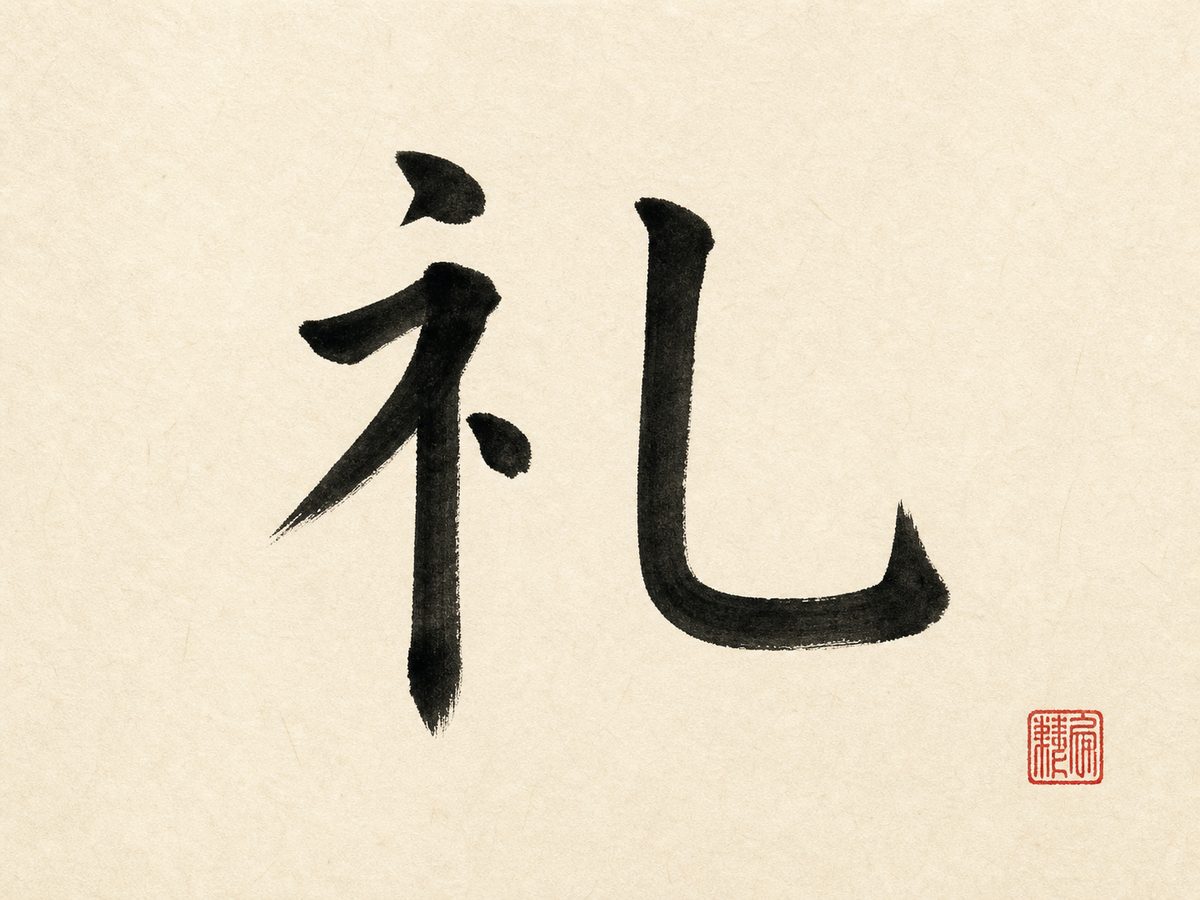
See 礼 in seal, brush & cursive Try it
How it's written
The traditional character 禮 has two halves, and both are worth knowing.
On the left is 礻, the squeezed writing form of 示 (shì). 示 is an altar: a stone table seen from the side, with lines beneath it that older commentaries read as emanations coming down from heaven. It is the component that marks the entire vocabulary of Chinese religion. Anything to do with sacrifice, blessing, spirits, prayer, ancestors, or divine favor tends to carry it on the left, and the moment you can spot it you can guess the neighborhood a character lives in.
On the right is 豊 (lǐ), which is a picture of a specific object: a tall-stemmed ceremonial dish, loaded. The Shuowen Jiezi describes it in five characters as "the vessel for performing rites," and says the bottom of the graph is the stemmed bowl and the rest is a drawing of what sits in it. Scholars have read the contents as strings of jade, or as two drums; either way the point stands. Before li was an idea it was a serving dish with the good things already on it.
So the traditional character is an altar plus a full offering vessel, which is about as literal as Chinese characters get.
Now the trap. 豊 is one stroke away from 豐 (fēng), meaning abundant, and the two are near enough to be confused by careful readers, let alone by tattoo stencils. They are unrelated characters with unrelated meanings. If you are working with the traditional form, this is the pair to check.
The simplified 礼 is five strokes: the altar radical, then a single hooked vertical. What it is not is a twentieth-century invention. The Shuowen Jiezi, compiled around the year 100, already lists this shape as the ancient form of the character, and it turns up again in a Tang dynasty guide to correct and popular spellings. When the mainland standardized simplified forms in the 1950s, this one was not designed. It was reinstated, after something like nineteen centuries in the wings.
What it means
Li is the virtue of doing things the right way, where "the right way" is a matter of established form rather than private conscience. It covers the state sacrifice, the wedding, the funeral, the correct depth of a bow, the order in which people enter a room, and whether you brought something. That range is not sloppiness in the Chinese word. It is the argument: the same faculty that gets a sacrifice right is the one that gets a dinner party right, and a civilization is the set of forms that hold both.
This makes li the most easily misread of the Five Constants for an English speaker. Benevolence and righteousness sound like virtues. Li sounds like etiquette, which in English is a minor social skill somewhere below punctuality. Confucian thought treats it as load-bearing. The forms are how an inner disposition gets out of your head and into the world where other people can rely on it, and a society that loses them does not become more authentic. It becomes unpredictable.
If you are looking for the Chinese symbol for respect
Two characters split that job, and picking the wrong one is the most common mistake here. 敬 (jìng) is respect as an inner attitude: reverence, taking something seriously, the feeling you have toward a teacher. Li is respect as enacted conduct: the bow, the form of address, the gift, the thing an observer could film. The everyday word for good manners is built on li; the word for a formal salute, jìnglǐ, contains both characters, which is the language quietly insisting that a salute is a feeling and a form at once. If you want one character for the feeling, it is not this one. If you want one character for respect made visible, this is it.
One more sense to hold onto, because it surprises people: li on its own is the normal modern word for a present. The compound lǐwù is what you carry to a birthday. That is not a degraded meaning or a modern drift. It comes straight out of the classical doctrine, for reasons the section below on reciprocity makes uncomfortably clear.
- 礼貌 politeness, good manners (literally the appearance of li; 没礼貌 is the standard rebuke)
- 礼物 a gift, a present (the everyday modern sense of the character)
- 礼拜 a worship service; colloquially, a week (礼拜三 is Wednesday)
- 婚礼 a wedding ceremony
- 葬礼 a funeral
- 典礼 a formal ceremony (graduation, opening, inauguration)
- 敬礼 to salute; a formal show of respect (reverence plus form, one character each)
- 礼节 etiquette, protocol, the specific observances of a situation
- 彩礼 bride price, the money and goods a groom's family gives the bride's
- 失礼 to commit a breach of manners; my apologies for the discourtesy
Idioms
- 礼尚往来“li values going and coming”courtesy demands reciprocity; a favor given calls for a favor returned, and the debt does not lapse. (《礼记·曲礼上》)
- 克己复礼“master the self, return to the rites”to subdue your own impulses and hold to proper form; Confucius' answer when asked what benevolence is. (《论语·颜渊》)
- 先礼后兵“courtesy first, soldiers after”to try the polite approach before resorting to force; still the standard description of a negotiating posture. (《三国演义》)
- 彬彬有礼“refined and possessing li”impeccably well-mannered; the compliment paid to someone whose courtesy looks effortless. (built on 《论语·雍也》, where 彬彬 describes the balance of substance and refinement)
- 礼轻情意重“the gift is light, the feeling is heavy”it's the thought that counts; said when handing over something modest, and the standard polite cover for an inexpensive present.
- 分庭抗礼“divide the courtyard and match the rites”to meet as an equal rather than a subordinate; two parties standing on opposite sides of the hall and bowing at the same depth. (《庄子·渔父》)
Right vs wrong forms
| Form | Type | Note |
|---|---|---|
| 礼 | simplified ✓ | The mainland standard, five strokes: the altar radical 礻 plus a single hooked vertical. Unusually for a simplified character it is not a modern reduction. The Shuowen Jiezi lists this shape as the ancient form of the character around the year 100, and a Tang dynasty orthography guide records it again, so the 1950s reform reinstated a form rather than inventing one. |
| 禮 | traditional | The traditional form, eighteen strokes, 示 (altar) beside 豊 (a stemmed vessel loaded for sacrifice). Standard in Taiwan, Hong Kong and Macau, and the form in every classical text and nearly all calligraphy. Fully correct, and the one where the character's origin is still legible. |
| 豐 in place of 豊 | wrong | The classic error in the traditional form. 豊 (lǐ), the ritual vessel, differs from 豐 (fēng), meaning abundant, by very little, and they are unrelated characters. A traditional 禮 built on the wrong right-hand side is not a stylistic variant; it is not a character at all. |
| 理 | wrong | Not a variant, but the most common mix-up. 理 (lǐ) means principle, reason, or logic, and is pronounced identically. Different character, different meaning, no relation. Worth checking whenever a design is described only by its pinyin. |
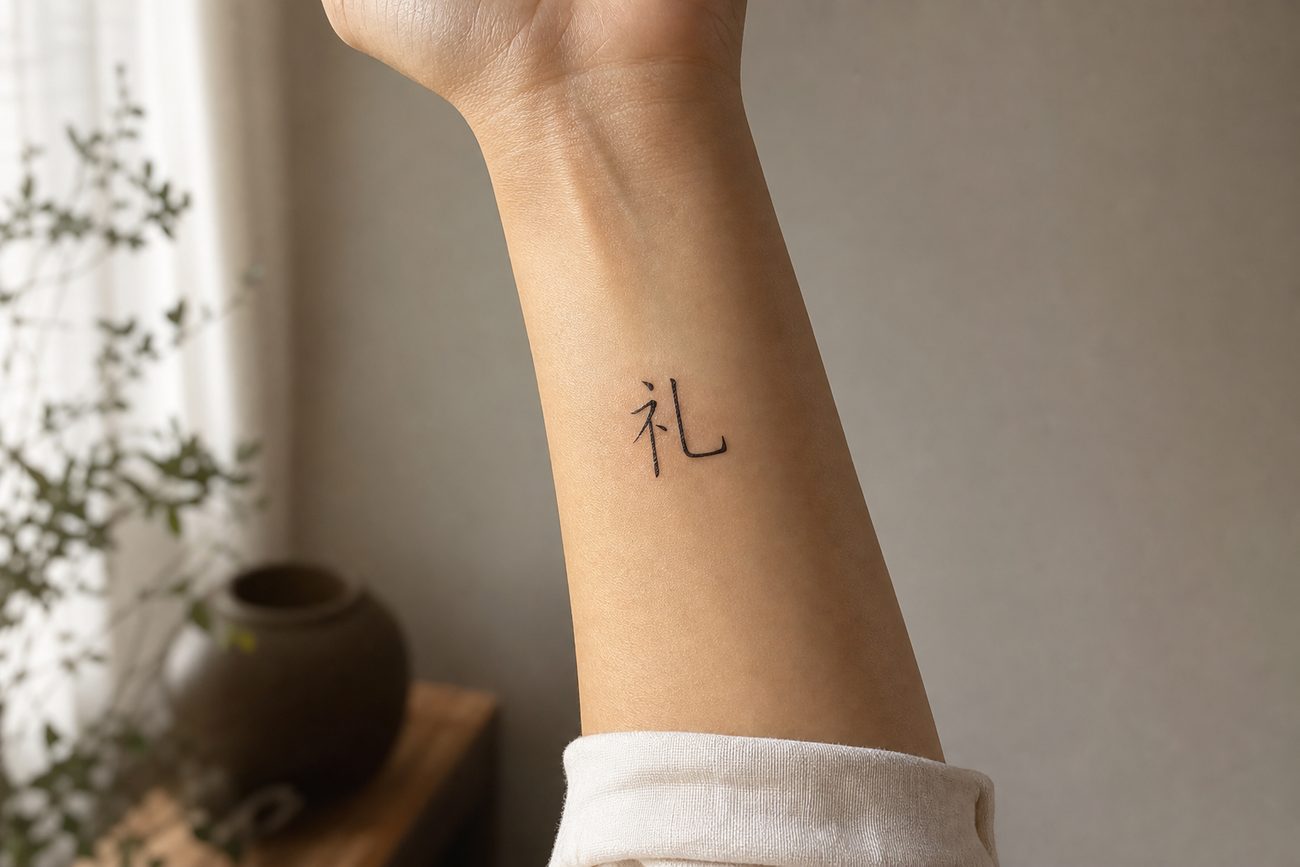
For a tattoo
礼 is an uncommon choice for ink, and that is worth knowing before you commit, because the meaning a Chinese reader takes from it is not the meaning most Western tattoo guides advertise. To a native reader a single 礼 does not read as "honor" or "respect" in the proud sense. It reads closer to courtesy, correct conduct, and, depending on context, a present. It is a fine and serious word. It is simply a quieter one than people expect.
The homophone trap is the real risk. Li is one of the most crowded sounds in Mandarin, and the character most often confused with this one is 理 (lǐ), meaning principle, reason, or logic. They sound identical in the third tone, they have completely different meanings, and a stencil sourced from a search result can easily hand you the wrong one. If someone tells you a design says "propriety," check which character is actually drawn.
On the two forms: the traditional 禮 is eighteen strokes and visibly an altar beside a loaded vessel, which is the version that carries the history where you can see it. It is also dense, and dense traditional characters at small sizes lose their internal structure and turn into a dark patch. The simplified 礼 is five strokes, is completely correct, and has the unusual advantage of not being a modern compromise, since it is the ancient form brought back. If you take the traditional route, check it against 豐 first, and print at full size before anyone starts.
Before you commit to any character, the eight ways a Chinese tattoo goes wrong covers the failure modes that are not specific to this one, including the stroke-density arithmetic that decides whether a traditional form survives at small sizes.
Propriety in life today
The character for Confucian ritual is how much of China says "Wednesday"
This is the best thing about the word and almost nobody outside the language knows it.
Chinese has two ways to say the days of the week. The official one, xīngqī, is what you learn in class. The other one, in constant colloquial use, is lǐbài, and lǐbài is li plus a word meaning to bow. It got there through the church: Christian missionaries used the compound for a worship service, the service happened on Sundays, so Sunday became lǐbàitiān, and once Sunday had a name the other six days simply took numbers off it.
The Qing government did not care for this. Late-imperial officials disliked reckoning Chinese time by a Christian liturgical cycle, and in 1907 the state settled on xīngqī as the correct term instead. The replacement was built out of the twenty-eight lunar mansions, the same star-lodge system that divides the sky into the four quarters guarded by the dragon, the tiger, the tortoise and the Vermilion Bird. It was, in other words, a deliberate attempt to name the week after Chinese astronomy rather than after a foreign religion.
It half worked. Xīngqī is the standard written form, and lǐbài never went anywhere. Enormous numbers of Chinese speakers still say lǐbàisān for Wednesday, which means the character Confucius built his ethics on is doing duty in a Christian loanword that an imperial edict tried and failed to suppress.
Every gift in China is an installment
The classical doctrine on gifts is one sentence long and it is ruthless. The Book of Rites says li prizes reciprocity, then adds the enforcement: to give and get nothing back is a failure of li, and to receive and give nothing back is also a failure of li. Legge's translation is exact and slightly chilling. The obligation runs both ways and it does not expire.
Two thousand years later this is not a historical curiosity, it is the operating system of Chinese social life. The red envelope at New Year, the gift you take to a hospital visit, the cash at a wedding, and the bride-price negotiations that make the national news every spring are all administered under the same rule, and the accounting is real. People remember what was given, and roughly what it cost, and what is therefore owed. A gift is not the closing of a transaction. It is the opening of a ledger, which is why the Chinese phrase for social obligation is a live and slightly heavy thing to have hanging over you.
Weddings, funerals, and the security guard
In ordinary modern Chinese the character is everywhere and almost invisible. A wedding is a marriage-rite, a funeral is a mourning-rite, a graduation or an opening is a canonical-rite. Politeness is lǐmào, which literally reads as the appearance of li, and to be rude is to be without it. A soldier saluting performs jìnglǐ. Christian baptism, when the term was translated, became washing-li. It is a character you cannot get through a Chinese day without meeting, usually while doing something completely unceremonious.
Want to see 礼 and 禮 side by side in real brush script, at a size where you can judge
the difference? Our Chinese calligraphy generator will render
either form for you.
Where the character comes from
The Shuowen Jiezi defines 禮 with a pun and then a purpose. The pun first: it glosses the word as "to tread," matching it to a near-homophone meaning a footstep or a shoe. Chinese lexicography did this constantly, and the Qing scholar Duan Yucai, whose commentary is still the one specialists reach for, unpacks it as the sense of a thing you walk on and therefore depend on. Li is the ground under conduct.
Then the purpose, and this is the sentence that matters: li is "that by which one serves the spirits and brings down blessings." Not that by which one is polite. The dictionary puts the character's origin squarely in sacrifice, and the components agree with it: an altar, a loaded vessel. Duan spells out the reasoning, noting that of the five classes of ritual, sacrifice comes first, which is why the graph takes the altar.
What happened next is the interesting part, and it is a story of a word climbing outward from an altar until it covers a whole society. The rites are performed for the spirits; the rites for the spirits require an exact order of precedence among the living people performing them; that order of precedence turns out to be the skeleton of the state; and the manners of ordinary life are the same skeleton at small scale. By the Zhou dynasty the tradition credited the Duke of Zhou with instituting the rites and the music together as a single system of government, and by the Han there were three separate classics devoted to the subject, covering the offices of state, the ceremonies themselves, and a sprawling collection of records and commentary.
Confucius put the word at the center of his teaching and gave it its sharpest formulation when his favorite student asked what benevolence was. Master yourself and return to li, he answered, and that is benevolence. Our page on benevolence takes that line as the hard limit on the warm virtue. From this side it reads as a job description. Whatever you feel, the tradition says, the test of it is whether you can hold to a form when the form costs you something, and the mastering-yourself half of the phrase is there precisely because forms are frequently inconvenient.
He was blunter with his own son. The Analects preserves a small scene in which the young man crosses the courtyard, his father stops him, asks whether he has studied the rites, and on hearing that he has not, says: without learning li, you have no way to stand. Legge translates it as "your character cannot be established." It is one of the few places in the book where you can hear a parent talking.
Han cosmology then filed the set. The Five Constants, benevolence and righteousness and propriety and wisdom and trustworthiness, were mapped onto the five phases, and li went to fire, with fire came the south and the summer, and the bright, upward, visible, public element got the virtue whose entire nature is to be performed where people can see it. That one lands better than most of the correlative scheme does.
History & roots
Xunzi says the rites exist to feed you
The deepest thing anyone in classical China wrote about li is also the least intuitive, and English-language explanations of the concept almost never get to it.
Xunzi, the hard-headed third-century BCE Confucian, opens his essay on the subject by asking where li came from, and answers it as an economist would. People are born wanting things. Wanting without getting produces seeking; seeking with no measure or boundary produces competition; competition produces disorder; and disorder produces poverty. The ancient kings hated the disorder, so they instituted the rites in order to draw the lines, and the purpose of the lines was to nourish what people want while keeping desire from exhausting the goods and the goods from being outstripped by desire, so that the two could sustain each other and grow.
Then comes the line that turns the standard picture inside out. Therefore, Xunzi writes, li is nourishment. And he gives an inventory: the grain-fed meats and the blended flavors are there to nourish the mouth; the pepper and the orchid to nourish the nose; the carving and the embroidery to nourish the eye; the bells and drums and strings and pipes to nourish the ear; the airy rooms, the mats, the couches and the armrests to nourish the body.
Ritual, on this account, is not a set of restrictions imposed on appetite. It is a delivery system for appetite, engineered so that a finite quantity of good things can be distributed without everybody fighting. It is the most materialist theory of ceremony produced anywhere in the ancient world, and it was written by a Confucian.
The ritual vessel that ate the bronze age
There is an argument for taking li seriously that requires no philosophy at all. Walk into the Chinese bronzes room of any major museum and look at what is in the cases. Almost everything you are looking at is a vessel for food, wine, or water, made for use in sacrifices to ancestors, and the technical achievement is staggering: piece-mold casting at a scale and complexity no other bronze-age culture attempted.
China's bronze age poured its metal into ritual equipment rather than into weapons and statuary, and it did so for something like a thousand years. The number of vessels of each type a household could legitimately use was itself regulated by rank, so the dinner service was a public statement of where you stood. That is li as a material fact, and it is the same object drawn in the right-hand side of the character.
What li cost, and who said so
A tradition this committed to form attracts an obvious objection, and it got one early. The Daoists made the argument most bitingly: by the time a society has to talk about ritual and propriety, on this reading, something has already been lost, and the rites are the thin outer husk left after genuine feeling has drained away. The Mohists attacked from a different angle, calculating the cost of elaborate funerals and long mourning periods and concluding that the practice impoverished ordinary families for no measurable gain.
Confucius had already conceded most of the ground, which is what makes him worth reading. Asked about the root of li, he said that in ceremony it is better to be sparing than extravagant, and that in mourning it is better to show real grief than to get the procedure right. Elsewhere he asks what li can possibly be if a person lacks benevolence, and answers with a shrug in the form of a question. The forms are not the point. They are the only reliable way anyone has found of transmitting the point.
The virtue with a caveat attached
One line about li is quoted more than all the others combined, and it is not by Confucius. His disciple You Ruo says that in the practice of li, harmony is the thing to prize. It is usually served up on its own as a piece of gentle wisdom about getting along, and the fuller passage carries a warning that is almost always cut off. We take that line apart on the peace and harmony page, where it belongs, since the character it really tells you about is the other one.
Questions people ask
What does li (礼) mean in Confucianism?
Li is the virtue of correct form: ritual, ceremony, propriety, courtesy, and manners, treated as one continuous thing. It covers state sacrifices, weddings, funerals, the order people enter a room in, and whether you brought a gift. It is the fourth of the Five Constants, alongside benevolence, righteousness, wisdom, and trustworthiness. The claim behind the word is that inner virtue only becomes reliable to other people once it takes an outward form, which is why Confucius told his son that without learning li there is no way to stand.
What is the Chinese character for li, and what does it show?
It is 礼 in simplified Chinese and 禮 in traditional. The traditional form combines 示, a picture of an altar, with 豊, a tall-stemmed ceremonial vessel with offerings in it. So the character is literally an altar beside a full offering dish. The Shuowen Jiezi, compiled around the year 100, defines the word as that by which one serves the spirits and brings down blessings, which puts its origin in sacrifice rather than in politeness.
Is the simplified character 礼 a modern invention?
No, and it is one of the more interesting cases in the whole simplification program. The Shuowen Jiezi already recorded this five-stroke shape as the ancient form of the character around the year 100, and it appears again in a Tang dynasty guide to correct and popular spellings. When mainland China standardized simplified forms in the 1950s, this one was reinstated rather than designed, after roughly nineteen centuries out of official use.
Is li the Chinese symbol for respect?
Partly, and the distinction matters. Chinese splits respect between two characters. 敬 (jìng) is the inner attitude: reverence, taking something seriously. 礼 (lǐ) is respect enacted: the bow, the form of address, the gift, the observable behavior. The word for a formal salute, jìnglǐ, contains both, since a salute is a feeling and a form at the same time. If you want a single character for the feeling of respect, 敬 is the better answer. For respect made visible, this is the one.
Why does li also mean 'gift' in modern Chinese?
Because the classical doctrine made gifts a formal obligation rather than a spontaneous gesture. The Book of Rites states that li prizes reciprocity, and then spells out the enforcement: to give and receive nothing back is contrary to li, and to receive and give nothing back is equally contrary to it. Gift exchange was therefore part of ritual conduct from the beginning, and the character followed the practice. Today lǐwù is simply the word for a present.
Why is li associated with fire and the south?
Because of the Han dynasty scheme that mapped the Five Constants onto the five phases. Benevolence went to wood, righteousness to metal, wisdom to water, trustworthiness to earth, and propriety to fire, which brings with it the south, the summer, and the color red. The fit is better than most correlative pairings manage: fire is the bright, upward, conspicuous phase, and li is the virtue whose whole nature is to be performed where other people can see it.
Why do Chinese people call a week lǐbài, using the character for ritual?
It came from Christian missionaries, who used lǐbài for a worship service. Since the service fell on Sunday, Sunday became lǐbàitiān, and the remaining days took numbers from it. The Qing government objected to reckoning Chinese time on a Christian cycle and in 1907 fixed xīngqī as the official term, built instead from the twenty-eight lunar mansions of Chinese astronomy. Both survive: xīngqī is standard in writing, while lǐbài remains extremely common in speech.
Sources
- Shuowen Jiezi entry for 禮: 履也,所以事神致福也。从示从豊,豊亦聲, with the 古文 form and Duan Yucai's commentary (hancibao.com)
- Wiktionary: 禮 (phono-semantic compound of 礻 altar and 豊, with the full range of senses from rite to gift)
- Wiktionary: 礼 (based on an ancient form of 禮 recorded in the Shuowen; earliest regular-script record in the Tang orthography guide Ganlu Zishu)
- Wiktionary: 豊 (the stemmed ritual vessel, distinct from 豐 fēng 'abundant')
- The Book of Rites, Quli I: 禮尚往來 and the two clauses that enforce it, in James Legge's translation (ctext.org)
- Analects 16.13 (季氏): 不學禮,無以立, Legge's 'if you do not learn the rules of Propriety, your character cannot be established' (ctext.org)
- Analects 12.1 (顏淵): 克己復禮為仁, Confucius' answer to Yan Yuan (ctext.org)
- Analects 3.4 (八佾): ritual better sparing than extravagant, mourning better grieving than correct (ctext.org)
- Xunzi, Discourse on Ritual (禮論): 禮起於何也 and 故禮者,養也 with the sensory inventory, original text (gushiwen.cn)
- Li (Confucianism), Wikipedia (the concept's scope, the Three Ritual Classics, and the Daoist and Mohist objections)
- 星期, Chinese Wikipedia (礼拜 from Christian usage, and the 1907 Qing decision to standardize on 星期, built from the twenty-eight mansions)
- Chinese ritual bronzes, Wikipedia (vessels for ancestral sacrifice, piece-mold casting, and quantity regulated by rank)
- Wuxing (Five Phases): the Han mapping of the Five Constants onto the five elements, propriety to fire
Make Propriety your own
See 礼 in calligraphy
From ancient seal script to flowing cursive. Pick a look before a tattoo or a card.
 Name
Name Get a Chinese name
A name matched to the sound of yours, with a meaning that fits.
Start yours Chinese Almanac
 Try the Chinese Gender Predictor
A different corner of Chinese culture: the old Qing-palace birth chart, worked out from your lunar birth date, with the math shown and its coin-flip odds honestly weighed.
Open the toolRelated: benevolence, righteousness, wisdom, peace, loyalty
By Julian 祝君瑜, sourced from the classics and from modern life, updated 2026-08-03