Feng Shui
Feng Shui Numbers and House Numbers: The Two Systems, Sorted
There are two completely different things called feng shui numbers, and English-language advice serves them as one. The first is the homophone layer: eight is lucky because it sounds like prospering, four is avoided because it sounds like death. That layer is real, recent, and mostly about money. The second is the Luoshu, a three-by-three arrangement of the numbers one to nine that is the actual numerical backbone of the compass school, has nothing to do with how anything sounds, and is the one a practitioner would use. Your own number belongs to the second system.
Two systems, served as one
Ask the English-speaking internet what feng shui says about numbers and you get a single confident answer, which is that eight is lucky and four is unlucky, plus some arithmetic about adding up the digits of your house number.
Ask a compass-school practitioner and you get a three-by-three grid, nine directions, and a question about the year you were born.
Both of these are real. They are not the same tradition, they are not the same age, they do not agree about what a number even is, and the whole reason numbers are confusing in feng shui is that almost nobody tells you they are two systems. So here they are, separately, oldest first.
The classical system: a grid that arrived on a turtle
The Book of Changes, in the Great Treatise appended to it, contains a sentence that Chinese thought has been chewing on for two thousand years. The Yellow River produced the Diagram, it says, the Luo river produced the Writing, and the sages took them as models.
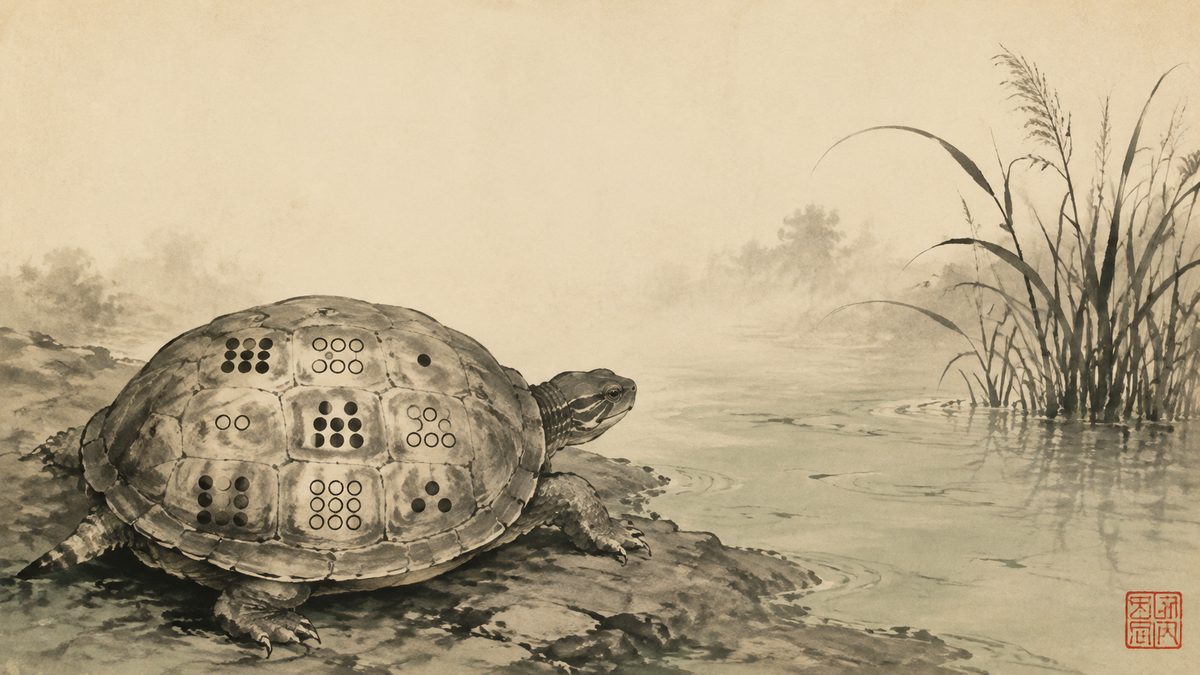
The Writing from the Luo is the Luoshu. Tradition supplies the picture that goes with the line: a turtle comes out of the Luo river with a pattern of dots on its shell, arranged in nine clusters. Someone reads them as numbers. And the numbers turn out to sit in the only three-by-three arrangement that works:
| Eastern column | Central column | Western column |
|---|---|---|
| 4 · southeast | 9 · south | 2 · southwest |
| 3 · east | 5 · center | 7 · west |
| 8 · northeast | 1 · north | 6 · northwest |
(The painting at the top of this page shows the turtle arriving, not the diagram: its shell carries the idea of the pattern rather than the exact counts, which are in the table above.)
Every row adds to fifteen. Every column adds to fifteen. Both diagonals add to fifteen. It is the smallest non-trivial magic square there is, and it is the same one whether you find it in a Chinese classic or a Renaissance treatise, because it is a fact about numbers rather than a claim about the world.
What Chinese practice did with it is the important part, and it is why the directions are printed in the table above. The nine cells were mapped onto the nine positions of a space: eight compass directions around the edge and the center in the middle. That is the nine palaces, and it is the frame the whole compass school runs on. Each position already carried a trigram and an element from the Book of Changes commentary that seats them, so each number inherits a direction, a trigram and an element in one move.
Notice what this system is not doing. It is not saying that nine is a good number and two a bad one. The number is an address. It tells you which of the nine positions you are talking about, and everything interesting follows from the direction rather than from the digit. In flying-star practice, the more advanced branch built on this grid, the numbers move through the palaces year by year, so the same digit is favorable in one position and difficult in another. A number in this system has no fixed personality at all. The square's own history, and the birth-date "Lo Shu grid" that numerology sites sell under its name, are on our Chinese numerology page.
If you want to lay this grid over your own floor plan, that is a job with its own rules and its own two competing methods, and it lives on our bagua map guide.
Your feng shui number is a person, not an address
When somebody asks what their feng shui number is, this is what they are reaching for even if they do not know it, and it belongs to the classical system rather than the homophone one.
Your kua number is a single digit from one to nine derived from your birth year, with a different formula for men and women. It puts you in the East group or the West group, and it gives you four favorable compass directions and four unfavorable ones, ranked. It is the number a practitioner would actually ask you for, and it is the input for every personalized recommendation on this site: which way to point your bed, which way to sit at a desk, which door direction suits you.
Two wrinkles worth knowing before you calculate it by hand. The formula differs by sex, so siblings born the same year can land in different groups. And the traditional year does not begin on January 1: it turns at the spring boundary in early February, so a birthday in late January belongs to the previous year's count. Our kua number calculator handles both and prints your full compass.
That is the entire classical answer to "what is my number," and you will notice it never once asked where you live.
The popular system: puns, and what they are worth
Now the other one, which is genuinely part of Chinese life and deserves to be described accurately rather than sneered at.
Chinese has a very large number of syllables that sound alike, and Chinese culture has long enjoyed doing things with that. The number associations are the most famous case:
- Eight is the good one, because in several Chinese varieties it sounds close to the word for prospering and getting rich. The association is strongest in Cantonese, which is a clue about where and when it got so powerful. - Four is the bad one, because it sounds close to the word for death. Fourteen and twenty-four are treated as worse by people who care, being read roughly as certain death and easy death. It is also why nothing is given in fours at the New Year, along with the clocks and pears that are avoided for the same kind of reason, all set out on our page of Chinese New Year gifts. - Six is smooth, from a word for flowing or going well. Nine is lasting, from a word for a long time. Two is doubling and therefore good for anything you want in a pair.
How seriously is this taken? Seriously enough to change buildings. Floor numbering in many towers in mainland China, Hong Kong and Taiwan simply omits the fours, and in some cases the entire forties, so a lift panel jumps from 39 to 50 and visitors assume floors are missing. Numbers rich in eights command real premiums at phone-number and license-plate auctions, and one Chinese airline paid the equivalent of hundreds of thousands of dollars for a telephone number that was nothing but repeated eights. Beijing timed its 2008 Olympic opening to the pun as well, which was not a coincidence and was not subtle.
And now the two honest observations that the pages selling you a lucky house number report will not make.
None of this is in the feng shui literature. Not in the form school, not in the compass school, not in the manuals. It is a pun tradition that grew up alongside feng shui and got absorbed into how people talk about it, in roughly the way that Western house-buyers avoid the thirteenth floor without anyone claiming architecture teaches it.
And it does not survive translation. The eight association only works because of how the words sound in Chinese, which means it is a fact about the Chinese language rather than about numbers or about space. A number that sounds like prospering in Cantonese sounds like nothing at all in English, and a system that stops working when you cross a language border is not describing a property of the number.
The site has the full accounts of both puns where they belong: eight and prosperity on the symbols side, and the avoidance of four, which goes considerably further than most readers expect.
So what about your actual house number?
This is what most people came here to ask, so here is a direct answer in three parts.
Metaphysically, from the classical side: it does not matter. No classical method judges a dwelling by the digits on its door. The judgments are about orientation, what sits behind the building, where the entrance opens, and how the interior relates to that. If you want your house assessed the way the tradition actually assesses one, that is the house design guide, and the first question it asks is which way the place faces.
Culturally: it can matter, and the market says so. In a Chinese-majority property market the number is priced in. A flat on a floor full of fours can be harder to sell and a little cheaper to buy, and an address heavy with eights carries a premium. That is a real economic effect produced entirely by other people's beliefs, which makes it no less real to your bank balance. If you are buying in Hong Kong, Singapore or a Chinese city, this is worth knowing. If you are buying in Ohio, it is trivia.
Personally: it matters exactly as much as you let it. Living behind a number you find ominous is a small daily unpleasantness, and there is no prize for enduring it. Living behind one you like is a small daily pleasure. That is the whole of it, and the tradition, which has always been more practical than its reputation suggests, would not argue.
What it would tell you to do instead is look at the door that number is nailed to. Which way does it face, what does it open onto, and can the person coming home see clearly where they are going. Those questions have answers, and the answers are older than the pun.
Work out your own number and your four directions in a few seconds with the kua number calculator, then take the grid to the bagua map guide and put it over your floor plan.
Questions people ask
How do I find my feng shui number?
The number a practitioner means is your kua number, and it comes from your birth year and your sex, not from your address or your birthday. It is a single digit from one to nine, it places you in either the East group or the West group, and it gives you four favorable compass directions and four unfavorable ones. Two people born a year apart can get opposite answers, and the traditional year turns at the spring boundary in early February rather than on January 1, so a late-January birthday counts to the previous year. Our kua number calculator handles both wrinkles and shows your full compass.
What is the luckiest number in feng shui?
It depends which of the two systems you are asking about, which is why the internet cannot agree. In the popular homophone layer the answer is eight, because the word sounds close to the word for prospering in several Chinese varieties, and eight is the number people pay real money for in phone numbers and license plates. In the classical Luoshu system there is no single lucky number at all: nine numbers occupy nine positions, each carries a direction and an element, and whether one is good depends on where it sits and who is asking. A practitioner asked this question would answer with your own kua number, not with a universal favorite.
What is the unluckiest house number in feng shui?
Four, in the homophone layer, and it is avoided seriously enough to be visible in real buildings: floor numbering in many Chinese, Hong Kong and Taiwanese towers skips the 4s outright, sometimes the whole 40s. Fourteen is treated as worse by some, being read as certain death, and 24 as easy death. None of this comes from any classical text. It is a pun, and it is a pun that only works in Chinese, so it travels with Chinese communities rather than with feng shui as a technique. The Chinese symbol for death page has the full account of how far the avoidance goes.
What house number should I avoid?
If you are asking practically rather than metaphysically: none, unless the pun bothers you or you expect to sell to someone it bothers. That second clause is not a joke, because in Chinese-majority property markets the effect is priced in, and a number is a real if small factor in resale. Beyond that, a classical practitioner would not judge a house by its number at all. The classical judgments are about which way the building faces, what is behind it, where the door opens, and how the rooms sit relative to that, which is what our feng shui house design guide works through.
What number attracts money?
Eight, in the popular system, and the belief is strong enough to be measurable: numbers heavy with eights sell at a premium in phone-number and license-plate auctions across Chinese markets, and Beijing timed the opening of its 2008 Olympics to the same pun. The Chinese symbol for prosperity page has that story in full, down to the seconds. What the classical system says is different and less quotable: money questions are handled by direction and position, not by digits, and the traditional wealth position in a home is a place rather than a number. That argument is on our feng shui wealth guide, including the water mistake almost every English page makes.
What are the nine feng shui numbers?
They are the numbers one to nine as arranged in the Luoshu, the magic square that Chinese tradition says was found inscribed on the back of a turtle emerging from the Luo river. Laid out in three rows they run four, nine, two on the top; three, five, seven across the middle; and eight, one, six along the bottom. Every row, every column and both diagonals total fifteen. Each of the eight outer numbers sits on a compass direction and carries the trigram and element of that direction, with five in the middle. This grid is the basis of the nine palaces and of flying-star practice, and it is what a compass-school practitioner means by numbers.
Sources
- • Book of Changes, the Great Treatise (Xi Ci I), on the Luo producing the Writing and the sages taking it as a model, with Legge's translation, at the Chinese Text Project
- • Shuo Gua (Book of Changes commentary; seats the eight trigrams by direction and assigns their elements)
- • Wikipedia, Lo Shu Square: the arrangement, its magic constant, and its role in the nine palaces
- • Wikipedia, Tetraphobia: the omission of 4 from floor numbering in Chinese, Hong Kong, Taiwanese, Korean and Japanese buildings
- • Wikipedia, Chinese numerology: the homophone associations and the auction premiums paid for numbers containing 8
Get your kua number and full direction chart
Enter your birthday and we work out your kua, your group, and all eight directions, with the February boundary handled for you. Open the calculator