Chinese Symbol
Chinese Symbol for Death (死): Meaning, the Number 4 Taboo, and Origin
The Chinese symbol for death is 死 (sǐ), and it is a character most Chinese people would rather not look at head-on. It is one of the most taboo words in the language: avoided in speech, dodged in elevators, unlucky even in its sound. And yet it is only six plain strokes with a clear, ancient picture folded inside, a living person kneeling beside the bare bones of the dead.
- Strokes
- 6
- Radical
- 歹 (bare bones / death; Kangxi 78)
- Formation
- Ideographic compound (歹 bare bones + 匕 a kneeling person)
Trace 死 yourself, or watch it drawn
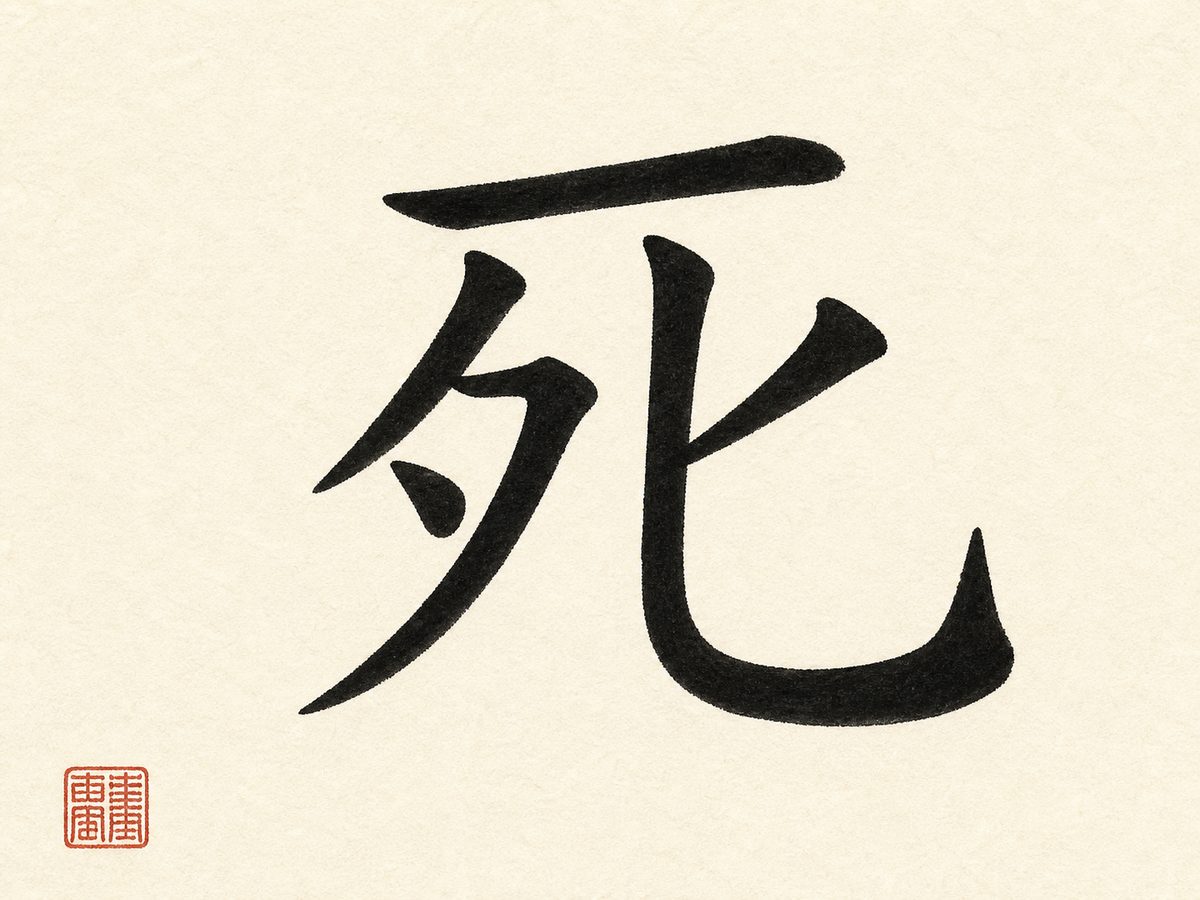
See 死 in seal, brush & cursive Try it
How it's written
死 is six strokes, and like many of the oldest characters it is really a small scene. On the left is 歹 (dǎi), a component that on its own now means bad or wicked but began as a picture of bare, broken bones, the remains of a body. To its right is 匕, here a bent human figure, a person crouched down. Read the two together and the character shows a living person kneeling beside the bones of the dead, in mourning, which is about as direct as writing gets.
The 歹 on the left is worth knowing on its own, because it heads a small family of grim characters, and its presence is a reliable signal that a word has to do with death or harm. 死 is written identically in simplified and traditional Chinese, so there is only one form to learn.
What it means
死 (sǐ) is the blunt, literal word for death and dying: to die, dead, the end of life. Chinese has dozens of gentler ways to say it, and in polite or grieving speech people reach for almost any of them before this one, but 死 is the plain root underneath them all.
What surprises learners is how far the word travels from the graveyard. In everyday speech 死 has become the language's favorite intensifier, the way English piles on "to death": a person can be lèisǐ le, "tired to death," a joke can be xiàosǐ rén, "funny enough to kill you," a dish hǎochī sǐ le, "so good it's lethal." It also means rigid or stuck, the opposite of living and supple: a sǐ knot will not come loose, a sǐ end is a dead end, and when a computer freezes, Chinese says it has "died." Living things bend and move; dead ones are fixed, and 死 carries that whole second life as the word for what has stopped.
- 死亡 death; to die (the formal term)
- 死板 rigid, inflexible, stiff
- 死角 a blind spot; a dead corner
- 死胡同 a dead-end alley
- 死机 (of a computer) to crash, to freeze
- 死党 diehard loyalists; a ride-or-die clique (slang)
- 死对头 a sworn, mortal enemy
- 该死 'damn it!' (literally 'ought to die')
- 死心 to give up hope; to resign oneself
- 拼死 to do something desperately, at the risk of one's life
Idioms
- 视死如归“to look on death as a return home”to face death without fear; heroic composure before the end.
- 死而后已“and only stop at death”to devote oneself utterly, to the very last breath. (诸葛亮《后出师表》: 鞠躬尽瘁,死而后已)
- 生离死别“parting in life, separation in death”a heartbreaking, possibly final farewell.
- 死里逃生“to escape alive from within death”to have a narrow escape from mortal danger.
- 死心塌地“heart set to death, feet planted on the ground”utterly and unshakably committed to something.
Right vs wrong forms
| Form | Type | Note |
|---|---|---|
| 死 | simplified ✓ | The standard form everywhere, identical in simplified and traditional Chinese: six strokes, the bare-bones radical 歹 on the left and a kneeling figure on the right. It was never simplified, so there is only one form to learn. |
| 歹 (the left radical alone) | wrong | Not a variant. The left component 歹 (dǎi) on its own means 'bad, wicked' (and pictures bare bones); it is not 'death.' The character 死 needs both halves together. |
| 死 (mirrored or rotated) | mirrored | Not a variant. A flipped or rotated 死 from a low-resolution stencil reads as an error to anyone literate. Check against a dictionary at full size before inking. |
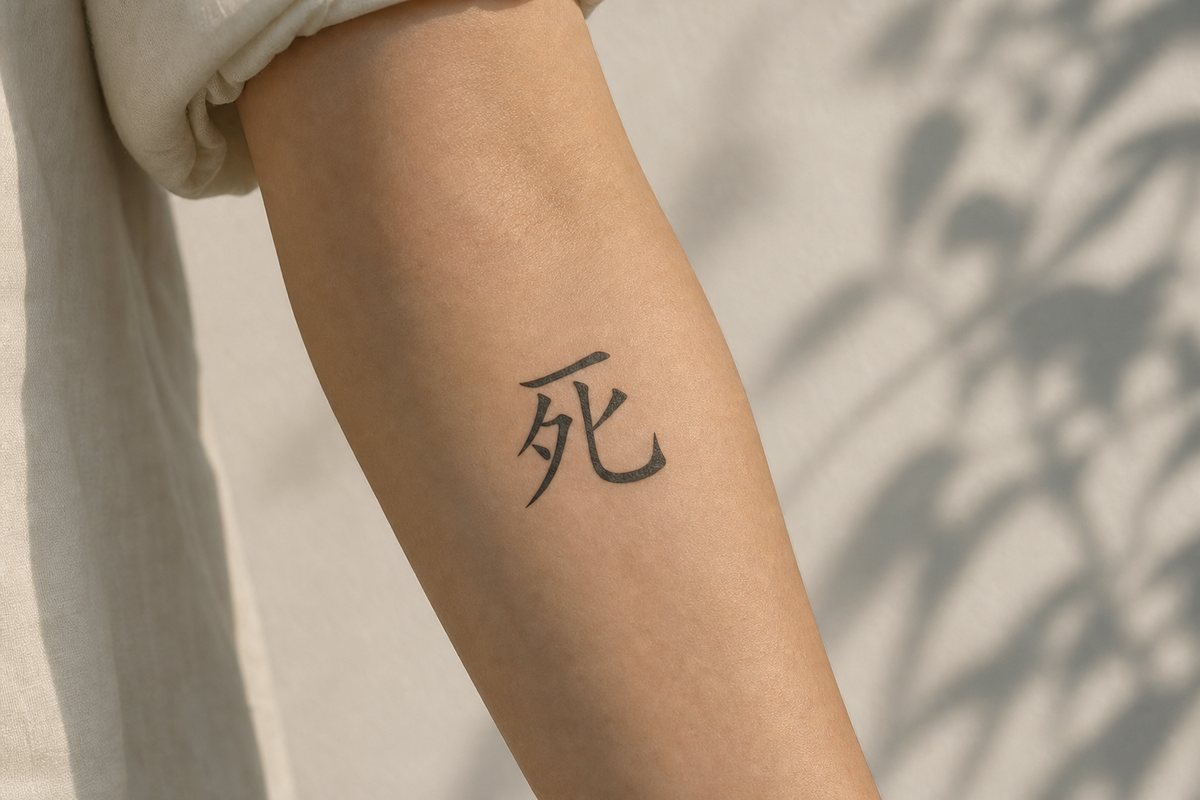
For a tattoo
Here honesty matters more than usual. 死 is a striking character to a Western eye, stark and unflinching, and it shows up in memento-mori and life-and-death designs. But you should know exactly what you would be borrowing. To a Chinese reader 死 is not edgy or philosophical; it is simply the unluckiest, most unwelcome character in the language, the one bound up with funerals, curses, and the dreaded number four. Almost no Chinese person would ever tattoo it.
A Chinese viewer seeing 死 on your arm will most likely read not "deep" but "ominous," or quietly wonder whether you know what it says. That is not a reason you cannot choose it, but choose it with open eyes. If it is the theme rather than the shock you are after, consider the pair shēng-sǐ, "life and death" together, or a fuller phrase, which carries the idea far more gracefully than 死 standing alone. As always, print it at full size and have someone who reads Chinese confirm the design before the needle.
Before you commit to any character, the eight ways a Chinese tattoo goes wrong covers the failure modes that are not specific to this one, including the stroke-density arithmetic that decides whether a traditional form survives at small sizes.
Death in life today
The unluckiest number in China
The strangest thing 死 does today is haunt a number. In Mandarin and most Chinese dialects, sǐ, "death," sounds almost exactly like sì, "four" (四), and that near-rhyme has made four the unluckiest number in the Chinese world, its answer to the West's unlucky thirteen, only far stronger. Buildings skip the fourth floor the way Western ones skip the thirteenth, and some Hong Kong towers leave out every floor in the forties. Phone numbers, license plates, and addresses heavy with fours sell at a discount; hospital wards and airline rows quietly omit them. The combinations only get worse: fourteen can be heard as "will die," seventy-four as "already dead." A whole architecture of avoidance, built on one unlucky echo.
Saying it without saying it
Because the word itself is unlucky, Chinese has grown an enormous garden of ways not to use it. An ordinary person does not die; they qùshì, "leave the world," or zǒu le, "have gone," or simply are bú zài le, "no longer here." An elder who dies is gently said to have "grown old"; a Buddhist monk reaches yuánjì, "perfect stillness"; an emperor, in the old language, "collapsed like a mountain." Even the words for burial clothes and a coffin borrow from long life, calling themselves "longevity clothes" and a "longevity board." A culture that fears a word this much ends up inventing a hundred tender ways around it.
Curious what your own name becomes in Chinese, matched to its sound and a good
meaning? Our Chinese name generator builds one for you.
Where the character comes from
The oldest dictionary reads the picture as a parting. The Shuowen Jiezi, from around the year 100, glosses 死 with the word sī, "to dissipate, to run dry," the way a stream dwindles away to nothing, and then adds the key phrase: 死 is "what a person departs from." Death, in this earliest written definition, is not an event so much as a separation, the living essence leaving the body behind, and the character is built, it says, from bones and a person. A great deal of later Chinese thought about the soul parting from the body is already folded into those six strokes.
History & roots
The sage who changed the subject
Confucius was famously reluctant to talk about death. In the Analects, when his student Zilu asked how to serve the spirits of the dead, he answered, "You cannot yet serve the living, how could you serve the dead?" Pressed further, asked outright about death itself, he gave one of his most quoted replies: wèi zhī shēng, yān zhī sǐ, "you do not yet understand life, so how could you understand death?" It is the whole temper of Confucianism in a sentence: turn your attention to this world, this life, the people in front of you, and let the rest wait. Chinese culture inherited that this-worldly focus, and it is one reason so much of its energy went into how to live rather than what comes after.
The man who drummed on a bowl
The great counterweight is a scene from the Zhuangzi, a founding text of Daoism. When Zhuangzi's wife died, his friend Huizi came to mourn and found the philosopher sitting on the ground, drumming on an upturned basin and singing. Scandalized, Huizi scolded him. Zhuangzi answered that he had grieved at first, until he thought it through: before her birth she had no life, no form, no breath; out of the formless, breath gathered, then form, then life, and now it had changed once more into death, "like the turning of the four seasons." To sit and wail would be to misunderstand the way of things. It is one of the most radical acceptances of death ever written, and it holds the Daoist view in a single image: death is not the enemy of life but its natural other half.
Deaths that weigh
If death is certain, Chinese thought asked, then the only real question is its weight. The historian Sima Qian, who chose the humiliation of mutilation over suicide so that he could finish his great history, wrote the line every Chinese student learns: "a person has only one death; it may be heavier than Mount Tai, or lighter than a goose feather." The difference is what you spend it on. The same idea powers the highest praise a Chinese hero can earn, shì sǐ rú guī, "to face death as calmly as going home," and it echoes in the loyal minister's vow to give everything "and stop only at death." Death is the one certainty; its meaning is the single thing left to decide.
The white affair
Western mourning is black. Chinese mourning is white. A funeral is a bái shì, a "white affair," set opposite the "red affair" that is a wedding, and the two together are how the language files a family's entire ceremonial life. Mourners wear undyed hemp and white cloth, the gift envelope that arrives red at a wedding arrives white at a funeral, and white flowers, chrysanthemums above all, belong to the dead. Writing in the South China Morning Post, Jason Wordie notes the unglamorous reason heavily scented blooms attached themselves to funerals to begin with: before refrigeration, they covered the smell. In Hong Kong the association has long outlived the problem, and the wrong bouquet still makes people flinch.
Then there is the clock. To give someone a clock is sòng zhōng; to sit with a parent through their last hours and see to the funeral afterward is also sòng zhōng, the same two syllables in the same order, with 钟 traded for 终. This is the most efficient way to ruin a present in Chinese, and it is taken seriously enough to have a standard escape hatch: the recipient hands over a small coin, which turns the gift into a purchase, and the whole problem dissolves on a technicality.
The strangest object went in the mouth. The Shuowen Jiezi, the first Chinese dictionary, carries an entry for a character almost nobody meets, hán 琀, and defines it as the jade placed in the mouth of the dead. In Han tombs that jade is very often carved as a cicada, and the choice was not decorative. A cicada spends years underground, hauls itself out, splits its shell, and flies away, which made it the obvious model for what the family hoped the body in the tomb would manage next.
One correction, since the English lists get this wrong with some regularity. Several of them file the jujube, the Chinese red date, among the symbols of death. It is the opposite. Zǎo, "date," sounds like zǎo, "early," which is why dates get scattered across a marriage bed alongside chestnuts and peanuts to wish the couple a son soon. The red date is one of the most cheerfully alive symbols in the culture, and it belongs at a wedding.
Questions people ask
What is the Chinese symbol for death?
The Chinese symbol for death is 死 (sǐ), a six-stroke character made of 歹 (bare bones) beside a kneeling human figure, a person mourning the dead. It means to die, dead, and death, and in everyday speech it also works as an intensifier ('to death') and as 'rigid' or 'stuck.' It is written identically in simplified and traditional Chinese, and it is the most taboo character in the language.
Why is the number 4 unlucky in China?
Because 四 (sì, 'four') sounds almost exactly like 死 (sǐ, 'death'). The near-homophone makes four deeply unlucky across the Chinese world, its version of the unlucky thirteen but far stronger: buildings skip the fourth floor, and phone numbers, license plates, and addresses full of fours are avoided. Fourteen can sound like 'will die,' and seventy-four like 'already dead.' Where that flinch meets an actual address, feng shui has its own separate rules for reading a house number, and they do not always agree with the homophone; see feng shui numbers and house numbers.
Does 444 mean death in Chinese?
Not as a phrase of its own. The taboo attaches to the digit itself, so a run of fours reads as unlucky several times over and buyers avoid phone numbers and addresses full of them, but 444 carries no separate traditional meaning. The combinations Chinese speakers actually flinch at are the ones that form words, like fourteen. Treating 444 as a message in its own right comes from Western angel-number numerology, a modern system with no connection to Chinese practice.
What is the Chinese symbol for life and death?
Chinese writes it as a pair rather than one character: 生死 (shēngsǐ), joining 生 (shēng), life, which pictures a sprout pushing up out of the ground, to 死 (sǐ), death. The compound is ordinary Chinese and carries the same weight the English phrase does, as in a matter of life and death, and it also names the Buddhist wheel of birth and rebirth that a person is trying to get off. For anyone drawn to this page for a tattoo, the pair is the graceful way out of the problem: a lone 死 reads to a Chinese eye as funereal, while 生死 reads as the philosophical idea it is. See the Chinese symbol for life.
Is 死 a good tattoo?
Honestly, for most people no. To a Chinese reader 死 is the unluckiest, most funereal character in the language, bound up with death, curses, and the number four, and almost no Chinese person would tattoo it. It reads as ominous rather than deep or philosophical. If the theme is what you want, the pair 生死 (life and death) or a fuller phrase carries it far more gracefully. Always have a Chinese reader confirm any design first.
What does wei zhi sheng yan zhi si mean?
Wèi zhī shēng, yān zhī sǐ (未知生,焉知死) means 'you do not yet understand life, so how could you understand death?' It is Confucius's reply in the Analects when a student asked him about death, and it captures the this-worldly focus of Confucianism: attend to living well, and let questions of the afterlife wait.
Where does the character 死 come from?
The Shuowen Jiezi (around the year 100) glosses 死 as sī, 'to dissipate,' like a stream running dry, and as 'what a person departs from,' explaining it as built from 歹 (bones) and a person. Death, in this earliest definition, is the living essence separating from the body, an idea folded into the character's six strokes.
Sources
- Wiktionary: 死 (歹 bones + kneeling person; 6 strokes; meanings incl. the intensifier)
- Shuowen Jiezi entry for 死: 澌也,人所離也,从歺从人 (shuowen.org)
- Analects, Xian Jin (论语·先进): 未知生,焉知死 — Confucius on death (ctext.org)
- Sima Qian, Letter to Ren An (报任安书): 人固有一死,或重于泰山,或轻于鸿毛 (gushiwen.cn)
- Zhuangzi, Zhi Le (庄子·至乐): 鼓盆而歌 — Zhuangzi drums on a basin at his wife's death (zhuangzi.5000yan.com)
- Tetraphobia: 四 (four) shunned for sounding like 死 (death); skipped floors (Wikipedia)
- Shuowen Jiezi, the entry for 琀 (han): 送死口中玉也, the jade placed in the mouth of the dead (Chinese Text Project dictionary)
- Jason Wordie, on how chrysanthemums, lilies and frangipani became associated with death in East Asia (South China Morning Post)
Make Death your own
See 死 in calligraphy
From ancient seal script to flowing cursive. Pick a look before a tattoo or a card.
 Name
Name Get a Chinese name
A name matched to the sound of yours, with a meaning that fits.
Start yours Chinese Almanac
 Try the Chinese Gender Predictor
A different corner of Chinese culture: the old Qing-palace birth chart, worked out from your lunar birth date, with the math shown and its coin-flip odds honestly weighed.
Open the toolBy Julian 祝君瑜, sourced from the classics and from modern life, updated 2026-09-05