Feng Shui
Feng Shui Bagua Map: The Two Versions, and How to Lay One Over Your Home
A bagua map is the eight-trigram diagram laid over the plan of your home so that each part of the house gets a meaning. There are two versions in circulation and they do not agree. The classical one is a compass map: you take a real bearing and the eight trigrams sit in fixed directions, north at the top. The popular Western one is a door map: you stand in the front door, divide the plan into nine squares, and the bottom row is always the wall you came in through. Both are used. They will give you different answers for the same room, and it is worth knowing which one you are holding.
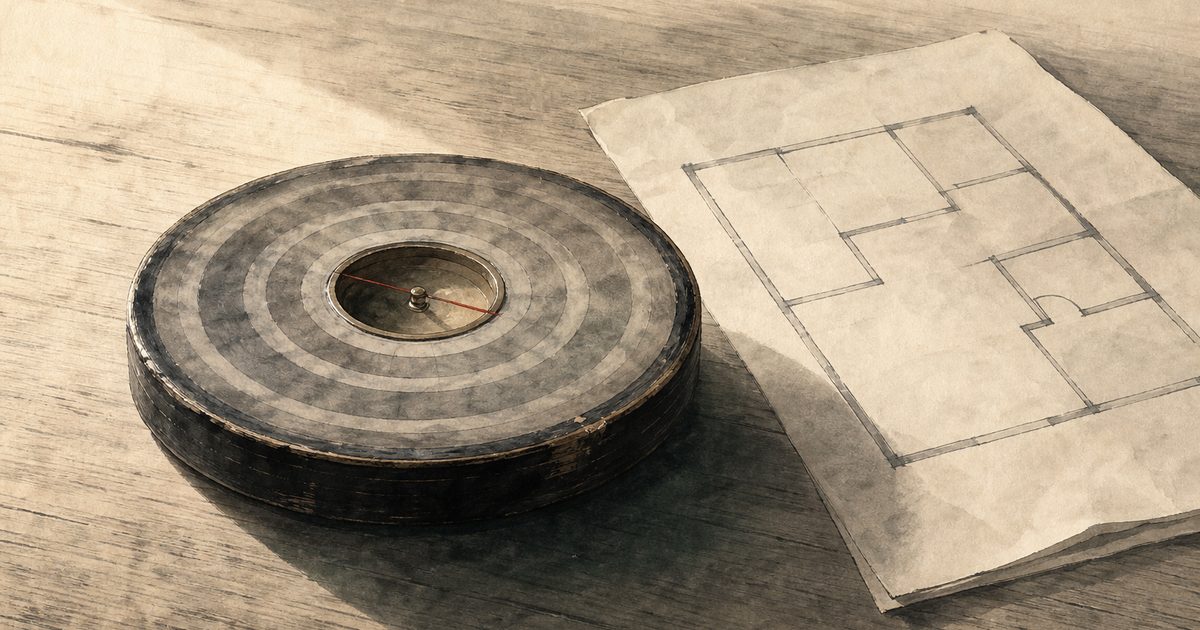
Two maps, and the one question that tells them apart
Before anything else, work out which system your source is using, because everything downstream depends on it and almost nobody says which one they mean.
Ask one question: does the map move when the house is rotated?
If the answer is no, you have the compass map. The trigrams sit in real directions, north stays north, and turning the building forty degrees moves every sector. If the answer is yes, you have the door map. The grid is anchored to the main entrance, the bottom row is always the wall you walked in through, and the building could be facing any direction at all.
| The compass map | The door map | |
|---|---|---|
| Anchored to | Actual compass directions | The main front door |
| You need | A bearing and a floor plan | A floor plan |
| Wealth sits | Southeast, always | Far left corner from the door, always |
| Age | The trigram seats are classical | Taught in the United States since the 1970s |
| Used by | Chinese practitioners, and every classical school | Most English-language books and blogs |
Neither is a fraud. The door map was built on purpose, by a real teacher, to make the system usable by people with no compass and no training, and it is internally consistent. But it is a simplification of the other one rather than a parallel tradition, and if you have been reading English feng shui writing you have almost certainly been given the door map without being told the compass map exists.
The rule that keeps you out of trouble is simple. Pick one and stay in it. The failure mode is not choosing wrong; it is running both, because then the northeast of one and the knowledge square of the other land in different rooms and you spend a weekend obeying two sets of orders.
The Western bagua (BTB, "Black Hat") vs the classical compass bagua
The door map has a proper name, and it is worth knowing so you can tell which book you are holding. It is the bagua of Black Sect Tantric Buddhist feng shui, usually shortened to BTB or "Black Hat," a system assembled by Grandmaster Lin Yun and taught in the United States from the 1970s, with a temple in Berkeley from 1986. Its bagua is anchored to the front door rather than the compass: stand in the main entrance looking in, and the bottom row of the nine squares is always knowledge, career and helpful people, whichever way the building faces. That is why it is often called the Western bagua map. It is not Western in origin, but it was designed for a Western audience with no compass and no training, and the English-language feng shui shelf is almost entirely built on it.
The classical compass bagua is the other one, and the older one by a couple of thousand years. Its eight seats are fixed to real directions by the Shuo Gua commentary on the Book of Changes, and every classical school, Eight Mansions and flying star included, reads the same octagon. Wealth is in the southeast whether your door faces north or west. On this site we use the compass version throughout, because it is the one the sources describe and the one the rest of the feng shui pages compute from; the calculator below rotates it to fit your floor plan so you do not have to do the geometry yourself. If you learned the door map first, nothing you know is wrong; it is a simplification, and you can carry on with it as long as you never run both at once.
How to actually lay one down
Both methods start the same way. Get a floor plan of the whole home, on one page, including every room under the same roof. Attached garages count. A balcony does not.
Find the center. For a rectangle that is where the diagonals cross. For anything more complicated, print it, cut it out, and balance the shape on a pencil point; the balance point is close enough, and this is genuinely how it is done.
For the compass map, take your bearing outdoors, standing back from the building, and away from cars, fuse boxes, steel and your own phone. Any of those will pull a needle several degrees, and several degrees is the difference between one sector and the next when you project the line across a house. Traditional practitioners use a luopan, a wooden disc with the trigrams and a great many other rings printed in circles around a central needle, but an ordinary compass takes the same bearing. Then lay the eight directions over the plan from the center you found, with north where north is.
Bagua map calculator: which way does your front door face?
Stand in the main entrance looking out and take the bearing. Open the sector it falls in, and the grid is the compass bagua turned so that the wall with your door runs along the bottom, ready to lay over the floor plan with the door in the bottom-center square. Each square names its trigram and its modern life area. A bearing within about five degrees of a boundary deserves a second reading from further out.
My front door faces north (337.5° to 22.5°) +
| ☴ Xun · SE wealth | ☲ Li · S fame and reputation | ☷ Kun · SW love and marriage |
| ☳ Zhen · E family and health | Center health of the household | ☱ Dui · W children and creativity |
| ☶ Gen · NE knowledge | ☵ Kan · N career | ☰ Qian · NW helpful people and travel |
Front door in the bottom-center square. If you are using the door map instead, the bottom row is always knowledge, career, helpful people, whichever way the house faces.
My front door faces northeast (22.5° to 67.5°) +
| ☲ Li · S fame and reputation | ☷ Kun · SW love and marriage | ☱ Dui · W children and creativity |
| ☴ Xun · SE wealth | Center health of the household | ☰ Qian · NW helpful people and travel |
| ☳ Zhen · E family and health | ☶ Gen · NE knowledge | ☵ Kan · N career |
Front door in the bottom-center square. If you are using the door map instead, the bottom row is always knowledge, career, helpful people, whichever way the house faces.
My front door faces east (67.5° to 112.5°) +
| ☷ Kun · SW love and marriage | ☱ Dui · W children and creativity | ☰ Qian · NW helpful people and travel |
| ☲ Li · S fame and reputation | Center health of the household | ☵ Kan · N career |
| ☴ Xun · SE wealth | ☳ Zhen · E family and health | ☶ Gen · NE knowledge |
Front door in the bottom-center square. If you are using the door map instead, the bottom row is always knowledge, career, helpful people, whichever way the house faces.
My front door faces southeast (112.5° to 157.5°) +
| ☱ Dui · W children and creativity | ☰ Qian · NW helpful people and travel | ☵ Kan · N career |
| ☷ Kun · SW love and marriage | Center health of the household | ☶ Gen · NE knowledge |
| ☲ Li · S fame and reputation | ☴ Xun · SE wealth | ☳ Zhen · E family and health |
Front door in the bottom-center square. If you are using the door map instead, the bottom row is always knowledge, career, helpful people, whichever way the house faces.
My front door faces south (157.5° to 202.5°) +
| ☰ Qian · NW helpful people and travel | ☵ Kan · N career | ☶ Gen · NE knowledge |
| ☱ Dui · W children and creativity | Center health of the household | ☳ Zhen · E family and health |
| ☷ Kun · SW love and marriage | ☲ Li · S fame and reputation | ☴ Xun · SE wealth |
Front door in the bottom-center square. If you are using the door map instead, the bottom row is always knowledge, career, helpful people, whichever way the house faces.
My front door faces southwest (202.5° to 247.5°) +
| ☵ Kan · N career | ☶ Gen · NE knowledge | ☳ Zhen · E family and health |
| ☰ Qian · NW helpful people and travel | Center health of the household | ☴ Xun · SE wealth |
| ☱ Dui · W children and creativity | ☷ Kun · SW love and marriage | ☲ Li · S fame and reputation |
Front door in the bottom-center square. If you are using the door map instead, the bottom row is always knowledge, career, helpful people, whichever way the house faces.
My front door faces west (247.5° to 292.5°) +
| ☶ Gen · NE knowledge | ☳ Zhen · E family and health | ☴ Xun · SE wealth |
| ☵ Kan · N career | Center health of the household | ☲ Li · S fame and reputation |
| ☰ Qian · NW helpful people and travel | ☱ Dui · W children and creativity | ☷ Kun · SW love and marriage |
Front door in the bottom-center square. If you are using the door map instead, the bottom row is always knowledge, career, helpful people, whichever way the house faces.
My front door faces northwest (292.5° to 337.5°) +
| ☳ Zhen · E family and health | ☴ Xun · SE wealth | ☲ Li · S fame and reputation |
| ☶ Gen · NE knowledge | Center health of the household | ☷ Kun · SW love and marriage |
| ☵ Kan · N career | ☰ Qian · NW helpful people and travel | ☱ Dui · W children and creativity |
Front door in the bottom-center square. If you are using the door map instead, the bottom row is always knowledge, career, helpful people, whichever way the house faces.
For the door map, stand in the main entrance looking into the house, divide the plan into a three by three grid, and place the bottom row along the entry wall. The middle square of that bottom row is career, so the far left corner ends up as wealth and the far right as helpful people. The important word is main. It is the formal front door, the one the architect meant, even if your household has used the side door exclusively since 2019.
Four mistakes, in order of how often they happen
Aligning to the wrong door. The single commonest error, and it moves every square at once. Use the front entrance.
Taking the bearing indoors. Steel framing, wiring, appliances and phones all deflect a needle, and a compass held next to a fridge is not measuring your house. Also worth knowing: magnetic north and true north differ by up to twenty degrees depending on where in the world you are standing, which is enough to shift a sector on its own.
Panicking about a missing corner. L-shaped and irregular homes leave a square or a wedge outside the plan, and English-language writing tends to treat this as a wound. The traditional response is much calmer: you cannot conjure floor space, so you strengthen what remains of that sector, keep it clean and lit and in use, and get on with your life. A house is not a spell that fails on a technicality. The reverse shape has a name too: in the door school a part of the plan that sticks out beyond the grid is called an extension, and it is read as extra strength for that square rather than as a problem to fix.
Running both systems. Covered above, and it is the one that quietly wastes the most effort.
The mirror over the door
The bagua turns up in one other place you will have seen without recognizing it.
Walk through an older neighborhood in Hong Kong or Taipei and look above the doorways. Every so often there is a small octagonal plaque with a mirror in the middle and the eight trigrams around the rim. That is a bagua mirror, and it is not decoration. It is hung to face something outside the home that the household considers hostile: a sharp roofline pointing at the window, a road running straight at the door, the corner of a taller building. The convex kind is chosen specifically because a curved surface scatters what hits it rather than sending it back.
Two things are worth knowing about them. First, the trigrams on most of these mirrors are in the Earlier Heaven arrangement, not the Later Heaven one you use for the floor plan, so a bagua mirror is not a portable version of your bagua map. Second, they are aimed at buildings, which means they are aimed at neighbors, and in dense Chinese cities the etiquette around them is genuinely fraught. Hanging one facing a neighbor's door is understood as an accusation, and it has started real disputes. If you want one, point it at a road or a rooftop, never at somebody's home.
The eight seats
Here is the whole map in one place, in the Later Heaven arrangement that feng shui uses for interiors.
Each trigram carries a natural image, a place in a family, an element and a direction. All four of those are old. The life-area labels in the last column are the modern layer, standard in practice today and not found in the classical texts, and they are what most bagua maps show you instead of everything else.
| Trigram | Direction | Element | The old image | The modern label |
|---|---|---|---|---|
| Kan | North | Water | Water, the middle son, the pit | Career and path in life |
| Gen | Northeast | Earth | The mountain, the youngest son, stillness | Knowledge and self-cultivation |
| Zhen | East | Wood | Thunder, the eldest son, arousing | Family and health |
| Xun | Southeast | Wood | Wind, the eldest daughter, gentle and penetrating | Wealth |
| Li | South | Fire | Fire and brightness, the middle daughter | Fame and reputation |
| Kun | Southwest | Earth | Earth, the mother, receptive | Love and marriage |
| Dui | West | Metal | The lake, the youngest daughter, joy | Children and creativity |
| Qian | Northwest | Metal | Heaven, the father, the creative | Helpful people and travel |
The center is the ninth position, the one the grid gives no trigram, and it is read as the overall health of the household. Keeping it open and uncluttered is the oldest advice in the system and the least glamorous.
If you want to go deeper on any single seat, our colors guide works from the same eight directions and assigns the palettes by element, and the wealth corner page takes the southeast apart in detail, including the one piece of advice about it that almost every English source has backward.
Where the map comes from
Now the roots, which are considerably older and stranger than the nine squares.
The eight trigrams are the base unit of the Book of Changes, and the text that puts them in directions is the Shuo Gua, one of the classical commentaries. It gives two orders.
The first is the arrangement traditionally credited to Fuxi, the mythical culture hero, and it is built entirely out of opposites: heaven and earth take their positions, mountain and lake circulate their air, thunder and wind press on each other, water and fire do not shoot at one another, and the eight trigrams interlock. That is a description of a balanced cosmos rather than a floor plan, and it is called the Earlier Heaven arrangement.
The second is credited to King Wen of Zhou and reads as a journey. The god comes forth in Zhen, it says, sets things in order in Xun, they see one another in Li, receive their tasks in Kun, speak their joy in Dui, do battle in Qian, labor in Kan, and complete their words in Gen. That is a circuit through the eight directions, and the same commentary anchors it to the compass in plain terms: Li is brightness, where the ten thousand things all see one another, the trigram of the south; Kan is water, the trigram of due north.
This second one is the Later Heaven arrangement, and it is the one feng shui builds on. The reason is practical rather than mystical. The Earlier Heaven order is about how the world is structured; the Later Heaven order is about how it moves through the seasons and the compass, and if you are siting a house you need the second kind of information.
Everything else stacks on that. The Eight Mansions school takes those same eight seats and sorts them into two families of four, which is where your own favorable directions come from. The flying star school runs the same eight positions through a shifting numerical cycle. The nine-square grid in the Western books flattens the whole thing into something you can do with a printout. They are all reading the same octagon.
Your own four directions
The map tells you what each part of the house is for. It does not tell you which parts suit you, and that is a separate calculation with a different input.
Find your directions
Your kua number comes from your birth year and sex, with a calendar wrinkle in early February. The fastest way to get it right is our calculator; then find your row below.
| Kua | Trigram | Group | Best (Sheng Qi) | Health (Tian Yi) | Harmony (Yan Nian) | Steady (Fu Wei) | Avoid (Jue Ming) |
|---|---|---|---|---|---|---|---|
| 1 | Kan ☵ | East | Southeast | East | South | North | Southwest |
| 2 | Kun ☷ | West | Northeast | West | Northwest | Southwest | North |
| 3 | Zhen ☳ | East | South | North | Southeast | East | West |
| 4 | Xun ☴ | East | North | South | East | Southeast | Northeast |
| 6 | Qian ☰ | West | West | Northeast | Southwest | Northwest | South |
| 7 | Dui ☱ | West | Northwest | Southwest | Northeast | West | East |
| 8 | Gen ☶ | West | Southwest | Northwest | West | Northeast | Southeast |
| 9 | Li ☲ | East | East | Southeast | North | South | Northwest |
Kua 5 does not appear: the traditional formula reassigns it, 2 for men and 8 for women, which the calculator handles.
Read together, they are two layers rather than two opinions. The bagua gives the sector its subject; your kua number tells you which of those eight seats your own chart treats as favorable, and it will not be the same set as your partner's. A household where two people have different families is completely ordinary, and the standard answer is to split the rooms rather than argue about the front door.
Start with the center of the plan and one honest bearing. Everything else on this page is downstream of getting those two right.
Questions people ask
How do I apply a bagua map to my house?
Pick one method and do not mix them. For the compass version, get a floor plan, find the center of the whole plan, take a compass bearing from somewhere well away from steel and wiring, and lay the eight directions over the plan with north where north actually is. For the door version, stand at the main entrance looking in, divide the plan into a three by three grid, and put the career square in the middle of the row nearest you, so the wealth square lands in the far left corner. The compass method is the classical one and the one every Chinese practitioner uses. The door method is a modern American simplification, and it is not wrong so much as it is a different tool.
What are the most common bagua map mistakes?
Four keep coming up. Aligning the grid to a side door or a garage door instead of the formal front entrance, which shifts every square. Taking the compass reading indoors next to a fuse box, a steel beam or a phone, all of which will pull the needle by several degrees and put you in the wrong sector entirely. Treating an L-shaped floor plan as catastrophic because a square is missing, when the traditional response is simply to strengthen the remaining part of that sector. And running both systems at once, so the northeast of the compass and the knowledge square of the grid land in different rooms and you end up managing two contradictory sets of instructions.
Can I use a bagua map on a single room?
Yes, in either system, as long as the whole-house reading comes first and the room reading is treated as the smaller of the two. For the compass map, find the center of the room the same way you found the center of the house and lay the same eight bearings over it; north is still north, so the southeast corner of your bedroom is the bedroom's wealth seat. For the door map, the door of the room stands in for the front door and the grid is laid from there. A desk works the same way on a smaller scale. What does not work is mixing scales: a room's southeast corner does not cancel a bathroom sitting in the southeast of the whole plan.
Is the bagua map Chinese or Western?
The bagua itself is unambiguously Chinese and very old. The eight trigrams are seated by direction in the Shuo Gua, a commentary on the Book of Changes, and the arrangement feng shui uses has been the standard for interior siting for centuries. The nine-square door-aligned grid is the Western part. It comes from Black Sect Tantric Buddhism, a school that Grandmaster Lin Yun brought to the United States and taught from a temple founded in Berkeley in 1986, and it was designed to make the system usable without a compass. So the diagram is Chinese and the way most English-language books tell you to place it is not.
What are the eight areas of the bagua map?
Working clockwise from the north in the compass version: Kan in the north for career, Gen in the northeast for knowledge and self-cultivation, Zhen in the east for family and health, Xun in the southeast for wealth, Li in the south for fame and reputation, Kun in the southwest for love and marriage, Dui in the west for children and creativity, and Qian in the northwest for helpful people and travel. The center is the ninth position and is read as overall health. The life-area labels are a modern layer laid on top of much older material; the classical texts give each trigram a natural image and a place in the family, not a department of your life.
What is the difference between the Earlier Heaven and Later Heaven bagua?
They are two different orders for the same eight trigrams, and feng shui uses one of them for layout. The Earlier Heaven arrangement, attributed to Fuxi, pairs the trigrams as opposites, heaven against earth and fire against water, and describes the world as a set of balanced forces. The Later Heaven arrangement, attributed to King Wen of Zhou, orders them as a cycle of seasons and directions, and it is the one used for siting a house, orienting a bed and computing your kua directions. If you see a bagua on a mirror above somebody's door, that is usually the Earlier Heaven one and it is doing a different job.
Sources
- • Shuo Gua (Book of Changes commentary; the Earlier Heaven pairing, the Later Heaven sequence beginning with Zhen, and the sentences seating Li in the south and Kan in the north), Chinese Text Project
- • Bagua (the eight trigrams, the Fuxi and King Wen arrangements, and their directional seats), Wikipedia
- • Wu Xing (the five phases and their directions, behind the element of each trigram seat), Wikipedia
- • Feng shui (the Form School and Compass School branches, and BTB described as a westernized method not based on classical teachings), Wikipedia
- • Yun Lin Temple: Grandmaster Lin Yun, who brought Black Sect feng shui to the United States, and the temple founded in Berkeley in 1986
- • Magnetic declination (why a compass bearing differs from true north by up to twenty degrees depending on where you are), Wikipedia
- • Luopan (the Chinese geomantic compass, its rings, and the bearings it is built to take), Wikipedia
- • Bagua mirror, in the Bagua article (the octagonal mirror hung above a doorway, the convex form that disperses, and the taboo on pointing one at a neighbor's home), Wikipedia
- • Livingetc, "How to use a Feng Shui map in your home" (2023): Anjie Cho on extensions versus missing areas, and the bagua laid over a single room, office or desk
Get your kua number and full direction chart
Enter your birthday and we work out your kua, your group, and all eight directions, with the February boundary handled for you. Open the calculator