Chinese Symbol
Chinese Symbol for Prosperity (富): Meaning, Wealth, and Fu Lu Shou
The Chinese symbol for prosperity is 富 (fù, which sounds a bit like "foo"), and it means rich, wealthy, and abundant. Look at how it is built and you can almost read the wish inside it: a roof, and under that roof a full vessel above a field. To the people who first drew it, prosperity was simply a household with more than enough laid in. But 富 is only one of several characters chasing this idea, which is where the story gets good.
- Strokes
- 12
- Radical
- 宀 (roof)
- Formation
- Phono-semantic compound
Trace 富 yourself, or watch it drawn
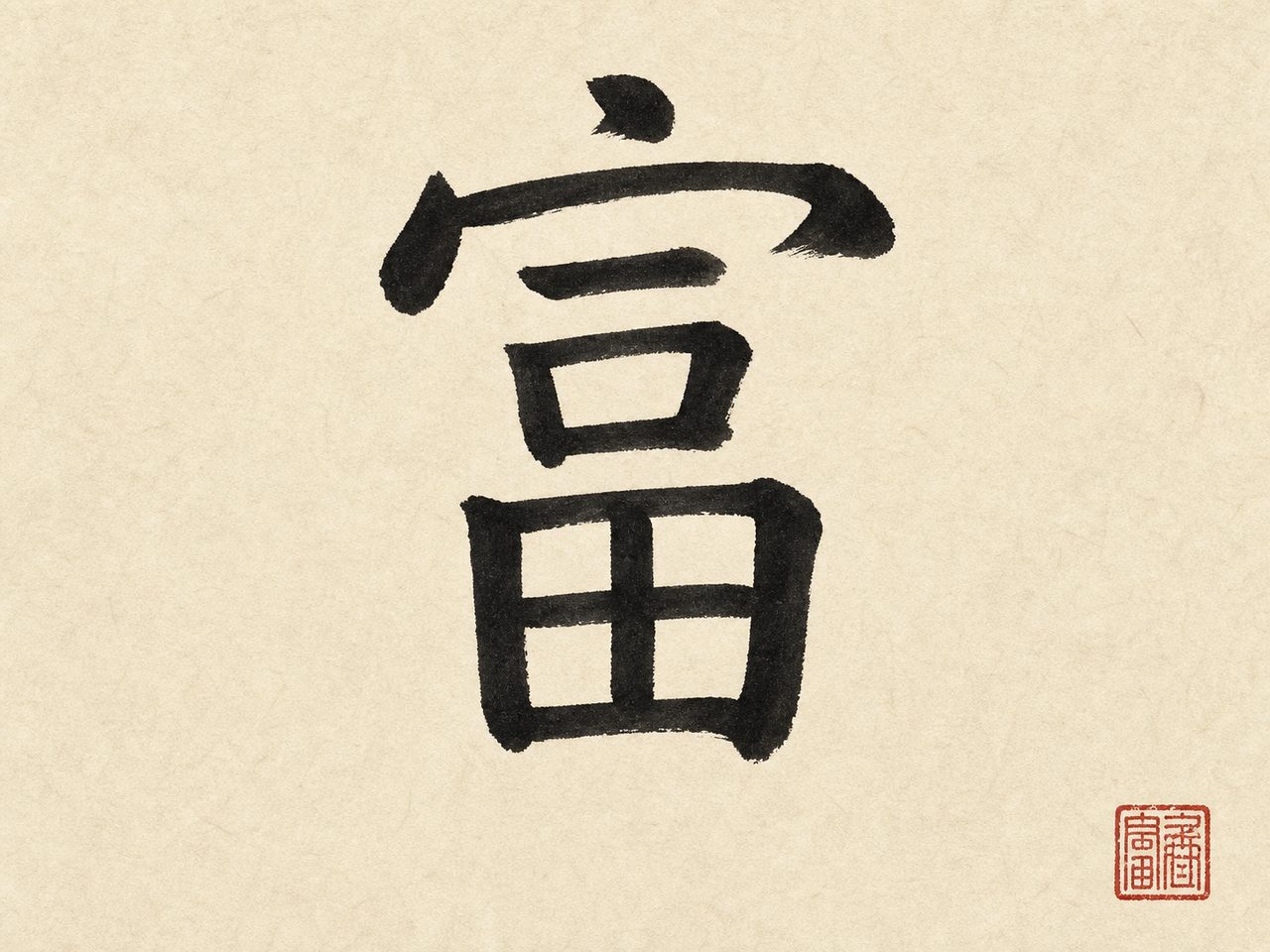
See 富 in seal, brush & cursive Try it
How it's written
富 is a stack of three ideas, twelve strokes, read top to bottom. The lid on everything is 宀 (mián), the "roof" radical, the same little roof that shelters the characters for home, for peace, and for safety. Under the roof sits the element 畐 (fú), which began life as a picture of a full jar, a vessel packed with grain or wine, drawn here as a short line above a small mouth 口 above a field 田. Put the roof and the jar together and the character is being very literal about it: a full storehouse, kept safe indoors. You write the roof first, its dot then its cover, then work downward through the vessel to the field at the base, roughly the way you would fill a granary from the top. It is identical in simplified and traditional Chinese, so there is no regional version to get wrong.
What it means
富 (fù) is the broad, everyday word for rich, wealthy, and abundant. It is the character hiding inside cáifù (wealth), fùyǒu (rich), fùyù (well-off), and fēngfù (abundant, the word you use for a rich variety of food or a full life). If you want one character for material prosperity, this is the workhorse, and it is the honest first answer to "the Chinese symbol for wealth" too.
The catch, and the reason this page exists, is that the single English word "prosperity" quietly covers a job that Chinese splits among four different characters. Anyone shopping for a wall scroll or a tattoo meets all four and tends to pick more or less at random. They are not interchangeable:
| Character | Pinyin | What it really means | Best for |
|---|---|---|---|
| 富 | fù | Rich, abundant, well-off; broad material prosperity | The general idea of prosperity and plenty |
| 福 | fú | Fortune, blessing, luck; the single luckiest character | Good luck and blessing |
| 财 | cái | Wealth as money, riches, cash | Money itself, the God of Wealth |
| 禄 | lù | Prosperity through career, rank, an official's salary | Professional success and advancement |
So the honest answer to "what is the Chinese symbol for prosperity" is: 富 if you mean broad abundance and being well-off, but reach for a different character if what you actually want is luck (福, the subject of our good-luck page), hard cash (财), or a thriving career (禄). Most red-and-gold decorations you will ever see simply hedge and use several at once.
- 财富 wealth; riches
- 富有 rich; wealthy
- 富裕 prosperous; well-off
- 丰富 abundant; rich in variety
- 富强 prosperous and strong (of a nation)
- 富贵 wealth and rank; riches and honor
- 致富 to get rich; to become wealthy
- 富豪 tycoon; a very rich person
- 首富 the richest person in a place
- 贫富 poor and rich; the wealth gap
Idioms
- 荣华富贵“glory, splendor, wealth, and rank”a life of wealth, status, and worldly splendor; the whole package of success.
- 富可敌国“wealth enough to rival the state”staggeringly rich; possessed of a private fortune on the scale of a nation's treasury.
- 为富不仁“to be rich is to be without benevolence”the rich are heartless; a standing Chinese suspicion that wealth and kindness pull against each other. (Mencius, quoting Yang Hu (Teng Wen Gong I))
- 富国强兵“enrich the state, strengthen the army”to make a country both prosperous and militarily strong; the classic goal of Chinese statecraft. (a Warring States reform slogan)
- 大富大贵“great wealth, great rank”immense wealth and high status; a fortune-teller's best blessing.
Right vs wrong forms
| Form | Type | Note |
|---|---|---|
| 富 | simplified ✓ | The standard modern form everywhere. Like the characters for home and peace, 富 was never simplified, so mainland China, Taiwan, Hong Kong, and Singapore all write the same twelve strokes. There is no simplified-versus-traditional choice to make. |
| 福 (chosen instead of 富) | wrong | Not a misprint but the most common mix-up on this word. People who want 'good luck' or 'blessing' sometimes pick 富 (wealth) when the character they actually mean is 福 (fú), the luckiest character of all and the one you see turned upside-down on doors at New Year. 富 is wealth; 福 is luck. If it is blessing you want, see our happiness page. |
| 富 (flipped or rotated) | mirrored | Not a real variant. Stencils pulled from a low-resolution image sometimes come out mirrored or rotated, which reads as a plain error to anyone literate. Check the character against a dictionary at full size before inking. |
For a tattoo
富 is far more often hung on a wall than worn on skin, and that is the first thing to say: this is a decoration character. Its natural home is a New Year couplet, a red banner, or a gold-foil charm, usually in the company of other lucky characters. If you do want it as a tattoo, the good news is that it is a clean, balanced, almost symmetrical character that sits well inside a square, and it is identical in simplified and traditional Chinese, so there is no version to get wrong. The one thing to weigh is meaning. A lone 富 says broad material wealth, being well-off, having plenty. If the feeling you are really chasing is luck or blessing you may want 福 instead, and if it is a thriving career, 禄. As with any character you cannot yet read, print it at full size, check it against a dictionary, and if you can, have one Chinese-reading friend look before the needle comes out.
Before you commit to any character, the eight ways a Chinese tattoo goes wrong covers the failure modes that are not specific to this one, including the stroke-density arithmetic that decides whether a traditional form survives at small sizes.
Prosperity in life today
The New Year wish, and the luckiest number in China
Spend the Lunar New Year anywhere Chinese is spoken and you will hear one phrase more than any other, and it is not "happy new year." It is gōngxǐ fācái, "congratulations and get rich." The get-rich half is fācái, built on 发 (fā), to prosper or make a fortune, and that one small syllable is responsible for the strangest fact about Chinese numbers. The word for eight, 八 (bā), sounds almost exactly like fā. And so eight became the luckiest number in the country, purely on the strength of a pun. This is not a mild preference. Beijing opened its 2008 Olympic Games at eight seconds past 8:08 in the evening, on the eighth day of the eighth month. A telephone number that was nothing but the digit eight, repeated, sold to Sichuan Airlines for 2.33 million yuan, around 280,000 US dollars. People will pay a fortune for the mere sound of the word for fortune. The same pun runs through the way people pick house numbers and floors, which is sorted out in our feng shui numbers guide.
New money, and all the words for it
Modern China grew rich in a hurry, and the language sprinted to keep up with the new kinds of wealthy person. The word everyone learned around 2013 was tǔháo, which welds "dirt" onto "grand" and lands somewhere near "filthy rich with no taste": the new-money type who buys the gold phone precisely because it is gold. When Apple released a champagne-gold iPhone, China named it tǔháo jīn, "tuhao gold," on the spot, and the joke traveled far enough that the Oxford English Dictionary publicly weighed adding the word in 2014. Its close cousin is fù'èrdài, the "rich second generation," the grown children of the first boom's tycoons; and above everyone sits the shǒufù, the "richest man," a title the business press awards and revokes like a boxing belt. Every one of these words is built on 富. Getting rich is zhìfù; a tycoon is a fùháo. The character turns up wherever the money is.
Prosperity as a national project
Prosperity in China is not only a private hope; it is official policy, printed on walls. In 2012 the Communist Party issued its twelve Core Socialist Values, the slogans now posted on billboards and bus stops across the country, and the very first word of the very first value is 富强 (fùqiáng), usually translated "prosperity," or more fully "prosperity and strength." It is an ancient pairing. Two thousand years earlier the hard-headed statesmen of the Warring States pushed a program they summed up as fù guó qiáng bīng, "enrich the state and strengthen the army," on the theory that a full treasury and a strong military were really one project. The modern billboard is a very old idea in fresh paint.
The name over the shop
One last place the character turns up is over doorways. 富 is far more common on a restaurant sign or a company name than in a person's given name, because a shop can wish out loud for wealth in a way that would seem a little naked on a child.
Curious what your own name could become in Chinese, chosen for its sound and its
good meaning together? Our Chinese name generator matches the
sound of your name to a real, well-omened character.
Where the character comes from
Open the Shuowen Jiezi, the first Chinese dictionary, compiled by Xu Shen around the year 100, and its entry for 富 is short and quietly revealing. It glosses the character as bèi, "to be provided for," and offers a second reading, hòu, "abundant." Prosperity, in the oldest definition on record, is not a heap of gold. It is the calm state of having enough laid in. The great scholar Duan Yucai, annotating the dictionary in the eighteenth century, added that 富 and 福 (fú, fortune) were once nearly the same word in both sound and sense, which is why, two thousand years later, "prosperity" and "good luck" still blur together on every red envelope.
The older half of the story is that element under the roof, 畐. Paleographers reading the bronze-age forms see in it a wine or grain vessel filled to the brim, the ancient shorthand for plenty, so the whole character resolves into a single, homely image: abundance gathered in and roofed over. There is even a tidy linguistic footnote. The linguist Laurent Sagart has proposed that the root behind 富 may connect to an old word for "pig," which, if he is right, would put Chinese in familiar company: the English "pecuniary" traces back through Latin to pecu, cattle. In more languages than one, wealth started life in the barn.
History & roots
The wealth Confucius would, and wouldn't, take
Classical China wanted to be rich and felt guilty about wanting it, and nobody staged that argument better than Confucius. He was refreshingly plain that wealth is desirable. "Riches and honors are what men desire," he says in the Analects, in James Legge's translation, before landing the condition: "If it cannot be obtained in the proper way, they should not be held." Money was fine. Money taken the wrong way was not. Elsewhere in the same book he says it more beautifully, picturing a life of coarse rice, plain water, and a bent arm for a pillow, and then delivering the line every Chinese schoolchild still learns: "Riches and honors acquired by unrighteousness are to me as a floating cloud."
The suspicion ran deeper in others. Mencius, the tradition's second sage, quotes an older figure named Yang Hu with a proverb that hardened into a permanent Chinese doubt about the rich: wéi fù bù rén, "he who seeks to be rich will not be benevolent." Twenty-three centuries later the phrase is still in daily use for a wealthy person behaving badly. Prosperity was the thing everyone wanted and no one entirely trusted.
The god of prosperity is really three gods
Walk into almost any Chinese shop or restaurant and look for the little altar, often up near the ceiling or beside the register, and you will usually find three cheerful old men standing in a row. These are the Sanxing, the Three Stars, and together they are the closest thing Chinese folk religion has to a portrait of the good life: Fu, fortune; Lu, prosperity; and Shou, longevity. Blessing, success, and a long time in which to enjoy them. The three star gods have their own page, star by star and man by man.
The middle one is the character worth knowing. Lu (禄) is prosperity in a very precise sense. The Shuowen dictionary glosses it simply as "blessing," but its working meaning for most of Chinese history was an official's salary, the state stipend paid to a mandarin. To have 禄 was to hold a post, draw a government paycheck, and climb the ranks. This is the real, dedicated Chinese character for prosperity as career success, and it is exactly the one the "twenty lucky symbols" lists never mention, because you almost never meet it alone. It lives inside this trinity, standing between fortune and long life, quietly representing the promotion.
The God of Wealth, and the honest way to be rich
If prosperity keeps a three-star committee, plain money has its own dedicated deity: Caishen, the God of Wealth, welcomed into homes and shops on the fifth day of the New Year, a day so bound up with him that it carries its own name, pò wǔ. He comes in more than one form. The martial God of Wealth is Zhao Gongming, a fierce general in armor, the patron of anyone whose fortune takes nerve. The civil version is gentler, and to my mind the better story. He is Fan Li, a real statesman of the fifth century BCE who, after steering the king of Yue to victory, walked away from power, remade himself as a merchant, and grew so famously and honestly rich that he was worshipped ever after, under the name Tao Zhugong, as the God of Wealth's gentler, ethical face. Classical China distrusted wealth, as we have seen. In Fan Li it found its reassurance: proof that a person could get rich and stay good. A statue of either of them, or of the three stars together, is exactly what the old household rules mean by putting something auspicious in the money corner, which our feng shui wealth guide locates three different ways.
Questions people ask
What is the Chinese symbol for prosperity?
It is 富 (fù), a twelve-stroke character meaning rich, wealthy, and abundant, written identically in simplified and traditional Chinese. It pictures a full vessel kept under a roof, so its oldest sense is a household with more than enough laid in. Note that 富 covers broad prosperity; Chinese uses different characters for luck (福), money (财), and career success (禄).
What is the Chinese symbol for wealth?
The same character does the main job: 富 (fù) is the everyday word for wealthy, and it is the 富 in cáifù, the ordinary word for wealth. If you specifically mean money or cash, the character is 财 (cái), the one in Caishen, the God of Wealth. 富 is being well-off in general; 财 is the money itself.
What is the difference between the Chinese characters for prosperity, luck, and wealth?
They are three different characters people often confuse. 富 (fù) is broad prosperity, being rich and well-off. 福 (fú) is fortune, blessing, and luck, the single luckiest character and the one shown upside-down on doors at New Year. 财 (cái) is wealth as money. A fourth, 禄 (lù), means prosperity through rank and career. Most festive decorations simply use several together.
What is the Chinese symbol for longevity and prosperity?
That pairing is part of a famous trio: 福禄寿 (Fú Lù Shòu), the Three Stars of Chinese folk religion. 福 is fortune, 禄 (lù) is prosperity in the sense of career and rank, and 寿 (shòu) is longevity. The three are usually shown as three old men and stand on shop altars, so 禄 and 寿 together are prosperity and long life side by side.
Is the Chinese symbol for prosperity a good tattoo?
It works, but know that 富 is far more often decoration than tattoo: its natural home is a New Year banner or a gold charm. It is clean and symmetrical and identical in simplified and traditional Chinese, so it is mechanically safe to ink. The thing to weigh is meaning: a lone 富 reads as material wealth, so if you want luck choose 福, and if you want career success choose 禄.
Sources
- Wiktionary: 富 (glyph origin, Shuowen gloss, radical, strokes)
- Shuowen Jiezi entry for 富, with Duan Yucai's commentary (hancibao.com)
- Wiktionary: 禄 (Shuowen gloss, official-salary meaning)
- The Analects, Li Ren (Chinese Text Project, ctext.org)
- The Analects, Shu Er (Chinese Text Project, ctext.org)
- Mencius, Teng Wen Gong I (Chinese Text Project, ctext.org)
- Fu Lu Shou, the three star gods (Wikipedia)
- Caishen, the God of Wealth (Wikipedia)
- Fan Li (Tao Zhugong), the merchant worshipped as a wealth god (Wikipedia)
- Numbers in Chinese culture: the number 8 and facai (Wikipedia)
- Core Socialist Values: fuqiang (Wikipedia)
- Tuhao, the internet slang for new money (Wikipedia)
Make Prosperity your own
See 富 in calligraphy
From ancient seal script to flowing cursive. Pick a look before a tattoo or a card.
 Name
Name Get a Chinese name
A name matched to the sound of yours, with a meaning that fits.
Start yours Chinese Almanac
 Try the Chinese Gender Predictor
A different corner of Chinese culture: the old Qing-palace birth chart, worked out from your lunar birth date, with the math shown and its coin-flip odds honestly weighed.
Open the toolRelated: good luck, happiness, strength, family, double happiness
By Julian 祝君瑜, sourced from the classics and from modern life, updated 2026-09-16