Feng Shui
Feng Shui House Design: Which Way a House Sits, and What That Decides
Which way does your house face? Almost every English guide answers "whichever way the front door points," and classical practice does not. Facing is a property of the building, read off its open, active, sunlit side, which in most homes is the opposite side from the door you use. That one reading assigns the house one of eight identities, sorts all eight of its sectors into four good and four bad, and decides where the tradition wants a bedroom, a stove and a bathroom to land. It happens before you place a single piece of furniture.
Open any English guide to feng shui house design and it begins at the front door. Paint it red, keep it clear, hang something over it. That is not where the Chinese method begins, and the gap is not a matter of emphasis. It is a different first question.
Classical practice begins by asking which way the building sits. Not the door, not the driveway, not the room you like best: the building, treated as one object with a back and a front. That reading takes a minute and produces a surprising amount. It tells you which of eight houses you live in, which four of its eight sectors the tradition considers favorable, and therefore which corners of the plan want a bedroom and which want a cupboard. Everything a house-design guide is normally about, the colors and the mirrors and the objects, sits several layers downstream of it.
Which way a house sits, and why it is rarely the door
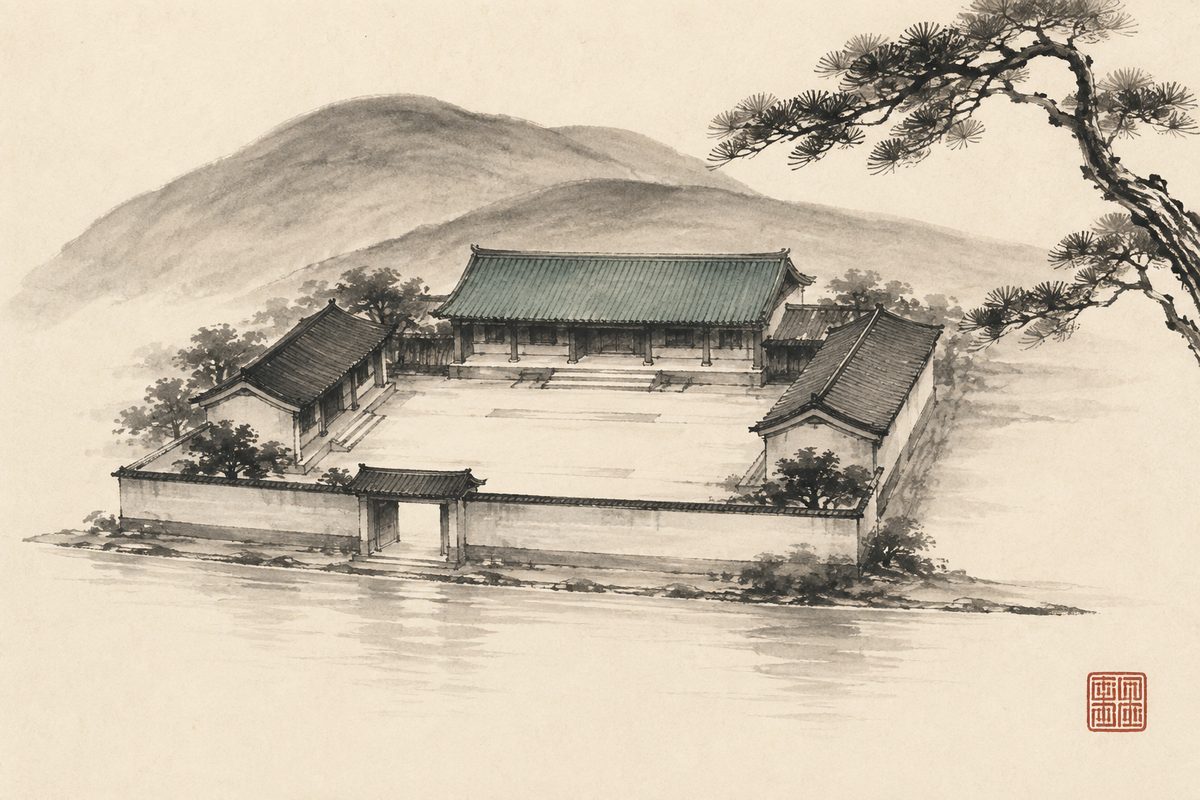
A dwelling in this system has two properties that are always opposite: it sits in one direction and faces the other. The facing side is the yang side, the open one. Practitioners look for where the light, the road, the noise and the view are, and that is the front; the sheltered, closed, backed-up side is where the house sits. The old ideal is a hall with a hill behind it and water in front, and every modern reading of a floor plan is a compressed version of that picture.
The trap is assuming the entrance marks the front. Feng Shui Nexus puts it flatly: do not use your front door to find your facing direction, because the two are independent. In a conventional house they usually coincide, the door is on the bright street-facing wall, and nobody has to think about it. In a house entered from a side path, a courtyard or a garage, they come apart. In an apartment they come apart almost by default, because the door opens onto a windowless interior corridor while every scrap of light and air arrives through a balcony on the opposite wall. The balcony side is the facing side. The door is just how you get in.
This matters more than a technicality should, because an error here rotates the entire plan. The sectors do not shift a little; they land on the wrong rooms altogether. It is the same failure our bagua map guide warns about when a grid gets aligned to a garage door, arriving by a different route.
Take the bearing standing outside, looking at the facing side, well away from steel doors, fuse boxes and your own phone, all of which will pull a needle several degrees. Then read off which house you are in.
The eight houses
The sitting direction assigns the building one of the eight trigrams, and Chinese practice names houses accordingly. A house sitting north is a Kan house, and so on around the compass. The eight fall into two families, exactly as people do.
| House | Sits | Faces | Group |
|---|---|---|---|
| Kan | North | South | East |
| Li | South | North | East |
| Zhen | East | West | East |
| Xun | Southeast | Northwest | East |
| Qian | Northwest | Southeast | West |
| Kun | Southwest | Northeast | West |
| Gen | Northeast | Southwest | West |
| Dui | West | East | West |
Yes, an East group house can face west, and a Kan house that sits north faces due south. The group is named for the sitting direction, not the view, which trips up nearly everyone the first time.
Once the house has a trigram, its eight sectors are fixed and no longer a matter of opinion. Four are favorable and four are not, and the classical names tell you what each is supposed to be good at. Sheng Qi, the generating breath, is the vigor and prosperity sector. Tian Yi, the heavenly doctor, is health. Yan Nian, extended years, is longevity and relationships. Fu Wei, the seat itself, is stability and calm. Against them run Huo Hai, mishaps, the mildest of the four; Wu Gui, the five ghosts, blamed for fire, theft and quarrels; Liu Sha, the six killings, associated with scandal and lost opportunity; and Jue Ming, life-severing, the one everyone wants to know about.
An East group house is favored in north, east, southeast and south. A West group house is favored in west, northwest, northeast and southwest. That is the whole sorting rule, and it is why a floor plan and a compass bearing answer more questions than a shopping list ever will.
The three things a house actually gets judged on
The Qing manual behind most modern Chinese practice, Zhao Jiufeng's The Three Essentials of the Yang Dwelling, is named for its whole argument: a house is judged on its door, its master bedroom, and its stove. Our kitchen guide sets out why those three and not others. What concerns a layout is the part that follows from it, and it is easy to miss.
All three are judged by where they land. Not how they look, not what is on them: which sector of the house they occupy. That turns a doctrine about three objects into an instruction about a floor plan, and it is the reason a house-design question is really a sorting question. The door opens from a sector. The master bedroom sits in one. The stove has the famous inverted requirement, sitting on a difficult sector so its mouth can face a favorable direction.
Each of the three has a page here that goes properly into it, and none of that is repeated below. The threshold, the screen and the straight sightline belong to the entryway. The commanding position and what hangs over a bed belong to the bedroom. The fire mouth and the stove's backwards rule belong to the kitchen. What belongs here is the sorting: get those three onto the right sectors of your particular house, and you have done more than any amount of remedial decorating.
The rest of the house sorts itself by how much you use it. Rooms you live in want the favorable four. Rooms you pass through want whatever is left. Storage, utility space and bathrooms are the traditional occupants of the difficult sectors, on the sensible logic that a room nobody sits in cannot be harmed much by sitting on bad ground.
What to avoid, and why almost none of it is an object
Chinese sources are remarkably consistent about the serious faults, and they are nearly all about the shell of the building rather than its contents.
The center of the plan. The middle cell, the zhonggong, is described as the heart of the dwelling, and the rule is that nothing draining, dirty or turbulent goes there. A bathroom at the center is treated by Chinese home writing as the worst layout fault there is, the argument being that whatever sits at the center disperses to everywhere else. A staircase in that position is judged the same way, and so is a stove. This is worth checking early, because it is a fault you cannot decorate your way out of and one that shows up constantly in modern apartment plans.
A line straight through. If you can stand outside the front door and see clean through to a back door, a balcony or a large window, the tradition considers the house unable to hold anything. Our entryway guide covers the classical fixes, which are all about interruption rather than removal.
A footprint with a bite out of it. L-shaped and irregular plans leave a sector partly outside the building. English writing tends to treat this as a wound; the traditional response is calmer, which is to strengthen and use what remains of that sector rather than mourn the missing corner. The bagua map guide works through it.
A bedroom or stove on a hostile sector. A placement problem, and the only one on this list you can usually solve by swapping which room does what.
Notice what is not here. No colors, no crystals, no fountains, no objects placed in squares. Those layers exist and some of them are genuinely old, but they are not what the classical literature judges a dwelling on, and a house that gets the shell right is not waiting on a cure.
When the house is one group and you are another
Here is the collision nobody warns you about. The house has a group. So do you. Eight Mansions gives every person a kua number from their birth year, sorting them East or West exactly as it sorts buildings, and there is no rule of nature that makes them match. A West group person can perfectly well buy an East group house, and frequently does.
Practitioners are relaxed about this in a way the English literature is not. The standard resolution is that directions outrank locations: as long as you sit, work and sleep facing one of your own four good directions, you are practising sound feng shui in a house whose group is not yours. You cannot rotate a building. You can turn a bed, a desk and a chair, and the tradition treats that as the part within your reach.
Where the two systems do agree, act on it, and that is the genuinely useful move. A sector that is favorable for the house and favorable for you is where the bedroom should go if the plan allows it. In a shared home where two people are in different groups, the usual compromise is to give the master bedroom's sector to the house and the bed's direction to whoever sleeps less well.
Find your directions
Your kua number comes from your birth year and sex, with a calendar wrinkle in early February. The fastest way to get it right is our calculator; then find your row below.
| Kua | Trigram | Group | Best (Sheng Qi) | Health (Tian Yi) | Harmony (Yan Nian) | Steady (Fu Wei) | Avoid (Jue Ming) |
|---|---|---|---|---|---|---|---|
| 1 | Kan ☵ | East | Southeast | East | South | North | Southwest |
| 2 | Kun ☷ | West | Northeast | West | Northwest | Southwest | North |
| 3 | Zhen ☳ | East | South | North | Southeast | East | West |
| 4 | Xun ☴ | East | North | South | East | Southeast | Northeast |
| 6 | Qian ☰ | West | West | Northeast | Southwest | Northwest | South |
| 7 | Dui ☱ | West | Northwest | Southwest | Northeast | West | East |
| 8 | Gen ☶ | West | Southwest | Northwest | West | Northeast | Southeast |
| 9 | Li ☲ | East | East | Southeast | North | South | Northwest |
Kua 5 does not appear: the traditional formula reassigns it, 2 for men and 8 for women, which the calculator handles.
The 2026 layer goes on last
One more system runs across all of this, and it is the one people meet first because it is the one that gets written about every January. The flying stars redeal nine numbers across the sectors of every building on earth each year, turning over on February 4. They are real, they are old, and they are the least of the three layers, for the simple reason that they are the only one that moves.
The order practitioners use is worth copying: permanent arrangement first, personal directions second, the annual stars last. Your house's sitting direction will outlive you. Your kua number will not change. The stars will be entirely different next February. If you are rearranging a home from scratch, sort the sectors for the building, check them against your own directions, and read what 2026 is doing only once the first two are settled.
That order is also the honest one. A house whose door, bedroom and stove sit sensibly, whose center is clear, and which nobody can see straight through, is doing the thing the tradition has actually asked for since the Qing. The rest is weather.
Questions people ask
What is the best Feng Shui layout for a house?
There is no single best layout, because the answer depends on which way the building sits. In the Eight Mansions method, a house's sitting direction makes it one of eight types, and each type has four favorable sectors and four unfavorable ones in fixed positions. A house that sits north is favored in the north, east, southeast and south; a house that sits southwest is favored in the west, northwest, northeast and southwest. The layout question then becomes a sorting question. Bedrooms and the places you spend hours want the good sectors. Bathrooms, storage and the stove are the tradition's usual candidates for the bad ones, on the reasoning that a room you barely occupy is the safest thing to park on difficult ground. Work out the sitting direction first, then sort.
What are the basic Feng Shui rules for a house?
The classical shortlist is much shorter than the internet's. The Qing manual most modern Chinese practice descends from judges a dwelling on three things and names them in order: the door, the master bedroom and the stove. Everything else is commentary. Beyond those three, the durable rules are structural rather than decorative. Do not let the entrance look straight through to a back door or window. Do not put a bathroom, a staircase or a stove at the center of the floor plan. Give a bed and a desk a solid wall behind them and a view of the door. Keep the sectors you actually live in bright and used. Notice what is missing from that list: colors, crystals, water features and objects placed in squares. Those belong to newer layers of the practice, and a house that gets the three requisites right is doing more than a house full of cures.
What things should I avoid in my house according to Feng Shui?
Four things come up in Chinese sources far more often than the rest. A bathroom at the center of the floor plan, which Chinese home writing treats as the single worst layout fault, on the argument that the center is the dwelling's heart and everything placed there disperses through the whole house. A staircase in that same center position, judged the same way. A straight unbroken line from the front door through to a back door, balcony or large window. And the master bedroom or stove sitting in a sector that is unfavorable for the house's type, which is a placement problem rather than an object problem. Almost none of the commonly repeated taboos are about things you own. They are about the shape of the building and what lines up with what.
How should I arrange my house according to Feng Shui for 2026?
Arrange it for the building first and for 2026 last. The annual flying stars shift every year on February 4, so any advice keyed to them expires on schedule, while the sitting direction of your house does not change and your own favorable directions do not change either. Practitioners resolve the collision by priority: permanent arrangement first, personal directions second, the year's stars last. Get the door, the bedroom and the stove onto sensible sectors for the house type, check them against your own kua directions, and only then read what 2026 is doing to each part of the plan. Our guide to the 2026 flying stars covers that annual layer in full.
Does the front door decide a house's facing direction?
Usually not, and this is the most consequential mistake in English-language feng shui. The facing direction belongs to the building, and practitioners read it off the most yang side, meaning the open, bright, active, street-facing side where light and movement arrive. In a typical house that is the front, so the door and the facing happen to agree and nobody notices the distinction. In a house whose entrance is off a side path or a courtyard, or in an apartment where the door opens onto an interior corridor and the light comes from a balcony on the far side, they part company completely. Get this backwards and every sector of the plan lands in the wrong place, which is the same failure that ruins a bagua grid aligned to the wrong door.
What is the best position and location for a house in feng shui?
The classical answer is a shape, not a compass point. The Book of Burial, the text that gives feng shui its name, describes the ideal site by four emblems: the Black Tortoise behind, the Vermilion Bird in front, the Azure Dragon on the left and the White Tiger on the right, reading left and right as you stand in the house looking out. Translated into a street, that means higher ground or a taller building at your back, open and lower ground in front, and something on each side, with the left side the livelier and the right side the quieter. A house with nothing behind it and a steep drop or a road aimed straight at it in front has the shape reversed. Only once the site is read does the compass come in, to name the house by the direction it sits in. Which way the front door itself should face is a separate question, taken up on the entryway page.
Sources
- • Feng Shui Web (Michael Hanley), Eight Mansions: the eight house types, group split, and the four favorable and four unfavorable palaces
- • Feng Shui Nexus, on finding a home's facing direction and why it is not the front door
- • Sohu, on Zhao Jiufeng's Qing-dynasty The Three Essentials of the Yang Dwelling (Yangzhai Sanyao) and its door, bedroom and stove doctrine
- • Fang.com, a major Chinese property portal, on a bathroom at the center of the floor plan
- • Book of Burial (Zangshu), Outer Chapters: the four-emblems passage, with the Azure Dragon on the left, the White Tiger on the right, the Vermilion Bird in front and the Black Tortoise behind (Chinese Wikisource)
Get your kua number and full direction chart
Enter your birthday and we work out your kua, your group, and all eight directions, with the February boundary handled for you. Open the calculator