Numbers, the Chinese way

Chinese Numerology a number chart, the Luoshu square, and your number from your birth date

Chinese numerology is not one system but three, and most pages that use the name stir them together. The first is a layer of puns: eight is lucky because it sounds like the word for prospering, four is avoided because it sounds like the word for death. The second is the Luoshu, a square of the numbers one to nine in which every row, column and diagonal adds up to fifteen. Tradition says it came out of the Luo River on the back of a turtle, and it still sits under every feng shui compass chart. The third is a number from your birth year: your own palace in that square, which the compass school uses to decide which way you should face.

The calculator below gives you that third number, counted the way the Qing emperor's own manual on choosing days counts it, together with the numbers the oldest classics attach to your element. After it comes a chart of what each number means in each layer, and then the square's own story, which turns out to be stranger, older and far better documented than the version sold under the name "Lo Shu grid."

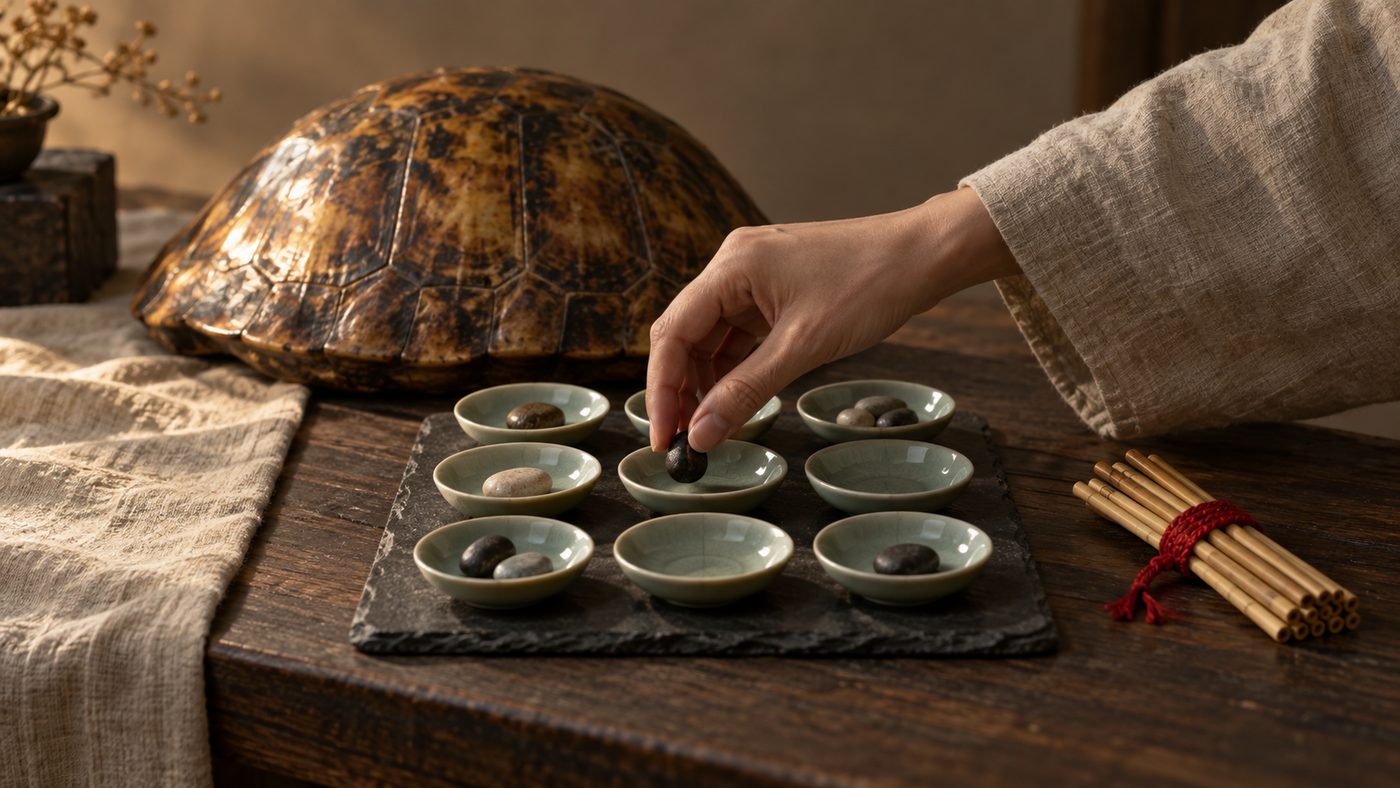
An antique tortoise shell behind nine small celadon dishes set in three rows of three on slate, a bundle of bamboo counting rods tied with red cord beside them, and a hand placing a pebble in the center dish.
The turtle and the nine palaces, with counting rods: the square began as a way of counting. Illustration.

Your number from your birth date

The count comes from the same tables as the kua calculator and the annual flying-star charts; the year turns at the Start of Spring, around February 4. Nothing you enter is stored.

Count as

Men and women count in opposite directions around the square. That is the imperial manual's rule, not our choice.

The chart: what each number means

Read across any row and you will see the two big layers do not agree about anything, because they are not answering the same question. The pun column is about sound: what the number's name resembles when spoken, mostly in Mandarin or Cantonese. The other columns are about position: where the number sits in the Luoshu, which of the eight trigrams of the Book of Changes lives there, and which of the five elements goes with it. In the square, a number has no personality. It is an address.

Chinese numerology chart, 1 to 9: the pun layer beside the Luoshu square
No. Said In the pun layer Seat in the square Trigram Element Flying star
1 yī Neutral. First place, and also being single: November 11 is Singles' Day. North Kan, water Water 1 White
2 èr Good. Good things come in pairs; in Cantonese it sounds like "easy." Southwest Kun, earth Earth 2 Black
3 sān Mostly good: close to shēng, "life." Sometimes read as sàn, "to scatter." East Zhen, thunder Wood 3 Jade
4 sì Avoided: close to sǐ, "death," most strongly in Cantonese. Southeast Xun, wind Wood 4 Green
5 wǔ Mixed: sounds like "me" in Mandarin and "not" in Cantonese. Center none (the center) Earth 5 Yellow
6 liù Good: "smooth" in Mandarin, "fortune" in Cantonese. Northwest Qian, heaven Metal 6 White
7 qī Mixed: "rise," but also the seventh month, the ghost month. West Dui, lake Metal 7 Red
8 bā The lucky one: close to fā, "to prosper." Northeast Gen, mountain Earth 8 White
9 jiǔ Good: sounds like "long-lasting," a wedding favorite. South Li, fire Fire 9 Purple

The pun layer is real and it moves money: towers in Hong Kong and Taiwan skip their fourth floors, and numbers heavy with eights fetch premiums at license-plate auctions. It is also younger than the square, strongest in Cantonese, and not even uniform across Chinese: Teochew speakers hear happiness in four and give red packets in fours. Our feng shui numbers page tells that story in full, with the reason your house number matters less than your front door; eight has its own page under prosperity, and four under death.

Where the square comes from

4 Southeast 9 South 2 Southwest
3 East 5 Center 7 West
8 Northeast 1 North 6 Northwest

The Luoshu, south at the top as the classical charts draw it. Every line of three totals fifteen.

Start with the sentence everybody quotes. The Great Treatise, the long commentary appended to the Book of Changes, says that the Yellow River put out a chart and the Luo put out a writing, and that the sages took them as their model. That is the whole of it. There is no turtle in the sentence, no square, and not a single number.

The first people on record to say what the Writing was did not think it was a square. The History of the Former Han, in its treatise on the five phases, reports the view of Liu Xin, the scholar who catalogued the imperial library at the end of that dynasty: the legendary Fu Xi received the River Chart and drew the eight trigrams from it, and Yu, when he tamed the great flood, was given the Luo Writing and set it out as the Great Plan. The Great Plan is a chapter of the Book of Documents, a list of nine divisions for governing a realm, starting with the five phases. For the Han, then, the Writing from the Luo was a text with nine headings. Nine was already the number that mattered; the digits had not arrived.

They turn up somewhere else entirely: in a description of the Bright Hall, the ritual building in which a Zhou king was supposed to move from room to room with the seasons. The Record of Rites of the Elder Dai says the hall had nine rooms, and then prints a bare row of digits, two, nine, four, seven, five, three, six, one, eight. Cut it into threes and you have the square, every line totaling fifteen. The Record never says why. Its commentator Lu Bian, writing in the sixth century, supplies the reason: the nine rooms copied the pattern on a turtle. The turtle itself had reached the story by another road. The traditional commentary to the Great Plan, credited to Kong Anguo, says a divine turtle came out of the Luo with markings on its back numbering up to nine, and that Yu put them in order as the nine divisions.

The square was also a way of counting. The Shushu Jiyi, a short handbook of calculation attributed to the Han scholar Xu Yue, lists fourteen methods, and one of them is the nine-palace method. Its commentary gives the layout as a body: two and four for shoulders, six and eight for feet, three on the left and seven on the right, nine on the head, one underfoot, five in the middle. That rhyme is still the standard way the square is remembered, and it is why the counting rods are in the picture at the top of this page.

And the square moved. When the astronomer Zhang Heng petitioned the throne in the second century against the prophecy books then in fashion, he listed the nine palaces among the methods that, unlike the prophecies, gave results that could be checked. The Tang commentary on his biography explains the term with a line from an apocryphal Changes text, the Qian Zao Du: the Taiyi spirit takes its numbers and travels the nine palaces. Then it quotes Zheng Xuan's note, which gives the route. The spirit sets out from the Kan palace, goes to Kun, then Zhen, then Xun, rests in the center, and goes on through Qian, Dui and Gen to finish at Li. Put the Luoshu numbers on those palaces and the route reads one, two, three, four, five, six, seven, eight, nine. It is precisely the path the stars take on every annual flying-star chart, including our feng shui 2027 chart. Whoever later systematized the flying stars was walking a road laid out in a second-century footnote. (This page checks that the route and the square agree every time it is built.)

The picture most people carry, a turtle with neat dots on its shell, is the Song dynasty's. Writing in the seventeenth century, Huang Zongxi observed that ever since Zhu Xi printed the River Chart and the Luo Writing in his commentary on the Changes, every household had recited them, and he recorded that the statesman Ouyang Xiu had dismissed the diagrams as preposterous. Song scholars could not even agree which diagram was which. One of them, Wei Liaoweng, held that the nine-square was not the Luo Writing at all but the numbers of the Taiyi's nine palaces, which, given Zheng Xuan's route, is not a bad argument.
The square in the sources, oldest first. The last column is the wording in the text, for readers who want to check it.
Text Date What it says Original
Book of Changes, the Great Treatise Warring States to Han The Yellow River produced the Chart and the Luo produced the Writing, and the sages took them as their model. No numbers, no turtle. 河出圖,洛出書,聖人則之
Book of Documents, "The Great Plan" Zhou tradition Heaven gave Yu the Great Plan in nine divisions; the first division is the five phases, numbered one to five: water, fire, wood, metal, earth. 天乃錫禹洪范九疇 · 一曰水,二曰火,三曰木,四曰金,五曰土
History of the Former Han, treatise on the five phases 1st century Liu Xin held that Yu was given the Luo Writing and set it out as the Great Plan: the Writing was a text with nine divisions. 禹治洪水,賜雒書,法而陳之,洪範是也
Record of Rites of the Elder Dai, "The Bright Hall" Han The hall had nine rooms; then a bare row of digits. Lu Bian's note: the nine rooms model the turtle pattern. 二九四七五三六一八 · 記用九室,謂法龜文
Traditional commentary to "The Great Plan" (attributed to Kong Anguo) Han attribution, probably later A divine turtle came out bearing markings on its back, numbering up to nine, and Yu set them in order as the nine divisions. 神龜負文而出,列於背,有數至於九
Zhang Heng's memorial, History of the Later Han, with its commentary 2nd century; commentary Tang The nine palaces are listed among methods with proven results; the note quotes the Qian Zao Du (the Taiyi travels the nine palaces) and Zheng Xuan's route through them. 太一取其數以行九宮 · 從坎宮始…還息於中央之宮…行起從坎宮始,終於離宮
Shushu Jiyi, attributed to Xu Yue, with its commentary Han attribution; commentary 6th century The nine-palace method is one of fourteen ways of counting; the commentary gives the layout as a body. 九宫者即二四為肩六八為足左三右七戴九履一五居中央
Monthly Ordinances, Record of Rites Warring States to Han Each season has its number: spring eight, summer seven, the center five, autumn nine, winter six. 其數八 · 其數七 · 其數五 · 其數九 · 其數六
Xieji Bianfang Shu, appendix "Nine palaces for men and women" Qianlong reign, 18th century Men's palaces start at 1, 4, 7 in the three cycles and run backward; women's at 5, 2, 8 and run forward. The editors: the men's count is the year's star in the center. 男命上元甲子起坎一…逆行九宫 · 女命上元甲子起中五…順行九宫 · 即三元年九星入中宫之一星
Huang Zongxi, Yixue Xiangshu Lun 17th century Ouyang Xiu called the diagrams preposterous; since Zhu Xi put them in his commentary every household recites them; Wei Liaoweng took the nine-square for the Taiyi's nine palaces. 河圖、洛書怪妄 · 自朱子列之本義,家傳户誦 · 戴九履一者則太乙九宫之數

The "Lo Shu grid" is Indian numerology on a Chinese square

Search for a Chinese numerology calculator and half of what comes back asks for your date of birth and fills in a Lo Shu grid. The method runs like this. Write the digits of your birth date into the square, each digit in the cell that carries the same number. Count which numbers repeat and which are missing. Add the digits of the day for a driver number and all the digits for a destiny number. Then read the rows, columns and diagonals as planes of thought, will or success, with certain complete lines hailed as a Raj Yog.

The better sites are candid about where this comes from. One of the larger ones describes its method as standard Indian numerology built on the Lo Shu Grid, and says that "Indian practice adopted it with Vedic planetary rulers." That is a fair account, and it settles the question. The square is Chinese. The reading is not. None of the texts in the table above, and nothing in the Chinese systems that grew out of them, puts the digits of a birthday into the nine palaces, counts missing numbers or names planes. Raj Yog is a Sanskrit term from Indian astrology; driver and destiny numbers belong to the vocabulary of Western and Indian numerology. Enjoy it if you like it. It is a modern Indian reading laid over a square that had already been Chinese for two thousand years.

What the Chinese tradition does with a birth date and the square is something else, and it produces one number, not a grid.

Your number is the center of your birth year

The rule is written down in the Xieji Bianfang Shu, the manual on choosing days compiled at the Qianlong emperor's order in the eighteenth century to settle what the court's almanac makers should follow. In an appendix on the nine palaces for men and women, it quotes an older text on the three cycles. Years run in cycles of sixty, three cycles to a great round. For a man, the first year of the upper cycle starts in the Kan palace, number one; the middle cycle starts at Xun, four; the lower cycle at Dui, seven; and the count runs backward through the square one year at a time. For a woman the three cycles start in the center, five, then at Kun, two, then at Gen, eight, and the count runs forward.

Then the imperial editors add a note that gives the whole thing away. The men's count, they write, is simply the star that enters the center of the square in each year: the annual star that every feng shui almanac prints in the middle of the year's chart. A man's number is the number that stood in the center of the square the year he was born. A woman's is the same walk taken the other way round, which set out from the middle in 1864.

Feng shui calls this number the kua, and it is the one number Chinese tradition takes from a birthday. Each time this page is built it checks the imperial rule against our kua number calculator and against the annual flying-star charts for every year from 1900 to 2100, and all three agree. Two details make the modern formula look odder than it is. The year turns at the Start of Spring, around February 4, so an early-February birthday may count from the year before. And a count that lands on five lands in the center, which has no trigram, so tradition hands it to men as two and to women as eight.

Where each sixty-year cycle starts the count, by the imperial manual (checked against the kua formula at build)
Years Cycle Men start at Women start at
1864–1923 Upper cycle 1, then one lower each year 5, then one higher each year
1924–1983 Middle cycle 4, then one lower each year 2, then one higher each year
1984–2043 Lower cycle 7, then one lower each year 8, then one higher each year
2044–2103 Upper cycle 1, then one lower each year 5, then one higher each year

Each cycle's first year is a jiazi year, the first of the sixty-year cycle; the lower cycle that began in 1984 ends in 2043. The count wraps from 1 to 9 and from 9 to 1.

Numbers and the five elements

The oldest numbers in Chinese thought that you can take personally belong to the five phases, and they are older than any diagram. The Great Plan, the chapter Liu Xin called the Luo Writing, opens its first division with a count: one is water, two is fire, three is wood, four is metal, five is earth. The Monthly Ordinances in the Record of Rites give every season a number of its own: eight for spring, the season of wood; seven for summer and fire; five for the center and earth; nine for autumn and metal; six for winter and water.

Lay the two lists side by side and each element has a pair: one and six for water, two and seven for fire, three and eight for wood, four and nine for metal, with five alone in the middle. So eight, the famous lucky number, is also the number of spring, which has nothing to do with money and a good deal to do with things growing. Your number's trigram belongs to one of the five elements, and the calculator prints that element's pair. If you want a personal lucky number with a classical pedigree, it is the only one we can honestly give you, and neither text promised it would bring luck. They were describing how the year is put together.

What Chinese numerology can tell you, and what it cannot

It can tell you

  • Which of the nine palaces your birth year puts you in, by a rule the imperial almanac makers followed.
  • What each number means as a pun and as a place in the square, kept apart.
  • Your element, and the numbers the oldest classics attach to it.

It cannot tell you

  • Your personality, life path or destiny from the digits of your birthday. That is the Lo Shu grid reading, and it is not Chinese.
  • Whether a phone number or a house number will make you rich. The pun is real; the mechanism is not.
  • Anything from your name spelled out in letters.

Questions people ask

What is Chinese numerology?

Three different things that share a name. The best known is a layer of puns: 8 is lucky because it sounds like the word for prospering, 4 is avoided because it sounds like the word for death. Older and more serious is the Luoshu, a square of the numbers one to nine in which every row, column and diagonal adds to fifteen; it is the grid under every feng shui compass chart. The third is a number taken from your birth year, your palace in that square, which the Eight Mansions school of feng shui calls the kua number.

What does 8 mean in Chinese numerology?

In the pun layer, 8 (bā) is the lucky number because it sounds close to fā, to prosper, especially in Cantonese, which is why phone numbers and license plates full of eights sell at a premium. In the Luoshu it is simply an address: the northeast palace, the Gen trigram (the mountain), and the element earth. In the older five-phase numbers of the Monthly Ordinances, 8 is the number of spring and of wood. None of those three meanings depends on the others.

What is the unlucky number in Chinese numerology?

Four. It sounds close to the word for death, most of all in Cantonese, so many towers in Hong Kong, Taiwan and mainland China skip the fourth floor and sometimes the whole forties. The avoidance is a pun, not a teaching of any classical text, and it is not universal: Teochew speakers, for whom four rhymes with happiness, give red packets in fours.

How do I find my Chinese numerology number from my birthday?

The one number Chinese tradition takes from a birthday comes from the birth year and your sex. The Qing imperial manual on choosing days counts it in sixty-year cycles: for men from 1 backward, for women from 5 forward, and a man's number turns out to be the number that stood in the center of the square the year he was born. The year turns at the Start of Spring, around February 4, not January 1. The calculator on this page does the count for any date from 1901 to 2100.

Is the Lo Shu grid Chinese?

The square is Chinese: the digits appear in a Han-dynasty ritual text and the name Luoshu comes from the Book of Changes. The Lo Shu grid reading is not. Writing the digits of a birth date into the cells, counting missing numbers, and reading planes, driver and destiny numbers is Indian numerology, and its own practitioners describe it as the Indian tradition with Vedic planetary rulers. No Chinese source we have read uses the square that way.

What is the Luoshu square?

The numbers one to nine arranged in three rows, 4 9 2, 3 5 7, 8 1 6, so that every row, column and diagonal totals fifteen. Chinese tradition places it on the compass, with 9 in the south, 1 in the north and 5 in the center, and names it the Luoshu, the Writing from the Luo River, after a line in the Book of Changes. The story of a turtle carrying it out of the river is recorded in the traditional commentary to the Book of Documents.

Is there a Chinese numerology name calculator?

Not in the sense most calculators mean. Turning the letters of a name into numbers is Western numerology (the Pythagorean and Chaldean systems). Chinese name analysis, where people use it, counts the brush strokes of the characters, and it is a separate practice from the Luoshu. If you want a Chinese name itself, our name generator builds one from meaning and sound.

Keep going

  • Kua number calculator shows the arithmetic, the exact minute the year turns, and your four good and four bad directions.
  • Feng shui numbers sorts the two systems for house numbers, and what your address is worth.
  • Feng shui 2027 deals the year's nine stars around the square, sector by sector.
  • Chinese zodiac calculator gives your animal, the other thing your birth year decides, on a twelve-year cycle instead of a nine.
  • Chinese name generator builds a Chinese name from meaning and sound, not from letter values.
  • Cast your chart reads the full birth chart, of which the year is only the first pillar.

Sources

The calculator's table is exported from the site's calculators at build: the number for every year from 1900 to 2100 by the imperial rule and by the kua formula (they are checked against each other), and the Start of Spring moment that turns each year. The classical texts were read in the editions below; English renderings on this page are our own paraphrases.

Stay in the loop.

Chinese mythology, the zodiac, and the meaning behind names and symbols, rooted in the classics and read back to you. No spam. Unsubscribe anytime.